

Account-based attribution assigns credit for pipeline and revenue to the account (the buying company) instead of to the single contact who happened to fill in a form. Every touchpoint from every person at that company is rolled up into one shared journey, then credited to the opportunity those people eventually create. If you sell to committees, it is the more honest way to measure what marketing is doing.
This guide explains how it works, how to set it up in a CRM, which models fit which questions, and where teams go wrong. We have written it for CMOs, revenue operations leaders and analysts who already run campaigns and want a measurement system that matches how their buyers actually decide.
TL;DR
- Account-based attribution credits touchpoints from all contacts at a company to that account’s opportunity, so committee activity is no longer undercounted.
- It depends on reliable account mapping first. Models are the easy part, and weak identity data is the usual point of failure.
- Define an opportunity window so that touches after a deal closes, or long before it was plausible, do not earn credit.
- Run influence and attribution side by side: influence tells you what mattered, attribution tells you how much budget credit to assign.
- Treat the output as a map for decisions, not a courtroom verdict.
Table of Contents
- What account-based attribution actually measures
- Start with account mapping, not models
- Choosing an attribution model at the account level
- Set an opportunity window
- Metrics worth reporting at the account level
- Common mistakes
- A 90-day rollout plan
- Our perspective
- How Brainiac can help
- FAQ
- Sources
What account-based attribution actually measures
Traditional lead-level attribution follows one person: a click, a download, a demo request. That works for a consumer buying a pair of shoes. It breaks down when a procurement lead, a department head, a technical evaluator and a finance approver each touch your brand on different days, through different channels.
Account-based attribution changes the unit of analysis. The question becomes: what did this account experience before it opened an opportunity, and which of those experiences deserve credit? Research on B2B advertising describes the buyer as a group of individuals who collectively decide whether to buy, which is the premise behind the whole approach.
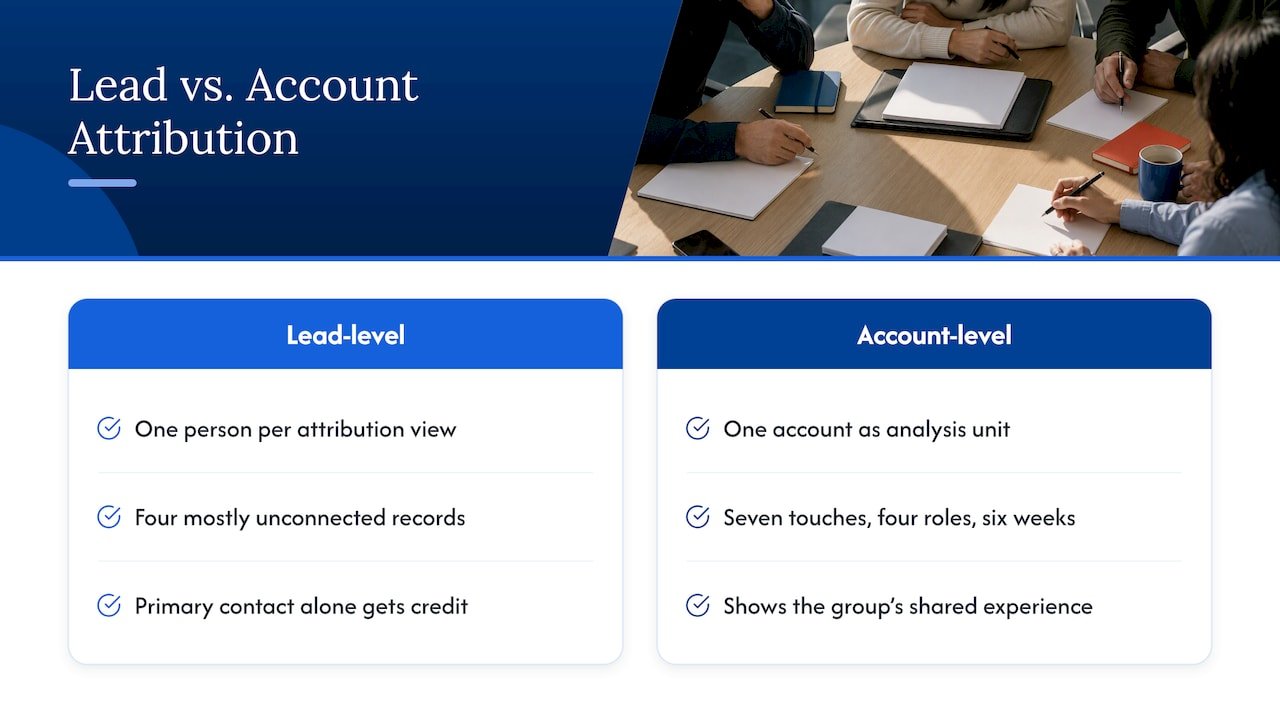
A simple example shows the difference. Three people from one target account attend a webinar, one reads two blog posts, and a fourth opens a pricing email. Lead-level reporting sees four separate, mostly unconnected records, and only the contact who later became the opportunity’s primary contact gets any credit. Account-level reporting sees one account with seven touches across four roles over six weeks, which is a far better description of reality.
How it differs from account-based marketing
Account-based marketing (ABM) is the go-to-market strategy: pick best-fit accounts and coordinate sales and marketing around them. Account-based attribution is the measurement layer that tells you whether that coordination is working. You can use it without a formal ABM programme, and any ABM programme needs it. Forrester’s research on ABM measurement makes the same point from the strategy side: metrics and goals have to be closely aligned for measurement to confirm you are on track.
Start with account mapping, not models
Most teams jump straight to choosing a model. In our experience that is backwards. A model can only credit what it can see, and it can only see what has been tied to an account.
Relying solely on sales-entered contact roles in the CRM is a common failure point. Reps add the contacts they talk to, so the quiet researcher who read ten pages of your site and the executive who attended an event stay invisible. The more robust pattern is automated mapping. Adobe’s documentation on attribution mapping methodology describes the process of looking up contacts, opportunities and accounts in the CRM so that touchpoints can be created against the associated opportunity.
A practical mapping checklist:
- Define the parent account. Decide how subsidiaries, regional offices and holding companies roll up. Write the rule down.
- Map by email domain. Associate contacts to accounts automatically using the email domain, with an exception list for free-mail domains and shared domains.
- Capture anonymous activity. Resolve known visitors to accounts as early as you lawfully can, and keep consent records with the data.
- De-duplicate. Merge duplicate accounts before you model anything. Two records for one company halves its apparent engagement.
- Audit monthly. Track the share of touchpoints that land on an account versus an orphan record. If that number is falling, fix it before reading any report.
We go deeper on this problem in our piece on fixing B2B account identity in buyer journey analytics. If your CRM is Marketo with Salesforce, our Marketo Measure (Bizible) service covers the setup end to end.
Choosing an attribution model at the account level
There is no model that is correct in the abstract. Each one answers a different question, and the right choice depends on your sales cycle, your data quality and what decision the report has to support.
Adobe’s Marketo Measure offers six attribution models: First Touch, Lead Creation, U-Shaped, W-Shaped, Full Path and Custom. First Touch and Lead Creation are single-touch models, and the others spread credit across more of the journey. That list is a useful vocabulary even if you use other tooling.
| Model type | Question it answers | Best used when | Watch out for |
|---|---|---|---|
| First touch | What started the relationship? | You want to understand demand creation | Ignores everything that nurtured the deal |
| Lead creation | What converted an anonymous visitor? | Your funnel has a clear conversion event | Over-credits form-fill channels |
| U-shaped | Which touches opened and converted? | Short to mid-length cycles | Undervalues the middle of the journey |
| W-shaped | Which touches opened, converted and created the opportunity? | Defined lifecycle stages | Needs clean stage timestamps |
| Full path | How did the whole journey contribute? | Long, multi-stakeholder cycles | Needs strong account mapping |
| Custom | How do we weight what we know about our buyers? | You have enough closed deals to calibrate | Easy to over-engineer |
For account-based work, the multi-touch family usually earns its keep, because the whole point is to see across people. But a single-touch view still has a role, which brings us to the next idea.
Sourced and influenced, side by side
Two questions get mixed up constantly. What sourced the opportunity, meaning what first created demand in this account? And what influenced it, meaning what accelerated the deal once it existed? Running both models next to each other gives a more balanced read of go-to-market health than either alone.
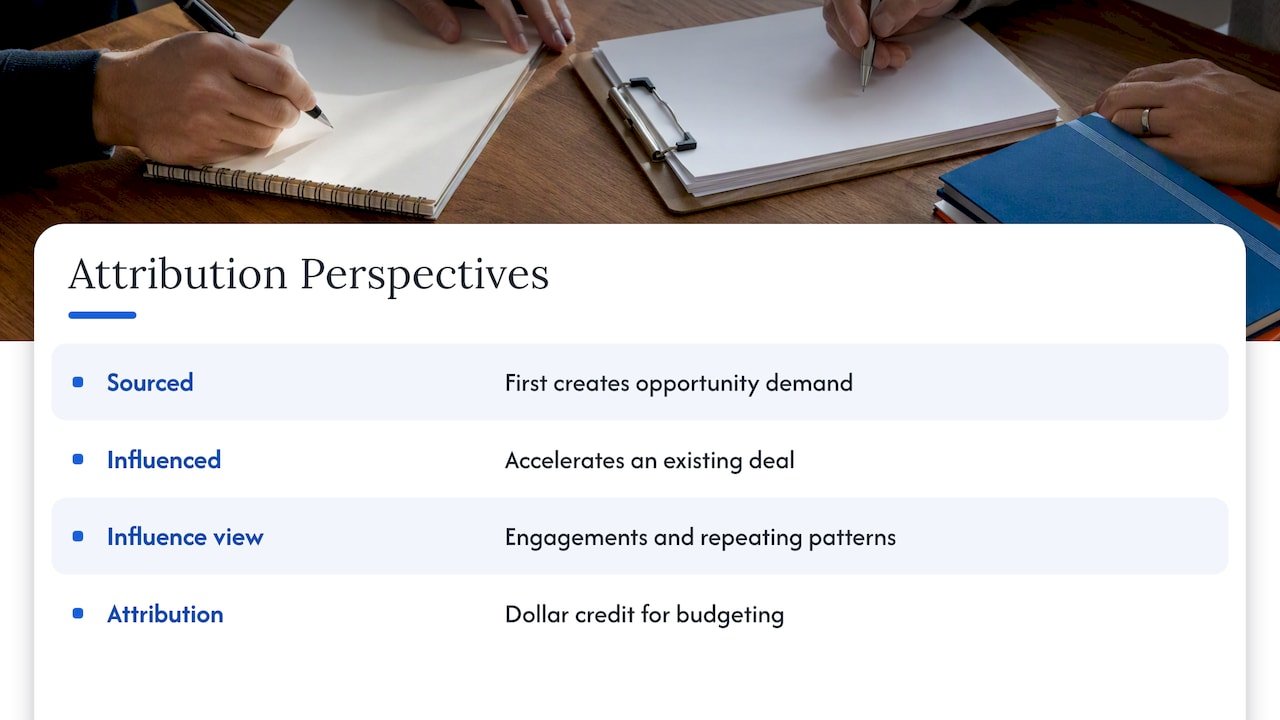
A good way to hold the two ideas apart: influence gives you the “what” (which engagements mattered, and what patterns repeat) and attribution gives you the “how much” (dollar credit for budgeting and finance). Relying only on influence tends to produce reporting that never touches budget. Relying only on attribution produces a number nobody can explain. Use both.
Set an opportunity window
One of the most common errors we see is leaving the time frame undefined. Without a window, a whitepaper download three years ago and a customer-support visit after the deal closed can both end up crediting the same opportunity.
Pick a window and apply it consistently. A sensible structure:
- Start: the earliest date a touch could reasonably have contributed. Many teams anchor this to when the account first showed engagement, capped at a maximum look-back that reflects their real sales cycle.
- End: opportunity close, won or lost. Post-close engagement belongs to expansion or retention reporting, not to the deal that just closed.
- Stage awareness: for forecasting, weight touches by the stage they occurred in. A touch during evaluation says more about deal progression than one during early awareness.
Keeping the window relevant to the deal stage is what lets attribution data feed forecasting at all. If you want to see how that connects to pipeline projections, our 60 to 90 day multi-touch forecasting pilot is built around exactly that link. The same logic also appears in discussions of how analytics in marketing connects to ROI, where the argument rests on tying measurement to decisions rather than reporting for its own sake.
Metrics worth reporting at the account level
Once mapping, model and window are settled, choose a short list of measures. A dashboard with forty tiles is a tapestry nobody can read.
- Account engagement coverage: how many roles in the buying committee you have reached, not just how many contacts.
- Time to opportunity: days from first meaningful engagement to opportunity creation, by segment.
- Sourced pipeline and influenced pipeline: both, labelled clearly and never summed.
- Pipeline velocity by account tier: do your priority accounts move faster than the rest?
- Cost per opportunity by channel and tier: where finance usually wants to start.
- Win rate for accounts with broad engagement versus single-threaded accounts: a quick check on whether multi-threading actually pays off for you.
Where your funnel conversion looks weak, a B2B funnel analysis helps locate the stage where accounts stall, which is often more actionable than another attribution tweak.
Common mistakes
Chasing perfect credit
Attribution is a map, not a courtroom verdict. It helps you decide where to go next, but it cannot prove objective truth about why a buyer signed. Teams that chase perfect credit distribution tend to lose sight of patterns, which are the part you can actually act on.
Trusting contact roles alone
As covered above, relying on rep-maintained contact roles hides most of the committee. Automate the mapping and let reps add context, not carry the whole load.
Mixing lead and account views in one report
If one chart counts leads and the next counts accounts, executives will compare numbers that are not comparable. Label the unit on every report.
Skipping the baseline
Before you change anything, record where you are: mapped-touch rate, current sourced pipeline, current cycle length. Without that, you cannot show improvement, and attribution programmes live or die on whether they change a budget decision. If you want to see the other common traps in plain terms, we have collected them in what marketers get wrong about attribution.
A 90-day rollout plan
- Weeks 1 to 2: audit. Measure the share of touchpoints mapped to accounts, document account hierarchy rules and list your channels and data sources. A five-phase marketing ops audit is a structured way to do this.
- Weeks 3 to 5: fix identity. De-duplicate accounts, automate domain mapping, close gaps in campaign tracking.
- Weeks 6 to 8: model. Stand up one sourced and one influenced view. Set the opportunity window. Resist adding a custom model yet.
- Weeks 9 to 10: validate. Compare the output with what sales knows about a dozen recent deals. Where the model disagrees with the account team, investigate before you dismiss either.
- Weeks 11 to 13: report and decide. Present one page to finance and sales leadership, with a single budget decision the data supports.
Our perspective
We build and run attribution and analytics systems for marketing, sales and finance teams, and the pattern is consistent: the teams that get value from account-based attribution treat it as an operations problem before a modelling problem. The sophisticated model sits on top of account identity, clean stage data and an agreed window. When those are right, even a modest model is useful. When they are wrong, an elaborate one only produces confident-looking error.
We also favour open, inspectable builds. You should be able to see how credit is calculated, in your own environment, and trace any number on a dashboard back to the records behind it. A black-box score that nobody can explain will not survive its first budget meeting. And we would rather help a client run sourced and influenced views side by side, and use them to ask better questions, than sell the idea that one number settles the debate.
— Don
How Brainiac can help
If account mapping, models and reporting are holding you back, our revenue attribution services cover design, implementation and ongoing operation, with integrations into platforms such as Salesforce, HubSpot, Marketo, Power BI and Tableau. For teams that want to automate the reporting and enrichment around it, our custom agent deployment builds agents that run inside your environment. You can also see results from past engagements before you talk to us.
FAQ
What is account-based attribution?
It is a method of crediting pipeline and revenue to the account, meaning the buying company, rather than to a single contact. Touchpoints from every person at the account are combined into one journey and credited to the resulting opportunity. It suits B2B sales where several people take part in the decision.
How is it different from lead-based attribution?
Lead-based attribution follows one person and credits only that person’s touches. Account-based attribution groups all contacts under their company, so activity from colleagues counts too. The practical effect is that marketing’s influence on committee deals is no longer undercounted.
Which attribution model should I use for accounts?
Multi-touch models such as W-shaped or full path usually fit long, multi-stakeholder cycles, provided account mapping is solid. Pair them with a simple first-touch view so you can separate what created demand from what accelerated it. Start simple and customise only once you have enough closed deals to calibrate against.
Do I need ABM software to do this?
Not necessarily. Many teams get most of the value from a clean CRM, automated account mapping and a well-defined window, along with a BI tool for reporting. Specialised tooling helps at scale, but it cannot fix poor account data.
Sources
- Attribution Mapping Methodology, Adobe Marketo Measure
- Marketo Measure Attribution Models, Adobe Marketo Measure
- Measuring the Impact of Account-Based Marketing, Forrester
- B2B Advertising: Joint Dynamic Scoring of Account and Users, arXiv