
A campaign influence model is a rule, or a statistical method, that splits the revenue from a closed deal across the campaigns that touched the buyer. In Salesforce you pick from standard and custom models inside Customizable Campaign Influence. In HubSpot you pick an attribution model inside attribution reports. The model matters less than the data underneath it: most disappointing attribution reports trace back to missing contact roles, a stubborn source field or leads that never became contacts, not to the wrong formula.
This guide covers how the models differ, how each platform implements them, where the setup breaks, and how to decide what to trust.
TL;DR
- Influence models distribute credit; they do not prove cause. Treat them as a map of the buyer journey, not a courtroom verdict.
- Salesforce builds influence records only when a campaign member is also an Opportunity Contact Role. Gaps in contact roles become gaps in reporting.
- The Primary Campaign Source field can override a multi-touch model in standard reports if you leave it unmanaged.
- HubSpot offers attribution reporting on contacts, deals and revenue, including an Empirical model that weights touchpoints by historical conversion paths.
- Use incrementality tests to check the channels where budget decisions are large.
Table of Contents
- What a campaign influence model actually does
- How campaign influence works in Salesforce
- The Primary Campaign Source trap
- How HubSpot handles attribution
- Salesforce and HubSpot side by side
- Choosing a model for your sales cycle
- Attribution is not causation
- A pre-flight checklist before you trust the report
- Our perspective
- Where we can help
- FAQ
- Sources
What a campaign influence model actually does
Every B2B deal has a tapestry of interactions behind it: an ad click, a webinar, three emails, a sales call, a pricing page visit. A campaign influence model answers one narrow question: if the deal is worth $100,000, how much of that should each campaign receive on the marketing dashboard?
The answer changes the story your reports tell. Give all credit to the first touch and top-of-funnel programs look brilliant while nurture looks useless. Give it all to the last touch and the reverse happens. Neither is false, they are just different lenses, and a CMO who sees only one lens will move budget in only one direction.
Models fall into three families:
| Family | Examples | Strength | Weakness |
|---|---|---|---|
| Single-touch | First touch, last touch | Simple to explain and audit | Ignores most of the journey |
| Rule-based multi-touch | Even distribution, linear, U-shaped, W-shaped, custom weights | Transparent, easy to agree on | Weights are opinions, not measurements |
| Data-driven | Markov chain, Shapley values, HubSpot’s Empirical model | Weights come from observed paths | Needs volume; harder to explain to finance |
Research reviewing the field finds that rule-based and single-touch models often introduce systemic bias into multi-touch journeys, which is why teams with enough data look at algorithmic alternatives. One such method, the Markov chain approach, scores each channel by its removal effect: how much the overall conversion probability falls if that channel disappears from the journey. For a broader view of where attribution sits in return-on-spend measurement, this guide to measuring marketing return is a useful companion.
How campaign influence works in Salesforce
Salesforce’s Customizable Campaign Influence (CCI) identifies revenue share with standard and custom attribution models that you can update manually or through automated processes. Each model is stored as a CampaignInfluenceModel record, and it groups the influence records created by a specific set of triggers and workflows.
Three mechanics decide whether your numbers are credible.
The default model and what it assumes
The default model that ships with CCI is Primary Campaign Source. According to Salesforce Help, it assigns 100% influence to the campaign named in that field on the opportunity. That is single-touch attribution with a different name. Other models (first touch, last touch, even distribution) are available to Marketing Cloud Account Engagement customers, as Salesforce Ben explains, and you can build custom models with your own logic.
Campaign members and contact roles
This is where most implementations stall. Influence records depend on both campaign membership and Opportunity Contact Roles. As SimplySfdc describes it, when a converted contact has campaign memberships and is tied to the opportunity through a contact role, Salesforce creates the influence records.
So if reps skip contact roles, the opportunity has no influence data, however sophisticated the model. If your marketing team tracks leads that never convert into contacts on the deal, the same hole appears. Salesforce Ben’s guidance is that the real work is enforcing data-entry discipline or building automation that creates contact roles at lead conversion, rather than just switching the feature on.
Timing: when records stop being created
Salesforce Help notes that influence records are created for open opportunities, and once an opportunity is closed, won or lost, they are no longer created. Any contact role you add after close will not backfill credit automatically. That is a strong argument for fixing contact-role hygiene before the deal reaches its final stage, not during quarter-end cleanup.
The Primary Campaign Source trap
A frequent complaint among admins: the team designs an even-distribution model, then the report still shows one campaign with all the revenue. The usual culprit is the Primary Campaign Source field. It can be filled manually or at lead conversion, and per SimplySfdc’s walkthrough it behaves differently from standard influence records, so a populated value can drown out the multi-touch picture in standard reporting.
Your options:
- Decide which view is the official one. If the multi-touch model is the source of truth, say so in writing and report from influence records.
- Stop populating the field by default. Remove it from page layouts or conversion mappings where possible.
- Clear or overwrite it with a process, if first-touch sourcing is not something you want in the same report.
- Train the team. Sales leaders should know why two reports show different answers for the same campaign.
The point is not that one view is right. It is that two views are running at once and nobody told the audience.
How HubSpot handles attribution
HubSpot’s approach is more packaged. Its attribution reports show the interactions contacts had along their journey, and let you apply different models to credit assets and interactions in a way that suits your business. You can report on contacts, deals and revenue, which covers most of what people mean when they search for HubSpot revenue attribution or campaign attribution.
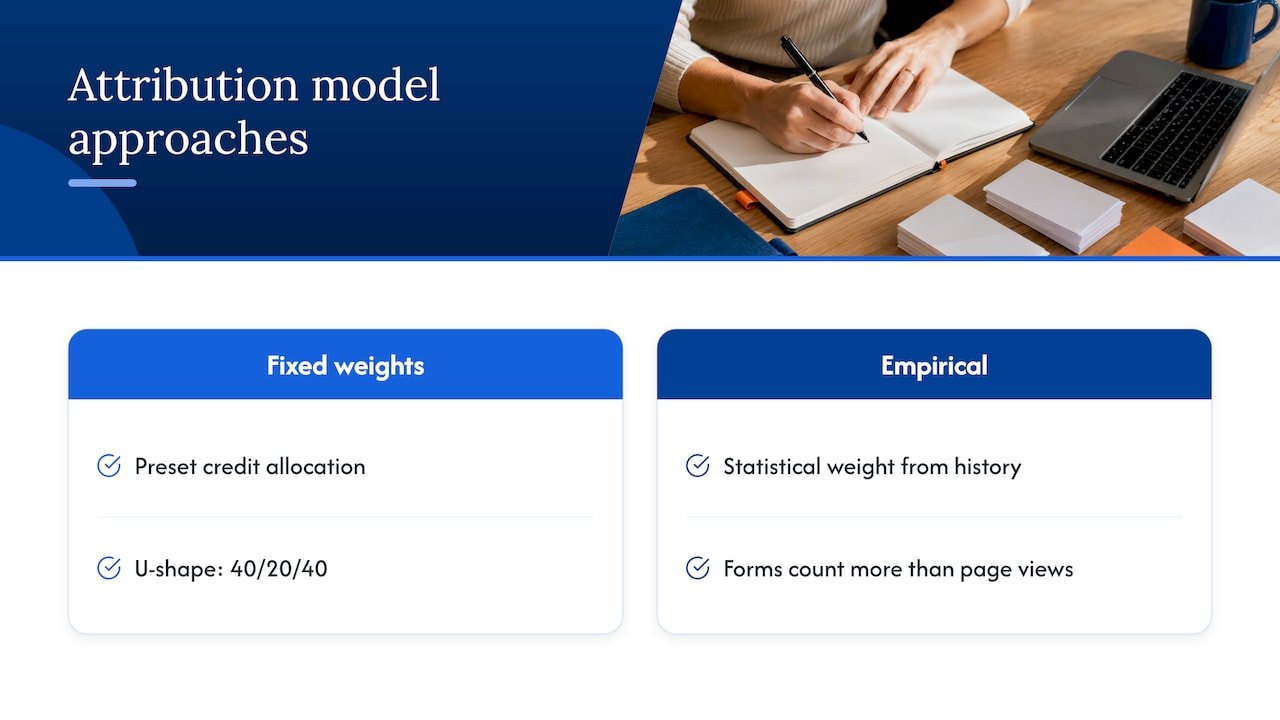
The model worth understanding is Empirical. Rather than fixing weights (40/20/40 in a U-shape, for example), it weighs interactions by their statistical importance across historical conversion paths. Rare, distinctive touchpoints such as form submissions count for more than frequent ones such as simple page views. Treat that as a data-driven model: it adapts to your own history, which is a strength when you have volume and a challenge when a stakeholder asks why a webinar got 11% and not 15%.
For teams that need programmatic access, the HubSpot developer documentation describes an endpoint to retrieve revenue attribution data for a campaign, filterable by attribution model and date range. That makes it possible to pipe attribution into a warehouse or a BI tool, rather than living only in HubSpot dashboards. Note that this reference is for a beta API version, so confirm it before building on it.
If HubSpot is your system of record and you want help getting reports you can defend, our HubSpot service page outlines how we work in the platform.
Salesforce and HubSpot side by side
| Question | Salesforce CCI | HubSpot attribution reporting |
|---|---|---|
| Where credit lands | Campaign influence records on opportunities | Reports on contacts, deals and revenue |
| Default behaviour | Primary Campaign Source, 100% to one campaign | You choose the model in each report |
| Custom weighting | Yes, custom models with triggers or API | Choose among provided models, including Empirical |
| Main dependency | Campaign membership plus Opportunity Contact Roles | Tracked interactions and deal association |
| Main risk | Missing contact roles; source field overriding | Untracked touchpoints; unclear deal associations |
| Best fit | Complex sales with many contacts per deal | Teams wanting built-in reporting with less admin |
Neither platform is universally better. Salesforce rewards teams with good admin discipline and complex buying groups. HubSpot rewards teams that want a model they can switch on and iterate without custom development.
Choosing a model for your sales cycle
Start from the decision the report must support, not from the formula.
- Short cycle, one buyer, few touches (many ecommerce and small service businesses): first or last touch is often enough, as long as you recognize what it hides. Our piece on ecommerce attribution models takes an experiment-first view of this.
- Longer B2B cycle with several stakeholders: a multi-touch model with explicit weights at lead creation and opportunity creation gives sales and marketing a shared language. Even distribution is a fair starting point but tends to overvalue repetitive touches.
- High volume and rich history: try a data-driven model next to a rule-based one. If the two disagree wildly, the disagreement is the finding.
- Budget reallocation across channels: no attribution model is enough. See the next section.
Whatever you choose, run two models side by side for a quarter before committing. If a program ranks first under one and last under another, you have learned how fragile that program’s story is.
The literature on heuristic models points the same way. Fixed-rule approaches have limits that data-driven alternatives such as Markov chains or Shapley values try to address, but they come with their own cost in explainability.
Attribution is not causation
Here is the misconception that costs the most money. Influence models describe correlation with a closed deal. Even an algorithmic model tells you which channels appeared on paths to conversion, not what would have happened without them. Researchers Florian Zettelmeyer and Brett Gordon of Kellogg have worked on predicting incrementality from experiments because randomized controlled trials give credible causal estimates, while observational measurement does not.
The practical consequence: branded search and retargeting often look excellent in attribution reports because they capture buyers who were already on their way. Cutting them blindly can hurt, and funding them blindly can waste money. A randomized holdout shows which one it is.
A sensible rhythm:
- Use the influence model for day-to-day reporting and program comparison.
- Pick the two or three channels with the biggest budgets or the most suspicious results.
- Run holdout tests on those, and compare the lift to what the model credited.
- Adjust model weights or budget accordingly.
We cover the approach in more depth in making incrementality testing always on and privacy first and in what marketers get wrong about attribution.
A pre-flight checklist before you trust the report
Before a board slide quotes campaign influence figures, check the following.
- Contact role coverage. What share of closed-won opportunities in the last two quarters have at least one contact role? Below that share, the report is a sample, not a total.
- Lead versus contact. Are the people who engaged with campaigns actually the people on the deal?
- Source field policy. Who populates Primary Campaign Source, and when?
- Closed-deal edits. Does anyone add or change contact roles after close, expecting credit to update?
- Model agreement. Do two different models give the same top three programs?
- Untracked touchpoints. Events, calls and dark social rarely appear. Say so on the slide.
- Privacy. Consent and data-handling rules affect what you can track. Our CCPA checklist for marketers is a starting point for California-facing data.
Our perspective
We see the same pattern across Salesforce and HubSpot builds: teams spend weeks debating U-shaped versus linear and almost no time on the plumbing that feeds the model. We would reverse that ratio. A plain model on clean data beats an elegant model on partial data every time.
We also think attribution should be a map rather than a courtroom verdict. It shows where buyers travelled, and it should make you curious, not certain. That is why we build open-source, inspectable pipelines instead of black boxes: your finance lead should be able to trace any number on the dashboard back to the records that produced it. And when the stakes are high, we pair the model with incrementality testing so the budget conversation rests on evidence of lift.
The last piece is operational. Contact-role enforcement, source-field rules and automation at lead conversion are not glamorous, but they decide whether your reports are trusted in the room.
— Don
Where we can help
If your influence report has holes, or two dashboards tell two stories, our revenue attribution services cover model design, CRM hygiene, and reporting across Salesforce, HubSpot and BI tools. For the day-to-day upkeep, marketing operations optimization and support keeps the data entry rules and automations running. You can also see results in our case studies.
FAQ
Why is my Campaign Influence related list empty on opportunities?
The most common causes are missing Opportunity Contact Roles or contacts who are not campaign members. Salesforce creates influence records only when a campaign member is also a contact role on the opportunity. Also check that the opportunity is still open, since records are not created after close, and that the related list is on the page layout.
Which attribution model should I use in HubSpot?
Start with the decision you need to make. Use first-touch to judge demand generation and last-touch to judge closing channels, then compare with a multi-touch model for the full picture. If you have enough history, test the Empirical model against a rule-based one and look at where they disagree.
Is multi-touch attribution more accurate than first or last touch?
It is more complete, not necessarily more accurate. Multi-touch models spread credit across the journey, but their weights are either assumptions or statistical associations. Only experiments such as holdout tests can tell you whether a channel caused additional revenue.
Why does one campaign get all the revenue in my Salesforce report?
Check Primary Campaign Source. When that field is populated, standard reporting can attribute the full amount to that campaign, which silences a multi-touch design. Decide which view is official, then manage the field with page layouts, conversion mappings or automation.
Sources
- How Customizable Campaign Influence Works, Salesforce Help
- CampaignInfluenceModel object reference, Salesforce Developers
- Creating a Salesforce Campaign Influence Model That Actually Reflects Your Impact, Salesforce Ben
- Salesforce Opportunity: Primary Campaign Source, Opportunity Contact Role and Campaign Influence, SimplySfdc
- Create attribution reports, HubSpot Knowledge Base
- Retrieve revenue report, HubSpot Developers
- Systematic Review of Attribution Modeling Methods Resolving Bias in Multi Touch Journeys (DOI)
- Systematic Review of Attribution Modeling Methods (PDF)
- Predicted Incrementality by Experimentation for Ad Measurement, Kellogg