
The most reliable prompt injection defense is architectural, not a clever prompt. Assume some malicious instruction will eventually reach your model, then design the agent so that a manipulated model can read little, touch little and change nothing important without a person approving it. That means narrow tasks, least-privilege access, separated external content, checked outputs, human approval for high-risk actions and regular adversarial testing. We build agents this way, and this guide walks through each layer in the order you would put it in place.
TL;DR
- Prompt injection is text that tricks a model into following an attacker’s instructions. It can arrive directly from a user or indirectly through a web page, document or email your agent reads.
- No single filter stops it. OWASP says fool-proof prevention is unclear, so the goal is to limit impact, not promise zero attempts getting through.
- The strongest controls are structural: narrow task scope, least-privilege tools, separated external content and human approval for high-risk actions.
- Test with adversarial prompts before launch and on a schedule after, and log what the agent reads and does.
- Marketing, sales and finance agents carry CRM, billing and customer data, so start with the actions that would hurt most if hijacked.
Table of Contents
- What prompt injection is, in plain terms
- What a hijacked agent can actually do
- Why “sanitize the input” is not enough
- The layered defense, step by step
- Where each control sits in the workflow
- A worked example: a lead-enrichment agent
- Monitoring and response
- Where to start if you have a small team
- What we offer
- Our perspective
- FAQ
- Sources
What prompt injection is, in plain terms
A language model receives your instructions and the data it is working on as one stream of text. It cannot reliably tell which part is a command from you and which part is content. Prompt injection exploits that. NIST’s Generative AI Profile defines prompt injection as modifying input so a generative AI system behaves in ways nobody intended, and it separates two forms:
- Direct injection: someone types a malicious prompt straight into the system, for example into a customer chat box.
- Indirect injection: the malicious prompt is planted in data the application is likely to retrieve, such as a web page, a shared document, a support ticket or an inbound email.
For business teams the indirect form matters most. Your lead-enrichment agent reads company websites. Your reporting agent reads spreadsheets and CRM notes. Your inbox triage agent reads email from strangers. Each of those is a door an attacker can use without ever logging in to anything you own.
What a hijacked agent can actually do
A chatbot that says something silly is an embarrassment. An agent with tools is a different category of problem. OWASP’s prompt injection guidance lists the possible outcomes: bypassed safety controls, unauthorized data access or exfiltration, system prompt leakage and unauthorized actions through connected tools or APIs. NIST’s profile adds that prompt injection can create downstream risks for interconnected systems, including disclosure of proprietary data.
Translate that into the systems you run:
- A lead-qualification agent told by a hidden line on a prospect’s page to mark every lead from that domain as sales-ready, polluting your pipeline.
- A reporting agent persuaded to include customer records in a summary that gets emailed outside the company.
- A CRM automation agent steered into editing opportunity stages or deleting records.
- A store operations agent induced to issue refunds or change prices.
Snyk Labs’ research on agent hijacking makes the underlying point: because agents are exposed to web pages, documents and communications, indirect injection opportunities multiply, and they can affect other users of the agent without those users noticing. The threat changes shape once an agent can retrieve content and use tools. The adversarial instruction no longer comes through the user’s prompt. It comes through ordinary content the agent was asked to read.
Why “sanitize the input” is not enough
The common advice is to clean user input and write a firm system prompt. Both help, and neither is a defense on its own. OWASP’s LLM01:2025 entry says that because of the stochastic nature of generative models, fool-proof prevention methods are unclear, so defenses should mitigate impact. AWS Prescriptive Guidance makes the same point from the engineering side: input validation is recommended, but prompt filters and guardrails should be complemented by defense in depth rather than relied on alone.
A useful way to think about it: a filter is a smoke detector, and architecture is the fire door. You want both, but only one of them stops a fire from spreading.
The layered defense, step by step
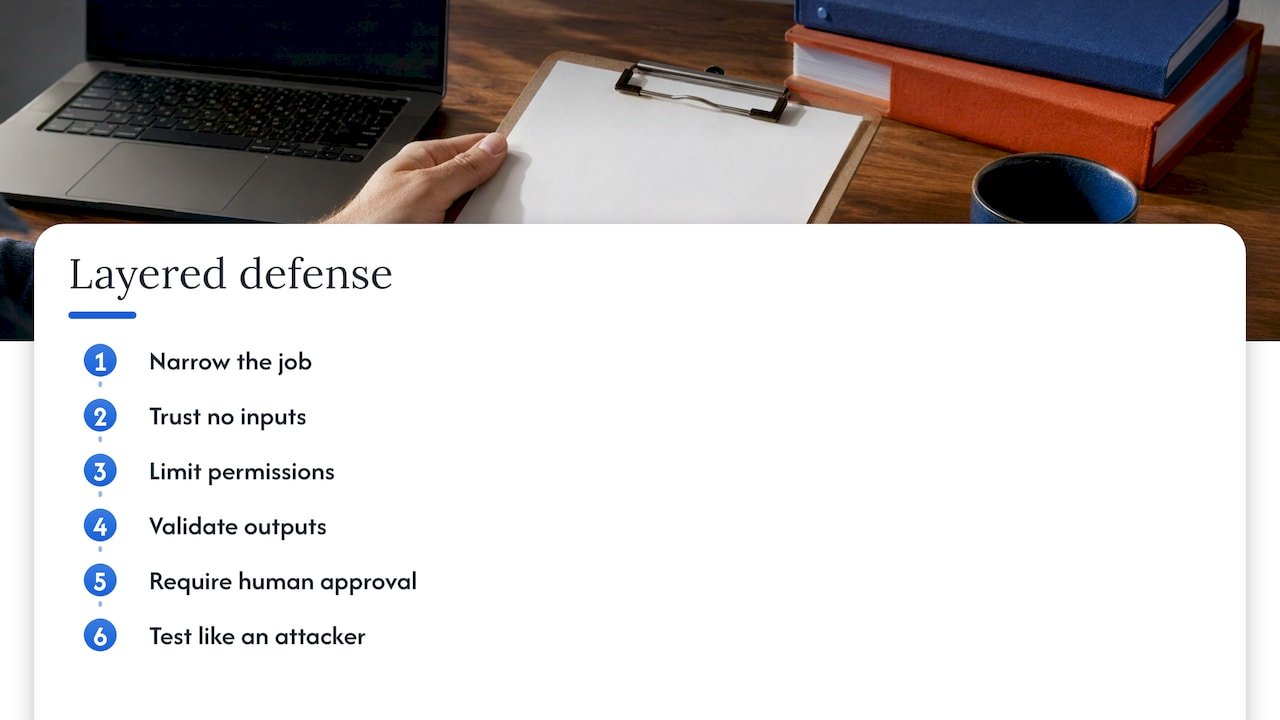
The order below follows how we would put controls in place on a new agent, starting with the ones that shrink the damage most.
1. Narrow the job
The broader the instruction, the easier the agent is to redirect. OpenAI’s November 2025 article on prompt injections notes that agents given broad instructions, such as reviewing email and taking whatever action is needed, are easier to mislead, while specific tasks and limited latitude make attacks harder, though not impossible.
Write the agent’s job as a short, bounded description: what it does, which data it may read, what it may output and what it must never do. OWASP’s LLM01:2025 guidance recommends constraining model behaviour with explicit role, capability and limitation instructions and keeping responses within a defined task or topic. Our guide on one agent until you need more than five tools covers how to keep a design this tight as requirements grow, and our AI agent job description template gives you a format for writing the scope down.
2. Treat everything the agent reads as untrusted
OWASP’s AI agent security guidance recommends treating external data as untrusted, sanitizing it and keeping it separate from instructions, filtering content, and considering a separate model call to validate or summarize it before the main agent sees it.
In practice:
- Mark where external content begins and ends, so it is passed as data and never merged into the instruction block.
- Strip what a human reader would not see. Microsoft’s guidance recommends scanning and sanitizing external content, including removing HTML or Markdown elements that could hide instructions.
- Use allowlists for expected data formats. If a field should hold a phone number, reject anything else.
- Where possible, let the agent retrieve only from approved sources. A 2026 peer-reviewed simulation study found that retrieval allowlisting nearly eliminated indirect injection in its tested scenarios, though it did not address other attack channels and its authors present the results as design guidance, not real-world incident rates.
3. Give the agent the least access that works
This is the layer that decides how bad a successful attack can be. OWASP recommends application-managed API tokens and restricting model access to the minimum necessary privileges, with functionality handled in code rather than exposing broad credentials to the model. The Five Eyes agencies’ joint guidance on agentic AI, from the cyber agencies of Australia, Canada, New Zealand, the United Kingdom and the United States, recommends limiting agent permissions to the minimum scope required for approved tasks, enforcing identity-based boundaries and checking authorization at each invocation.
Microsoft’s guidance describes the same idea in access-control terms: role-based access, scoped service identities and explicit data boundaries, so each component has only what its task requires.
A concrete test for your CRM agent: if it can read contacts, can it also export them? If it can update a lead score, can it also delete the lead? Each “also” is a permission to remove. The simulation study mentioned above found least-privilege tool design to be its strongest broad single control, with the caveat that it came from a simulation rather than field measurements.
For a wider view of how access limits connect to safe agent behaviour, the ethical AI and content safety standards overview covers limiting what a manipulated model or agent can reach.
4. Validate what comes out before it acts
Do not let model text trigger an action directly. Put deterministic code between the model and your systems. OWASP’s LLM01:2025 recommends validating expected output formats with deterministic code and filtering both inputs and outputs, including evaluating retrieval-augmented answers for context relevance, groundedness and question-answer relevance. OWASP’s cheat sheet adds that tool calls should be checked against user permissions and session context, with tool-specific parameters validated.
AWS Prescriptive Guidance points the same direction: use more coded logic and limit what the model’s response is used for. If an agent only needs to choose a lead category from a list of five, make the code accept one of those five values and nothing else.
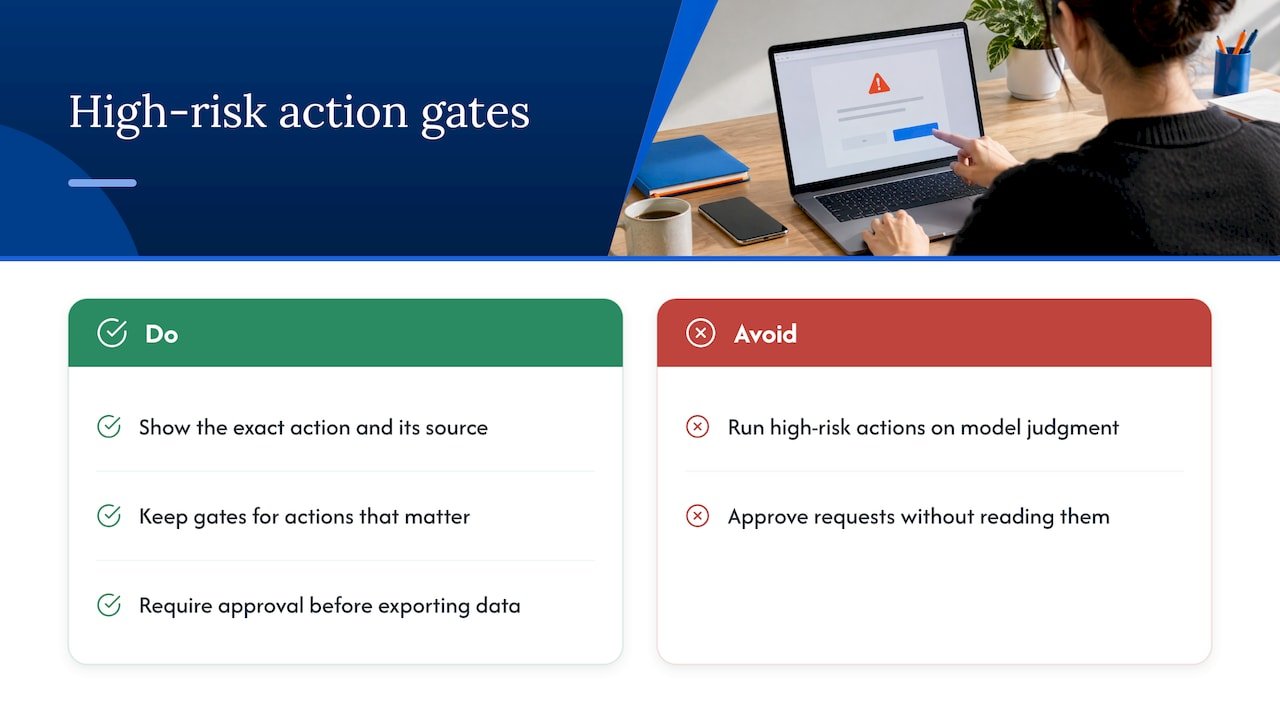
5. Put a person in front of high-risk actions
Some actions should never run on model judgment alone: sending external email, moving money, changing records in bulk, exporting data, changing permissions. OWASP recommends human approval for high-risk or privileged operations. The Five Eyes guidance recommends human oversight, live monitoring and interruption, auditability and reversibility, and explicit control flows that keep agents within authorized objectives.
Approval gates are not magic. The 2026 simulation study found that human approvals sharply reduced high-impact actions and exports, but that they remain exposed to user error and habituation. People who approve fifty requests a day stop reading them. Keep the gate for the few actions that matter, show the approver the exact action and its source, and you keep the control meaningful. We cover the design in human-in-the-loop approval that actually controls an agent and the handoff rules in our escalation policy guide.
6. Test it like an attacker would
OWASP recommends adversarial testing and attack simulations. AWS Prescriptive Guidance recommends building test suites for harmful and valid prompts, naming prompt injection, jailbreak and adversarial-input testing as useful evaluation targets.
A starter set for a business agent:
- Hidden instructions in a web page, PDF and spreadsheet cell that the agent is asked to summarize.
- A support ticket that tells the agent to ignore its rules and reveal its instructions.
- A document that asks the agent to send data to an outside address.
- A request that tries to use a tool the agent should not have for that task.
Run the same set after every change to the prompt, model, tools or data sources, and keep valid requests in the suite too, so you notice when a defense blocks real work.
Where each control sits in the workflow
| Stage | What happens | Control | What it limits |
|---|---|---|---|
| Before the model | Content is retrieved or received | Allowlisted sources, format checks, hidden-markup removal, clear data boundaries | What hostile text reaches the model |
| Inside the model call | The agent reasons over the task | Narrow role, explicit limits, separate validation call for external content | How easily the task is redirected |
| Between model and tools | The agent requests an action | Deterministic output validation, parameter checks, least-privilege tokens | What a manipulated request can do |
| Before high-risk actions | An action is about to run | Human approval with the exact action shown | Irreversible or external effects |
| Around everything | The agent runs in production | Logging, monitoring, interruption, adversarial test suite | How long a failure goes unnoticed |
The NIST Generative AI Profile treats prompt injection as an information-security and system-architecture concern: LLM applications widen the attack surface and can affect confidentiality, integrity and availability, so conventional security practice may need adapting. That is why this table reads like a security review and not a prompt-writing exercise.
A worked example: a lead-enrichment agent
Take an agent that researches inbound leads, writes a summary into the CRM and suggests a qualification score.
- Scope: it reads the lead’s company website and public profile and writes two fields, a summary and a suggested score. Nothing else.
- Untrusted content: website text is passed as marked data, with hidden elements stripped, and summarized by a separate call before scoring.
- Access: its CRM token can update those two fields on lead records. It cannot delete, export or edit other objects.
- Output validation: the score must be one of the allowed values and the summary must stay under a set length with no links to unknown domains.
- Approval: a suggested score above a threshold that would route the lead straight to a sales rep goes to a human first.
- Testing: a test page carrying a hidden instruction runs weekly, and a failure raises an alert.
If an attacker plants an instruction on a prospect’s site, the worst realistic outcome is one wrong score on one lead, flagged for review. Without these controls, the same injection could reach every record the agent’s broad credentials can touch.
Monitoring and response
Plan for the day something gets through. The Five Eyes guidance stresses live monitoring, interruption, auditability and reversibility. Translated into operations:
- Log the content the agent retrieved, the tool calls it made and the approvals it received, so you can reconstruct what happened.
- Alert on unusual patterns: a spike in tool calls, outputs containing unfamiliar URLs, attempts to call tools outside the agent’s scope.
- Keep a kill switch that pauses the agent without taking down the system around it.
- Make actions reversible where you can, for example by writing proposed changes to a staging field before they go live.
Our AI agent guardrails guide covers the types of guardrail and where to place them, and the governance implementation framework shows how to assign owners and review cycles so these controls do not decay after launch.
Where to start if you have a small team
You do not need to do everything at once. Rank your agents by the damage a hijack could cause, then work down:
- List every agent and every tool and data source it can reach.
- Remove permissions the task does not need. This costs little and cuts risk the most.
- Add human approval to external sends, exports and bulk changes.
- Add output validation in code for any field that feeds a system of record.
- Build the first ten-case test set and schedule it.
For ecommerce stores, treat refunds, price changes and customer data exports as the high-risk list. For service businesses, start with anything that emails clients or edits billing. For enterprise marketing and revenue operations teams, begin with the CRM and attribution data the agents write to, since bad data from a hijacked agent corrupts every report downstream.
What we offer
Brainiac Consulting designs and operates AI agents and analytics systems for marketing, sales and finance teams. Our approach is open source, which means you can see how an agent is built instead of trusting a black box, and our custom agents are production-grade and run end-to-end within your own environment. Our AI Strategy & Readiness Advisory includes a Governance & Guardrails workstream, and the agents themselves are built through Custom Agent Deployment.
If you already have agents running or planned, the AI strategy and readiness work is the place to define scope, guardrails and approval rules before deployment. Our enterprise deployment approach pairs shadow validation with governance, so you can see how an agent behaves before it acts on live systems.
Our perspective
We think of prompt injection the way a good operations lead thinks about a new hire with a master key: the question is not whether the person is clever, it is what the key opens.
Most advice treats the model as the thing to protect. We treat the model as a component that will sometimes be fooled, and we design the surrounding system so that being fooled is survivable. A narrow job, a short list of tools, validation in code and a person on the few actions that matter will do more for you than the most elaborate system prompt.
This is also why we build in the open. When you can see how an agent is wired, which data it reads and which tools it can call, you can review the attack surface. A black box asks you to take the security posture on trust. An open build lets you inspect it, and inspection is the habit that makes every other control work.
The agents we deploy sit inside your existing stack, whether that is Salesforce, HubSpot or Marketo, so the permissions you already manage in those platforms become part of the defense, not a parallel system to maintain.
Don
FAQ
Can prompt injection be fully prevented?
Not with current methods. OWASP states that fool-proof prevention is unclear because of how generative models work, so the practical goal is to limit impact. Layered controls, least privilege and human approval keep a successful injection from becoming a serious incident.
What is the difference between direct and indirect prompt injection?
Direct injection is a malicious prompt entered straight into the application. Indirect injection hides the prompt in content the application retrieves, such as a web page, document or email. Agents that read outside content face the indirect kind far more often.
Is a strong system prompt enough?
A clear system prompt that states the agent’s role, limits and scope is a worthwhile layer, and OWASP recommends it. It should sit alongside input and output checks, restricted tool access and approval gates, because a model can still be steered by content it reads.
Which controls should a small business implement first?
Start with least-privilege access and human approval for high-risk actions, since they limit damage whatever the attacker writes. Then add output validation in code and a small set of adversarial tests that you rerun after each change.
Sources
- NIST Artificial Intelligence Risk Management Framework: Generative AI Profile
- OWASP LLM Prompt Injection Prevention Cheat Sheet
- OWASP AI Agent Security Cheat Sheet
- OWASP Gen AI Security Project: LLM01:2025 Prompt Injection
- Snyk Labs: Agent Hijacking
- Securing Tool-Using AI Agents Against Injection (MDPI, 2026)
- Microsoft Learn: Prompt Injection (Direct / Indirect)
- AWS Prescriptive Guidance: Security for agentic AI on AWS
- OpenAI: Understanding prompt injections
- Careful adoption of agentic AI services (Five Eyes joint guidance)