

Incrementality testing is the causal experiment that isolates the conversions your marketing actually caused, rather than the ones it merely got credit for. It compares an exposed test group against a matched, unexposed control group, so the gap between them is real, net-new demand. In a world where cookies are disappearing and platforms grade their own homework, it’s the most defensible way to decide where your next dollar of budget goes.
TL;DR:
- Randomized holdout tests provide the most accurate measure of incremental conversions and iROAS, especially when individual targeting is possible.
- Platform-reported lift often overstates true incrementality due to internal biases and limitations in cross-channel tracking, making first-party data validation essential.
- Contamination, small sample sizes, and premature test stopping are the most common pitfalls that invalidate incrementality results.
- Using multiple measurement methods—including geo holdouts, synthetic controls, and marketing mix modeling—ensures robust, cross-validated insights.
- Establishing a continuous, governance-driven testing program with standardized processes and integrated data infrastructure maximizes long-term value.
Table of Contents
- What incrementality testing marketing actually measures
- Why incrementality matters more now than it did five years ago
- Four core methods to measure incrementality (and when to use each)
- How do you design a reliable incrementality test?
- How to calculate lift and incremental ROAS
- What platforms offer natively, and where those numbers fall short
- Common pitfalls that quietly invalidate your results
- Turning lift results into budget decisions
- Making incrementality an always-on program, not a one-off project
- A quick-start template you can use this week
- Where incrementality measurement is heading
- How Brainiac Consulting helps you operationalise incrementality
- Sources
What incrementality testing marketing actually measures
Incrementality testing marketing starts with a simple question: what happened because of this campaign that wouldn’t have happened anyway? The answer is lift, the percentage difference in conversions between a group exposed to your marketing and a comparable group that wasn’t. Everything else in this discipline, from geo holdouts to synthetic controls, exists to produce a clean, believable lift number.
A few terms carry the weight of the entire practise, and getting them precise matters more than most marketers assume:
- Incremental conversions: the raw number of conversions in the test group that would not have occurred without exposure, calculated by subtracting the control group’s conversion rate (scaled to the test group’s size) from the test group’s actual conversions.
- iROAS (incremental return on ad spend): revenue from incremental conversions divided by media spend. This is a stricter, more honest number than standard ROAS, which counts every conversion regardless of whether the ad caused it.
- Baseline behaviour: what your audience would do with zero marketing exposure. Every incrementality test is, at its core, an attempt to estimate this baseline accurately.
- Test/control split: how you divide your audience or geography so one group sees the campaign and one doesn’t.
Here’s where incrementality diverges sharply from multi-touch attribution and last-touch models. Attribution assigns credit across touchpoints based on rules you (or a platform) define. It answers “who gets the credit?” Incrementality answers “did this cause anything?” A campaign can win every attribution model in your dashboard and still show near-zero lift, because it was reaching people who were already going to convert.
Three signals tell you it’s time to move beyond attribution and run a real test. First, if your platforms report wildly different numbers for the same conversion, you’re looking at platform bias, not reality. Second, if privacy rules or browser restrictions have degraded your tracking accuracy, attribution’s underlying data is already compromised. Third, if you’re spending heavily across five or six channels and can’t explain why the mix looks the way it does, incrementality gives you a causal answer that a weighted attribution model simply cannot.
Why incrementality matters more now than it did five years ago
Attribution was built for a cookie-rich, tracking-permissive internet that no longer exists. As third-party identifiers erode and privacy regulation tightens, the touchpoint data that multi-touch attribution depends on has gotten thinner and less reliable, which is exactly why trade coverage now treats incrementality as the most defensible measurement standard available to marketers.
There’s a second force pushing in the same direction: your own bidding algorithms. Automated bidding on Google, Meta, and most demand-side platforms optimizes toward conversions, but it can’t tell the difference between a conversion it created and one it simply intercepted. If your algorithm keeps bidding on branded search terms from people who were already searching for you by name, it will report fantastic ROAS while adding almost nothing incremental. Incrementality testing is the only practical way to catch that.
Statistic Callout: Marketing measurement increasingly requires triangulating experimental ground truth with model-based methods like MMM, because neither approach alone gives a complete, privacy-safe picture of channel contribution.
And then there’s finance. CFOs who once accepted a dashboard screenshot as proof of marketing performance are now asking harder questions, particularly when budgets tighten. A causal lift number, with a defined control group and a calculated confidence interval, survives that scrutiny in a way that a last-touch attribution report never will. If you want your next budget request approved without a fight, iROAS is the number that does the convincing.
Four core methods to measure incrementality (and when to use each)
Not every team has the audience size, budget, or channel mix to run the same kind of test. Choosing the right method matters as much as running the test well.
- Randomized holdout testing: You randomly assign known users (email addresses, customer IDs, logged-in accounts) to test and control groups, then suppress marketing exposure for the control. This is the gold standard when you can address individuals directly, because randomization eliminates most selection bias. It works best for email, retail media loyalty programs, and paid social campaigns targeting a defined customer list.
- Geo holdout testing: You split by geography instead of individual, running the campaign in some markets and withholding it in matched comparison markets. This is the practical answer when your media can’t be targeted at the individual level, such as CTV, out-of-home, radio, or broad-reach display, and it also works well for mixed online/offline campaigns where you can’t stitch a single customer ID across channels.
- Synthetic control and causal modelling: When a true experiment isn’t feasible, either for cost or timing reasons, you construct a statistical “synthetic” control group from historical and comparison data that approximates what the test group would have done without exposure. It’s a reasonable fallback, not a replacement for a real holdout, and it depends heavily on data quality and a stable pre-period.
- MMM calibration: Marketing mix modelling gives you a macro, cross-channel view of contribution over months or quarters, but its coefficients drift without grounding. Feeding validated lift results from randomized or geo holdouts back into your MMM keeps the model honest and turns it into a genuinely strategic planning tool rather than a black box.
Most mature measurement programs use all four at different points: holdouts for tactical channel decisions, MMM for the annual budget conversation, and synthetic controls when neither pure option is available.
How do you design a reliable incrementality test?
A test that isn’t designed carefully will hand you a number that looks precise and means nothing. Here’s the sequence that keeps a test honest from setup through to results.
- Write a specific, falsifiable hypothesis. “Paid social drives incremental purchases among lapsed customers” is testable. “Paid social helps brand awareness” is not, because you haven’t defined a measurable outcome.
- Pick one primary KPI before you launch. Incremental conversions, incremental revenue, or iROAS, whichever ties most directly to the budget decision you’re trying to make. Secondary metrics are fine to watch, but only one should decide the outcome.
- Choose your split method based on addressability. Use a known-user randomized holdout when you can suppress exposure at the individual level; use a geo split when you can’t. Don’t default to geo just because it’s easier to set up if a cleaner method is available.
- Size the control group correctly. A control that’s too small produces noisy results; one that’s too large wastes reach. Most teams run 10% to 20% of eligible audience or geography as control, though the right figure depends on baseline conversion volume and expected lift size, the same statistical-power thinking that underlies standard A/B test design.
- Confirm comparability before you launch, not after. Check that test and control groups match on prior purchase behaviour, seasonality exposure, and demographic mix. A geo test comparing a growing market to a declining one will lie to you no matter how clean the math looks afterward.
- Lock down your data plumbing first. You need first-party transaction data linked to exposure status, ideally through a CRM or measurement layer like Marketo Measure, with privacy-safe matching that doesn’t depend on third-party cookies.
- Set a minimum run time based on your sales cycle, not your patience. Cutting a test short before the conversion window closes systematically understates lift, particularly for higher-consideration purchases.
- Avoid launching during a platform’s algorithmic learning phase. Meta’s own guidance warns that evaluating performance during the learning phase produces unstable, biased results because the algorithm is still exploring, not optimizing.
- Document everything before you hit go. Hypothesis, KPI, split method, sample size, start and end dates, and the decision rule you’ll apply to the result. This single habit is what separates a repeatable testing program from a pile of one-off experiments nobody can reconstruct later.
Pro Tip: Run a “silent” pre-test period of at least two weeks before launch to confirm your test and control groups already track each other closely on your primary KPI. If they diverge before you’ve introduced any exposure, your split is broken, not your campaign.
How to calculate lift and incremental ROAS
The formulas behind incrementality are simple; the discipline is in applying them correctly and reading the result without kidding yourself.
- Incremental conversions = Test group conversions − (Control group conversion rate × Test group size)
- Lift % = (Test group conversion rate − Control group conversion rate) ÷ Control group conversion rate × 100
- iROAS = Incremental revenue ÷ Media spend
Say you run a geo holdout across comparable markets over several weeks. The exposed markets show higher conversion rates than the control markets, resulting in measurable lift. If the exposed markets generated substantial incremental revenue against your media spend, your calculated iROAS will provide a stricter measure than platform-reported ROAS, revealing revenue that platforms may over-attribute to your marketing.
A few interpretation rules keep you from over-reading a single number. Negative lift doesn’t always mean the campaign failed; sometimes it means the control group had unusually strong organic performance, which is why comparability checks matter before you launch, not after. Always pair your lift estimate with a confidence interval rather than a single point figure, because baseline volatility, seasonality, competitor activity, macro shifts, can swing raw conversion numbers independent of your campaign. When you present iROAS to finance, lead with the incremental revenue dollar figure and the confidence range, then follow with the ratio. Executives fund dollars, not decimals.
What platforms offer natively, and where those numbers fall short
Google Ads runs conversion lift studies using either user based or geographic holdouts, letting advertisers choose granularity based on budget and audience size. User-based tests need enough scale to produce a statistically stable comparison; geo-based tests trade some precision for the ability to run without individual-level tracking, which also makes them more privacy resilient by design.
That native support is genuinely useful, but treat it as one input, not a verdict.
- Platform-reported lift is calculated inside a walled garden, using that platform’s own conversion data and its own definition of exposure, so it can’t see or account for cross-channel interference.
- A platform has a structural incentive to report favourable lift for its own inventory; that’s not necessarily bad-faith, but it’s a reason to validate with your own transaction data before scaling spend.
- Many of these lift products already run without third-party cookies, relying on aggregated or hashed matching and geo-based methods, which makes them a reasonably privacy-safe starting point even as tracking restrictions tighten.
- For genuine cross-channel comparability, first-party measurement tied to your CRM beats any single platform’s internal number, because it’s the only view that sees the whole customer journey rather than one platform’s slice of it.
The practical move for most teams: use platform-native lift tools for fast, directional reads on a single channel, and reserve first-party geo or randomized holdout tests for the decisions that actually move significant budget.
Common pitfalls that quietly invalidate your results
Contamination is the most common way a clean-looking test turns out to be worthless; using proxies for ad verification helps ensure the control group remains unexposed and your test results stay valid. It happens when someone in your control group gets exposed to the campaign anyway, through retargeting overlap, a shared household device, or a channel you forgot to suppress. Audit your suppression lists before launch and spot check mid-test, particularly on paid social and display, where audience overlap between campaigns is easy to miss.

Low statistical power is the second-biggest killer. If your baseline conversion volume is small, or your expected lift is modest, you need a larger sample and a longer run than most marketers budget for. The same sample-size and duration thinking that governs standard split testing applies directly here: an underpowered test doesn’t fail loudly, it just gives you a number that looks fine and means nothing.
Resist the urge to call a test early because the early numbers look good, or bad. Peeking at results before your planned end date and stopping when you like what you see is one of the fastest ways to manufacture a false positive.
Statistical and practical significance are not the same thing, and conflating them causes real budget mistakes. A test can hit a statistically significant result on a lift so small it wouldn’t cover its own testing cost; practical significance asks whether the effect is large enough to justify the business decision you’re about to make, not just whether it’s mathematically real. Set your business-impact threshold, the minimum lift that would actually change a budget decision, before you see any data.
Finally, timing matters on algorithmic channels. Launching a test in the middle of an automated bidding system’s learning phase introduces exploration noise that has nothing to do with your campaign’s true effect.
Pro Tip: Build a simple pre-launch checklist that includes a contamination audit, a minimum sample-size calculation, and a written stopping rule. Teams that skip the stopping rule are the ones most likely to call a test early and regret it later.
Turning lift results into budget decisions
A test result that never changes a budget line is a wasted test. The point of incrementality testing marketing is to convert lift and iROAS into rules your team applies consistently, not into a slide that gets admired once and forgotten.
- Set a scaling threshold in advance: if iROAS clears your target (say, 3.0 or higher, calibrated to your margin structure), scale spend in defined increments and re-test at the new level, since lift often decreases as you saturate an audience.
- Set a pause or reallocate threshold with the same rigor: if a channel’s iROAS falls below your business-impact floor, move that budget to a channel with proven incremental lift rather than letting inertia keep funding it.
- Feed every validated holdout result back into your marketing mix model. This is how experimental ground truth calibrates MMM coefficients, correcting for the platform bias that creeps into any model trained purely on platform-reported data.
- Stagger your test calendar so overlapping experiments on adjacent channels don’t contaminate each other’s results, particularly when campaigns share audiences or geography.
- Prioritize testing the channels with the largest spend and the most attribution ambiguity first; that’s where a wrong assumption costs the most money.
- When presenting to finance, lead with incremental revenue in dollars, the confidence range around it, and the specific budget action you’re recommending, in that order.
Treat incrementality results as inputs to a standing decision framework, not as isolated verdicts on individual campaigns.
Making incrementality an always-on program, not a one-off project
Most teams run their first incrementality test as a special project, then let the discipline lapse once the results get presented. That’s the wrong model. Industry practitioners increasingly treat incrementality as a continuous practise that feeds budget decisions on a rolling basis rather than a periodic audit.
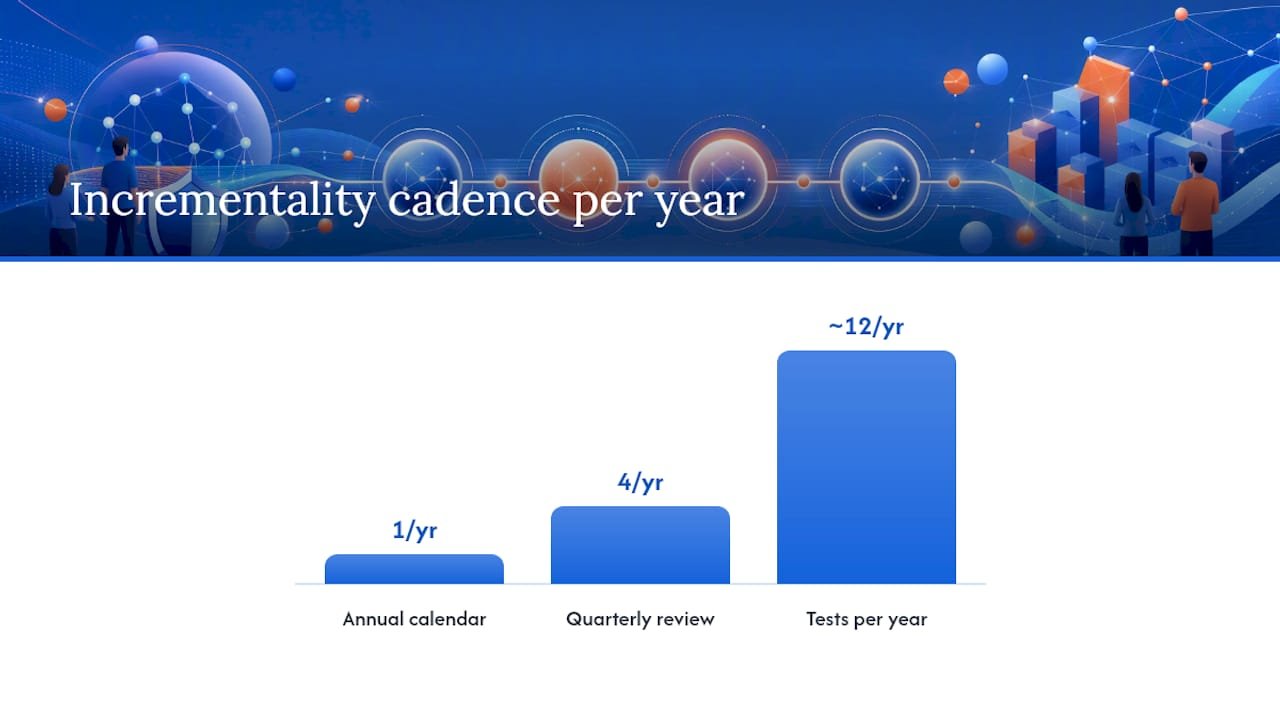
Building that cadence starts with governance, not tooling. A central log of every test, its hypothesis, its result, and the decision it produced, keeps institutional knowledge from walking out the door with whoever ran the original study. That log becomes your organization’s single source of truth for “what have we already learned,” which matters enormously once you’re running a dozen tests a year across different channels and teams.
- Draft an annual testing calendar that prioritizes your highest-spend, highest-ambiguity channels first, and revisit it quarterly as budget and channel mix shift.
- Standardize a hypothesis template so every test, regardless of who runs it, produces comparable, comparable-quality documentation.
- Integrate first-party transaction data into your CRM so exposure and conversion status live in one place; Brainiac Consulting’s work implementing Marketo Measure for Hitachi Vantara is a working example of what that integration looks like when it’s built correctly, linking marketing exposure directly to pipeline outcomes rather than living as a disconnected spreadsheet.
- Use AI agents to automate the tedious parts, audience matching, suppression list maintenance, and result compilation, so your analysts spend their time interpreting results instead of assembling them by hand.
- Build a post-test playbook: every experiment closes with a written summary covering hypothesis, method, result, decision, and what you’d do differently next time.
- Review your governance log quarterly with finance and channel owners together, so the testing program stays tied to actual budget conversations rather than becoming an analytics side project.
Brainiac Consulting’s broader case study library shows the pattern across different implementations: the organizations that get real value from incrementality are the ones that treat it as infrastructure, not as a research initiative that happens once a year.
A quick-start template you can use this week
You don’t need a full measurement team to run your first legitimate test. You need a documented hypothesis, a clean data source, and a decision rule.
- Hypothesis template: “[Channel/campaign] drives incremental [conversion type] among [audience segment], measured over [time window], with a decision threshold of [iROAS or lift %].”
- Minimum data checklist: confirm you have first-party conversion data linked to exposure status, a defined control group with no exposure leakage, and at least two weeks of pre-period baseline data for comparability checks.
- Pre-run contamination audit: verify suppression lists are active, check for audience overlap with concurrent campaigns, and confirm the control group hasn’t been retargeted by another channel.
- Post-test report fields: incremental conversions, lift %, iROAS, confidence interval, business-impact threshold met (yes/no), and the specific budget decision the result triggers.
- Decision rule, written before launch: scale if iROAS exceeds your target, hold if it’s within range but inconclusive, and reallocate if it falls below your floor.
Keep this template in the same governance log every future test feeds into. The value compounds once you have a dozen results to compare instead of one.
Where incrementality measurement is heading
Always-on incrementality is quickly becoming a baseline expectation for CMOs, not a nice-to-have measurement upgrade. The organizations pulling ahead aren’t the ones running the most sophisticated single test; they’re the ones who’ve built the governance and data plumbing to run tests continuously, cheaply, and consistently enough that results actually change behaviour month over month.
The tighter integration I expect to see over the next few cycles is between incrementality experiments and automated bidding itself, holdout results feeding directly into bid strategy rather than sitting in a quarterly deck. That’s a meaningful improvement over today’s disconnected workflow, but it raises the stakes on getting the experiment design right, because a biased test will now poison the bidding algorithm’s inputs, not just mislead a budget meeting.
My caution for teams moving fast here: platform-native lift tools are a reasonable starting signal, but they are not a substitute for first-party validation. Any platform grading its own performance has a structural reason to look good. Trust the number that ties back to your own transaction data.
— Don
How Brainiac Consulting helps you operationalise incrementality
Running one clean test is manageable with a spreadsheet and discipline. Running a dozen a year, with governance, first-party data integration, and results that actually reach the bidding algorithm, is an operations problem, and that’s the layer Brainiac Consulting builds for marketing teams.

The Atlas AI Operations Platform connects your CRM, ad platforms, and analytics stack so exposure and conversion data live in one governed source instead of scattered exports, which is the single biggest blocker teams hit when they try to scale incrementality past a first pilot. Custom AI agents can handle the repetitive mechanics, audience matching, suppression list checks, report compilation, freeing your analysts to focus on interpreting results and making the budget call. And because Brainiac’s team has implemented measurement integrations like Marketo Measure for enterprise clients, we know what the data plumbing needs to look like before a test ever launches, not after the results come back inconclusive.
If you’re ready to move from occasional testing to a governed, repeatable program, book a discovery call and we’ll walk through what your first quarter of always-on incrementality could look like.
Sources
- Why incrementality is the only metric that proves marketing’s real impact
- Use incrementality testing for effective marketing measurement
- A new gold standard for digital ad measurement
- Practical vs statistical significance
- A/B testing: What it is and how to run A/B tests (2026)