
AI lead enrichment automatically transforms partial lead records into sales-ready profiles by combining entity resolution, confidence scoring and real-time API augmentation. The immediate payoff is straightforward: more complete, verified leads reach your sales team faster, with less manual lookup. This guide walks through how the pipeline works, where it fits in your CRM, how to roll it out, and the compliance guardrails you need before switching on automated outreach.
TL;DR:
- AI lead enrichment improves data quality by maintaining up-to-date, accurate contact and firmographic information, reducing duplicates and invalid addresses.
- Enrichment typically moves leads through stages like identity resolution, augmentation, validation, and scoring, using confidence scores and provenance metadata for trust.
- Real-time versus batch enrichment options depend on urgency and volume, with high-intent contacts benefiting from instant updates and larger databases suited for scheduled refreshes.
- Ensuring compliance involves documented consent, suppression list management, and storing provenance data, especially for outbound outreach under laws like CAN-SPAM.
- A staged rollout, including a pilot with clear KPIs and proper integration, is essential to prevent data pollution and build trust before full deployment.
Table of Contents
- What AI lead enrichment is and typical B2B use cases
- Benefits and measurable outcomes for sales and marketing
- How the enrichment pipeline and core AI technologies work
- Common integrations and CRM workflow patterns
- Implementation checklist: pilot to production
- How to evaluate tools and providers
- Privacy and compliance: CAN-SPAM and lead-generator guidance
- Publisher case studies and when to choose a managed build
- Challenges and limitations of AI lead enrichment
- Best practices for maintaining and updating enriched lead data
- Comparison of AI lead enrichment tools and platforms
- Future trends and advancements in AI lead enrichment technology
- Prioritize governance and pilots over shiny features
- Brainiac Consulting: services that deliver AI lead enrichment
- FAQ
- Sources
What AI lead enrichment is and typical B2B use cases
AI lead enrichment takes a thin record, say a name and a work e-mail from a form fill, and builds it into a usable profile by pulling in firmographic data, validated contact details, technographic signals and behavioural intent markers. Traditional rule-based enrichment matches fields against static lookup tables and often breaks when a company changes its name, merges, or lists a slightly different domain. AI-based enrichment instead uses entity resolution models that can recognize “Acme Corp” and “Acme Corporation Inc.” as the same account even when the underlying records disagree, and it can weigh conflicting signals from multiple sources instead of just taking the first match.
The inputs typically come from a mix of sources:
- Web forms and gated content downloads that capture a name, e-mail and sometimes a job title.
- Event and webinar registrations that add context about intent and timing.
- First-party behavioural signals such as pricing-page visits or product usage data.
- Third-party firmographic and technographic databases that fill in company size, industry and tech stack.
The outputs are what your sales team actually uses: validated and deliverable e-mail addresses, confirmed job titles and seniority, firmographic details like employee count and revenue band, and intent tags that flag which accounts are actively researching a purchase.
In practice, B2B teams apply this in a few recurring ways. Outbound prospecting teams use enrichment to prioritize which accounts to call first, based on firmographic fit and intent signals rather than a flat list. Lead scoring models become more reliable once the underlying data is accurate, because a scoring model built on stale or incomplete fields will misrank leads no matter how clever the algorithm is. Routing rules benefit too: enriched records let you send enterprise accounts to one team and small business leads to another without a human checking each one. Personalization at scale, from dynamic landing pages to tailored outreach sequences, depends on having accurate company and role data in the first place.
Benefits and measurable outcomes for sales and marketing
The business case for AI lead enrichment comes down to four areas where teams typically see change.
- Data quality improves first: duplicate records drop, contact details get validated before they hit your CRM, and e-mail deliverability rises because bounced or invalid addresses are filtered out earlier.
- Velocity increases next, since reps spend less time manually researching a prospect’s company and title before the first call, which shortens time-to-first-contact.
- Revenue impact follows from the first two: better-qualified leads tend to convert at a higher rate, and shorter research cycles mean deals move through the pipeline faster.
- Operational gains accumulate on the back end, with fewer manual lookups, less data entry, and a CRM that stays cleaner over time instead of accumulating orphaned or duplicate records.
Third-party review platforms such as G2 show that data accuracy, coverage and customer support consistently rank among the top purchase drivers for enrichment and prospecting tools, which suggests that teams evaluating this category should weight accuracy as heavily as feature breadth when comparing options.
None of these gains happen automatically. A pipeline that enriches data but never scores or validates it just moves the mess from one system to another, which is why the architecture matters as much as the intent behind it.
How the enrichment pipeline and core AI technologies work
Most AI lead enrichment systems move a record through six stages: ingest, identity resolution, augmentation, validation, scoring and sync.
- Ingest pulls in the raw record, whether that’s a form submission, a CSV import, or a webhook from a marketing automation tool.
- Identity resolution matches that record against existing data to determine whether it’s a new lead, an update to an existing contact, or a duplicate under a different name.
- Augmentation calls external APIs and internal data sources to fill in missing fields: company size, industry, technology stack, verified e-mail, and intent signals where available.
- Validation checks the augmented data for plausibility and freshness, flagging fields that conflict or come from low-confidence sources.
- Scoring applies a model that weighs firmographic fit, behavioural signals and intent data to produce a priority or quality score.
- Sync writes the finished record back to the CRM or data warehouse, ideally with metadata intact.
The technologies behind these stages vary by vendor but generally include natural language processing for parsing unstructured profile data like a LinkedIn bio or a press release, machine learning models trained to infer purchase intent from behavioural patterns, entity resolution algorithms for matching records across disparate sources, and API aggregation layers that query multiple data providers and reconcile the results.
One detail that separates reliable systems from noisy ones is confidence and provenance metadata. Every enriched field should carry a confidence score and a source tag, so a sales rep or an automated routing rule can tell the difference between a job title confirmed by three sources last week and one inferred from a single stale record two years old. Without this, enrichment quietly degrades CRM trust over time, because nobody can tell which fields to believe.
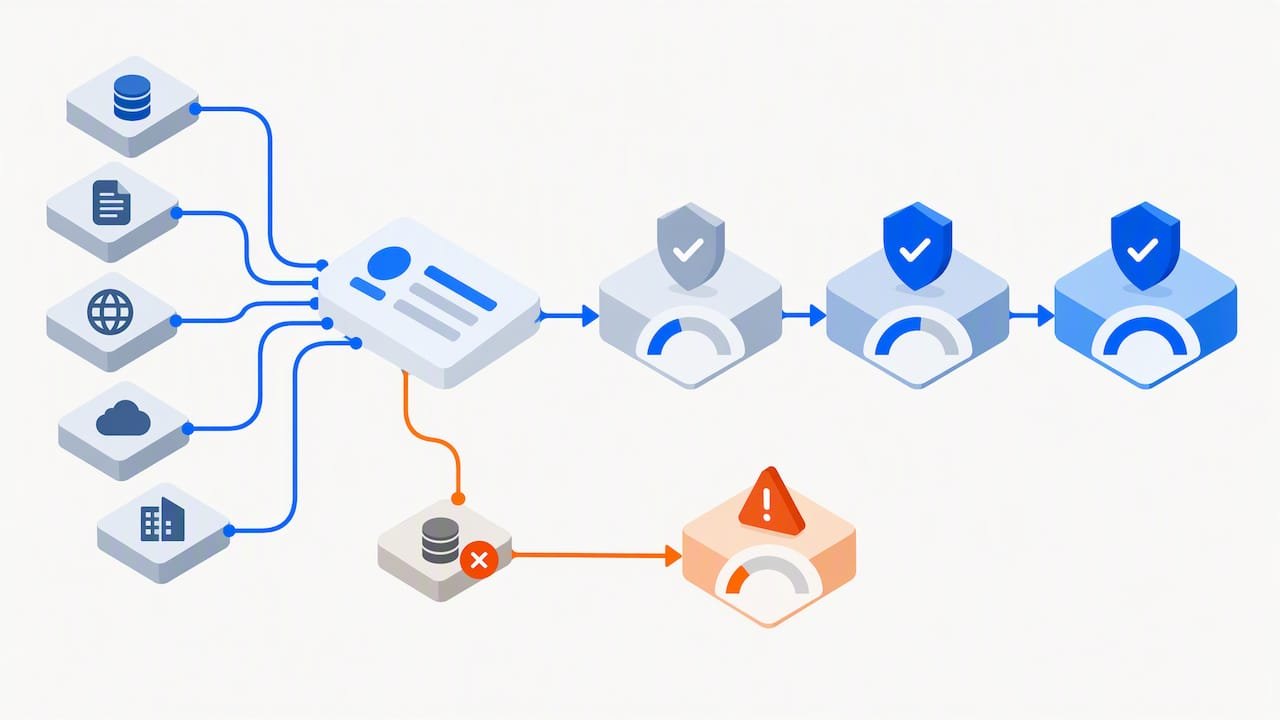
Architecturally, teams generally choose between real-time and batch enrichment. Real-time enrichment fires the moment a lead fills out a form, which matters for high-intent moments like a demo request where speed to contact affects conversion. Batch enrichment runs on a schedule, often nightly or weekly, and suits lower-urgency use cases like refreshing firmographic data across an entire database. Many mature implementations run both: real-time for new inbound leads, batch for periodic re-enrichment of the existing base.
Pro Tip: Treat confidence scores as a first-class field in your schema, not metadata you discard after the first sync, so you can gate automated actions on data you actually trust.
Common integrations and CRM workflow patterns
Enrichment rarely lives as a standalone tool. It sits between your lead sources and your CRM, which means the integration pattern you choose affects both reliability and cost.
Four connector patterns show up most often:
- Direct CRM API integration, where the enrichment tool writes straight into Salesforce or HubSpot fields, works well for smaller volumes but can hit rate limits at scale.
- Middleware platforms sit between the enrichment service and the CRM, handling transformation, retries and logging, which adds resilience for higher-volume teams.
- Event-driven webhooks trigger enrichment the moment a new lead is created, which suits real-time use cases like instant lead routing.
- Change data capture (CDC) patterns watch for updates in the source system and only enrich what’s changed, which keeps costs down for large existing databases.
Whichever pattern you choose, field mapping and merge rules need to be explicit before you turn anything on. A common and costly mistake is letting enrichment overwrite a field your sales team has already manually corrected. The safer pattern adds provenance fields alongside each enriched attribute, so a merge rule can check the confidence score and source before deciding whether to overwrite, update or simply flag the conflict for review. Suppression lists matter here too, since you don’t want enrichment re-adding a contact who has already opted out.
Rate limits and cost add a practical constraint that’s easy to underestimate. Most third-party data APIs charge per lookup or per match, so enriching your entire historical database in one pass can get expensive fast. Throttling and sampling strategies, enriching only active or recently engaged leads first, then expanding to the rest of the database on a slower schedule, keep costs predictable while still prioritizing the records that matter most right now.
Monitoring and audit trails round out a safe integration. Every write to the CRM from an automated enrichment process should be logged with a timestamp, source and confidence score, both for troubleshooting and for the compliance reviews covered later in this guide. Our overview of Salesforce CRM best practices covers governance patterns that apply directly here.
Implementation checklist: pilot to production
Rolling out AI lead enrichment safely means resisting the urge to flip it on across your entire database at once. A staged approach protects data quality and builds the internal trust you’ll need for full adoption.
- Run a data audit of your existing CRM to understand current duplicate rates, missing fields and data decay before you enrich anything.
- Select KPIs upfront, such as deliverability rate, time-to-first-contact or lead-to-opportunity conversion, so you can measure whether enrichment actually moves the numbers you care about.
- Get stakeholder sign-off from sales, marketing and whoever owns CRM governance, since enrichment touches data everyone relies on.
- Design a pilot with a defined sample size, a control group that doesn’t receive enrichment, and clear acceptance criteria for what counts as success.
- Operationalize carefully: build error handling for failed API calls, store provenance data alongside every enriched field, and set up suppression list management before any automated sync goes live.
- Monitor on an ongoing basis, re-evaluating accuracy periodically and building a feedback loop where sales reports back on lead quality so the model and the source mix can be adjusted.
A readiness check at this stage pays off. Our guide on whether your CRM is ready for AI agents walks through the technical prerequisites that often get missed before a pilot even starts, and our lead nurturing guidance is useful once enriched leads start flowing into nurture tracks.
Pro Tip: Keep your pilot’s control group untouched for at least one full sales cycle before comparing results, otherwise you’ll be measuring noise instead of impact.
How to evaluate tools and providers
Comparing enrichment options gets easier with a consistent rubric rather than a feature checklist. Seven axes cover most of what matters:
- Coverage: how many of your target accounts and contacts does the provider actually have data for?
- Freshness: how recently was each data point verified or updated?
- Accuracy and confidence: does the provider expose confidence scores, or do you get a single unqualified value?
- Provenance: can you trace each field back to its source, and does the tool support audit trails?
- Integration effort: does it offer direct connectors to your CRM, or will you need middleware?
- Pricing structure: is it per-lookup, per-seat, or a flat platform fee, and does that scale with your volume?
- SLA and support: what happens when a data feed breaks or match rates drop unexpectedly?
A simple weighting exercise helps when comparing shortlisted options: score each axis from one to five, weight accuracy and provenance most heavily if your team is enriching records that feed automated outreach, and weight integration effort more heavily if you have limited engineering support. Industry roundups, including Zapier’s 2026 overview of data enrichment tools, note that most providers trade off cost, coverage and freshness differently, so there’s rarely a single option that wins on every axis.
A few questions separate a serious vendor conversation from a sales pitch: ask how they calculate confidence scores, ask what happens to suppressed contacts across their data refresh cycles, and ask for a sample match rate against your own account list before committing. A provider that can’t answer the confidence question clearly is a red flag regardless of how polished the demo looks.
Privacy and compliance: CAN-SPAM and lead-generator guidance
Enrichment speeds up outreach, but it doesn’t change your legal obligations once that outreach goes out. The CAN-SPAM Act compliance guide from the Federal Trade Commission applies to commercial e-mail, including B2B messages, and requires truthful sender information, a clear opt-out mechanism, and prompt honouring of opt-out requests. CAN-SPAM violations carry statutory penalties assessed per violation, and the FTC’s compliance guide notes that liability can extend to multiple parties involved in sending a message, which matters if enrichment and outreach run through separate vendors.
Lead generation specifically carries its own guidance. FTC staff advisory opinion on internet lead generators recommends clear prior disclosure to consumers about who may contact them and how many parties might reach out, and notes that a business receiving a lead generally does not have an established business relationship with that contact unless disclosures were adequate at the point of collection. That has direct implications under the Telemarketing Sales Rule for any team layering phone outreach onto enriched leads.
A practical pre-launch checklist:
- Confirm every enriched contact has a documented consent or legitimate interest basis before automated outbound begins.
- Maintain suppression lists that sync across every tool touching the lead, not just your primary CRM.
- Store provenance data so you can show where a contact’s information came from if asked.
- Route anything touching phone outreach past legal review given the Do Not Call and TSR implications above.
A partner resource on reference call recording consent for B2B teams walks through practical consent tracking and suppression workflows that complement these controls.
Publisher case studies and when to choose a managed build
Engagements by some providers show what this looks like applied. One case study documents an improved lead-to-opportunity conversion after layering enrichment and intent signals into an existing pipeline, and another details deploying Marketo and Salesforce together to boost SQL conversion rates. The architecture behind such engagements often integrates directly with Salesforce or HubSpot, using custom agents for augmentation and scoring instead of a single off-the-shelf connector.
Whether a managed, custom build makes sense versus a self-serve tool depends on a few factors: data sensitivity (regulated industries often need tighter audit trails than a SaaS connector provides out of the box), scale (very high lead volumes strain per-lookup pricing models), and complexity (multiple CRMs or data warehouses usually call for custom middleware rather than a point solution). Our AI-powered CRM consulting work focuses on exactly this kind of integration.
Challenges and limitations of AI lead enrichment
Enrichment is not a solved problem, and teams run into the same handful of limitations regardless of which tools they choose. Data accuracy remains the biggest one: no provider has complete, perfectly current coverage, and company data decays constantly as people change jobs and firms merge or rebrand. Models trained on historical intent data can also carry bias, favouring account types or industries that were overrepresented in the training data, which can skew scoring toward familiar-looking leads instead of genuinely promising ones.
Conflicting data between sources is another recurring issue. When three providers disagree on a company’s employee count, a system without a clear reconciliation rule will either pick one arbitrarily or average numbers that shouldn’t be averaged. Over-enrichment is a subtler risk: adding more fields than your team actually uses creates noise without adding decision value, and it increases the compliance surface you have to manage.
None of this means enrichment isn’t worth doing. It means the confidence and provenance metadata discussed earlier isn’t optional polish, it’s the mechanism that lets a human or a downstream rule catch these limitations before they cause a bad call or a wasted outreach sequence.
Best practices for maintaining and updating enriched lead data
Enrichment degrades the moment you stop maintaining it, since contact details and firmographics change constantly. A few habits keep data usable over time. Set a re-enrichment cadence based on how fast your segment moves: fast-moving tech accounts might need quarterly refreshes, while more stable industries can run on a longer cycle. Sample and audit a portion of enriched records regularly rather than trusting match rates blindly, since a data source can degrade silently without any error message.
Keep merge rules strict: never let an automated process overwrite a field your sales team has manually verified unless the new data carries a higher confidence score and comes from a more current source. Retire stale intent signals on a schedule, since a prospect who showed buying intent eight months ago and went quiet shouldn’t still be scored as hot. Finally, close the loop with sales regularly: reps often notice data quality problems before any dashboard does, and that feedback should feed back into which sources and models you trust going forward.
Comparison of AI lead enrichment tools and platforms
Enrichment platforms generally fall into a few categories rather than a single spectrum. Pure data providers focus on supplying firmographic and contact data through an API, leaving scoring and workflow to whatever system you plug them into. All-in-one prospecting platforms bundle enrichment with outreach sequencing and CRM syncing, which simplifies setup but can limit flexibility if you want to swap data sources later. Enterprise data platforms emphasize governance, audit trails and custom integration over simplicity, aimed at teams with compliance requirements that a lightweight tool can’t meet.
Each category trades off differently on the evaluation axes covered earlier. Pure data providers tend to offer the strongest coverage and freshness but require more integration work. Bundled platforms reduce integration effort substantially but can lock you into their scoring logic. Enterprise platforms generally cost more and take longer to deploy but give you the provenance and audit trail depth that regulated industries need. The right category depends less on which has the most features and more on where your team sits on the build-versus-buy spectrum and how much compliance oversight your data requires.
Future trends and advancements in AI lead enrichment technology
A few directions are shaping where this category heads next. Real-time enrichment is becoming the default rather than the exception, as API latency drops and more providers support webhook-triggered augmentation at the moment a lead is captured rather than on a batch schedule. Intent data is getting more granular too, moving beyond simple topic-level signals toward more specific behavioural patterns that can distinguish a prospect doing early research from one actively comparing vendors.
Agentic approaches are also emerging, where instead of a static pipeline, an AI agent actively decides which data sources to query based on what’s already known about a lead, reducing wasted API calls on fields that are already high-confidence. Expect governance to get more attention as this matures, since regulators and enterprise buyers alike are pushing for clearer audit trails and explainability around how an enriched score was actually calculated, not just what the final number says.
Prioritize governance and pilots over shiny features
The biggest mistake we see is teams chasing the enrichment tool with the longest feature list instead of the one with the clearest provenance model. A tool that enriches fast but can’t tell you where a field came from will eventually pollute your CRM, and by the time anyone notices, untangling it costs more than the enrichment ever saved.
Skipping a small-scale pilot is the second common failure. Run a controlled pilot first, track provenance from day one, and expand only once you trust what the data is telling you.
— Don
Brainiac Consulting: services that deliver AI lead enrichment
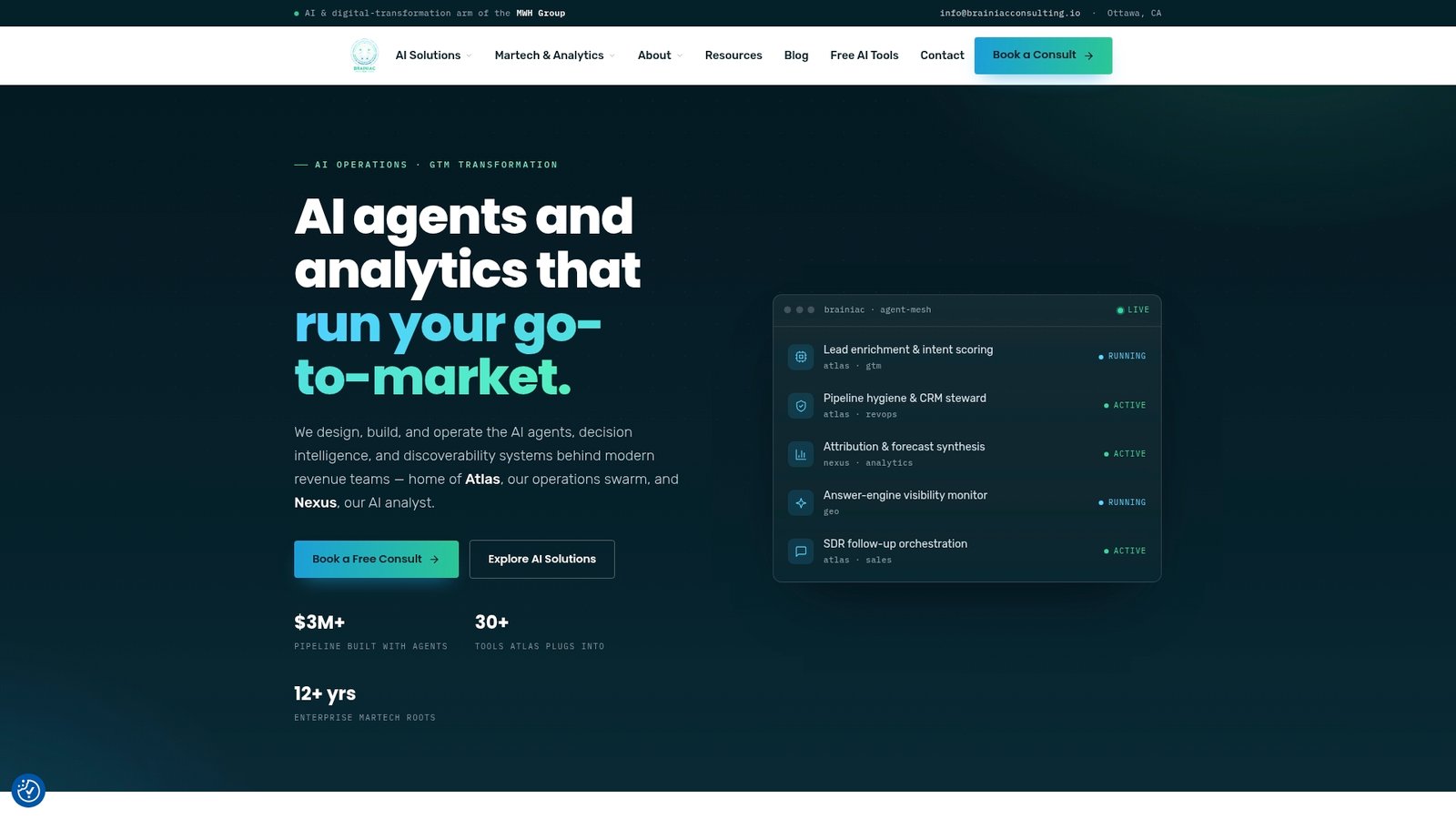
If your team has outgrown what a single enrichment tool can handle, whether that’s because of integration complexity, data sensitivity, or the need for custom scoring logic, our custom agent deployment work builds enrichment pipelines that run inside your own environment with full visibility into every decision the system makes. We also support agentic AI enablement for teams that want enrichment tied directly into broader go-to-market automation rather than running as an isolated tool.
Initial assessments generally start by auditing current CRM data and lead sources, followed by scoping a pilot with defined KPIs before production sync. From there, integration patterns, connectors for Salesforce or HubSpot, middleware, or webhook-driven syncing are designed around client volume and compliance needs rather than using one-size-fits-all templates. Visit Brainiac Consulting to see our full range of GTM services, or review our case studies to see how this has played out for other teams before reaching out to scope your own pilot.
FAQ
What is AI lead enrichment?
AI lead enrichment is the process of using machine learning and entity resolution to automatically fill in missing details on a lead record, such as company size, verified contact information and intent signals. It turns a partial record, like a name and e-mail from a form, into a fuller profile a sales team can act on without manual research.
How does AI lead enrichment differ from automated lead enrichment?
Automated lead enrichment broadly refers to any system that fills in lead data without manual lookup, including simple rule-based matching. AI lead enrichment specifically uses machine learning and entity resolution models to handle messier matches, such as recognizing a company under slightly different naming conventions across sources.
Is CAN-SPAM relevant to B2B lead enrichment and outreach?
Yes. The CAN-SPAM Act applies to commercial e-mail generally, including B2B messages sent to enriched leads, and requires accurate sender information along with a working opt-out mechanism that gets honoured promptly.
What should I look for when comparing lead enrichment providers?
Focus on data coverage, freshness, and whether the provider exposes confidence scores and source provenance for each field, not just the headline feature list. Pricing structure and integration effort with your existing CRM matter just as much as raw data accuracy.
Does Brainiac Consulting build custom lead enrichment pipelines?
Yes, we design and deploy custom AI agents for lead enrichment that integrate directly with platforms like Salesforce and HubSpot, built around a client’s own data and compliance requirements rather than a generic template.