

A pipeline inspection framework is a repeatable set of checks, scorecards and cadences that make CRM and revenue-data trusted for forecasting and handoffs. Built on recognized data quality dimensions such as accuracy and completeness, it gives revenue teams a structured way to catch the errors that distort forecasts before those errors reach a board deck.
TL;DR:
- Focusing on current-quarter pipeline reduces the inspection scope to high-risk deals, making checks more impactful and easier to manage weekly.
- Critical fields like amount, close date, owner, next step, and source must be verified and completed to ensure forecast accuracy and smooth handoffs.
- Duplicate detection and sync error monitoring are essential to prevent forecast distortion caused by record redundancy and integration failures.
- Systematic inspections should follow a recurring cadence: weekly for sales managers, monthly for RevOps, and quarterly for governance updates.
- Tracking KPIs such as duplicate rate, missing fields, stale close dates, and sync errors over time helps maintain pipeline hygiene and inform prioritized fixes.
Table of Contents
- What pipeline inspection covers and who owns it
- Mapping data quality dimensions to concrete CRM checks
- A checklist and scorecard you can use this week
- Running the inspection: weekly, monthly and quarterly cadence
- KPIs and tools that turn inspection into a repeatable signal
- Governance, ownership and keeping the playbook alive
- How Brainiac Consulting operationalizes pipeline inspection
- Why inspection has to become a habit, not a project
- Put the framework to work with Brainiac Consulting
- FAQ
- Sources
What pipeline inspection covers and who owns it
A pipeline inspection framework applies to CRM and revenue-data pipelines: the opportunities, accounts, contacts and activity records that feed forecasting, attribution and handoffs. It has nothing to do with physical infrastructure or industrial monitoring; the “pipeline” here is the flow of deals and data through your revenue stack.
Ownership is shared by design. Sales managers inspect their own forecast categories before weekly calls. RevOps owns the systemic view: duplicate trends, integration errors and field-level hygiene across the whole database. Marketing operations is responsible for source and attribution fields on active opportunities, since those fields originate upstream. Data owners, often RevOps or a data governance lead, maintain the dictionary that defines what each field means and who can change it.
This structure matters because CRM data hygiene underpins forecasting, routing, attribution and handoffs, and each of those outcomes has a different owner. When inspection is distributed this way, forecast governance stops depending on one person’s memory of which deals are real, and sales-to-customer-success handoffs stop breaking on missing fields.
Mapping data quality dimensions to concrete CRM checks
Pipeline inspection borrows its structure from established data quality dimensions, most clearly described in standards such as ISO/IEC 25012. We focus on five of them because they map directly to revenue outcomes: accuracy, completeness, consistency, timeliness and uniqueness.
Each dimension translates into checks you can run today:
- Accuracy: verify enriched firmographic fields against a trusted source and flag opportunities where amount or close date contradicts recent activity notes.
- Completeness: enforce required fields by stage, so a deal cannot reach late stage without a next step, an economic buyer, or a close date.
- Consistency: compare picklist values across objects, since a lead source recorded one way on the lead and another way on the opportunity breaks attribution.
- Timeliness: flag close dates that have not moved in over a month against open activity.
- Uniqueness: run duplicate detection rules on accounts and contacts, prioritizing records with open pipeline attached.
The relationship between checks and dimensions is rarely one to one. A single diagnostic check can signal multiple dimensions at once: a stale close date, for example, points to both a timeliness problem and, often, an accuracy problem if the deal is effectively dead but still forecast. Rather than chasing every dimension with equal effort, prioritize the checks that most directly change a forecast number or a handoff outcome.
A checklist and scorecard you can use this week
Start narrow. The highest-value checks target current-quarter pipeline and high-risk records rather than the entire historical database.
- Pull every open opportunity closing this quarter and confirm amount, close date, owner and next step are populated.
- Run duplicate detection on accounts tied to open pipeline and merge or flag matches.
- Check source attribution on every active opportunity above your average deal size.
- Confirm closed-won records have the handoff fields customer success needs (contract terms, key contacts, implementation notes).
- Review integration sync logs for the past seven days and resolve any failed records tied to active deals.
A compact scorecard keeps this visible across teams:
- Forecast: percentage of commit-stage deals with a close date unchanged in 30+ days, owned by sales managers.
- Pipeline: percentage of opportunities missing a next step, owned by sales managers.
- Source: percentage of active opportunities with blank or inconsistent lead source, owned by marketing ops.
- Duplicate: duplicate account rate among records with open pipeline, owned by RevOps.
- Handoff: percentage of closed-won deals missing required handoff fields, owned by RevOps and customer success jointly.
- Integration: sync error rate across connected systems, owned by RevOps.
Prioritize by revenue risk: a duplicate on a six-figure active deal is high risk, a blank source field on a closed-lost deal from last year is low risk. Fix what threatens this quarter’s number first.
Running the inspection: weekly, monthly and quarterly cadence
Inspection only works as a habit, not a project. A recurring operating rhythm, tied to active revenue risk, prevents the fatigue that kills most one-time cleanup efforts.
- Weekly, sales managers: review commit and best-case opportunities before forecast calls, flag stale close dates and missing next steps, and push corrections back to reps the same day.
- Monthly, RevOps: review duplicate rate trends, integration sync error rates and completeness by stage across the full pipeline, not just the current quarter.
- Quarterly, governance: clean unused picklist values, retire fields nobody has populated in two quarters, and reassign ownership where a role has changed.
Each step needs a clear service level: managers correct flagged records promptly after a forecast call, RevOps reports systemic trends within a few business days of month end, and governance changes go through a lightweight approval before any field is retired or renamed.
KPIs and tools that turn inspection into a repeatable signal
A short list of KPIs, tracked over time, does more than dozens of one-off audits. Useful metrics include duplicate rate by object, percentage of records missing critical fields by stage, count of stale close dates, and integration sync error rate.
- Duplicate rate by object: tracked separately for leads, accounts and contacts, since each has different merge risk.
- Missing critical fields by stage: completeness measured against the fields each stage actually requires, not a blanket list.
- Stale close dates: opportunities where the close date has not moved despite ongoing activity.
- Integration sync error rate: the percentage of records failing to sync between your CRM and connected systems.
Data profiling run before, during and after a cleanup gives you a baseline to measure against, revealing fill patterns and distribution anomalies that a single snapshot misses. Tooling falls into four categories worth knowing by capability: profiling tools that surface fill rates and anomalies, deduplication tools that match and merge records, enrichment tools that validate and append firmographic data, and integration monitors that flag sync failures before they pile up. Our own view on CRM workflow observability covers how logs, alerts and owner-based recovery fit into this picture.
Pro Tip: Track your KPI set for one full quarter before adding alerts, so you know what a normal range looks like before you flag deviations from it.
Governance, ownership and keeping the playbook alive
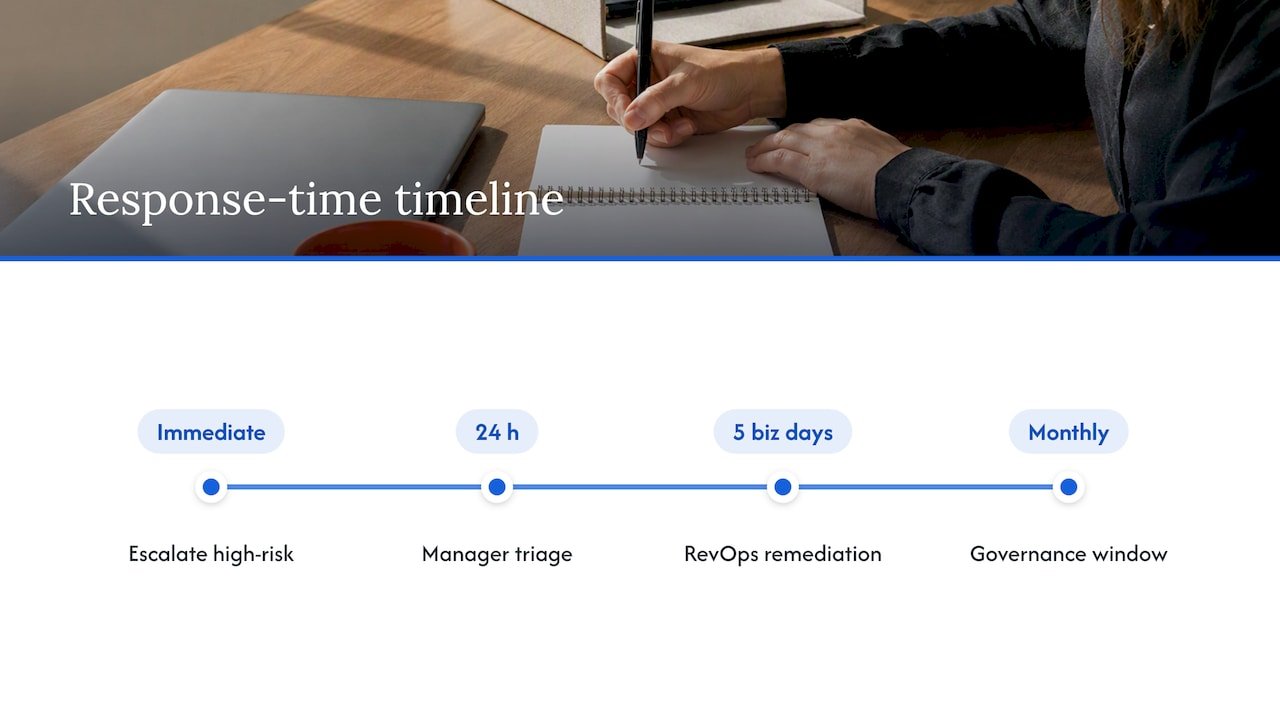
Every scorecard area needs a named owner and a service level for triage and remediation. A reasonable starting point: 24 hours for manager-flagged forecast issues, five business days for RevOps systemic fixes, and a monthly window for governance changes. High-revenue-risk issues, such as a duplicate or missing handoff field on a deal above your average contract value, should escalate directly to a RevOps lead rather than waiting for the next scheduled review.
A living data dictionary, documenting what each field means, who owns it and when it was last reviewed, keeps this from decaying. Pair it with a lightweight change-control process: any new or retired field gets a one-line justification and a sign-off before it goes live, which prevents the picklist sprawl that makes future inspections harder.
How Brainiac Consulting operationalizes pipeline inspection
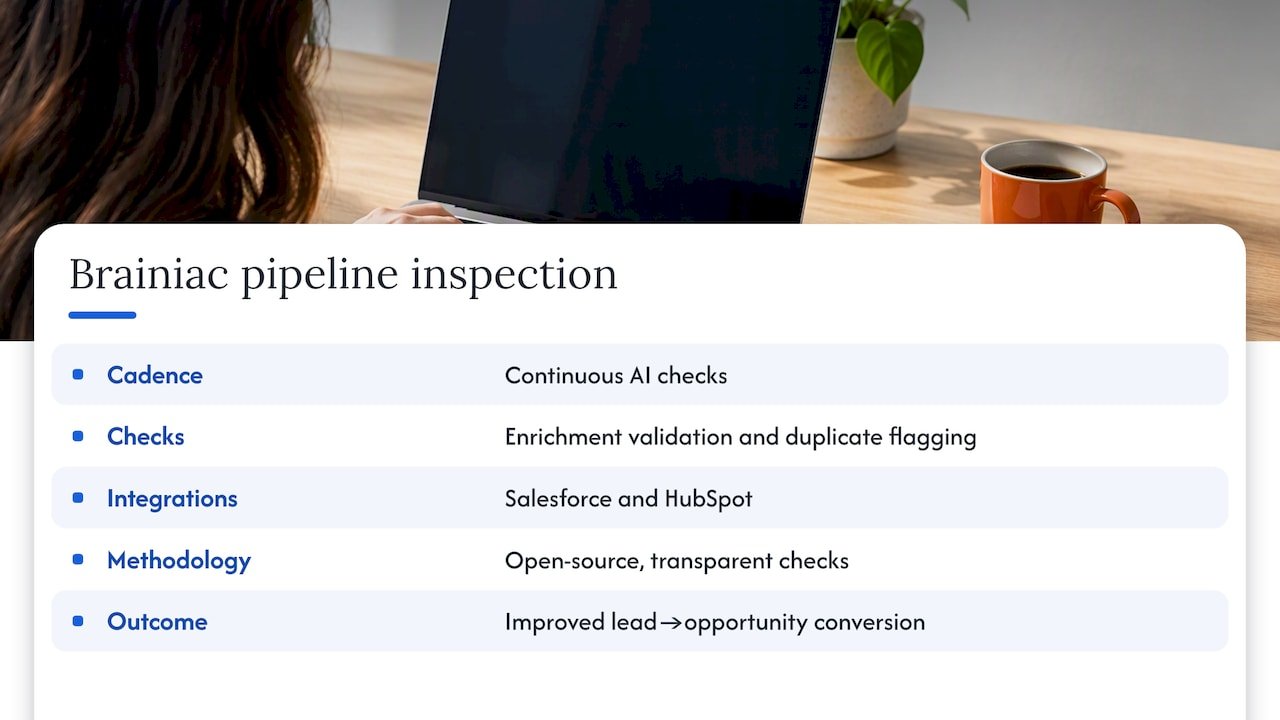
We built our approach around the same problem this framework addresses: CRM data that looks clean until a forecast call proves otherwise. Our AI agents handle enrichment validation and duplicate flagging continuously rather than on a quarterly cycle, and our AI-powered CRM consulting work integrates directly with Salesforce and HubSpot using an open-source methodology, so clients see exactly how each check runs rather than trusting a black box.
One result of this approach shows up in our lead-to-opportunity conversion case study, where tightening source and routing fields improved downstream conversion. If your team is weighing whether to build this inspection capability internally or bring in a managed partner, an assessment of your current pipeline hygiene is a reasonable starting point.
Why inspection has to become a habit, not a project
The teams that get this right treat inspection like brushing teeth, not like a root canal. A weekly manager check on current-quarter pipeline, paired with a monthly RevOps scorecard review, catches problems while they are still cheap to fix. Waiting for a quarterly audit means discovering your forecast was wrong after the quarter is already closed. Start with the deals closing this month. Everything else can wait a week.
— Don
Put the framework to work with Brainiac Consulting
Building this inspection capability takes less effort when AI agents handle the recurring checks, enrichment validation and duplicate detection instead of a person doing it manually every week. We design and operate these agents inside your existing CRM, with full visibility into how each check runs, and we pair that with managed marketing operations support for teams that want the whole cadence run for them.
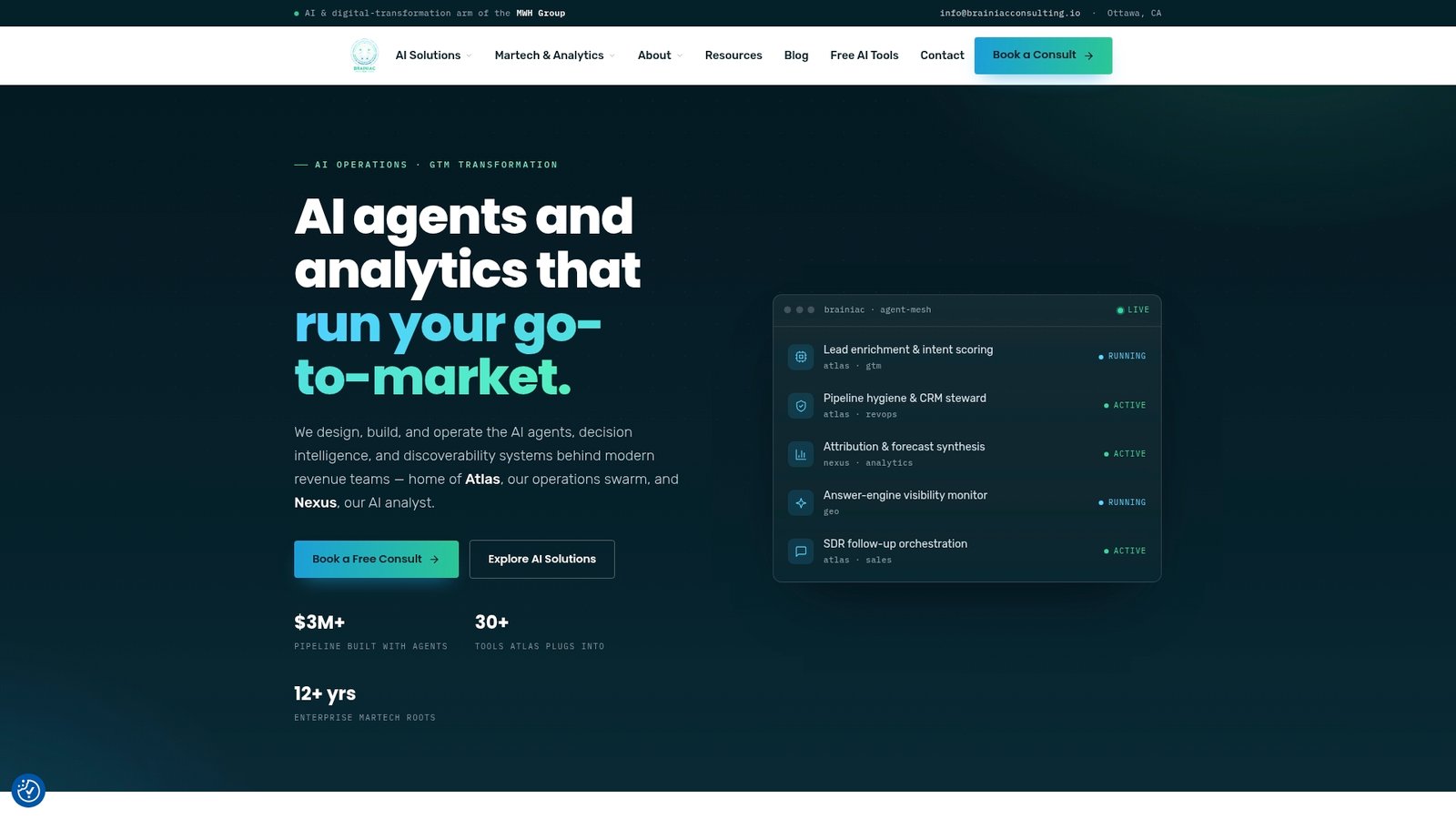
If you want a clear picture of where your pipeline hygiene stands today, start with an AI readiness assessment and see what a scorecard built for your own CRM would actually surface.
FAQ
What is a pipeline inspection framework in RevOps?
A pipeline inspection framework is a repeatable set of checks, scorecards and cadences that validate CRM and revenue-data quality, covering fields like amount, close date, source and handoff data. It draws on data quality dimensions such as accuracy, completeness and timeliness to catch forecast-distorting errors before they compound.
How often should we inspect our CRM pipeline?
Weekly checks by sales managers on current-quarter pipeline catch the most urgent issues before forecast calls. Monthly RevOps reviews and quarterly governance cycles handle systemic hygiene and field cleanup.
What fields matter most for pipeline inspection?
The highest-priority fields are amount, close date, owner, source, stage and next step, since these feed forecasting directly. Closed-won records also need complete handoff fields so customer success teams receive accurate contract and contact information.
What tools support pipeline inspection?
Data profiling tools establish a baseline of fill rates and anomalies, while deduplication and enrichment tools fix accuracy and uniqueness issues directly. Platform features like Salesforce Pipeline Inspection add historical trending and annotated changes that help managers spot close-date or amount pushes.
Can Brainiac Consulting help implement a pipeline inspection framework?
We design AI agents and managed workflows that run enrichment validation, duplicate detection and integration monitoring continuously inside your existing CRM. Our AI-powered CRM consulting work covers both the assessment and the ongoing operation of this kind of framework.
Sources
- CRM data hygiene: the RevOps foundation for trusted revenue reporting
- Unfolding data quality dimensions in practice: a survey
- Pipeline Inspection | Salesforce Help