A CRM is not “AI ready” in the abstract. It may be ready for one agent to perform one defined workflow, while being entirely unprepared for another.
That is why a broad data-cleanup initiative is often the wrong starting point. The useful question is narrower: Can a named agent safely read and act on the exact records, fields, lifecycle states, and systems required for this workflow?
Readiness should be tested against that operating contract, including permissions, approvals, failures, retries, and rollback.
Name the workflow before assessing the CRM
“Support sales” or “improve pipeline” is not a workflow. Define a bounded unit of work with a start, an end, and an owner.
Document:
- The event that starts the work
- The authoritative object and record
- Required inputs
- Permitted decisions
- Expected output or state change
- Conditions that mean the work is complete
- Human owner and escalation path
This prevents a general platform assessment from avoiding the actual access decision. A CRM can contain imperfect data and still support a narrow read-only workflow. Conversely, a clean database may be unsafe for an agent if identity, lifecycle, or write controls are undefined.
Establish record and field authority
For each piece of information the agent needs, identify the authoritative source. A CRM may contain several records for the same company, person, deal, or activity. The agent needs rules for choosing among them.
Ask:
- Which object is authoritative for this decision?
- Which record wins when duplicates conflict?
- Which fields are required?
- Who owns each required field?
- How are stale values identified?
- Which related systems can overwrite the value?
Do not launch a complete cleanse by default. Focus first on duplicate, stale, or conflicting records that can materially change this workflow’s outcome.
The goal is minimum sufficient integrity, not an abstract promise that every record is perfect.
Define lifecycle states in operational language
Agents need more than field access. They need an enforceable interpretation of state.
Specify which lifecycle status means work may begin, which transitions are permitted, and what marks completion. Clarify whether the agent may reopen, skip, or reverse a state. Identify validation rules and required fields associated with every transition.
If teams use the same status to mean different things, the agent cannot resolve the operating disagreement through automation. Fix or document the rule before granting authority.
Success criteria must also be independent of the agent. Do not let it change a status field and then use that same field as the sole proof that the work succeeded. Validate the actual end state or downstream outcome.
Separate data tools from action tools
OpenAI distinguishes data tools, which retrieve context, from action tools, which change a system. That distinction is useful when designing CRM access.
Begin by listing each tool the workflow requires:
| Tool purpose | Typical access question |
|---|---|
| Read record | Which objects, fields, and rows are visible? |
| Search or match | How are duplicates and identity resolved? |
| Create record | Which required fields and defaults apply? |
| Update record | Which fields and lifecycle transitions are permitted? |
| Trigger downstream work | Which automations and integrations will fire? |
OpenAI recommends standardized, tested tool definitions and strict access controls. Avoid a generic CRM tool that grants broad operations when the workflow needs only a few specific reads and writes.
Choose the execution identity deliberately
Determine which identity runs the agent and how its permissions are governed.
Microsoft states that Dynamics 365 Copilot follows existing data permissions and bases responses on information the user can access. This illustrates why current permission design matters: AI does not make a weak access model safer.
A separate Microsoft integration pattern for connecting a sales agent to Salesforce uses a connected app, an integration user, and a permission set for server-to-server access. Microsoft describes that pattern as least privilege and notes that the connection must be recreated if configured custom-field scope expands.
That is one implementation pattern, not the only valid design. The transferable questions are:
- Is the agent acting as an end user or a service identity?
- Can its access be limited to required objects, records, and fields?
- Is access reviewed when workflow scope changes?
- Can credentials and permissions be suspended quickly?
- Is each action attributable to the agent and run?
Trace what happens on every write
A CRM write rarely ends at the database field. It may activate validation rules, workflow automation, assignment logic, notifications, integrations, scoring, attribution, or synchronization.
Map these effects before enabling writes:
- Proposed field or record change
- Validation and permission checks
- CRM automation triggered
- External integrations notified
- Result returned to the agent
- Final state verified
Test the complete chain. A successful API response does not prove that every downstream effect completed correctly.
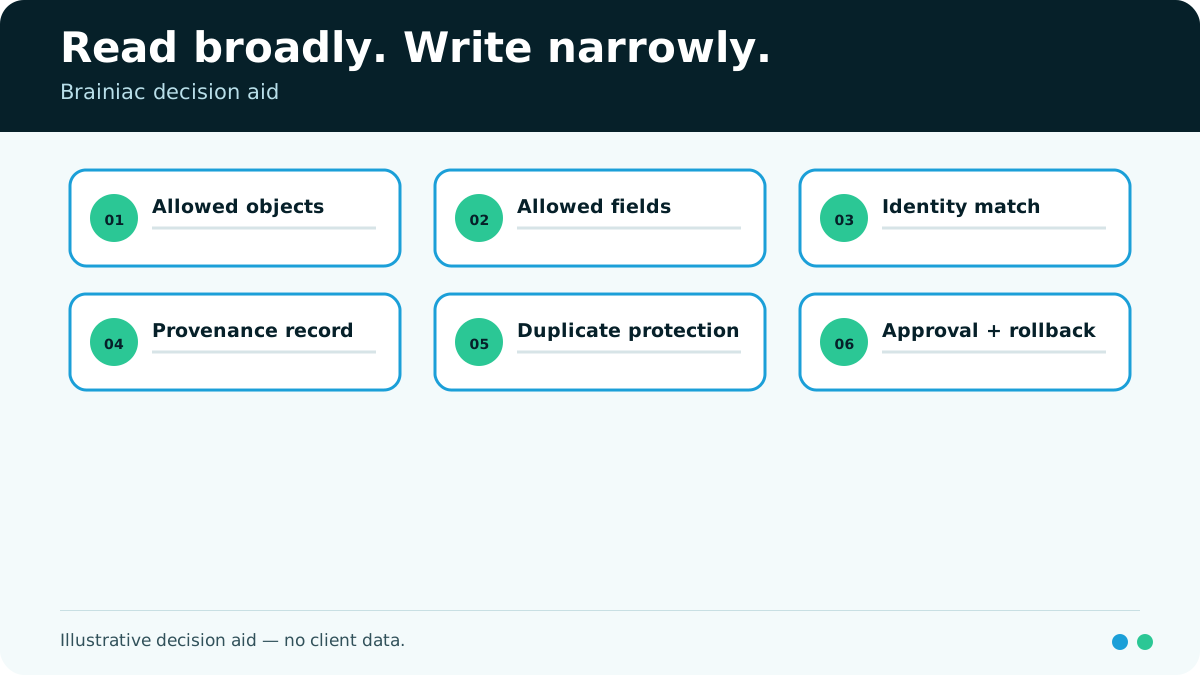
For each write, define prior-value capture, a trace ID, timeout behavior, retry rules, duplicate protection, and rollback or repair. Determine whether the action is reversible and who owns recovery when it is not.
Place approvals around risk, not around every click
Identify actions that require human approval based on sensitivity, reversibility, permission scope, and business impact. The reviewer should see the exact proposed action and its relevant consequences before execution.
NIST calls for human oversight, roles, testing, monitoring, and incident practices to be defined and documented. Apply that guidance concretely:
- Name the approver role
- Define what triggers review
- Bind approval to immutable action parameters
- Expire stale approvals
- Record the decision
- Define escalation and recovery ownership
Not every write requires approval. The appropriate control depends on the workflow and consequence.
Make a narrow readiness decision
Summarize readiness as a capability decision, not a broad maturity score. The workflow is ready only if its required records, lifecycle rules, identity, permissions, tools, writes, approvals, monitoring, and recovery are sufficiently defined and tested.
List unresolved gaps by the capability they block. A missing rollback plan might block one write while leaving a read-only recommendation mode available. This supports staged access without pretending the whole CRM is ready.
Brainiac’s RevOps/MarTech work can map one CRM workflow and close the minimum system, data, attribution, and operating gaps it exposes. Only then should an Agentic Workforce implementation receive the corresponding write access.
Sources
Primary sources used for the factual claims in this article: