
Choose Tealium if governance, consent and real-time activation across a large enterprise stack are your priorities. Choose Twilio Segment if engineering-led teams need fast, standardized event collection and the widest catalog of connectors. Both are customer data platforms, but they start from different places, charge in different ways and suit different buyers. This guide sets out where they differ, what each costs, and how to decide before you commit budget.
TL;DR
- Tealium grew out of tag management and leans toward consent, governance and enterprise orchestration. Segment began as a developer-first event pipeline.
- Segment’s published pricing starts free and moves to $120 per month on the Team plan. Tealium is quote-based, with mid-market deals commonly reported at $60,000 to $150,000 a year.
- Segment is usually the quicker start for engineering-led teams. Tealium rollouts tend to be projects that run over several months.
- Neither tool is a measurement or attribution layer on its own. The value shows up in the models, agents and reports you build on top of the data.
- Pick on team skills, compliance load and traffic profile, not on feature checklists.
Table of Contents
- What Tealium and Segment each are
- Side-by-side comparison
- Data collection, identity and activation
- Governance, consent and compliance
- AI capabilities
- Attribution, lead qualification and ecommerce revenue
- What each one really costs
- Team skills and implementation effort
- Which one to choose
- Perspective
- How Brainiac helps
- FAQ
- Sources
What Tealium and Segment each are
Tealium is an independent platform founded in 2008. Its Customer Data Hub combines tag management, server-side event routing and customer data unification, and it lists more than 1,300 pre-built connectors. The same source names Microsoft, Hyatt and Gap among its enterprise customers. Tealium is headquartered in San Diego, with offices across the US, Europe and Asia-Pacific.
Twilio Segment was founded in 2011 as a Y Combinator startup and was acquired by Twilio in November 2020 for $3.2 billion. Its product family covers Connections (collecting and routing data to 700+ destinations), Unify (identity resolution and real-time profiles) and Twilio Engage (audience building and journey orchestration). Protocols handles schema governance, and a Privacy Portal handles consent.
The practical difference is the origin story. Tealium’s roots in tag management mean it thinks first about what is collected, under which consent, and where it flows. Segment’s roots in an API-first pipeline mean it thinks first about getting clean, standardized events from every source to every tool. According to Alium Research’s buyer comparison, the decision usually comes down to real-time collection on one side and integration breadth and ease on the other.
Side-by-side comparison
| Criterion | Tealium | Twilio Segment |
|---|---|---|
| Origin | Tag management, enterprise orchestration | Developer-first event pipeline |
| Typical buyer | Governance-heavy enterprise teams | Product and engineering-led growth teams |
| Connectors | 1,300+ pre-built | 700+ destinations |
| Identity | Real-time stitching via AudienceStream | Deterministic resolution via Unify |
| Consent | Built in, enforced across tags and connectors | Privacy Portal, plus Protocols for schema control |
| Pricing model | Quote-based, consumption and module driven | Monthly Tracked Users (MTUs) |
| Entry point | Custom quote | Free plan, then $120 per month |
| Rollout | Multi-month project | Faster for engineering teams |
The identity row comes from a vendor comparison page, so treat it as a framing and not a benchmark. Test identity match rates on your own data during any evaluation.
Data collection, identity and activation
Collection
Both platforms collect from web, mobile and server sources. Segment’s SDKs and APIs funnel everything through a single, standardized event spec, which is why growth-stage teams connect their stacks quickly. Tealium collects client-side and server-side and carries its tag-management heritage, which buyers praise for real-time handling. Buyer reviews also flag a steep learning curve and heavier implementation for Tealium.
Identity and audiences
Tealium builds visitor profiles in real time through AudienceStream. Segment’s Unify resolves identities deterministically, meaning it merges profiles on known identifiers such as email or user ID. Segment’s Engage layer then builds audiences and journeys. Reviewers praise Segment for efficient audience building, and they note that reporting needs skilled users.
Activation
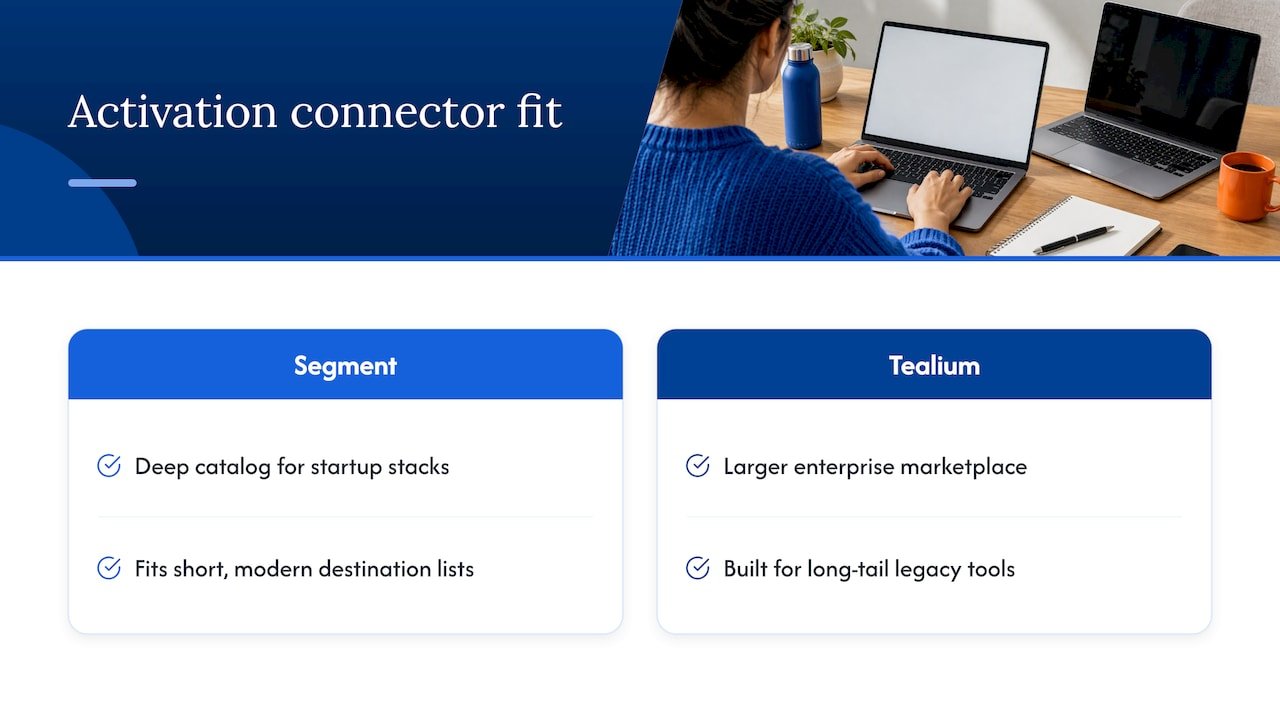
Activation is where connector breadth matters. Segment’s catalog is deep for startups and product-led stacks. Tealium’s marketplace is larger by count and is built for enterprise martech estates that include older platforms. If your destination list is short and modern, either works. If you run a long tail of legacy tools, count the connectors you actually need before you let any total decide for you.
Governance, consent and compliance
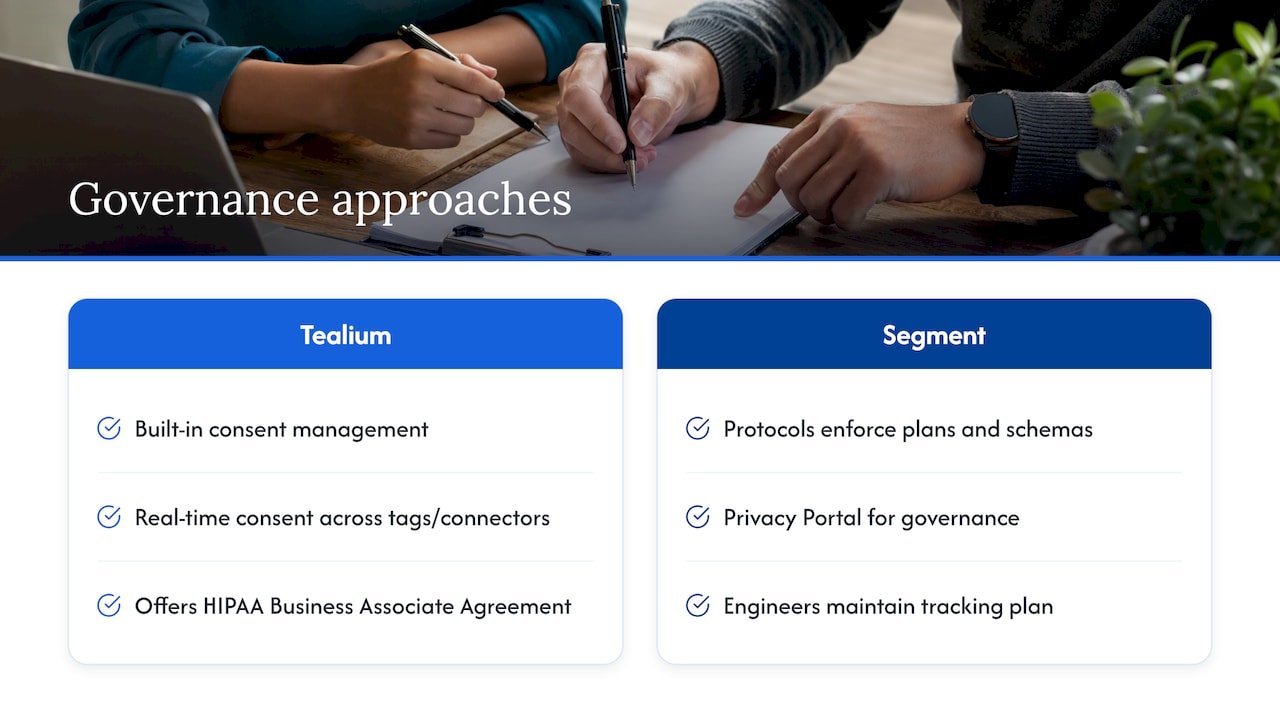
This is the clearest dividing line. Tealium offers built-in consent management that enforces privacy preferences across all data collection and activation, with consent state passed across tags and connectors in real time. The same source says Tealium offers a HIPAA Business Associate Agreement, which makes it a common pick in healthcare and life sciences.
Segment approaches governance through Protocols, which enforces tracking plans and schemas, and through its Privacy Portal. That keeps data clean, but the weight of the work falls on the engineers who maintain the plan.
If your team handles US state privacy rules, you also need your own data map regardless of vendor. Our CCPA checklist for marketers walks through nine steps for mapping martech data before any platform decision.
AI capabilities
Both vendors have moved toward AI. Tealium has introduced a suite it calls Tealium for AI, a Behavioral Insights Agent that classifies event data, and an MCP server integration that lets external AI agents reach real-time customer data through its Moments API. Segment offers predictive scoring and automated segmentation through its Predictions capability.
The useful question is not which vendor has more AI features. It is whether your data is clean, consented and well-identified enough for an agent to act on it safely. An agent that routes leads or adjusts spend on bad identity data will do the wrong thing faster. That is true of either platform. Our guide to customer intent prediction explains what the data has to look like before a model can score intent reliably.
Attribution, lead qualification and ecommerce revenue
Segment does not measure anything by itself. It collects and transmits events, and analysis happens in the tools that receive them. The same applies to Tealium: the platform unifies and activates data, while attribution logic lives in your warehouse, BI tool or attribution system.
What the data layer does well is make good measurement possible. Bonobos used Segment’s Facebook point-of-sale integration to tie in-store visits to ad campaigns and reported a 3X increase in offline purchases and 2X offline return on ad spend against a control group. The result came from connecting offline and online events, with a control group to prove it.
For teams that want that kind of clarity, the model matters as much as the pipe. We cover the practical options in open source marketing attribution and, for ecommerce stores, in experiment-first attribution models. For B2B, account-based attribution credits revenue to accounts and not to individual clicks.
What each one really costs
Pricing models differ more than headline numbers.
Segment publishes tiers. The Free plan covers up to 1,000 MTUs per month with two sources, and Team starts at $120 per month for 10,000 MTUs. Business is custom-priced and is the only tier with Unify, Protocols, Engage and Predictions, with Engage quoted separately. MTUs include anonymous visitors, so a high-traffic consumer site can see cost climb quickly. G2 reviewers, as summarized by that source, consistently name MTU pricing as their top concern. Total cost is driven by MTU volume, destination breadth, warehouse sync needs and engineering time on tracking plans.
Tealium does not publish tiers. Vendr reports typical annual costs of $60,000 to $150,000 for a mid-market company with 1 to 5 million monthly unique visitors using EventStream and AudienceStream on a 12-month contract. For larger enterprises with 10+ million visitors and multiple modules, it reports $200,000 to $500,000 or more.
A few ways to keep the comparison honest:
- Model cost at your real traffic, including anonymous visitors, not at your customer count.
- Add implementation labour. Both need data engineering time, and Tealium rollouts are typically projects, not sprints.
- Price the modules you need on day one and the ones you expect in year two.
- Ask each vendor how pricing behaves when traffic doubles.
Team skills and implementation effort
Segment fits a team with engineers who own tracking plans and are comfortable in code. Tealium fits an organization where marketing operations, privacy and IT share ownership of a larger, more governed estate, and where a multi-month rollout is planned for.
Either way, the constraint is often people. If you lack the in-house capacity to maintain tracking plans, mappings and pipelines, you can hire senior data engineers to extend the team while you run the platform evaluation. Settle who owns the data model before you sign, because the platform will not do that for you.
Which one to choose
Tealium is the stronger match when:
- You operate in a regulated industry and consent enforcement is non-negotiable.
- Your martech estate is large and mixes legacy and modern tools.
- You have a budget and timeline for a project-style rollout.
Segment is the stronger match when:
- Engineering leads the data stack and wants one standard event spec.
- You are mid-market or growth stage and want to start small on a free or Team plan.
- Your destination list is dominated by common, modern tools.
Consider neither as the first move when your real problem is reporting you cannot trust, attribution nobody agrees on, or a warehouse that already holds most of your data. In that case, a warehouse-first approach may deliver the CDP outcome with less duplication. We describe one in our warehouse-first enterprise CDP build.
Perspective
We see the Tealium vs Segment question asked at the wrong moment. Teams ask it before they have decided what decisions the data should drive.
Think of a CDP as the plumbing of a house. Good plumbing matters, but nobody chooses a house for its pipes. They choose it for what happens in the rooms: lead routing, intent scoring, attribution you can defend in a budget meeting, and agents that act on clean data.
That is why we build open, visible systems. Our approach is open-source and integrates with platforms such as Salesforce, HubSpot, Marketo, Power BI and Tableau, so you can see how every number and every agent decision is produced. Whichever platform you choose, we help you design the layer above it so it earns its cost.
Start with the outcome, then the data it needs, then the platform. In that order the comparison gets much easier.
Don
How Brainiac helps
We design and operate AI agents and analytics systems for marketing, sales and finance teams, and we work with whichever data layer you have or choose. If you are still deciding, our AI Readiness Assessment, roadmap and governance work clarifies where AI and data investment will pay back first. If you already have the data flowing, our custom agent deployment puts production-grade agents to work inside your environment.
Talk to us through the Brainiac Consulting site about the outcome you need from your customer data, and we will help you map the shortest path to it.
FAQ
Is Tealium or Segment better for enterprise?
Tealium is generally positioned for compliance-heavy enterprises, with built-in consent enforcement and a HIPAA BAA. Segment is positioned toward mid-market and growth-stage teams led by engineering. Large organizations do use Segment, so the deciding factors are governance load and team skills.
Is Segment cheaper than Tealium?
At the entry level, yes. Segment has a free plan and a $120 per month Team plan, while Tealium is quote-based. At scale the gap narrows, because Segment’s MTU pricing can rise with anonymous traffic and Business tiers are custom-priced. Model both against your own traffic.
Do I need a CDP to do marketing attribution?
Not necessarily. A CDP collects and unifies data, but attribution models run downstream in your warehouse or analytics tools. Many teams get reliable attribution from clean event data plus a well-designed model, with or without a packaged CDP.
How long does implementation take?
Tealium implementation is typically a multi-month project. Segment is described as more developer-friendly and can start faster, though full use of identity and audiences on the Business tier takes engineering effort. Your timeline depends mostly on how many sources and destinations you connect.
Sources
- What Is Tealium? CDP Features, Pricing & Alternatives
- What Is Twilio Segment? Features, Pricing & Alternatives
- Tealium vs. Segment: What Buyers Say, Alium Research
- Tealium Software Pricing & Plans 2026, Vendr
- Twilio Segment vs Tealium (2026): Scores, Reviews & Verdict
- Bonobos Customer Story, Twilio
- Tealium company profile, RepVue