
A customer 360 implementation gives us one canonical customer profile, built from every system that touches a buyer, so sales, service, and marketing act on the same facts at the moment of a decision. The fastest route to proving the concept is a narrow pilot: pick one activation, assign a single data owner, and measure the result before expanding scope.
TL;DR:
- Keep CRM, CDP, and MDM roles distinct: CRM manages relationships, CDP resolves and activates identities, while MDM governs attribute ownership when records conflict.
- Start identity matching with exact identifiers, test rules on historical samples, and send uncertain or shared account matches to human review before broad activation.
- Choose a warehouse based CDP for engineering control, a packaged platform for activation with limited data engineering capacity, or Salesforce Data 360 for CRM activation.
- Use Operational MDM to set source precedence for each attribute, while keeping it separate from the activation layer that displays profiles to teams.
- A focused pilot can reach a measurable result in three to six months; adding sources and near real time syncs belongs to a later phase.
Table of Contents
- What is customer 360, really?
- Why implement customer 360: the business case
- Core components of a customer 360 architecture
- Identity resolution: stitching identifiers into a golden record
- Architecture choices: warehouse-native, packaged, or Salesforce Data 360
- Practical implementation roadmap and checklist
- Governance, operational MDM, and production readiness
- How we approach customer 360 projects at Brainiac Consulting
- What stalls a customer 360 project
- Turning a unified profile into working revenue operations
- FAQ
- Sources
What is customer 360, really?
Customer 360 describes a unified profile that merges identifiers, transactions, behavioural events, and computed traits (lifetime value, churn risk, next-best-action) into one record per person. It is not a product you buy off a shelf. It is an outcome that a CRM, a customer data platform (CDP), and a master data management (MDM) layer produce together, each doing a distinct job.
A CRM stores the relationship: contacts, opportunities, cases. A CDP ingests and resolves identity across many sources, then makes the merged profile available for activation. MDM governs which value wins when two systems disagree, and who is accountable for that decision. Teams that treat these as interchangeable usually end up rebuilding the same logic three times.
A working profile typically includes:
- Identifiers: email, phone, device ID, loyalty number, payment token.
- Transactions: orders, renewals, support tickets, billing events.
- Behaviours: site visits, product usage, campaign engagement.
- Consent metadata: marketing permissions, data-processing basis, region-specific flags.
Why implement customer 360: the business case
The case for customer 360 rests on three practical gains: better personalization, fewer handoff errors, and faster response at the point of contact. Gartner’s research on service leaders’ priorities ties trusted, unified customer data directly to the operational improvements service organizations need to support AI-enabled experiences and automation, which is exactly what a 360 profile is built to supply.
Unified customer data tends to show up directly in revenue. Personalization built on a single customer view is widely associated with meaningful lift in conversion and retention, because offers and messages finally reflect what a buyer actually did, not a stale snapshot from one channel.
The operational gains are just as real, even when they are less visible on a dashboard:
- Sales gets lead routing that reflects recent product usage, not just a static lead score.
- Service agents see the full history (purchases, prior tickets, consent status) at the moment a case opens.
- Marketing can trigger next-best-action journeys instead of batch-and-blast campaigns that ignore recent behaviour.
Each of these depends on the same underlying asset: a profile that updates close to real time and that every team trusts enough to act on without double-checking it in another system.
Core components of a customer 360 architecture
Before any vendor conversation, we need agreement on the building blocks. A customer 360 architecture is made of five layers, and skipping one usually shows up later as a trust problem rather than a technical one.
- Ingestion layer: streaming and batch pipelines that pull data from CRM, commerce, support, and product systems.
- Canonical profile store and profile API: the single place where resolved profiles live, with an API that activation tools can query without duplicating data.
- Identity stitching and identity graph: the matching logic that links identifiers to one canonical ID.
- Activation connectors and orchestration: the pipes that push resolved profiles into email, ads, CRM fields, and agent-facing tools.
- Observability, lineage, security, and consent layers: the audit trail that shows where a value came from and who is allowed to see it.
Pro Tip: Build the profile API before the first activation use case. Teams that activate straight from raw tables end up rebuilding the same join logic in five different tools.
The ingestion layer deserves particular care because it sets the ceiling on everything downstream. If support tickets arrive once a day in a batch file while web events stream in real time, the resulting profile will always be stale for someone, and stakeholders will quietly stop trusting it. Deciding which sources need near-real-time delivery, and which can stay batch, is a business conversation disguised as a technical one.
Identity resolution: stitching identifiers into a golden record
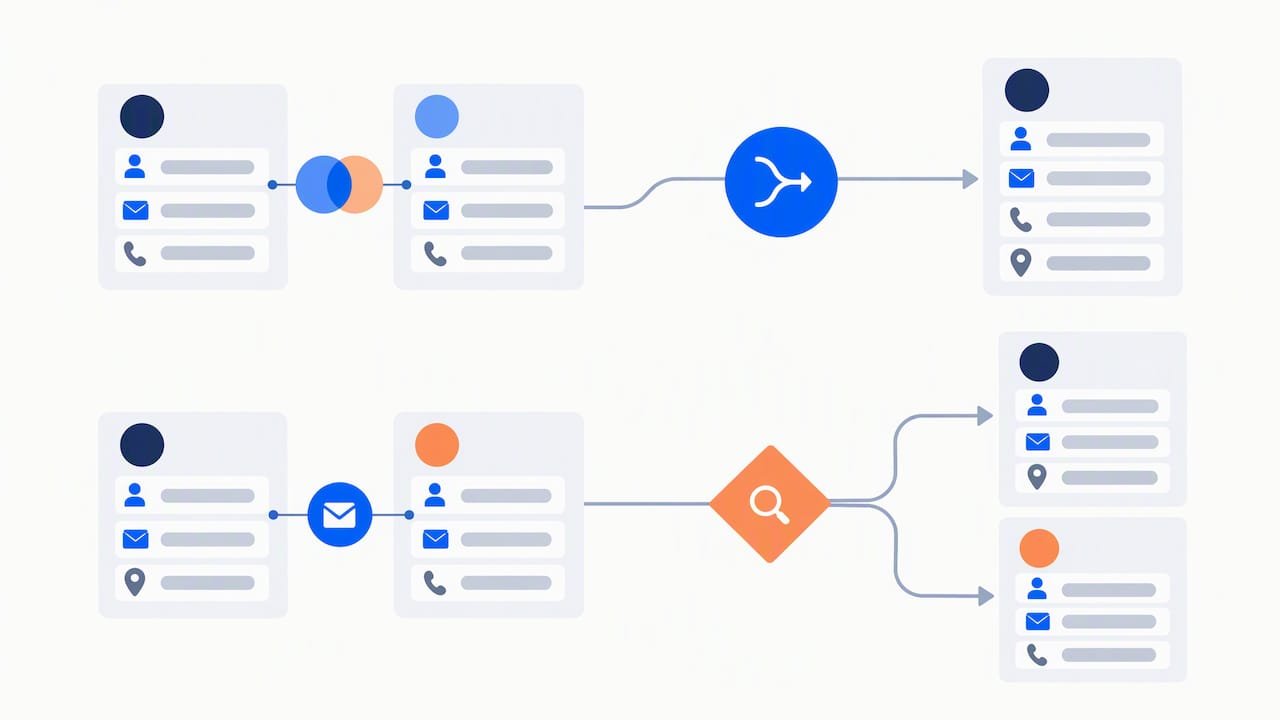
Identity resolution is the part of a customer 360 implementation that determines whether “jsmith@email.com,” a mobile device ID, and a loyalty card number all belong to the same person. The Identity Resolution Playbook lays out the mechanics: multiple identifiers get stitched to one canonical ID, usually through an identity graph that tracks every link and the evidence behind it.
Two matching strategies do most of the work:
- Deterministic matching links records on an exact, high-confidence identifier, such as a verified e-mail or an account number.
- Probabilistic matching scores partial similarity (name plus postal code plus device fingerprint) and merges records above a set threshold.
- Hybrid approaches use deterministic rules for low-risk merges and probabilistic scoring for the harder cases, with a human review step above a certain confidence band.
Designing match rules is iterative. We recommend starting with conservative thresholds, running a backfill against a sample of historical records, and manually reviewing a batch of merges before trusting the rules on the full dataset.
Pro Tip: Keep every match decision explainable. If a steward cannot see why two records merged, they cannot catch the rule that is quietly over-matching unrelated customers.
Manual stewardship is not a failure of the system. It is the mechanism that catches edge cases (a shared family e-mail, a corporate account used by several buyers) that no rule set handles perfectly on its own.
Architecture choices: warehouse-native, packaged, or Salesforce Data 360
Three architecture patterns dominate most customer 360 projects, and the right choice depends on existing skills, latency needs, and how much control over the data we want to retain.
- Warehouse-native CDP: identity resolution and profile storage run inside the existing data warehouse or data cloud, giving full observability into every match and transformation. This suits teams with a mature data engineering practice who want to avoid moving customer data into a second system of record.
- Packaged CDP: a vendor-managed platform that ships with pre-built connectors and matching logic, trading some control for faster time to first activation. This suits teams without in-house data engineering capacity who need a working pilot in weeks rather than months.
- Salesforce Data 360: a pattern built around the CRM itself. According to Salesforce’s own implementation documentation, teams commonly import CRM and transactional data, map it to standard data model objects, create identity-resolution rulesets, and then surface the unified record as a related list directly on CRM pages, without duplicating that data into CRM objects.
Data 360 solves activation inside Salesforce well, but it answers “how do we show a unified view in the CRM,” not “who owns this attribute when two systems disagree.” That second question is a governance problem, and guidance on pairing Data 360 with Operational MDM treats Operational MDM as the trust layer that governs golden records and survivorship rules, while Data 360 handles the activation-ready view on top of it.
Before committing to a pattern, we work through a short checklist:
- How much latency can the business tolerate between an event happening and it appearing in the profile?
- Who owns the canonical record today, and does that team have the capacity to own it going forward?
- Which activation channels matter most in the first six months?
- What data engineering and CRM administration skills already exist in-house?
Practical implementation roadmap and checklist
A customer 360 implementation moves faster when it is broken into phases with clear owners and exit criteria, rather than treated as one long build. The sequencing below reflects what tends to work across pilot-to-scale projects.
Phase 0: Alignment and pilot selection (weeks 1 to 2)
- Agree on one measurable business outcome the pilot must move (lower cart-abandonment follow-up time, faster case routing, a single personalized email journey).
- Assign a named data owner for each source system involved in the pilot.
- Define the success metric and baseline before any data moves.
Phase 1: Data discovery and pilot ingestion (weeks 3 to 6)
- Catalogue the source systems feeding the pilot, and confirm which fields map to which profile attributes.
- Pull a representative sample, not the full dataset, to validate schema and quality before scaling ingestion.
- Document known data quality issues (duplicate accounts, missing consent flags) so the identity rules account for them from the start.
Phase 2: Identity rules, backfill, and stewardship (weeks 5 to 9, overlapping phase 1)
- Draft deterministic match rules first, then layer in probabilistic rules for the remaining unmatched records.
- Run a backfill against historical data and manually review a sample of merges before trusting the output.
- Set up a stewardship workflow so a flagged match routes to a human reviewer rather than auto-merging silently.
Phase 3: First activation, measurement, iteration (weeks 8 to 12)
- Connect the resolved profile to exactly one activation channel (a CRM field, an e-mail trigger, a routing rule).
- Compare the pilot metric against the phase 0 baseline on a fixed schedule, not ad hoc.
- Treat the first result as a hypothesis test: widen scope only after the metric moves in the expected direction.
Phase 4: Scale and automation (months 4 and beyond)
- Move from batch to near-real-time syncs for the sources where latency matters most to the business case.
- Add model-driven activations (churn scores, next-best-action) once the base profile has proven stable.
- Formalize the stewardship runbook so exception handling does not depend on one person’s institutional memory.
Most teams running a focused pilot can reach a working first activation within a few months, with the heaviest effort sitting in phases 1 and 2. Our guide on building a warehouse-first CDP and our walkthrough of real-time data sync patterns both go deeper into the technical sequencing for teams ready to move past the pilot stage.
Governance, operational MDM, and production readiness
A profile that activation tools trust needs more than a working match algorithm behind it. Operational MDM is the governance layer that decides which source wins when two systems disagree, and the Salesforce guidance on pairing Operational MDM with Data 360 frames this pairing as the difference between an activation layer that merely displays data and one that the wider business can rely on for reporting and automation.
A practical governance setup includes:
- A survivorship matrix that states, attribute by attribute, which source wins (billing system wins on legal name, CRM wins on preferred contact method, the loyalty platform wins on points balance).
- A stewardship runbook describing exactly what a reviewer does when a match is flagged: who gets notified, what evidence they check, and how long they have to respond.
- A cutover plan that runs the new profile in parallel with the legacy system for a fixed window, with a reconciliation report comparing the two before anyone turns the old system off.
- Monitoring and SLA targets for match accuracy and profile freshness, reviewed on a regular cadence rather than only at launch.
Pro Tip: Keep Operational MDM and Data 360 (or your activation layer) as separate responsibilities. Blurring who owns attribute truth versus who owns the activated view tends to create governance disputes later, not fewer of them.
How we approach customer 360 projects at Brainiac Consulting
Our pattern favours warehouse-first CDP builds over packaged black boxes, because a client’s own data engineering team can see and modify every match rule rather than trusting a vendor’s internal logic. We typically scope a pilot to run three to six months, from first data discovery to a measured first activation.
Our open-source CDP build work follows the same phased sequencing described above: narrow pilot, visible identity rules, one activation before scaling. Our Marketo and Salesforce deployment work shows what that looks like when the activation channel is lead routing and nurture, with measured lifts in qualified conversion once the unified profile was in place.
A starter pilot we scope with a client typically covers: one priority source system plus CRM, a named data owner, one activation channel, and a success metric agreed before the first record moves.
What stalls a customer 360 project
Most failed implementations do not fail on the identity algorithm. They fail on three predictable traps. Teams underestimate the cost of running legacy systems in parallel during cutover, then find the “temporary” dual maintenance drags on for months and quietly eats the budget meant for phase 2.
Overly elaborate match rules, built without a stewardship process to catch the edge cases, tend to over-merge or under-merge silently until someone notices a customer complaint that traces back to a bad golden record. And pilot creep (adding “just one more source system” before the first activation ships) is the single most common reason a three-month pilot becomes a nine-month stall. Keep the first pilot narrow and tied to one measurable outcome, and resist expanding scope until that metric moves.
— Don
Turning a unified profile into working revenue operations
Getting the architecture and identity rules right is the hard part of customer 360. Turning that resolved profile into something sales, service, and marketing actually use every day is where our work tends to start. We build the activation layer on top of the unified profile: lead scoring that reflects real intent signals, routing rules that use the full customer history, and reporting that finance and marketing can both trust because it comes from one source.
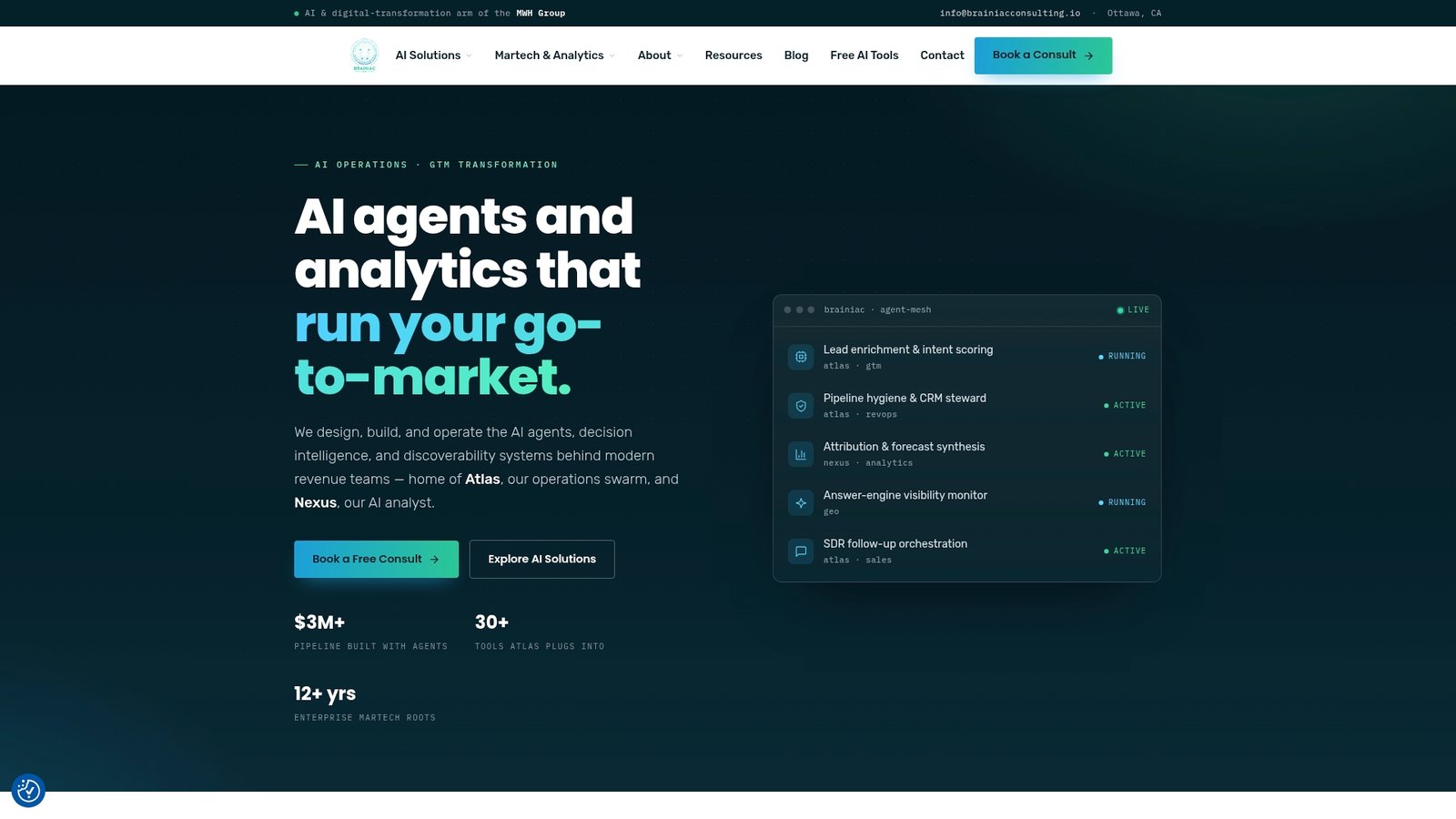
Relevant practices map directly onto a customer 360 engagement including turning the resolved profile into automated routing and next-best-action logic, connecting the unified profile to forecasting and attribution reporting, and wiring the profile into marketing platforms without duplicating data.
A short pilot engagement with us typically covers a scoped discovery of your existing data sources, a proposed identity-resolution approach, and one measurable activation, delivered against a timeline agreed up front. If you are weighing where to start, the clearest next step is a pilot briefing: visit Brainiac Consulting to request one and walk through what a scoped pilot would look like against your current systems.
FAQ
Is customer 360 a CRM?
No. A CRM manages the relationship record for sales and service, while customer 360 is the broader unified profile built from CRM data plus transactions, behaviour, and consent metadata across other systems. A CRM is typically one of several sources feeding a customer 360 implementation, not a replacement for it.
What are the three customer benefits of a unified profile?
A unified customer profile typically delivers more relevant personalization, faster and more accurate service because agents see full history at the point of contact, and more consistent treatment across channels since every team works from the same record. These benefits compound because they all stem from the same underlying asset: one trusted profile instead of several partial ones.
What are the qualities of good customer service that a 360 view supports?
Good customer service depends on context, speed, consistency, and accuracy, qualities that are hard to deliver when an agent cannot see a customer’s recent purchases or prior tickets. A customer 360 profile surfaces that context directly in the service tool, which is part of why Gartner ties trusted customer data to service leaders’ operational priorities.
What is 360 sales, and how does it relate to customer 360?
“360 sales” generally refers to a sales process informed by a full view of the customer, including past purchases, product usage, and prior service interactions, rather than a deal record alone. It depends on the same unified profile that a customer 360 implementation produces, since sales teams need the same canonical record that service and marketing use.
How long does a customer 360 implementation usually take?
A focused pilot, covering one priority source system, identity resolution, and a single activation channel, commonly reaches a measurable first result within three to six months. Scaling to additional sources and near-real-time syncs is a separate, later phase rather than part of the initial pilot.
Sources
- How to create a customer 360 view using Data 360 | Salesforce Help
- The Identity Resolution Playbook
- How SIs can deliver the A-grade Data 360 outcome (Operational MDM guidance)
- Service leaders priorities (Gartner)