
Next best action marketing is the discipline of selecting, in real time, the single most valuable thing to say or do for a customer, whether that’s an offer, a message, a service fix, a delay, or nothing at all. The benefit is straightforward: interactions become more relevant, better timed, and tied to measurable value instead of guesswork. This article walks through how the models work, where NBA earns its keep, how to pilot it without a massive build, and how to measure whether it’s actually working, including a Brainiac Consulting case example.
TL;DR:
- Successful NBA implementation requires unified customer data to improve prediction accuracy and decision-making quality.
- Pilot projects should focus on high-volume decision points like win-back or cart abandonment, with a small action catalog and simulation testing.
- Governance, fairness, and transparency are critical to prevent bias, over-messaging, and legal compliance issues in real-time decisions.
- Reinforcement learning and generative AI are evolving NBA, enabling autonomous, context-specific actions and continuous model improvement.
- Organizational readiness, clear objectives, and existing data integrity are essential before moving from policy-driven to autonomous decisioning systems.
Table of Contents
- What is next best action marketing, exactly?
- Why does next best action marketing matter for revenue and retention?
- How do next best action models actually work?
- What are the best next best action use cases?
- How do you implement next best action marketing in a pilot?
- What KPIs prove next best action marketing is working?
- What causes next best action marketing to fail?
- What can Brainiac Consulting’s client work teach about NBA rollouts?
- What data privacy rules apply to next best action marketing?
- How does NBA integrate with existing CRM and marketing channels?
- Why do segmentation and data quality determine NBA effectiveness?
- What are the ethical risks of next best action marketing?
- What’s next for next best action marketing?
- Policy driven NBA or autonomous decisioning: which should you choose?
- How can Brainiac Consulting help you pilot next best action marketing?
- Sources
What is next best action marketing, exactly?
Next best action marketing weighs several possible moves for a specific customer at a specific moment and picks the one worth the most. That’s a meaningfully different job than sending a personalized email or picking a “next best offer” from a catalog. A next best offer engine answers “what should we sell them?” Next best action asks a broader question: should we sell anything right now, or would a service message, a support fix, a delay, or silence create more value?
The distinction matters because NBA treats “do nothing” as a legitimate outcome, not a failure state. Cdp frames NBA as a combination of customer context, candidate actions, predictive models, and business constraints working together to choose the most valuable intervention, and explicitly notes that no action can be the correct answer when every option would annoy, oversell, or under-serve the customer.
Four components make this work in practice:
- Candidate actions: the finite menu of things you could actually do (a specific offer, a retention message, a service callback, or nothing).
- Scoring: a prediction of the expected value, or probability of success, for each candidate given that customer’s context.
- Constraints: business rules, such as frequency caps, margin floors, inventory limits, and legal restrictions, that filter out otherwise attractive options.
- Decision policy: the logic that arbitrates between scored, filtered candidates and commits to one action.
Next-best-action marketing has been feasible at scale since early this century, but the componentry above is what separates a genuine NBA system from a personalization layer that just swaps in a first name and a product recommendation.
Why does next best action marketing matter for revenue and retention?
NBA earns its investment when a business has to choose between multiple plausible actions in real time, not when it’s simply deciding which template to send. Campaign-based marketing schedules a message and hopes the timing lands. NBA evaluates the customer’s actual state the moment a decision is needed and picks accordingly, which is precisely where campaign logic runs out of road: a scheduled win-back email doesn’t know the customer called support yesterday and is already frustrated.
Retailers that unify point-of-sale and analytics data into a single customer profile, then feed that unified view into personalization models, report roughly a 9% increase in revenue. That figure is a useful proxy for the underlying mechanic NBA depends on: decisions only get better when the data feeding them is unified rather than scattered across five disconnected systems.
The decision points where NBA outperforms scheduled campaigns share a pattern: multiple viable actions exist, timing is genuinely uncertain, and the cost of the wrong choice (an ill timed upsell to a churning customer, a discount offered to someone who was going to buy anyway) is high enough to justify a modelling investment.
How do next best action models actually work?
Most NBA systems run on a layered scoring approach rather than a single model. Propensity scoring predicts the likelihood a customer responds to a given action. Expected-value scoring goes a step further, multiplying that likelihood by the action’s business value, so a low-probability, high-margin offer can beat a high-probability, low-margin one. Portfolio arbitration then resolves conflicts when several actions clear the bar simultaneously, since you can’t message a customer about a renewal, a cross-sell, and a service issue in the same breath.
Learning methods vary by maturity. Simpler NBA setups use supervised models trained on historical outcomes. More adaptive systems use multi-armed bandits or reinforcement learning, which let the system test and learn from live outcomes rather than relying solely on past data, an approach that fits what some vendors now call “next best everything,” a continuous decisioning layer rather than a static rules engine.
A second technical split matters just as much: runtime decisioning versus offline scoring. Offline scoring batches predictions overnight and works fine for email sequencing. Runtime decisioning happens in the milliseconds during a web session or a call, and it demands a genuinely low-latency decision engine, not a nightly batch job repurposed for a real-time channel.
Building or buying this requires:
- Identity resolution and a CDP (or equivalent) to unify the customer view across touchpoints.
- A feature store so scoring models draw on consistent, current inputs rather than stale exports.
- A scoring and arbitration engine capable of evaluating candidates within the latency budget of the channel.
- An orchestration layer that actually executes the winning action across email, web, app, and call centre.
Pro Tip: Before evaluating any decisioning platform, ask a simple question: can it explain why it chose action A over action B for a specific customer? If a vendor can’t produce that trace, you’re buying a black box, and black boxes are hard to govern.
What are the best next best action use cases?
Four decision points consistently produce the clearest returns, because each one involves a genuine choice among several actions rather than a single scripted message.
- Retention and win-back. When a customer goes dormant, NBA decides whether a discount, a service check-in, a content nudge, or silence is the right response, rather than firing the same win-back template at everyone who hasn’t purchased in 60 days.
- Cross-sell and upsell. NBA weighs an offer against a piece of educational content against no contact at all, based on where that specific customer sits in their relationship with the brand.
- Restock reminders and loyalty nudges. Timing and channel selection matter more than the message itself here; NBA can hold a nudge until the model predicts the customer is actually ready to reorder, rather than firing on a fixed 30-day clock.
- Proactive service interventions. A spike in support tickets, a failed payment, or a shipping delay can trigger a service-first action instead of a marketing message, which protects the relationship instead of testing its patience.
Each of these shares the same underlying test: is there more than one reasonable thing to do, and does getting it wrong carry a real cost? If yes, NBA modelling is worth the investment. If a single scripted response already works fine, you don’t need a decision engine to send it.
How do you implement next best action marketing in a pilot?
Skip the enterprise-scale build. Start narrow, prove the model earns its keep, and expand from there.
- Pick one high-volume decision point with one measurable outcome. Dormant-customer win-back or cart abandonment tends to work well as a first pilot because volume is high and the outcome (reactivation, purchase) is unambiguous.
- Build a small action catalog. Two or three candidate actions plus a genuine no-action option is enough. Cdp specifically recommends starting this small, with explicit guardrails and a holdout group, rather than launching with a sprawling menu of options.
- Unify the data and resolve identity. Decide whether a CDP or a well-modelled warehouse view fits your stack better; either way, breaking down the silos between transaction, service, and engagement data is the step most pilots underestimate.
- Simulate before you go live. Wikipedia’s overview of next-best-action marketing points to simulation as essential groundwork, and for good reason: an NBA policy that suddenly redirects volume toward one offer can strain fulfillment or overload a call centre before anyone notices the pattern.
- Run holdouts, set guardrails, and keep a human approval step for the first few cycles, then iterate based on measured lift rather than assumed lift.
Pro Tip: Resist the urge to build the full candidate catalog before you launch. A pilot with three actions and a clean holdout beats a pilot with twenty actions and no way to prove which one moved the needle.
What KPIs prove next best action marketing is working?
The primary metrics are the ones finance actually cares about: incremental revenue attributable to the NBA-selected action, retention lift compared to a holdout group, and margin contribution, since a “successful” offer that erodes margin isn’t a win.
Operational metrics matter just as much, and they’re the ones teams tend to skip:
- Failed action rate: how often the recommended action can’t actually be delivered (out of stock, ineligible customer, blocked channel).
- Contact pressure: whether NBA is quietly increasing how often customers get messaged, even if each message is individually smarter.
- Complaints and manual overrides: a rising override rate from frontline staff is an early signal the model’s recommendations aren’t matching reality on the ground.
Experiment design should always include a genuine holdout group so lift is measured incrementally, not assumed from a before-and-after comparison. Harvard Business School’s guidance on personalized marketing policies recommends designing proper experiments and modelling how different customer segments respond differently, rather than treating the customer base as one uniform population that reacts the same way to the same policy.
What causes next best action marketing to fail?
Technology is rarely the reason NBA pilots stall. Organisational friction and misaligned incentives are the more common culprits: a product team measured on unit volume for one SKU will resist an NBA policy optimizing for total customer value across the whole relationship, because the two goals genuinely conflict.
Unpredictability is the second risk, and it’s an operational one. An NBA policy that shifts demand suddenly toward one action can strain inventory, staffing, or service capacity before anyone catches it, which is exactly why simulation before rollout isn’t optional polish, it’s risk management.
Governance needs to cover, at minimum:
- A clear objective the policy is optimizing for, stated in business terms, not model terms.
- Guardrails on frequency, margin, and eligibility that no scoring model is allowed to override.
- Fairness checks to catch systematic bias in who gets offered what.
- Frequency caps across channels so no customer gets triple-contacted by three uncoordinated systems.
- An escalation path for when override rates or complaint volume spike.
Resetting incentives across departments before launch, so the NBA objective doesn’t quietly compete with an existing team’s targets, prevents more failures than any modelling improvement will.
What can Brainiac Consulting’s client work teach about NBA rollouts?
Brainiac Consulting’s marketing and sales alignment case study followed the same pilot logic outlined above: integrate fragmented data sources first, simulate the decision policy before committing budget to it, run a genuine holdout, and put governance in place before scaling past the pilot.
Three lessons transfer directly to any team starting an NBA project:
- Data integration comes before modelling. A scoring model built on incomplete customer data will make confident, wrong decisions faster than a simple rule ever would.
- Simulation catches problems holdouts can’t. Testing a policy against historical data before it touches live customers surfaces operational strain (like inventory pressure) that a live holdout would only reveal after the damage is done.
- Governance has to be built alongside the model, not bolted on afterward. Teams that treated approval steps and guardrails as an afterthought spent far more time firefighting once the pilot expanded.
The throughline across each engagement is that measurable lift came from disciplined process as much as from the underlying model itself.
What data privacy rules apply to next best action marketing?
NBA systems draw on more customer data than most marketing tools, purchase history, browsing behaviour, service interactions, sometimes location and device signals, and that concentration of data raises the compliance stakes. Consent has to cover every downstream use of that data, not just the channel it was originally collected on; a customer who opted into email marketing hasn’t automatically consented to a real-time decisioning model scoring their support tickets.
Regulations like the GDPR in the European Union and various US state privacy laws (California’s CCPA among them) require that customers can understand, and in many cases contest, decisions made about them using personal data. That has direct implications for NBA: if your decision engine can’t explain why it chose one action over another for a given customer, you have a governance gap that’s also a legal exposure.
Data minimization matters here too. Feeding every available signal into a scoring model because it’s technically possible isn’t the same as feeding in the signals that actually improve decisions. Fewer, better inputs are usually safer and often perform just as well as sprawling feature sets that are harder to audit and harder to explain to a regulator or a customer who asks why they received a particular message.
Retention policies need equal attention. A feature store that keeps behavioural signals indefinitely because deleting them is inconvenient is a liability waiting to surface during an audit, not a modelling asset.
How does NBA integrate with existing CRM and marketing channels?
NBA doesn’t replace your CRM or your marketing automation platform; it sits as a decisioning layer that tells those systems what to do next. Salesforce and HubSpot remain the systems of record for customer relationships and campaign execution. The NBA engine’s job is to feed a recommendation into whichever channel the customer is already in, email, an app notification, a call centre script, a website banner, at the moment the decision needs to be made.
The integration challenge is less about connecting APIs and more about orchestration: making sure the email platform, the app, and the call centre aren’t each independently deciding to contact the same customer about different things in the same afternoon. Without a shared orchestration layer, an NBA engine that’s individually smart in each channel produces a customer experience that feels chaotic in aggregate.

Marketo and similar platforms already support the kind of dynamic content and scripting that NBA decisions can populate, which means teams often don’t need to rip out existing MarTech to run a pilot. The practical starting point is usually a single integration point, feeding the NBA engine’s output into one existing channel’s decisioning logic, rather than a wholesale platform migration. That keeps the CRM as the system of record while the NBA layer earns trust one decision point at a time.
Why do segmentation and data quality determine NBA effectiveness?
An NBA model is only as good as the customer view feeding it, and fragmented or stale data produces confidently wrong recommendations more often than it produces no recommendation at all. Segmentation still matters inside an NBA system, even though the whole point of NBA is individual-level decisioning: segments help you sanity-check whether the model’s behaviour makes sense for known customer groups before you trust it at the individual level.
Data quality problems tend to hide in specific places. Duplicate customer records split behavioural history across two profiles, so the model sees half the picture for a customer who’s actually a strong candidate for an offer. Stale purchase data makes a churned customer look active. Inconsistent identity resolution across channels means the web behaviour and the email behaviour never get connected to the same person at all.
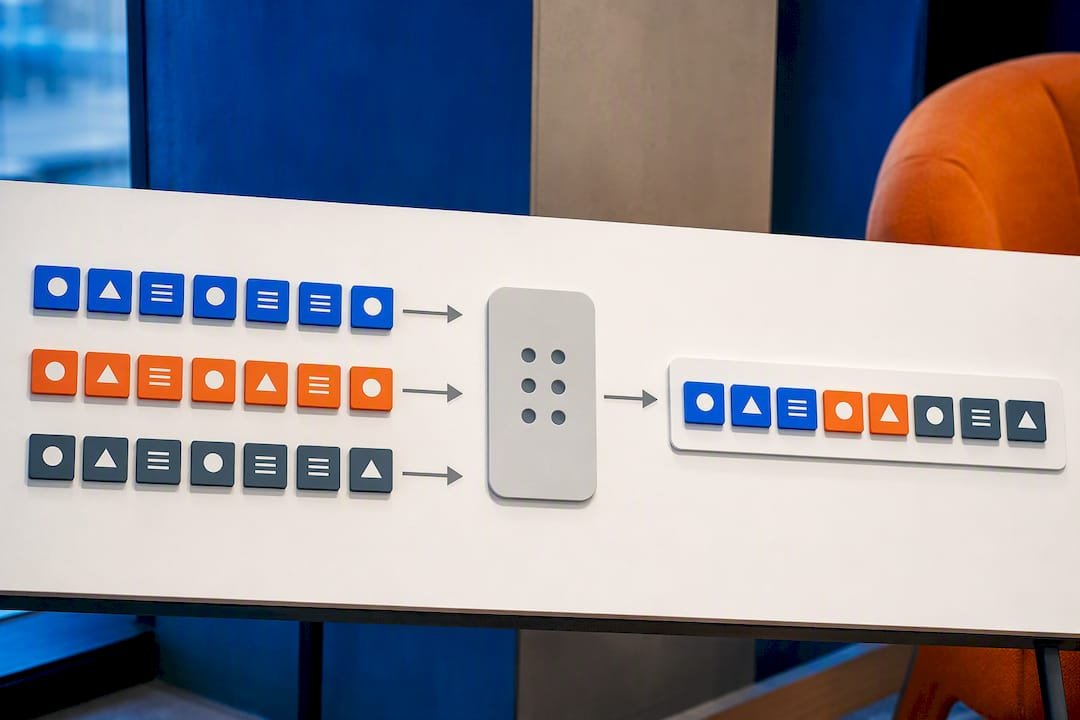
The unified profile point from the retail data cited earlier isn’t just a revenue statistic, it’s a data quality argument: the 9% revenue lift tied to unified POS and analytics profiles shows up specifically because unification fixes the fragmentation that would otherwise feed bad inputs into the scoring model. No amount of modelling sophistication compensates for a customer record that’s split across three systems that don’t talk to each other.
What are the ethical risks of next best action marketing?
The line between helpful personalization and manipulation gets thin fast in NBA, because the system is explicitly optimizing to influence behaviour at the individual level. A model that learns a specific customer responds well to urgency messaging or scarcity framing can end up exploiting a psychological pattern rather than serving a genuine need, and the model itself has no built-in sense of that distinction unless someone designs constraints against it.
Frequency and fatigue are the most immediate customer experience risks. An NBA system optimizing purely for response rate, without a contact pressure guardrail, will happily message a responsive customer more and more often, right up until that customer unsubscribes or complains. The fix isn’t a smarter model, it’s a policy constraint that caps contact regardless of what the scoring engine predicts.
Fairness deserves explicit attention too. If historical data reflects biased treatment of certain customer groups, whether by geography, spending tier, or another proxy for a protected characteristic, an NBA model trained on that history will learn to replicate the bias rather than correct it. Building fairness checks into the governance layer, not just accuracy checks, is the only reliable defence against this.
Transparency closes the loop. Customers increasingly expect to understand why they received a particular offer or message, and an NBA system that can produce that explanation builds trust; one that can’t creates the kind of quiet unease that erodes a brand relationship long before it shows up in a churn metric.
What’s next for next best action marketing?
Generative AI is changing what a “candidate action” even looks like; for service industries looking to leverage these advances, check out practical AI marketing tools for home service business growth. Instead of choosing between a handful of pre-written offer templates, next-generation NBA systems can generate the message itself in real time, tailored to the specific context that triggered the decision, which shifts complexity from content production into model governance.
Agentic AI is the more significant shift on the horizon. Rather than scoring a fixed set of candidates, agentic systems can construct a novel action within defined boundaries, chaining several steps together (checking inventory, drafting an offer, selecting a channel) autonomously. Some industry commentary describes this evolution as a move from next best action toward “next best everything,” a continuous decisioning layer rather than a discrete campaign trigger, and AI personalization leaders are already growing faster than laggards as this shift takes hold.
Reinforcement learning adoption is likely to accelerate too, since bandit-based and RL-driven systems learn from live outcomes rather than relying solely on historical training data, closing the loop between decision and result faster than traditional supervised models allow. The organisations that benefit most from this won’t be the ones with the fanciest model, they’ll be the ones with governance mature enough to trust a system that keeps learning and changing its own behaviour.
Policy driven NBA or autonomous decisioning: which should you choose?
Human-in-the-loop policy design keeps a person accountable for the objective and the guardrails; autonomous reinforcement learning lets the system adapt faster but demands governance maturity most teams haven’t built yet. Readiness shows up in specific signals: clean unified data, a working holdout culture, and leadership that already resets incentives across departments without a fight.
If those signals aren’t there, start with policy-driven NBA and earn your way toward autonomy. A short checklist: do you have a holdout discipline already? Can you explain any single decision your model makes? Has your organisation resolved who “owns” the NBA objective when it conflicts with a team’s existing target? Answer no to any of those, and the next step is governance, not a fancier model.
— Don
How can Brainiac Consulting help you pilot next best action marketing?
Most teams don’t fail at NBA because the modelling is hard, they fail because the data is scattered across five systems and nobody owns the simulation step before launch. Brainiac Consulting’s Atlas AI Operations Platform is built specifically to close that gap, combining managed AI decisioning with the open-source integrations and CRM connections (Salesforce, HubSpot, Marketo) most pilots actually need, without locking you into a black-box vendor relationship.
A typical first engagement starts small on purpose: pilot design around one decision point, data and identity integration across your existing stack, policy simulation before anything touches live customers, and a governance framework with the guardrails and holdout structure this article walked through. That’s a materially faster path than assembling a CDP, a feature store, and an orchestration layer from scratch on your own.
If you’re ready to move past the planning stage, explore the Atlas AI Operations Platform and book a conversation about scoping your first NBA pilot.
Sources
- AI Personalization Marketing: Winning Strategies for 2026 – Shopify
- Cdp
- Next-best-action marketing — Wikipedia
- Harvard Business School faculty article on personalized marketing policies