
Most enterprise teams with a mature warehouse and an existing dbt practice should build a warehouse-first, composable customer data platform rather than buy a packaged one. Teams without that engineering foundation are usually better served by a vendor or a hybrid model. Either way, the next move is the same: run a focused proof of concept that proves identity resolution and activation before committing budget.
TL;DR:
- Building a warehouse-first CDP is ideal for teams with strong data engineering and dbt maturity, focusing on cost control and auditability.
- A focused proof of concept for identity resolution and activation may take 3 to 6 months, with full production reaching 9 to 18 months.
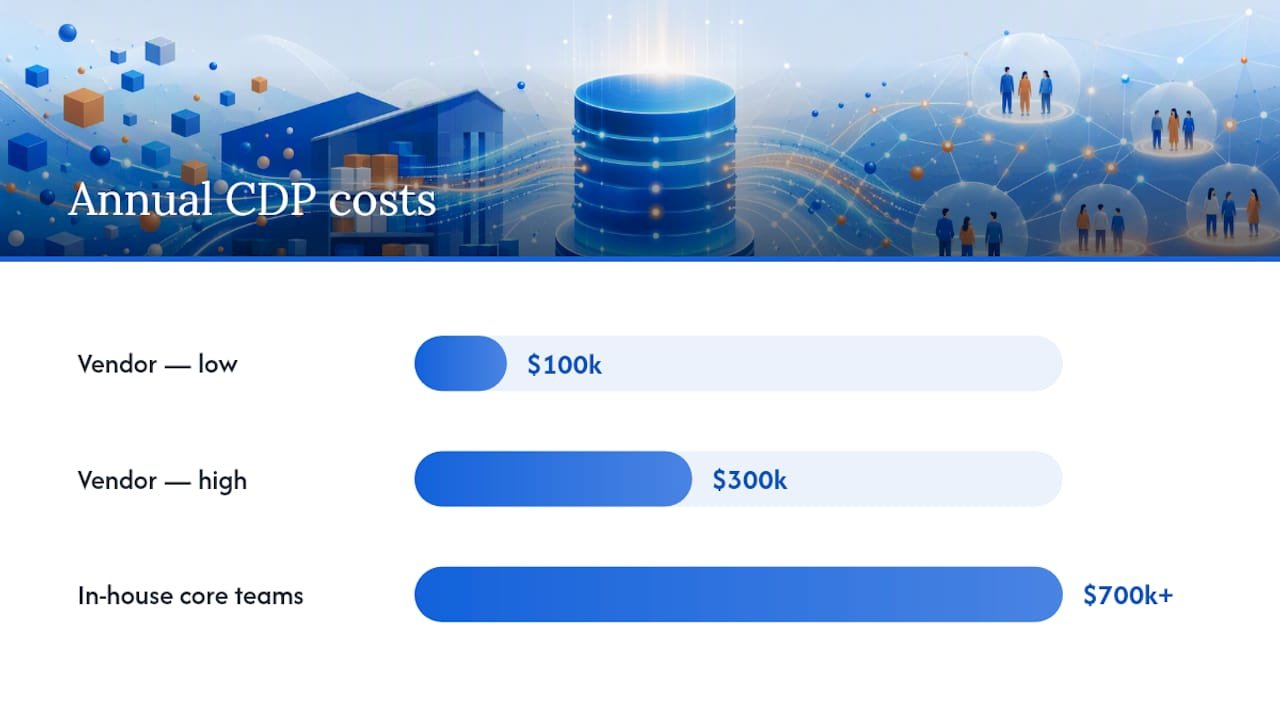
- In-house development can cost over $700,000 annually, while vendor solutions typically range from $100,000 to $300,000 per year.
- Key components include event connectors, a suitable data model, deterministic identity resolution, a semantic layer, governance, and reliable activation.
- Successful governance requires rigorous tracking plan versioning, reproducible identity models, auditable activations, and early consent management.
Table of Contents
- What is a customer data platform build, really?
- The six components every CDP architecture has to plan for
- Which architecture pattern should you actually build?
- How long does a CDP build take, and what does it cost?
- How Brainiac Consulting supports an enterprise CDP build
- What experienced teams get wrong about CDP governance
- Sources
- FAQ
What is a customer data platform build, really?
A customer data platform build is the work of assembling event collection, identity resolution, a modelled semantic layer, and activation into one governed system that marketing, sales, and analytics teams can all query with confidence. That’s the standard definition of a customer data platform (CDP): unified customer profiles built from first-party data, made usable for segmentation and personalisation. The question enterprise teams actually face isn’t “what is a CDP” but which architecture class to build it on.
Three patterns dominate right now, and each fits a different organisation.
- Warehouse-first (composable): the warehouse (Snowflake, BigQuery, Databricks) is the system of record. Identity resolution and modelling happen in SQL and dbt, with reverse ETL handling activation. This pattern rests on three pillars: identity resolution, semantic modelling, and reverse ETL, and it wins on cost control and auditability when the team already has data engineering depth.
- Packaged CDP: a vendor owns collection, identity, and activation behind a UI. Faster to launch, easier to staff, but less flexible and typically the more expensive path at scale.
- Self-hosted open-source CDP: you deploy and operate an open-source stack yourself (more on specific projects below). You avoid licence fees and lock-in, but you inherit all the operational burden.
The decision signals are fairly blunt. If your team already ships dbt models weekly, has sub-day latency requirements that a vendor’s batch sync can’t meet, or operates under compliance regimes that demand full data lineage, warehouse-first is usually the right call. If you lack dedicated data engineering headcount, or you need activation live in weeks rather than quarters, a packaged CDP or a hybrid buys you time. The hybrid approach many enterprises land on: own identity resolution and the semantic layer in-house, because that’s where competitive advantage and compliance risk concentrate, and buy collection SDKs or reverse ETL tooling off the shelf rather than reinventing plumbing that’s already commoditised.
The six components every CDP architecture has to plan for
Whatever pattern you choose, six things have to work, and each one has its own failure modes.
- Event collection and connectors. Plan for the actual source count you’ll onboard, not the three you’re testing with. Connector sprawl (dozens of web, mobile, and server-side sources) is where most PoCs quietly break.
- Warehouse selection and data model. Your choice of Snowflake, BigQuery, or Databricks shapes cost, latency, and how easily downstream marts can join to a canonical identity table.
- Identity resolution. This should be implemented as an incremental, version-controlled dbt model that outputs a canonical person_id to which every downstream mart joins. Deterministic stitching (email, login, device ID matches) covers most authenticated traffic; probabilistic matching fills the gaps, but it needs ongoing testing to avoid false merges.
- Data quality and semantic layer. dbt models compute derived attributes (lifetime value, churn risk, last-touch channel) so marketing and analytics teams query the same definitions instead of arguing about whose SQL is right.
- Segmentation and activation. Reverse ETL syncs audiences to Salesforce, HubSpot, or ad platforms. Syncs need to be idempotent. A retried job shouldn’t double-enrol someone in a campaign.
- Privacy, consent, and governance. Consent lineage and audit logs aren’t optional add-ons. Open-source projects like Apache Unomi now ship consent management and audit-trail features as core functionality, which tells you where the industry baseline is heading.
Pro Tip: Build your tracking plan as a version-controlled document before you write a single connector. Teams that skip this step spend twice as long fixing broken event schemas six months in.
Which architecture pattern should you actually build?
A warehouse-first build typically treats Snowflake, BigQuery, or Databricks as the runtime, not just storage. Vendor guidance on this pattern describes modelling customer entities in SQL, keeping data in place, and activating audiences with audited syncs, which gives you traceability a packaged tool rarely matches.
The composable stack layers on top: identity graph logic lives in dbt, a semantic layer sits above it, reverse ETL tools push audiences out, and a monitoring layer watches sync health.
For teams evaluating self-hosted open-source options, a few projects illustrate what’s already been solved:
- Krenalis supports Snowflake and PostgreSQL with real-time event collection and identity resolution built into the warehouse layer.
- LEO CDP takes an AI-first, on-premise approach with ML-based segmentation and real-time customer 360 views, aimed at teams that want data sovereignty over cloud convenience.
- Uniflow ships as an AWS-deployable stack (API Gateway, Lambda, Kinesis, DynamoDB, Glue), a practical reference for cloud-native ingestion and activation.
- Tracardi offers a lighter-weight open-source option for teams testing real-time personalisation before committing to a heavier build.
Real-time use cases (on-site personalisation, fraud signals) still tend to favour packaged CDPs with purpose-built streaming infrastructure. Batch-oriented activation, the majority of B2B marketing use cases, is where warehouse-first genuinely shines.
How long does a CDP build take, and what does it cost?
Budget and timeline are where most projects get ambushed. Here’s a realistic sequence.
- Assemble the minimal team. You need a data engineer, an analytics engineer fluent in dbt, a privacy or compliance lead, and a product owner who owns the roadmap and stakeholder priorities.
- Ship the tracking plan first. Before any code, agree on event names, properties, and identity keys across every source system.
- Build ingestion, then identity, then the semantic layer. Each milestone unlocks the next; skipping ahead to activation before identity is stable produces bad audiences.
- Stand up activation and monitoring together. A sync without alerting is a sync that fails silently for weeks.
- Layer in compliance workflows. Consent capture, deletion requests, and audit logging need to be live before, not after, production launch.
A proof of concept proving identity resolution and one or two activation syncs typically takes 3 to 6 months. Full production maturity, including governance and monitoring, usually runs 9 to 18 months.
Cost is the harder number to soften. Building a production-grade CDP means owning all six layers permanently, and in-house core engineering teams can run past $700,000 a year once you account for senior engineers and ongoing AI or ML staffing. Vendor implementations, by contrast, often land between $100,000 and $300,000 a year for standard deployments. That gap is exactly why the hybrid model, buying commoditised pieces and building the parts that touch identity and compliance, appeals to so many enterprise teams once the first PoC numbers come in.
How Brainiac Consulting supports an enterprise CDP build
If your team has decided a warehouse-first build is right but doesn’t want to carry the full $700,000-a-year engineering load alone, Brainiac Consulting is built for exactly that middle ground. We work open-source-first, meaning your identity graph and semantic models stay yours, not locked inside a proprietary vendor schema, and we integrate directly with Salesforce, HubSpot, and Marketo so activation doesn’t mean ripping out your existing stack.
Our engagements run three ways: strategy work to pick the right architecture pattern for your team’s maturity, hands-on build support for identity resolution and semantic modelling, and managed operations once the platform is live. Clients typically see this show up as faster lead qualification and stronger pipeline conversion, the kind of outcome documented in our lead-to-opportunity conversion work. Once your CDP is producing clean, governed customer data, our AI Analytics Platform and Governed AI Analyst can sit on top of it, turning unified profiles into predictive intent scoring and real-time reporting your revenue teams actually trust.
The fastest way to find out where your team stands is a short discovery audit. Start by reviewing our Atlas AI Operations Platform and booking a scoping conversation before you write your first connector.
What experienced teams get wrong about CDP governance
The traps I see repeatedly aren’t technical, they’re organisational. Teams skip a versioned tracking plan because “we’ll document it later,” and six months in, nobody agrees what an event property actually means. Consent handling gets bolted on after launch instead of designed in from day one, which turns every new regulation into an emergency sprint. And identity resolution rarely gets proper testing, so a probabilistic match quietly merges two customers who were never the same person.

Five rules hold up across every build I’ve reviewed. Consent first, not last. Version and test the tracking plan like you would production code. Make the identity graph reproducible, meaning anyone can rerun the dbt model and get the same person_id mapping. Make every activation auditable, so you can answer “who got this email and why” months later. And define service-level objectives for sync latency and data freshness before launch, not after a stakeholder complains.
Composable stacks succeed when teams accept that assembling a full CDP without vendor lock-in means accepting ongoing maintenance as a permanent line item, not a one-time project cost.
— Don
Sources
- Build vs. Buy a CDP: What It Actually Takes to Build One In-House | Amperity
- How to build a composable CDP on a data warehouse | TrackRaptor
- krenalis/krenalis
- uniflow — open-source Customer Data Platform
- Apache Unomi (privacy and consent features)
FAQ
Is it cheaper to build or buy a customer data platform?
Buying is usually cheaper upfront: standard vendor implementations run $100,000 to $300,000 a year, while in-house engineering teams can exceed $700,000 annually once staffing is fully loaded. Building pays off long-term only when your team already has warehouse and dbt maturity to leverage.
What is the best open-source CDP for enterprise teams?
There’s no single best option. It depends on your stack: Krenalis fits Snowflake or PostgreSQL environments with built-in identity resolution, LEO CDP suits teams prioritising on-premise AI features, and Uniflow works well for AWS-native deployments.
How long does a CDP proof of concept take?
A focused PoC proving identity resolution and activation to one or two destinations typically takes 3 to 6 months. Full production maturity, including governance and monitoring, generally takes 9 to 18 months.
Do I need a data warehouse before starting a CDP build?
Yes, for a warehouse-first approach, since the warehouse acts as the system of record for identity resolution and modelling. Teams without an established warehouse and dbt practice are better served by a packaged CDP or a managed build like Brainiac Consulting’s hybrid engagement model.
What roles do I need to build and maintain a CDP?
At minimum, you need a data engineer for ingestion and infrastructure, an analytics engineer fluent in dbt for identity and modelling, a privacy or compliance lead, and a product owner to prioritize the roadmap. Ongoing maintenance typically requires a smaller but permanent version of this same team.