
LLM SEO means optimising content so AI answer engines extract and cite specific passages, not just rank your page. The single highest-leverage move is making your top pages do two jobs at once: rank in classic search (because retrieval still runs through search indexes) and expose standalone, quotable answers. Success looks like your brand named, quoted, or linked as a source inside a ChatGPT, Perplexity, or Gemini answer.
TL;DR:
- Fixing technical access issues is the first step, as many pages remain uncrawlable by AI bots despite having high-quality content.
- Restructuring pages into question-based headings with concise, answer-first passages improves AI citation rates more quickly than other tactics.
- Publishing unique data, original claims, or proprietary surveys creates a strong citation moat because models rely on unique sources for factual claims.
- Monitoring server logs for AI crawler activity and performing prompt tests helps confirm whether your content is entered into the retrieval system and named in answers.
- Ensuring your structured data and schema are correctly implemented supports reliable attribution from answer engines across different AI systems.
Table of Contents
- What is LLM SEO and how does it differ from traditional SEO?
- How do LLMs find, retrieve, and attribute web content?
- Which tactics actually move the needle for AI citations?
- Can AI crawlers actually access your content?
- How do you measure LLM SEO without fooling yourself?
- How should you structure content for passage-level retrieval?
- How Brainiac Consulting operationalises LLM SEO for B2B clients
- Our take: what actually moves the citation needle
- Put LLM SEO into practice with Brainiac Consulting
- Sources
- FAQ
What is LLM SEO and how does it differ from traditional SEO?
Traditional SEO optimises the page. LLM SEO optimises the passage. That distinction reshapes almost every editorial decision you make, because a large language model doesn’t “rank” your content the way Google’s blue links do. It retrieves a handful of candidate documents, pulls specific claims or sentences out of them, and synthesizes an answer. Your job shifts from winning a position to winning inclusion inside that synthesis.
Ranking still matters enormously, though. Most AI-cited URLs already sit on page one of Google’s organic results, because the retrieval layer behind engines like ChatGPT and Gemini leans on the same search indexes traditional SEO has always targeted. Classic organic performance remains the foundation for LLM citations, so skipping technical SEO and content quality to chase “AI visibility” is a losing bet. You need both.
The engines themselves behave differently enough to matter. ChatGPT leans heavily on Bing’s index and reference sites. Perplexity favours freshness and community sources, including Reddit threads and recent editorial coverage. Google’s AI Overviews and Gemini pull from the Knowledge Graph and reward tightly structured, extractable answers. Claude tends to cite more conservatively and often prefers primary sources over aggregator content. Each engine is a different retrieval system with its own biases, which is why a single “rank #1” mindset doesn’t transfer cleanly. You’re not optimising for one algorithm anymore. You’re optimising for a family of them, each with its own appetite for structure, freshness, and authority.
How do LLMs find, retrieve, and attribute web content?
Every major answer engine runs some version of a retrieval-augmented generation pipeline: retrieve candidate documents, synthesize an answer from the strongest passages, then attribute the claim to a source (or several). Understanding this three-stage flow tells you exactly where your content can win or lose.
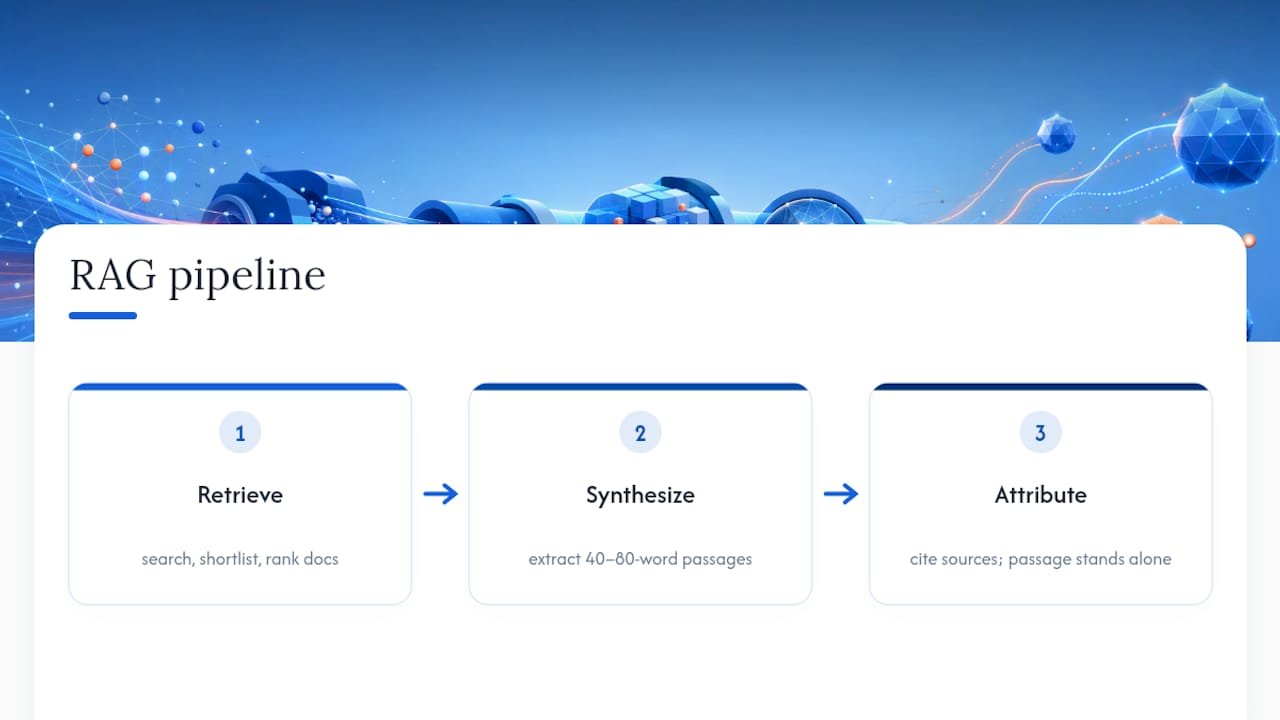
Retrieval happens first. The engine issues a search query (often reformulated from your original prompt), pulls a shortlist of documents from an index like Bing or Google, and ranks them by relevance signals that look a lot like traditional SEO factors: topical match, authority, freshness, and structure.
Synthesis happens next. The model doesn’t read a full page and summarize it holistically. It extracts specific passages, usually short, self-contained chunks of 40 to 80 words, and stitches them into a coherent answer. This is why the unit of retrieval is a passage, not a whole page. A brilliant 2,000-word article buried under a rambling introduction can lose to a mediocre competitor whose third paragraph happens to answer the question in one clean sentence.
Attribution happens last, and it varies by engine. Perplexity shows numbered citations inline. ChatGPT often names a source conversationally without a visible link. Google’s AI Overviews show expandable source cards. Claude tends to cite fewer sources but weights them toward primary, authoritative documents. In every case, the passage that gets lifted needs to stand on its own: no pronouns referring to a previous paragraph, no “as mentioned above,” no half-finished thought that only makes sense in context. Write every answer passage as if a machine will rip it out of your page and drop it into a stranger’s inbox, because that’s essentially what happens.
Which tactics actually move the needle for AI citations?
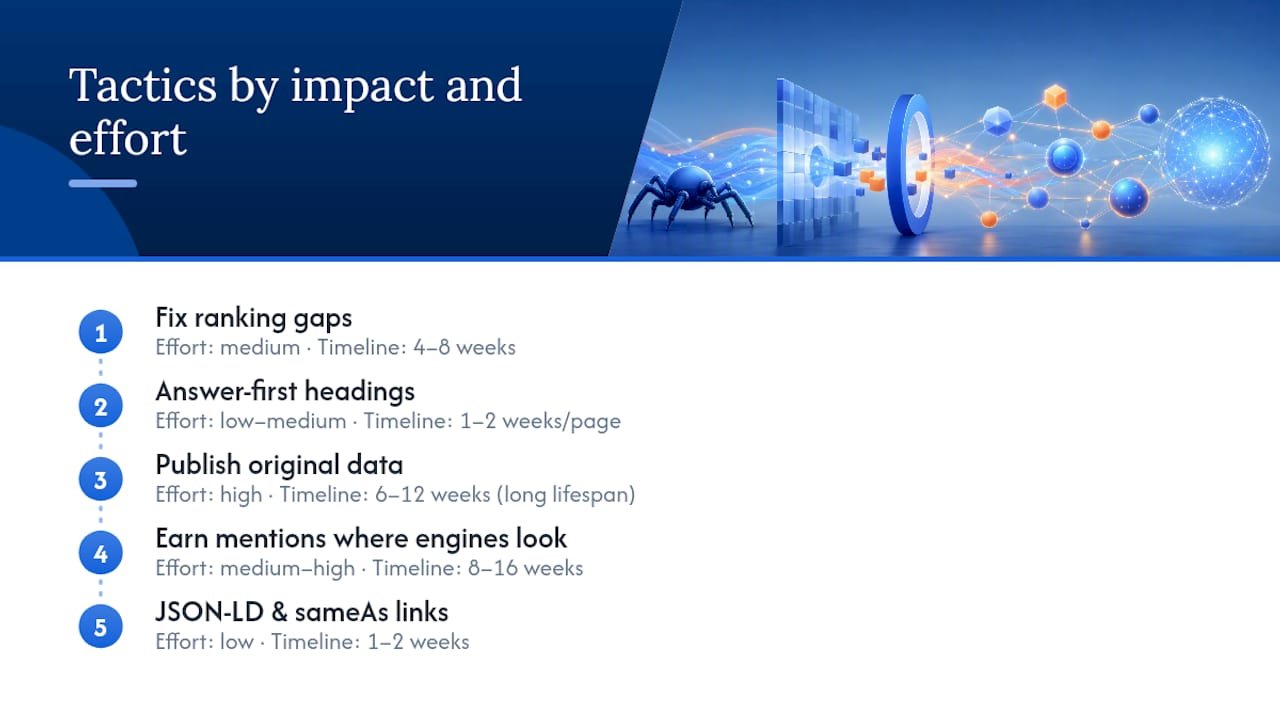
Not every LLM SEO tactic delivers the same return, and treating them as equally urgent wastes time. Here’s the order we’d tackle them in, ranked by expected impact against effort.
1. Fix classic ranking gaps for the query fragments AI retrieves first. If your page doesn’t rank for the underlying search query an AI tool reformulates behind the scenes, none of the passage-level polish below matters. Audit your top 20 target queries in a standard rank tracker, and treat anything outside page one as priority technical or content debt. Effort: medium. Timeline: 4 to 8 weeks, tied to your existing SEO cycle.
2. Restructure pages into question-led headings with answer-first passages. Rewrite your H2s and H3s as the actual questions readers (and AI reformulation engines) ask, then answer each one in the first 40 to 60 words beneath it. Front-loaded answers under matching question headings correlate with higher citation rates because the model doesn’t have to hunt for the payload. Effort: low to medium. Timeline: 1 to 2 weeks per priority page.
3. Publish original data and named claims to build a citation moat. A stat nobody else has published forces the model to either cite you directly or leave the claim out entirely. Original research and proprietary data consistently outperform recycled commentary for generating citations, because there’s no competing source for the model to pull from instead. Run a small internal survey, publish anonymized client benchmarks, or aggregate a dataset nobody else has bothered to compile. Effort: high. Timeline: 6 to 12 weeks for a proper study, but the citation lifespan is long.
4. Earn mentions where each engine actually looks. ChatGPT and Bing weight reference sites and tier-one editorial coverage. Perplexity pulls from Reddit threads and recent news. Google’s systems respond to structured data and Knowledge Graph presence. A mention in a relevant subreddit, a quoted expert line in a trade publication, or a YouTube explainer that ranks for your core topic all feed different engines differently. Effort: medium to high, largely PR and community work. Timeline: 8 to 16 weeks to see citation impact.
5. Implement JSON-LD schema and Person/Organization sameAs links. Article, FAQPage, Person, and Organization schema improve the entity resolution that LLMs rely on to confirm who’s making a claim and whether that source is trustworthy. Link your author and company schema to Wikidata, LinkedIn, and Crunchbase profiles wherever they exist. Effort: low, mostly a one-time dev task. Timeline: 1 to 2 weeks.
Pro Tip: Run tactic 2 (answer-first restructuring) on your five highest-traffic pages before touching anything else. It’s the fastest tactic to implement and the one most likely to produce a visible citation within a single measurement cycle.
A clean entity graph, third-party editorial mentions, and standalone answer passages together predict citation success across engines more reliably than any single tactic in isolation. Treat this as a system, not a checklist you complete once and forget.
Can AI crawlers actually access your content?
Before you optimise a single passage, confirm the crawlers can reach your pages at all. This is the part teams skip because it’s unglamorous, and it’s also the part that silently kills otherwise excellent LLM SEO work.
- Check robots.txt for AI crawler blocks. Confirm you’re not disallowing GPTBot, PerplexityBot, ClaudeBot, or Google-Extended. Many sites inherited a blanket block from a security-focused developer years ago and never revisited it.
- Audit rendering for critical passages. If your answer-first paragraphs load via client-side JavaScript, some crawlers may never see them. Server-side rendering or prerendering for at least your key content is the safer default.
- Refresh your sitemap.xml with accurate lastmod dates. Stale or missing lastmod values tell crawlers your content hasn’t changed, which can suppress recrawl frequency exactly when you’ve published something citation-worthy.
- Submit your sitemap to Bing Webmaster Tools. Multiple engines, including ChatGPT, rely on Bing’s index for retrieval, so Bing indexation deserves the same attention Google Search Console gets.
- Consider publishing an /llms.txt file. This emerging proposal gives LLM crawlers a simple, low-cost map of your most important pages, similar in spirit to a sitemap but written for machine consumption rather than search indexing.
- Validate your JSON-LD and confirm FAQ markup renders visibly. Structured data generated from hidden or scraped content is fragile. FAQ blocks should exist as real, visible Q&A on the page, with the schema mirroring exactly what a human reader sees.
Server logs are your earliest reliable signal here. Hits from GPTBot, PerplexityBot, or ClaudeBot in your raw access logs confirm a page has entered the AI retrieval candidate pool, often weeks before you’d ever see a citation appear in a live prompt. If those bots aren’t showing up in your logs for pages you expect them to crawl, something in this checklist is blocking them. A tool built specifically for this, like Brainiac’s AI crawler access audit, can confirm exactly what each bot can and can’t fetch before you invest further in content restructuring.
How do you measure LLM SEO without fooling yourself?
Measurement here is genuinely harder than traditional SEO reporting, and the honest answer is that no single dashboard gives you the full picture. You need three complementary signals running at the same time.
Prompt-panel testing means running a fixed set of realistic prompts against ChatGPT, Perplexity, Gemini, and Claude on a consistent cadence, weekly or biweekly, and logging whether your brand appears, how it’s described, and which competitors show up instead. Keep the prompt list stable so trends are comparable month over month.
Server-log crawler monitoring tells you whether your pages are even in the running. Log evidence of GPTBot, ClaudeBot, and PerplexityBot activity is an earlier and more technical signal than a prompt-panel result, because it shows retrieval candidacy before synthesis and attribution happen. Together, logs confirm candidate status while prompt panels confirm you were actually named in the output — you need both to know where a citation attempt is failing.
Self-reported attribution from sales and CRM notes catches the leads your analytics tools miss entirely, since most AI platforms don’t pass clean referral data. Ask your sales team to add one field: “How did you hear about us?” and watch for “ChatGPT recommended you” showing up more often than your dashboards suggest.
Report against KPIs that reflect this reality rather than forcing AI visibility into old organic-traffic metrics. Track share of AI mentions relative to competitors, the citation trend over each testing cycle, and qualified leads tagged as AI-referred. AI answer surfaces measurably reduce organic click-through in many categories, so a flat or declining click number alongside rising AI mentions isn’t necessarily a failure. It’s often the expected trade.
How should you structure content for passage-level retrieval?
Writing for extraction is a discipline, not a formatting trick. A few consistent habits separate content that gets lifted into AI answers from content that gets read past.
- Use question-format H2s that mirror how people actually ask, then answer in the first 40 to 60 words beneath the heading, before any throat-clearing or context.
- Add a short FAQ block near the end, each answer running 40 to 150 words, marked up with FAQPage schema and rendered as visible text on the page.
- Include explicit numbers, dates, and named sources inside the answer passage itself, not two sentences later. “Bing indexation matters because ChatGPT uses it for retrieval” is weaker than naming the specific mechanism and linking the source.
- Keep paragraphs short, ideally three to five sentences, so a model extracting a “chunk” doesn’t have to cut a claim in half.
- Make every claim independently verifiable. If a sentence only makes sense next to the sentence before it, rewrite it so it survives being pulled out entirely on its own.
This structure serves human skimmers just as well as it serves machines, which is part of why it works. Nobody reads a 2,000-word article start to finish anymore, and no model does either.
How Brainiac Consulting operationalises LLM SEO for B2B clients
The work at the intersection of AI agent deployment and go-to-market analytics provides a useful position on LLM SEO: building the crawler audits, schema pipelines, and attribution models this playbook describes, focused on internal marketing and revenue operations rather than consumer search.
For clients, this translates into Generative Engine Optimization services built on an open-source, integration-first approach, including with platforms like Salesforce and HubSpot, so citation and attribution data flow into CRM systems revenue teams already trust. Typical engagements include audits (crawler access, entity graph, citation gaps), implementation (schema, page restructuring, original data projects), and measurement (prompt-panel tracking tied to pipeline reporting). Clients may see changes in server-log crawler activity within the first month and citation gains within the first quarter.
Our take: what actually moves the citation needle
Most LLM SEO advice overstates novelty and understates engineering discipline. The tactics that work best (crawler access, passage structure, original data, schema) are extensions of things good SEO teams already do, sharpened for a retrieval system that rewards extractable, standalone claims over comprehensive pages.
The conventional advice oversells “AI content optimization” as a distinct discipline requiring new tools and new vocabulary. It isn’t. It’s classic technical hygiene plus tighter writing plus better measurement, applied to a retrieval pipeline instead of a ranking algorithm.
If we had to pick one place to start, it’s the crawler access audit. Teams skip it because it feels boring next to writing new content, and it’s precisely why so many well-written pages never get cited: nobody checked whether the bot could actually fetch them. Fix access first, then invest in structure and original data. Everything else compounds from there.
— Don
Put LLM SEO into practice with Brainiac Consulting
Many agencies still report organic traffic alone, leaving uncertainty about whether AI answer engines cite your brand. Some consulting firms address this gap with server-log crawler audits, entity graph work, and prompt-panel measurement integrated into existing analytics and CRM systems, so citation data is visible alongside pipeline metrics rather than isolated in separate reports.
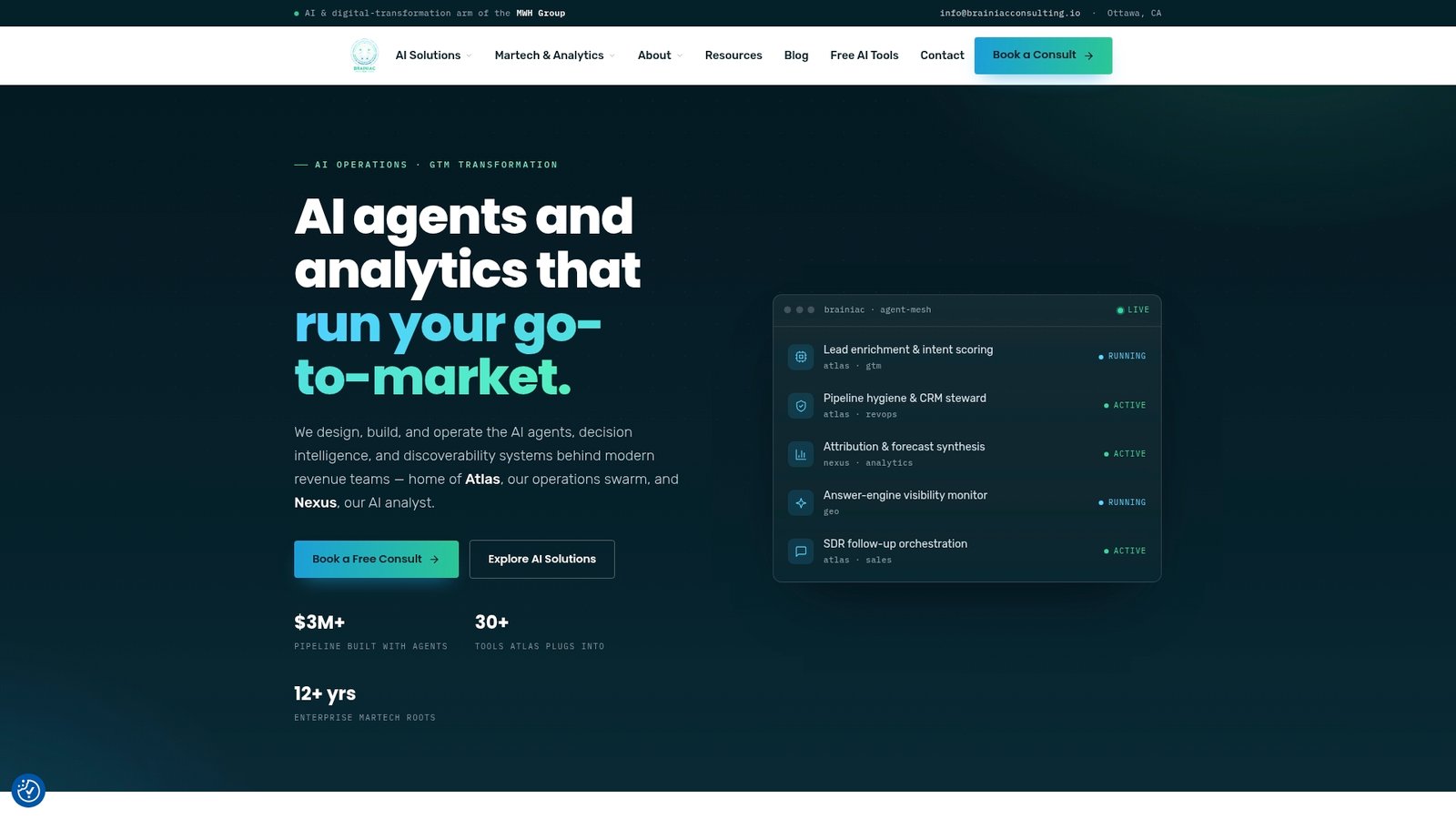
The Generative Engine Optimization service encompasses crawler access audits, schema implementation, and measurement to assess brand citation in AI answers. A preliminary AI search citation gap analysis can provide insights into which sources are cited instead of your own, and a citation readiness calculator offers a self-assessment tool.
A discovery call through the main site can help scope a citation-readiness audit and develop a plan to close gaps within a future reporting period.
Sources
The schema.org documentation remains the definitive reference for implementing Article, FAQPage, Person, and Organization JSON-LD correctly. For engine-specific tactics, Why Optimize for ChatGPT breaks down ChatGPT-specific visibility factors, and the ChatGPT vs. Gemini vs. Claude vs. Perplexity comparison is a useful companion to the per-engine differences covered above. For citation format guidance when disclosing AI-assisted work, see Grammarly’s guide to citing ChatGPT.
- LLM SEO: The B2B Guide to Getting Cited in AI Search
- LLM SEO: The 2026 Guide to Ranking in AI Search Engines
- Large Language Model Search Engine Optimization (LLM SEO): What It Is & How It Works
- Schema
FAQ
What is LLM in SEO?
LLM SEO is the practice of optimising web content so large language model powered answer engines, like ChatGPT, Gemini, and Perplexity, retrieve and cite it directly in generated answers. It shifts the unit of optimisation from the whole page to the standalone passage a model can extract and quote.
What’s the difference between traditional SEO and LLM SEO?
Traditional SEO targets a ranking position for a whole page in a search results list. LLM SEO targets citation inside a synthesized answer, which depends on passage-level clarity, schema, and entity signals as much as ranking. Most AI-cited pages already rank on page one organically, so the two disciplines overlap far more than they compete.
Which LLM is best to optimise for?
There’s no single best engine to target, because each retrieves differently: ChatGPT leans on Bing and reference sites, Perplexity favours fresh and community sources, and Gemini and Google AI Overviews reward structured, entity-rich content. A practitioner-first approach, like the crawler audits and schema work in Brainiac Consulting’s GEO service, targets the signals shared across all four rather than chasing one engine.
Is SEO going away because of AI answer engines?
No. Traditional organic ranking remains the foundation most AI engines retrieve from, so technical and content SEO work still matters. What’s changing is the added layer of passage structure, schema, and original data needed to win the citation once your page is already in the retrieval pool.
What does Brainiac Consulting charge for LLM SEO work?
Pricing for Generative Engine Optimization and related services isn’t published; current rates and engagement scopes are available directly through Brainiac Consulting’s site.