An AI crawler access audit answers a narrow technical question: can the relevant bot request the page, receive the intended response, and read the content you expect it to read?
That is worth proving before you rewrite a page for AI search. If access is broken, content changes cannot fix the transport layer. If access works, the audit has done its job. It has not proved that an answer engine will select, cite, or recommend the page.
This boundary matters because crawler purpose, access, retrieval, and citation are different events.
Start with purpose, not a list of bot names
A user-agent name does not tell you what the request is for. Some bots gather material for model training. Others support search discovery, live retrieval, or browser-agent tasks. Policies that treat every AI bot as interchangeable can block a surface the business wants while allowing one it meant to restrict.
OpenAI, for example, separates OAI-SearchBot access for ChatGPT search from GPTBot controls for potential model training. Its publisher guidance says allowing OAI-SearchBot helps content become eligible for summaries and snippets. It does not promise inclusion. OpenAI’s publisher FAQ is the source to check for that distinction.
Build a crawler-purpose register with four fields:
| Crawler | Stated purpose | Desired policy | Evidence owner |
|---|---|---|---|
| Named user agent | Search, training, retrieval, agent task, or unknown | Allow, block, or investigate | Web, security, legal, or content owner |
Do not copy a third-party bot list and call the register complete. Provider documentation changes, user agents can be spoofed, and some requests arrive through other services. Record the source and review date for each entry.
Follow the request through every control layer
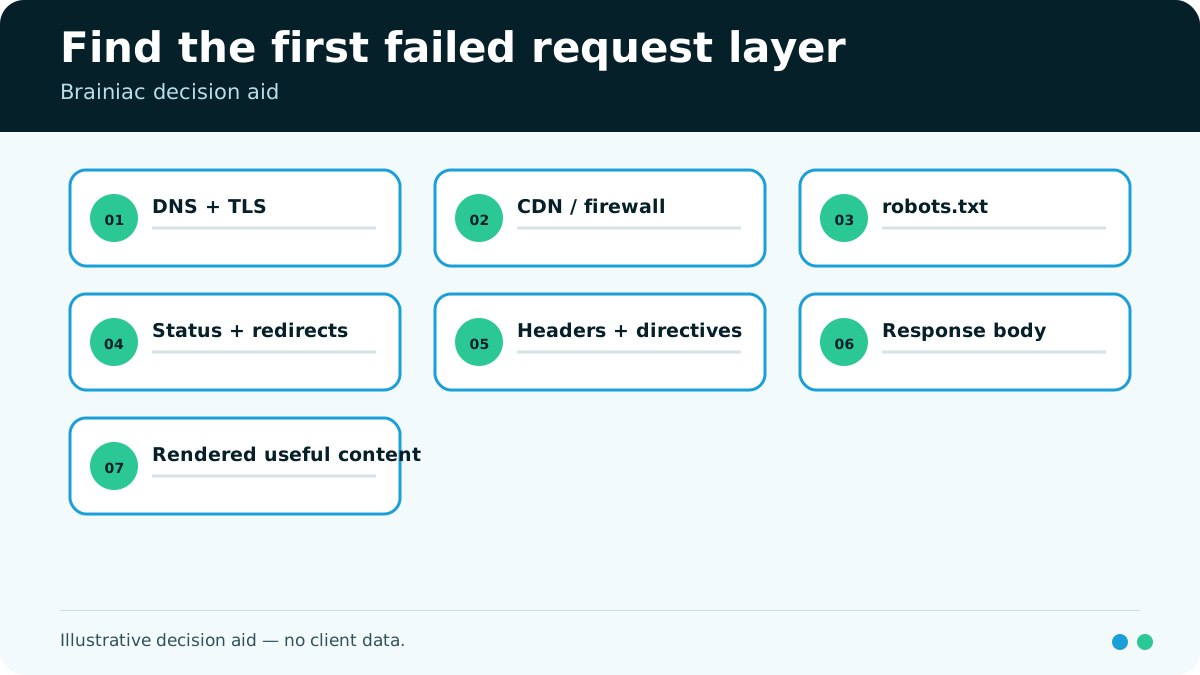
Robots.txt is only one layer. A request can pass robots policy and still fail at the content delivery network (CDN), web application firewall, origin, application, redirect, or rendering layer.
Test the same priority URL through this order:
- DNS and TLS reachability
- CDN and firewall decision
- Robots.txt policy for the named crawler
- HTTP status and redirect chain
- Response headers and page-level robots directives
- Response body and rendered body
- Canonical page path and content completeness
The order prevents a common diagnostic mistake. If a firewall returns a challenge page, debating the wording of robots.txt is premature. If the origin returns a clean 200 response but the article exists only after client-side JavaScript runs, the status code alone is not enough.
Cloudflare’s AI Crawl Control documentation describes monitoring crawler activity, applying crawler-specific policies, and reviewing robots compliance. Whether or not you use Cloudflare, the useful idea is to compare declared policy with observed requests and responses.
Collect server evidence, not browser impressions
Your browser is not the crawler. A page that loads for a logged-in person may behave differently for a non-browser user agent, a different network, or a request without cookies.
For each test, retain:
- Timestamp in UTC
- Requested URL
- User agent and verification method
- Source IP or provider verification result, where available
- CDN or firewall action
- Origin status
- Final status after redirects
- Response headers
- Response-body hash
- Visible-content comparison
- Trace or request ID
User-agent strings alone are weak evidence because they can be forged. When the provider publishes an IP verification method or your CDN verifies known bots, retain that result beside the request. Label unverified traffic as unverified rather than assigning it to a provider with certainty.
Compare response HTML with the useful page
Many audits stop after a 200 response. That proves the server returned something. It does not prove that the response contains the information a crawler needs.
Check whether the first response includes the page title, main explanation, meaningful headings, links, dates, and source references. Then compare it with the browser-rendered page. Large differences may reveal content that depends on JavaScript, blocked resources, consent state, personalization, or an application error.
The goal is not perfectly identical markup. It is equivalent useful content. Navigation animation can differ. The main answer, evidence, and links should not disappear.
Run this comparison across representative templates. A site can serve the homepage and articles correctly while failing on product pages, documentation, or dynamically generated resources.
Turn failures into a diagnostic path
Classify each result by the first failed layer:
| Result | Meaning | Owner’s first question |
|---|---|---|
| No request observed | The bot may not have visited, or logging may be incomplete | Can we run a controlled fetch or verify log coverage? |
| Blocked before origin | CDN or firewall policy intervened | Was the rule intentional and bot identity verified? |
| Robots disallow | Declared policy blocks the path | Does policy match the crawler’s purpose? |
| Redirect, 4xx, or 5xx | The requested path did not return the intended page | Is the failure bot-specific or universal? |
| 200 with thin response | The server replied, but useful content may be missing | Is key content added only after JavaScript? |
| Complete response | Technical access works for this test | Move to content and answer-level analysis separately |
This table is deliberately unromantic. It keeps the audit focused on evidence that a web, security, and content team can review together.
Do not convert access into a citation claim
A crawler visit is proof of a request. An allowed response is proof of access. Neither is proof that the page entered an answer, influenced a model, earned a citation, or produced a visit.
Keep those measures in separate records:
- Access evidence from server or CDN logs
- Answer observations from a fixed question set
- Citation and link observations from those answers
- Referral visits in first-party analytics
- Qualified actions under the organization’s attribution rules
The separation protects the team from celebrating a technical fix as a market outcome. It also makes a later result more useful. If access is clean but a page remains absent from observed answers, the next investigation moves to source fit, content, evidence, or the wider source set.
Brainiac can help technical and marketing teams establish that access evidence and connect it to a broader GEO baseline. The useful deliverable is not a magic crawl score. It is a request-by-request record of what passed, what failed, and which layer owns the repair.