
A single AI visibility score is attractive because it turns a complicated question into a tidy number. It is also a weak foundation for decisions.
Generative search systems use different crawlers, retrieval methods, query rewrites, reports, and user context. Their answers and supporting sources can vary. Compressing all of that into one score hides the distinctions a marketing or web team needs to act.
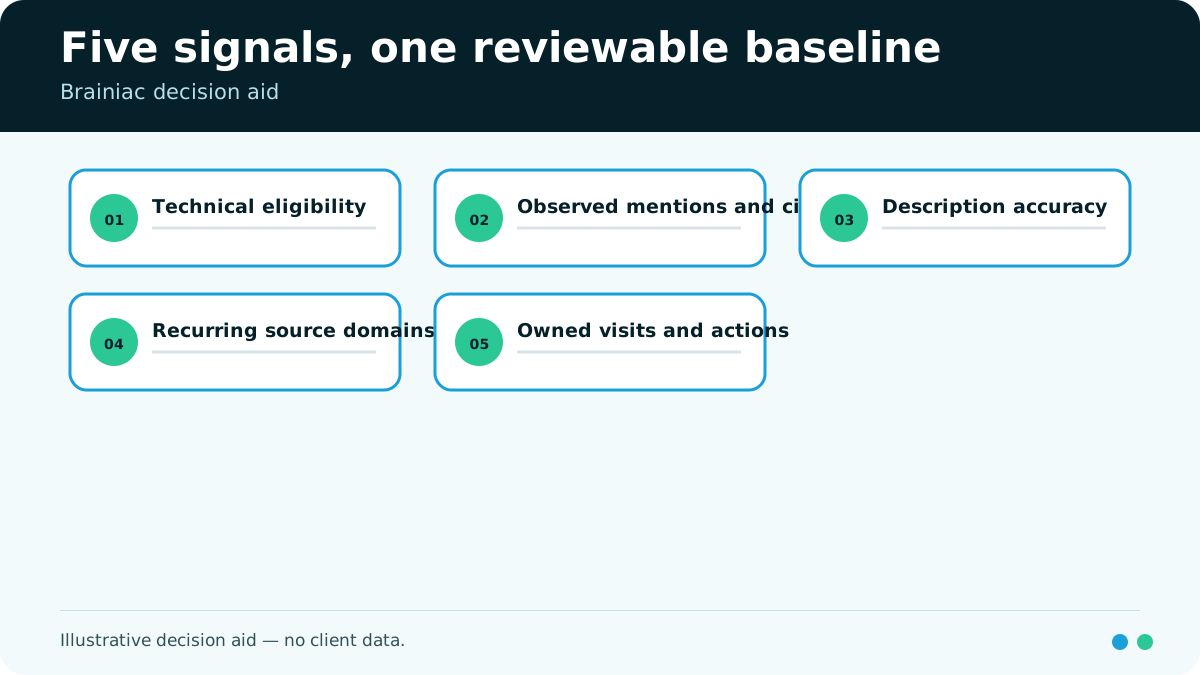
A defensible audit should preserve those distinctions. It should show where your content is technically eligible, where it appears in observed answers, how accurately it is described, which sources shape those answers, and whether any observable visits or qualified actions follow.
Start with the question the score cannot answer
Before reviewing a dashboard, ask what its score represents:
- Which answer systems were tested?
- Which questions were asked?
- When and from what context were they asked?
- Was the brand mentioned, cited, linked, or merely associated with a topic?
- Were technical eligibility and answer inclusion treated separately?
- Does the score include traffic or conversion data?
- Which data is unavailable?
A third-party tool can be a useful workflow aid. It can organize tests, preserve observations, and reveal patterns. But Google explicitly warns that third parties do not have access to its internal ranking or AI systems. A proxy should therefore be treated as an observation method, not ground truth.
The practical response is not to invent a better blended score. It is to build a multi-signal baseline.
Establish a stable question set
Create a set of questions that reflects how buyers investigate the category, problem, options, requirements, and tradeoffs relevant to your business. Include realistic variations in wording, because the initial prompt is not necessarily the exact query used for retrieval.
Google says its AI features may use query fan-out, while OpenAI says ChatGPT Search may rewrite a prompt into one or more targeted searches. OpenAI also notes that general location can influence results. This means a single prompt and response should not be presented as a fixed ranking.
For every test, retain:
- The exact question
- The answer system and date
- Any relevant location or account context you can legitimately record
- The complete raw response
- Brand and product mentions
- Linked or cited sources
- A note about description accuracy
Version the question set whenever it changes. Otherwise, a reported improvement may merely reflect different questions.
There is no universal prompt count or ideal testing frequency. Choose a sample that matches the decisions you need to make, then state its limits plainly.
Separate eligibility from appearance
A page cannot contribute if a system cannot access or use it, but access does not guarantee that the page will appear.
For Google, established SEO practices remain relevant to generative AI features. A page must be indexed and eligible for a snippet to be eligible as a supporting link in AI Overviews or AI Mode. Eligibility is only a prerequisite. It is not evidence of inclusion or ranking.
For ChatGPT search experiences, OpenAI advises publishers to allow OAI-SearchBot if they want content to be eligible for summaries and snippets. Again, crawler access does not guarantee appearance or placement.
Keep technical checks in their own audit view:
- Can the relevant crawler access the page?
- Is the page indexed where index reporting is available?
- Is it eligible for a normal search snippet?
- Do canonical, redirect, robots, or rendering choices interfere?
- Is the important information actually present on the accessible page?
This view diagnoses whether the content can participate. It should not be reported as proof that the content is being selected.
Record answer-level evidence
The second view should describe what you actually observed. For each question, note whether the organization, product, or page was:
- Mentioned without a link
- Used as a cited or linked source
- Described accurately
- Omitted from the observed answer
- Represented through another source
Also track recurring source domains. If answer systems repeatedly rely on a trade publication, directory, documentation site, or competitor page, that is useful diagnostic evidence. It can reveal where the accessible source landscape differs from your preferred narrative.
Do not jump from that pattern to a causal claim. A recurring source does not prove why your page was omitted. It gives you a focused place to compare coverage, clarity, evidence, and technical accessibility.
Connect observations to owned measurement
Answer observations should be paired with whatever first-party measurement is available for the same period.
OpenAI says ChatGPT referral URLs include utm_source=chatgpt.com, which provides one observable traffic signal. Google announced dedicated generative-AI Search Console reports for a subset of sites in June 2026, but that coverage is Google-specific and not universally available.
Useful measurement views include:
- Observable referral visits
- Landing pages receiving those visits
- Qualified actions completed during those sessions
- Assisted pipeline signals, where attribution rules support them
- Unknown or unavailable traffic sources
Avoid claiming that a page edit caused a later mention, visit, or conversion unless the evidence supports that conclusion. The audit can show timing and association. It usually cannot expose the complete retrieval process or prove causality.
Report dimensions, not a single verdict
A useful audit summary can fit on one page without becoming one score. Report these dimensions separately:
- Crawl and index eligibility
- Mentions and citations by question, engine, and date
- Description accuracy
- Recurring source domains
- Observable referral visits and qualified actions
- Unknown or unavailable data
This structure makes action easier. A technical eligibility problem goes to the web team. An inaccurate description calls for clearer source content. Weak coverage across a buyer question set points toward editorial gaps. Missing measurement requires analytics work, not speculative content changes.
Turn the audit into a decision system
The purpose of an AI search visibility audit is not to declare a winner. It is to identify the first weak layer you can responsibly improve.
Preserve raw evidence, timestamps, question-set versions, and sampling limits. Compare like with like over time. Use third-party tools to support the workflow, while retaining the underlying observations needed to challenge their conclusions.
Brainiac’s GEO work can help establish this baseline, trace weak or inaccurate answers to likely source and page gaps, and prioritize technical, content, and measurement changes. It cannot guarantee inclusion, but it can replace an opaque score with a reviewable body of evidence.
Sources
Primary sources used for the factual claims in this article: