
You cannot buy or configure a guaranteed position in ChatGPT. You can improve the conditions under which your public pages are discovered, understood, cited, and measured.
That work begins with crawl access and technically sound pages. It continues with clear, sourceable answers and reliable business facts. Then it uses repeated observations and first-party referral data to decide what to improve.
This is less exciting than a secret ranking factor. It is also more defensible.
Make the right content accessible to the right crawler
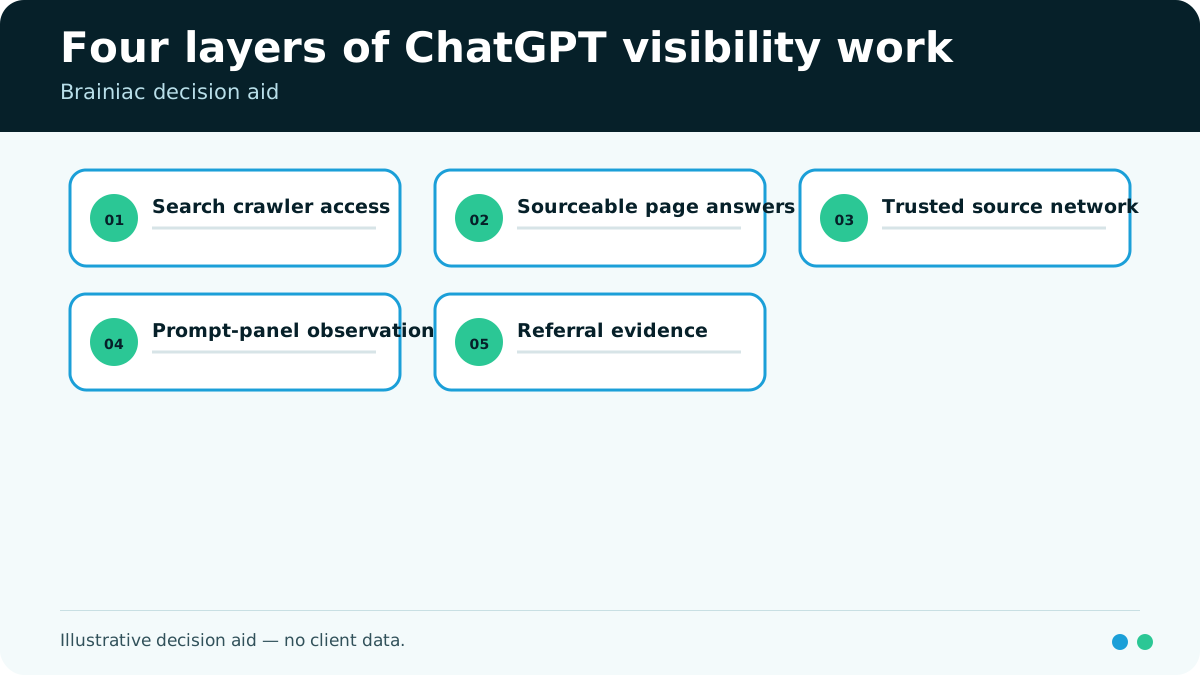
OpenAI says any public website can appear in ChatGPT search. For content to be eligible for summaries and snippets, its publisher guidance says not to block OAI-SearchBot. OpenAI treats GPTBot separately for potential model training. The current publisher FAQ should be the reference for those controls.
Check the specific pages you want people to find:
- OAI-SearchBot is not blocked by robots.txt for those paths.
- The server or CDN does not return a challenge, denial, or error to the request.
- Redirects resolve to the intended canonical page.
- The main answer and supporting facts are present in the response.
- Page-level directives match the business’s intended visibility.
Passing these checks creates eligibility. It does not promise that ChatGPT will choose the page.
Publish answers that can be sourced without reconstruction
Content becomes harder to use when the answer is scattered across slogans, tabs, vague claims, and pages that contradict one another.
For an important buyer question, give the page one clear job. State the answer early. Define the conditions that change it. Place evidence close to the claim. Name dates, units, scope, and ownership where they matter.
Useful source material often includes:
- Original research with a clear method and date
- Product or service facts that match current reality
- Comparison criteria with explicit scope
- Technical documentation tied to a version
- Practitioner explanations that add judgment rather than repeat common definitions
Google’s 2026 guidance for generative search makes a related point: unique, helpful, people-first material is more useful than commodity pages that restate what is already available. It also warns against creating many near-duplicate pages to target query variations. Google’s AI search guidance applies to Google, not ChatGPT ranking, but the editorial principle is sound.
Repair fact conflicts across your own site
An answer engine may encounter a current service page, an old announcement, a directory profile, and a PDF with different descriptions of the same company. A clean new article does not erase those conflicts.
Create a fact register for the statements that buyers and answer systems need to get right:
| Fact type | Examples | Control |
|---|---|---|
| Identity | Company name, relationship, location | One approved form and named owner |
| Offer | What the service does and who it is for | Current canonical page |
| Proof | Permissioned result, method, date, scope | Source link and review date |
| Commercial detail | Availability, package, terms | Current sales or product owner |
| Technical detail | Supported integration or requirement | Versioned documentation |
Fix owned contradictions first. For third-party profiles or articles, record what can be corrected, what requires a relationship, and what is outside your control. Do not manufacture mentions or push unsupported language into external sources.
Strengthen the source network around the question
Your site is not the only source available for an answer. Trade publications, standards bodies, documentation, directories, customer-controlled references, forums, and competitors may supply the context.
Study which sources appear for a stable set of buyer questions. Then ask what each source contributes:
- A definition the market accepts
- Independent evidence
- A comparison or shortlist
- Current product facts
- A practitioner explanation
- A local or industry-specific perspective
The useful response is not automatically “get a link from that domain.” Sometimes your page is missing the actual answer. Sometimes a third-party source has earned authority you cannot reproduce. Sometimes the result varies and no durable pattern exists yet.
Build or improve material only where your organization can add something true and useful. Public relations, partnerships, or directory corrections may be appropriate when they reflect real relationships and accurate information. Outreach for the sake of synthetic mentions is not.
Observe visibility without inventing a rank
Use a fixed panel of realistic buyer questions. Preserve the question, date, raw answer, cited links, brand description, and relevant account or location context. Repeat the panel because one answer is an observation, not a stable position.
Report dimensions separately:
- Mentioned or absent
- Cited or linked
- Description accurate or inaccurate
- Owned page or third-party source selected
- Referral visit observed
- Qualified action observed under existing attribution rules
OpenAI says ChatGPT referral links include utm_source=chatgpt.com, which provides one first-party traffic signal. It does not capture every influence, and a later visit does not prove that a specific content edit caused the answer.
Avoid a single blended score unless the underlying records remain available. A score can help sort work. It should not hide which questions, dates, sources, and systems produced it.
Prioritize the first failed layer
The work queue should follow the mechanism:
- Fix access failures for priority pages.
- Fix incorrect or conflicting owned facts.
- Improve pages that do not resolve the buyer question.
- Add original evidence where the organization can support it.
- Address legitimate third-party fact gaps.
- Improve observation and referral measurement.
This keeps the article downstream from a broad AI visibility audit. The audit tells you where the weakness appears. This implementation path tells you what you can responsibly change for ChatGPT.
Brainiac’s GEO work can help turn observed gaps into a source, content, and technical backlog. It cannot promise a ChatGPT rank or citation. It can make the work traceable enough to know what changed and whether the observed evidence changed with it.