
A citation-gap analysis begins after you have a stable question set and captured answer sources. Its job is to explain which sources appear where your organization does not, what those sources contribute, and which response is feasible and honest.
It is not another visibility audit. The audit produces the baseline. The gap analysis turns that baseline into a source and content plan.
The most important discipline is to avoid treating every missing citation as a page defect. The selected source may offer independent evidence, a format, a relationship, or an authority your owned page cannot simply imitate.
Freeze the baseline before comparing sources
Use the same buyer-question panel, answer systems, dates or sampling window, and capture method used in the baseline. Preserve the raw answers and exact cited URLs.
For each observation, retain:
- Question and topic
- Engine and date
- Your brand mentioned or absent
- Your domain cited or absent
- Selected domains and exact URLs
- Claim or answer segment each source supports
- Source type
- Description accuracy
- Relevant account or location context
Do not merge mentions and citations. A brand can be named without its site being used as a source. A source can be cited in an answer that never names the brand.
Repeated runs matter because source selection can vary. Report how often a pattern appeared in your sample, not as a universal property of the engine.
Map each claim to the source that supports it
A domain-level count can show where to look. It cannot tell you why a particular URL was useful.
Read the cited page and identify the claim it supports. Then compare that claim with your current source coverage. A source map might look like this:
| Buyer question | Answer claim | Selected source | Source type | Your current coverage | Feasible response |
|---|---|---|---|---|---|
| Category comparison | Independent strengths and limits | Trade publication | Editorial third party | Owned comparison only | Supply verifiable facts; do not mimic independence |
| Implementation question | Versioned setup steps | Vendor documentation | Primary technical source | Outdated docs | Update canonical documentation |
| Risk question | Standard or control guidance | Standards body | Independent authority | Unsourced assertion | Cite the authority and narrow the claim |
| Product-fit question | Current capabilities and limits | Product page | Owned primary source | Facts split across pages | Consolidate a clear canonical answer |
This turns “competitor got cited” into a specific information problem.
Classify the gap before choosing the remedy
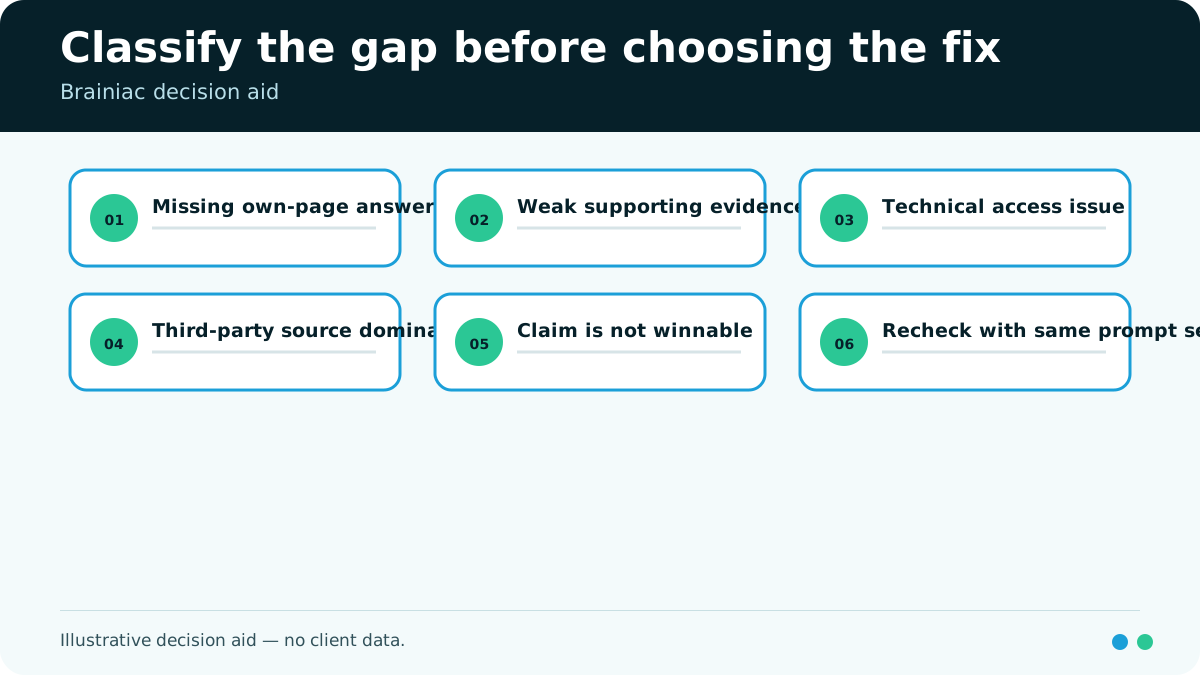
Four gap types cover most useful cases:
Coverage gap
Your sources do not answer the question or omit a material condition. The remedy may be new content, documentation, research, or a revision to an existing canonical page.
Evidence gap
The page makes a claim without the primary data, method, source, date, or scope needed to support it. Add evidence only if it exists and can be published. Do not manufacture precision.
Source-role gap
The answer relies on an independent publication, standard, review, or community source. Your company page cannot become independent by adopting the same structure. The remedy may be accurate public facts, permissioned proof, legitimate analyst or media relations, or no action.
Access or freshness gap
The right owned page exists but is blocked, stale, redirected, duplicated, or inconsistent. Fix the technical or governance issue before creating another page.
The classification keeps the work narrower than a broad AI-search audit and prevents a generic “write more content” recommendation.
Score feasibility without predicting citations
Prioritize work by business relevance, evidence ownership, source role, effort, and controllability. Do not estimate a probability of citation unless you have a defensible model and data for that exact use.
A practical decision table uses qualitative labels:
| Factor | Strong candidate | Weak candidate |
|---|---|---|
| Buyer relevance | Material to an active decision | Peripheral curiosity |
| Evidence | Brainiac or the client owns publishable evidence | Claim depends on unavailable proof |
| Source role | Owned source is appropriate | Independent judgment is the value |
| Control | Page, documentation, or fact can be changed | Selection depends on external editorial choice |
| Reuse | Fix improves several important questions | One unstable observation only |
| Risk | Claim can be stated accurately and safely | Fix invites unsupported performance language |
The output should be a small action queue with reasons, not a long list of domains to chase.
Treat third-party sources with restraint
Competitor methods often turn cited domains into outreach targets. Similarweb’s current guide, for example, compares topics, domains, URLs, and proprietary influence measures before planning content and relationship work. Similarweb’s citation-gap guide is useful market evidence, but its metrics and recommendations belong to its platform and method.
Your own analysis should separate three cases:
- The source contains an inaccurate fact that can be corrected respectfully.
- The source covers the topic but lacks verifiable information your organization can supply.
- The source made an independent editorial choice that you do not control.
Only the first two create a plausible relationship task. Even then, the goal is accurate and useful source material, not a promised citation outcome. Do not buy hidden endorsements, create synthetic mentions, or pressure publishers to state what the evidence cannot support.
Connect every action to a recheck
For each approved change, record the exact pages or sources affected and the observations it is intended to address. After the change is available, repeat the same question panel and retain the new raw evidence.
Compare:
- Access and page freshness
- Source selection within the same question set
- Accuracy of brand or product descriptions
- Owned versus third-party source use
- Referral visits, where observable
- Qualified actions under existing attribution rules
Movement can be associated with the change in time. It should not be called causal proof unless the test design supports that conclusion.
Produce a source plan, not a citation promise
The final deliverable should name the gap type, affected buyer question, chosen source, required evidence, owner, action, and recheck method. It should also say when no responsible action exists.
Brainiac can help turn a completed GEO baseline into that source-level plan. The value is better allocation: technical repair where access is broken, editorial work where coverage is weak, evidence development where proof is missing, and restraint where the selected source plays a role an owned page cannot replace.