The best first workflow for an AI agent is rarely obvious from the cost ledger. A large, visible process may promise substantial value while also carrying broad permissions, unclear exceptions, and consequences that are difficult to reverse.
A better first candidate is frequent enough to generate learning, bounded enough to contain harm, and clear enough to evaluate against real work. It should make meaningful use of unstructured information or contextual judgment. Stable, predictable rules may be better served by deterministic automation.
This is a selection problem, not a contest to automate the biggest department.
Start with a workflow, not a function
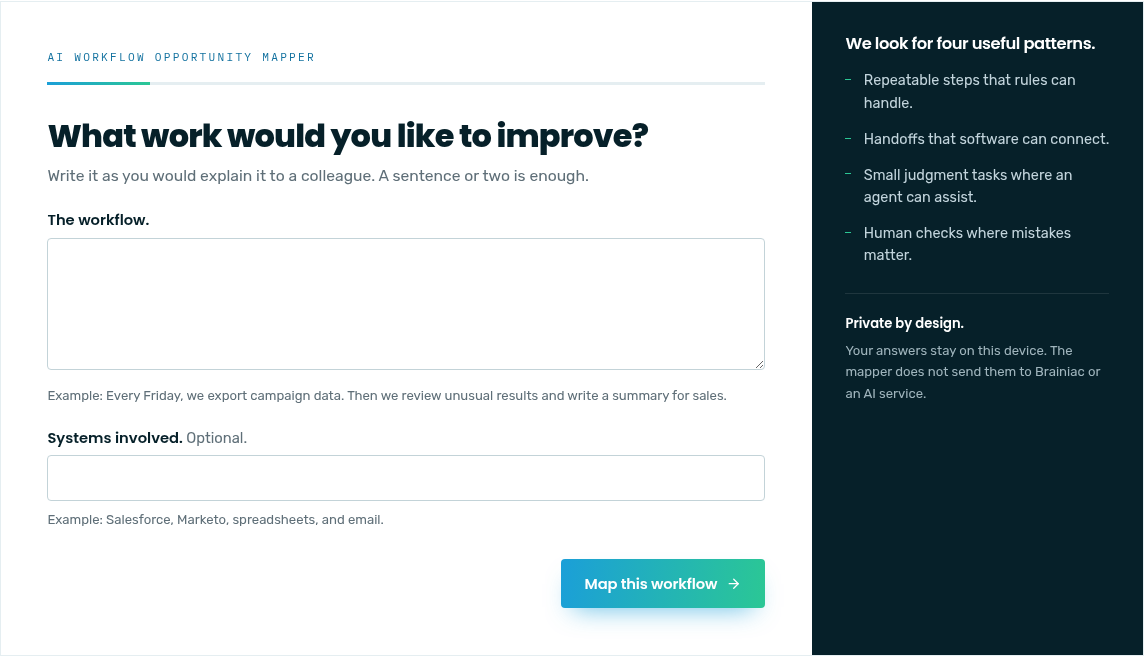
“Finance operations” and “shared services” are organizational areas. They are not workflows.
A candidate should have:
- A specific trigger
- Defined inputs
- A repeatable sequence or decision boundary
- A clear end state
- Known owners
- Identifiable exceptions
- Observable outcomes
Narrow framing makes evaluation possible. It also reveals the actual systems, data, permissions, and consequences involved.
For example, “invoice exception preparation” is a candidate category. It is narrower than accounts payable, but it still needs further definition: which exception types, what information is gathered, what recommendation is produced, and who makes the final decision?
Confirm that agentic behavior adds value
OpenAI recommends considering agents for workflows involving complex decisions, brittle or difficult-to-maintain rules, and substantial unstructured data. When those conditions are absent, it says a deterministic solution may suffice.
Use that distinction early. Ask whether the work involves interpreting documents, combining context from several sources, or navigating exceptions that cannot be expressed economically as stable rules.
If the same validated steps should occur for every case, a conventional automation may be easier to test and operate. The goal is not to maximize agent use. It is to choose the right execution model.
Screen candidates across separate dimensions
Do not collapse the selection into one average score. High value and high risk are different dimensions, and a critical control gap can outweigh an attractive total.
Frequency and value
A first workflow should occur often enough to produce useful evidence and operational learning. Consider both the value of a completed case and the frequency of cases.
Avoid relying only on aggregate annual cost. A high-cost process may contain many distinct workflows with different controls and outcomes.
Variation and unstructured input
Assess how much the work depends on emails, documents, notes, contracts, forms, or contextual judgment. Variation can make a workflow a stronger agent candidate, but only when the boundaries remain understandable.
Unbounded variation is a warning sign. If the team cannot describe common paths and meaningful exceptions, it will struggle to build a representative test set.
Boundary clarity and end state
The agent needs a defined point at which work begins and a verifiable state that means it is complete.
Anthropic recommends defining tasks and success criteria early and checking outcomes as well as traces. A claim of completion is not enough. The record, file, decision package, reconciliation, or downstream state must match the expected outcome.
Data availability
Identify required data and whether the proposed execution identity can access it reliably. Missing access, inconsistent identifiers, stale sources, or unclear ownership can make an otherwise promising workflow unsuitable for the first release.
Do not assume a broad data-modernization program is necessary. Determine the minimum data required for this candidate and evaluate that scope.
Exception discoverability
A team should be able to identify common exceptions and recognize when a new case falls outside the tested boundary.
Known exceptions can become test cases, escalation rules, or deterministic checks. Unknown and undetectable exceptions increase the risk that the agent will proceed confidently without appropriate review.
Reversibility and permission scope
OpenAI recommends assessing tools by read versus write access, reversibility, account permissions, and financial impact. Higher-risk actions should trigger checks or escalation.
Separate capabilities such as reading, preparing, proposing, and executing. A workflow might be a strong first candidate for recommendation mode but a poor candidate for autonomous writes.
Impact and review capacity
Assess customer, financial, security, and operational consequences separately from value. Then confirm that qualified people have capacity to compare proposed outcomes with actual work.
A pilot without an available owner cannot produce reliable feedback. The owner must understand the process, adjudicate ambiguous cases, and help maintain the evaluation set.
Testability
Ask whether expected outcomes can be defined before execution. Determine what evidence will be retained and which failures should act as gates rather than averaged defects.
NIST calls for documented roles, test sets, metrics, monitoring, and incident practices. If these cannot be assigned for a candidate, it is not yet ready to run first.
Use candidate categories as a screening list
Potential back-office categories include:
- Document intake and classification
- Invoice exception preparation
- Reconciliation support
- Internal request triage
- Vendor review preparation
- Master-data change proposals
- Reporting-pack assembly
These are not automatic winners and do not imply existing deployments. Each category must be narrowed into a specific workflow and assessed against the same dimensions.
A useful comparison table can keep the decision honest:
| Dimension | Evidence to collect |
|---|---|
| Frequency | Case volume over a relevant period |
| End state | Observable completion criteria |
| Data | Required sources and access conditions |
| Exceptions | Known categories and escalation triggers |
| Actions | Read, propose, write, and approve boundaries |
| Risk | Reversibility, permissions, financial and customer impact |
| Ownership | Process, review, monitoring, and incident owners |
| Testability | Reference cases, outcome checks, and regression plan |
Use the table to expose tradeoffs, not to manufacture a universal passing score.
Graduate the workflow in stages
Once a candidate is selected, avoid treating production as one switch. Test reading and extraction first, then drafting or recommendations, then reversible writes, and finally any higher-impact actions if the evidence supports them.
Maintain regression tests as prompts, models, tools, policies, and source systems change. Anthropic recommends evaluating outcomes and traces and preserving regression coverage over time.
The first workflow should teach the organization how to define work, evaluate variation, enforce access, handle exceptions, and operate incidents. That learning is part of its value.
Choose the right implementation wedge
Atlas fits standardized, repeatable operational patterns that can be delivered as productized operations. Agentic Workforce fits a workflow whose systems, controls, integrations, or decisions require custom implementation.
Neither model is inherently superior. The workflow determines the fit.
Brainiac can help map candidate workflows against value, boundary, risk, ownership, and testability, then identify whether a productized Atlas pattern or a custom Agentic Workforce implementation is appropriate. The decision should follow the evidence, not the prominence of the process.
Sources
Primary sources used for the factual claims in this article: