
AI agent deployment means moving an agent from a working prototype into a governed, monitored production system that survives real traffic, real failures, and real audits. For enterprise teams, the recommended path is architecture first: match your execution model (stateless, stateful, or event-driven) to how the agent actually behaves, wire in observability and cost controls before launch, and gate every promotion behind governance checks. Start with a scoped pilot validated through shadow deployment before anything touches production traffic.
TL;DR:
- Deployment requires matching the agent’s execution model to its infrastructure, with emphasis on observability, governance, and cost controls before launch.
- Choosing the correct architecture pattern, such as stateless, stateful, event-driven, or multi-agent systems, is critical because changing it later is costly and complex.
- Runtime and storage should be selected based on the agent’s need for statefulness, with managed agent runtimes offering a balanced middle ground for security and control.
- Building an orchestrator with task routing, memory management, and conflict resolution is essential for scaling multi-agent systems effectively and securely.
- Continuous monitoring of token spend, latency, success rate, and failure count is vital to detect issues early and avoid unanticipated costs or poor performance.
Table of Contents
- What does AI agent deployment actually involve?
- Which architecture pattern fits your agent?
- What infrastructure and runtime should you provision?
- How should orchestration and multi-agent systems be designed?
- How do you build a CI/CD pipeline for agent workloads?
- How do you secure and govern deployed agents?
- What should you monitor once agents are live?
- How do you control cost and scale a growing agent fleet?
- What does a deployment readiness checklist look like?
- How does Brainiac Consulting approach production agent deployment?
- What do enterprise rollouts actually teach you?
- Brainiac’s Atlas AI Operations Platform for governed production deployment
- Sources
What does AI agent deployment actually involve?
Deploying an AI agent is not the same job as building one. A prototype proves an idea works in a notebook or a demo. Production deployment proves it keeps working when a thousand concurrent sessions hit it, when a downstream API times out, and when someone tries to make it do something it shouldn’t. IBM frames this as a distinct engineering discipline built around design, infrastructure selection, integration, governance, and ongoing monitoring, not a bolt-on step after the model is trained.
Most teams that struggle at scale made the same mistake: they treated agent deployment like deploying a stateless web API. Agents hold context across turns, call external tools mid-task, and sometimes run for minutes or hours. A request-response deployment model breaks under that weight because it has no concept of a task that survives a pod restart.
The stages worth planning around look like this:
- Design: define the agent’s scope, tool access, and failure modes before writing infrastructure code.
- Infrastructure selection: pick the runtime and storage tier that match statefulness needs.
- Integration: connect the agent to CRMs, data warehouses, and internal APIs with defined contracts.
- Security and governance: set permissions and audit logging before the agent touches production data.
- Deployment: ship through a pipeline with health checks and rollback paths.
- Monitoring and iteration: watch cost, latency, and task success, then adjust.
Ownership matters here. Platform engineering typically owns the runtime and CI/CD pipeline, SRE owns uptime and incident response, security owns permissioning and audit review, and product owns the KPIs that define whether the agent is actually doing its job. When one team tries to own all of it, something gets skipped, usually observability or governance.
Which architecture pattern fits your agent?
The execution model you choose early is one of the most consequential decisions in the whole project, because changing orchestration patterns after wide deployment is expensive. Get this wrong and you will rebuild memory design, testing, and governance from scratch later.
Four patterns cover most enterprise use cases:
- Stateless agents handle one-shot tasks with no memory between calls, such as a classification or enrichment step. They scale horizontally with almost no coordination overhead and are the easiest to test.
- Stateful agents maintain context across a session, like a research assistant that remembers earlier turns. They need persistent storage and careful recovery logic when a process crashes mid-task.
- Event-driven agents react to a stream of triggers (a new lead, a support ticket, a CRM update) rather than direct calls. They fit naturally into existing message queues but add latency and require idempotent handling of duplicate events.
- Multi-agent orchestrated systems split work across specialist agents coordinated by a router or planner. They handle complex workflows well but multiply the surface area for failure and governance risk.
MachineLearningMastery’s architecture roadmap frames these as core topology choices, each carrying different trade-offs in recoverability, latency, and testability. A stateless agent is trivial to roll back; a stateful agent mid-task is not. An event-driven agent decouples cleanly from your API surface but makes debugging a live incident harder because the trigger and the failure are separated in time.
The orchestration choice you lock in early also determines how you’ll test the system later. Stateful and multi-agent designs need integration tests that simulate multi-turn conversations, not just unit tests on individual tool calls.
What infrastructure and runtime should you provision?
Your runtime choice should follow your statefulness needs, not the other way around. Forcing a stateful agent onto infrastructure designed for stateless workloads is one of the most common causes of silent data loss in early deployments.
Here’s how the common options break down:
- VPS or single-server deployments work for internal pilots and low-volume tools where you control every variable, but they don’t scale past a handful of concurrent agents without manual intervention.
- Platform-as-a-Service (PaaS) options reduce operational burden and suit teams without dedicated platform engineers, though you trade away fine-grained control over networking and scheduling.
- Kubernetes gives you the most control over scheduling, scaling, and multi-tenancy, but it demands real platform expertise to run safely. This is where most of the five-layer stack, compute, storage, communication, observability, and security, gets built explicitly rather than inherited from a managed provider.
- Managed agent runtimes deliver Kubernetes-level capability, including persistence, RBAC, audit trails, and observability, without requiring you to hire a full platform team. For many enterprises this is the pragmatic middle path.
Storage needs a tiered approach: fast ephemeral memory for in-session context, a durable store for long-term knowledge or user history, and a model gateway layer that mediates every call to an LLM provider so you can swap models without touching agent code. Secrets management and identity propagation deserve equal weight. Every tool the agent calls needs a scoped credential, rotated on a schedule, with egress rules that block the agent from reaching endpoints it has no business touching. Declarative infrastructure-as-code approaches, using manifest files that define agent permissions, cost limits, and deployment targets, let you enforce these rules consistently across dozens of agents instead of configuring each one by hand.
How should orchestration and multi-agent systems be designed?
An orchestrator is the traffic controller for a multi-agent system, and enterprises that skip building one properly tend to hit a governance wall as their agent fleet grows. It needs a task routing engine, a memory layer, a way to resolve conflicting outputs, and a monitoring hook, none of which are optional once you’re running more than two or three agents together.
Routing comes in two flavours. Rule-based deterministic routing sends a task to a fixed agent based on explicit conditions, which is predictable and easy to audit but brittle when new task types appear. LLM-based dynamic routing lets a planner model decide which specialist agent should handle a task, which adapts better to novel requests but is harder to test exhaustively and can misroute in ways that are difficult to trace after the fact.
Memory also splits into tiers that serve different jobs:
- Ephemeral session memory holds context for the current task and disappears when it’s done, keeping costs and privacy exposure low.
- Durable knowledge stores persist facts, prior decisions, or customer history across sessions, feeding retrieval systems that ground future agent responses.
- Shared cross-agent memory lets specialist agents in the same workflow see each other’s outputs, which speeds coordination but raises the stakes if one agent writes bad data.
When two agents disagree, you need a resolution mechanism rather than a coin flip. Simple majority voting works when you have three or more agents attempting the same task independently. Confidence scoring, where each agent attaches a certainty value to its output, works well when agents have different specialisations and you want the most confident answer to win. Quorum-based approval, requiring agreement from a minimum number of agents before an action executes, suits high-stakes actions like financial approvals or customer-facing commitments where a wrong call is expensive.
How do you build a CI/CD pipeline for agent workloads?
Standard web app pipelines don’t account for long-running sessions, in-flight tasks, or the probabilistic nature of LLM outputs. Agent pipelines need extra stages built specifically for that.
- Build: containerize the agent with a pinned runtime and model version so you know exactly what shipped.
- Provision infrastructure: apply declarative manifests for compute, storage, and network policy.
- RBAC and approval gate: require a named approver to sign off before the build can reach a production target.
- Deploy: push to the target runtime, whether that’s a managed platform, Kubernetes cluster, or serverless target like Cloud Run. Google’s agents-cli documentation shows this pattern concretely, with commands that provision infrastructure, build the container, and deploy to targets like GKE or managed runtimes in one flow.
- Health checks: confirm the agent responds correctly to synthetic test tasks before routing real traffic.
- Telemetry registration: connect logging and metrics pipelines so the new version is observable from its first request.
Validation has to go beyond a green test suite. Run synthetic workloads that mimic real task distributions, then run a shadow deployment: route real production traffic to both the old and new agent version simultaneously and compare outputs before the new version ever serves a user directly. Automated promotion gates should require the divergence between versions to stay under a defined threshold before cutover.
For rollback, stateless agents can simply revert to the prior container image. Stateful agents need a drain-and-swap approach: stop routing new sessions to the old version, let in-flight tasks finish naturally, then decommission it once the queue is empty.
How do you secure and govern deployed agents?
Every tool call an agent makes is a potential liability if it’s not scoped and logged. Governance isn’t a compliance afterthought, it’s a runtime control that has to be enforced the same way memory and routing are.
Start with per-agent tool permissioning built on a least-privilege model: an agent that enriches leads should never have write access to your billing system, even if the same underlying model theoretically could generate that request. Layer in immutable audit logs that capture every tool call, every state change, and every decision the agent made, timestamped and tied to a specific agent version. MIT Technology Review’s analysis of orchestration risk makes the point directly: multi-agent systems raise both the productivity ceiling and the systemic risk floor, and governance has to be enforced at runtime, not just documented in a policy.
- Scope tool access per agent, never per team or per environment.
- Log every action immutably, including failed and denied attempts.
- Map runtime guardrails to a recognised framework like the NIST AI Risk Management Framework.
- Require human approval gates for any action with financial or contractual consequences.
- Review permissions on a fixed schedule, not only after an incident.
A structured governance implementation framework helps standardise these controls across a growing agent fleet instead of reinventing them for every new project.
Pro Tip: Build your audit log schema before you write your first agent tool integration. Retrofitting logging onto agents that are already in production is significantly harder than designing it in from the first tool call.
What should you monitor once agents are live?
Deployment success isn’t binary. An agent can be technically online and still be quietly burning budget or giving wrong answers to half its users, and you won’t know unless you’re watching the right signals.
Four metrics matter more than the rest: token spend per agent, latency per task, task success rate, and restart count. Token spend deserves first-class treatment as an operational signal, not an afterthought buried in a monthly billing report, because a single misbehaving agent can rack up costs fast if nobody’s watching in real time.
Many organisations report relying on AI agents in daily operations, yet many of them still lack the orchestration and governance to manage that reliance safely, according to Dataiku’s research on enterprise agent orchestration. That gap between adoption and control is exactly what a monitoring plan needs to close.
Beyond the four core metrics, build out:
- Structured logs that trace the full decision path: which tools were called, in what order, with what inputs.
- Distributed tracing across agent hops so a slow multi-agent workflow can be diagnosed hop by hop.
- Egress destination tracking, flagging any agent calling an endpoint outside its expected allowlist.
- Dashboards segmented by agent, by team, and by task type, not just a single aggregate view.
- Alerts tuned to rate of change, not just absolute thresholds, since a sudden spike in token spend is often more informative than the raw number.
How do you control cost and scale a growing agent fleet?
Scaling an agent fleet without cost controls is how a promising pilot turns into an unpleasant finance conversation. The fix is the same discipline cloud teams applied to compute a decade ago: quotas, circuit breakers, and clear attribution.
Set token and request quotas per agent, not just per application, so one runaway loop can’t consume the budget allocated to five other agents. Pair every quota with a circuit breaker that auto-kills or throttles an agent when it exceeds its allowance, rather than relying on someone noticing the bill days later.
- Set hard token and request quotas per agent and per team.
- Build automatic circuit breakers that pause an agent exceeding its quota, with alerting attached.
- Attribute cost to the team or business unit that owns each agent for accurate chargeback.
- Isolate tenant data and memory in multi-tenant deployments so no agent can read across tenant boundaries.
- Apply rate limits per tenant to prevent one customer’s workload from degrading service for others.
Cost attribution matters as much for internal politics as for the finance team. When a marketing operations agent’s spend is clearly separated from a sales forecasting agent’s spend, you can make real decisions about which use cases justify their cost and which need retuning. Multi-tenant isolation follows the same logic applied to security: an agent serving one customer’s data should never have a code path that lets it see another’s, regardless of how confident you are that path will never be triggered.
What does a deployment readiness checklist look like?
A safe rollout moves through defined stages, each with its own exit criteria, rather than jumping straight from staging to full production traffic.
- Scope a pilot with a narrow task, a defined KPI (task success rate, cost per completed task, latency ceiling), and a hard stop date for evaluation.
- Run a shadow deployment, routing real traffic to the new agent alongside the current process or a previous version, logging divergence in outputs using defined similarity metrics rather than eyeballing a sample.
- Promote to canary, sending a small, defined percentage of live traffic to the new agent and watching the same metrics you tracked in shadow mode.
- Set explicit rollback triggers: a success rate drop past a fixed threshold, a latency spike, or a cost overrun should automatically halt the rollout.
- Drain and swap for stateful agents, letting in-flight sessions finish on the old version before full cutover.
- Launch fully, keeping the same dashboards and alerts live that you built during shadow and canary phases.
Pro Tip: Define your rollback triggers as numbers before the rollout starts, not during an incident. A team arguing about whether a 4 percent success rate drop qualifies as “bad enough to roll back” while the agent is live has already lost the argument to the clock.
How does Brainiac Consulting approach production agent deployment?
Brainiacconsulting builds and operates AI agents for marketing, sales, and finance teams using an open-source methodology paired with deep integrations into platforms like Salesforce and HubSpot, giving clients full visibility into how their agents behave rather than a black box they have to trust blindly.
The core operational primitives don’t change from client to client: runtime RBAC on every agent’s tool permissions, immutable audit trails on every action, and cost attribution mapped back to the team or campaign that owns each agent. That consistency is what lets a pipeline scale from one pilot agent to dozens without governance becoming an afterthought.
That consistency shows up in results. Brainiacconsulting’s engagements have generated multi-million-dollar pipelines and measurably increased qualified lead volume for clients across different sectors, with detailed case studies documenting how agent deployments moved specific revenue metrics, including one engagement that improved lead-to-opportunity conversion through better pipeline hygiene and automated enrichment.
What do enterprise rollouts actually teach you?
Three lessons hold up across most enterprise agent deployments. First, start small and instrument early: the teams that struggle are almost always the ones that skipped observability to hit a launch date, then had no data when something went wrong. Second, treat governance as a pipeline stage, not a review meeting after the fact. Bolting RBAC on after an incident is far costlier than building it into the first deployment gate. Third, resist the urge to scale fast. The agent fleets that hold up under real load are the ones that grew one measurable, validated stage at a time, not the ones that jumped straight to full rollout because the demo looked good.
— Don
Brainiac’s Atlas AI Operations Platform for governed production deployment
If you’ve read this far, you already know the hard part of agent deployment isn’t the model, it’s everything around it: the runtime, the audit trail, the cost controls, the rollback plan. Building that infrastructure in-house means hiring platform engineers, security reviewers, and observability specialists before your first agent ever earns its keep.
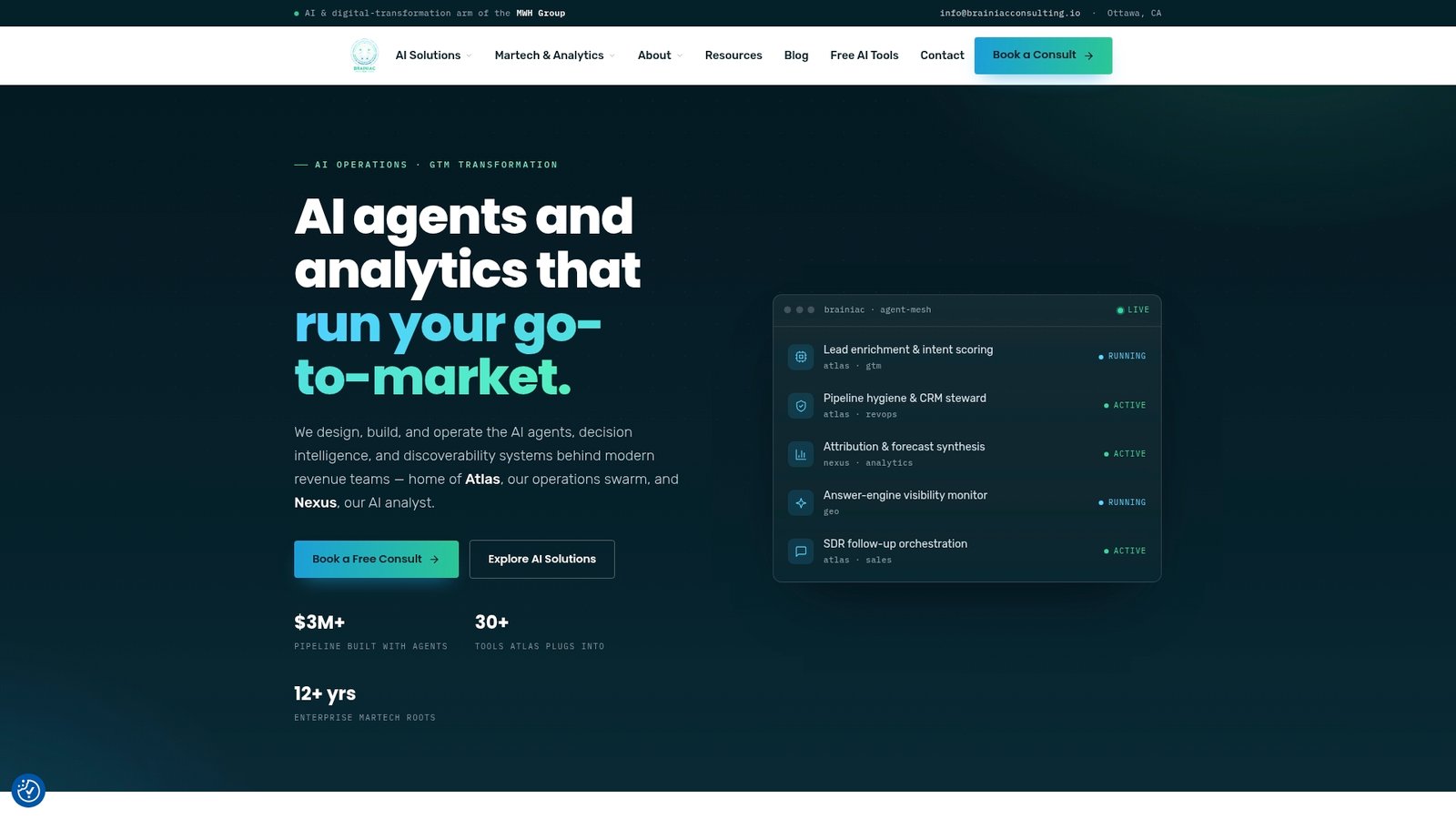
Brainiacconsulting’s Atlas AI Operations Platform gives you that governed runtime already built, with RBAC, audit logging, and cost attribution wired in from day one instead of retrofitted after a scare. For teams that want the reliability of a managed runtime without losing visibility into how their agents actually work, Atlas pairs with Brainiacconsulting’s custom agent design services so the architecture matches your actual workload instead of a generic template. If your team is weighing whether to build this internally or bring in operators who’ve already solved the governance problem at scale, a side-by-side look at managed versus custom-built agents is a useful next read. When you’re ready to move past the pilot stage, book a scoping call with Brainiacconsulting to map your first shadow deployment on Atlas.
Sources
- How to deploy AI agents across the enterprise
- Deploying AI Agents to Production: Architecture, Infrastructure, and Implementation Roadmap
- Agent orchestration explained: How enterprises manage multi-agent AI workflows
- agents-cli deployment guide