

Buyer journey analytics is the practice of stitching every touchpoint an account produces, across web, email, sales, and dark-funnel research, into a time-ordered record you can query for cause and effect. Done well, it lets you shift budget toward what actually moves deals and catch churn signals before renewal season. Organizations with mature journey analytics have reported multi-percentage revenue improvements and outsized ROI once identity and attribution are built correctly.
TL;DR:
- Successful journey analytics require a complete, consistent UTM taxonomy and structured data collection across all paid, organic, and offline channels.
- Accurate identity resolution must combine deterministic matching, probabilistic techniques, and account stitching to correctly connect contacts to buying groups.
- Implementing the right attribution models on clean, revenue-linked data enables precise budget reallocation and early churn detection, improving sales outcomes.
- Most projects fail due to poor sequencing, broken governance, or inaccurate UTM tagging, not a lack of modeling sophistication or advanced tools.
- Building in-house is feasible if your team has technical bandwidth and a clean data foundation; otherwise, engaging a specialist can ensure reliable results.
Table of Contents
- What buyer journey analytics actually measures
- The building blocks you need before you model anything
- Where journey analytics changes real decisions
- Building buyer journey analytics: a step-by-step sequence
- Why most journey analytics projects stall
- How Brainiacconsulting builds this in production
- What actually moves the needle here
- Get help building buyer journey analytics that holds up
- Sources
- FAQ
What buyer journey analytics actually measures
Journey analytics is not journey mapping, and it is not what your CRM or web analytics platform already gives you. Journey mapping is a qualitative exercise, often a workshop with sticky notes, that describes how you believe buyers move through consideration. Journey analytics replaces belief with a measured, time-ordered stream of real events tied to real accounts.
Web analytics shows you sessions and pageviews. CRM reporting shows you opportunities and closed deals. Neither shows you the connective tissue between an anonymous research visit in March and a signed contract in September. That gap is exactly what journey analytics closes.
- Journey mapping: qualitative, workshop-driven, describes intended experience
- Web/CRM analytics: partial, channel-siloed, missing cross-system identity
- Journey analytics: cross-channel event streams, identity-resolved, time-ordered, built for causal analysis
For B2B accounts, this matters more than for consumer purchases. A single deal often involves five or more stakeholders researching independently before anyone talks to sales, which is why Forrester recommends measuring buying groups rather than individual leads.
The building blocks you need before you model anything
You cannot model your way out of bad inputs. Four layers have to exist and hold together before attribution numbers mean anything.
- Channel inventory and instrumentation. Catalogue every paid, organic, and offline channel, then enforce a consistent UTM taxonomy so campaign data does not fracture into unattributable “direct” traffic.
- Identity resolution. Start deterministic (logged-in email matches, CRM contact IDs), add probabilistic matching for anonymous sessions, and layer account stitching so five contacts at one company resolve to one buying group.
- Pipeline and warehouse. Ingest raw events, transform them with something like dbt, land them in a warehouse, and orchestrate the refresh cadence so data does not go stale between board meetings.
- Modelling and attribution. Apply multi-touch, time-decay, or data-driven models on top of clean, revenue-linked events. Reliable attribution needs four specific data layers: unified identity, chronological touchpoints, revenue-linked conversions, and channel classification.
- Governance and review. Set a quarterly cadence to audit UTM compliance, re-validate identity match rates, and retire dead channels from the taxonomy.
Pro Tip: *Audit your UTM completeness before you touch a modelling tool.
Where journey analytics changes real decisions
The value of journey analytics shows up in decisions, not dashboards. Once you can trace revenue back to specific touchpoints and account behaviour, four things become possible that were not possible with siloed reporting.
- Budget reallocation. You stop funding channels that generate volume and start funding channels that generate revenue, because the attribution model finally separates the two.
- Churn prediction. Declining engagement across a buying group, fewer logins, no replies, stalled usage, becomes a leading indicator you can act on months before a renewal conversation.
- Funnel repair. Time-ordered event data exposes exactly where accounts stall, whether that is a slow demo-to-proposal gap or a stakeholder who never re-engages after a pricing page visit.
- Buying-group prioritization. Instead of scoring one contact, you score the collective engagement of the whole committee, which better predicts deal health.
Top-quartile journey analytics maturity correlates with measurable gains: benchmarks from industry research point to roughly 15 to 20% cost reduction alongside 10 to 15% revenue increases for organizations that reach that maturity level. Separate analysis has tied strong analytics practices to 57% better marketing ROI among teams that invest in the discipline consistently.
Those are not small numbers for a marketing operations budget, and they are the reason journey analytics keeps climbing analyst agendas.
Building buyer journey analytics: a step-by-step sequence
The order you do this in matters more than the tools you pick. Teams that select technology before defining decisions tend to fail, and 61% of analytics implementations miss their ROI target largely for that reason.
- Define the decisions first. Write down exactly what budget or process change this analytics work needs to enable, whether that is reallocating paid spend or triggering a retention play. If you cannot name the decision, do not build the dashboard.
- Inventory channels and instrument events. Build a UTM taxonomy that every campaign owner actually follows, and add server-side tracking wherever client-side tags break down (ad blockers, iOS privacy limits, single-page apps).
- Resolve identity and stitch to accounts. Match deterministically first, fall back to probabilistic matching for anonymous visits, and roll every resolved contact up to the account and buying-group level.
- Centralize data and apply business logic. Land everything in a warehouse, transform it with dbt-style models, and encode your attribution rules once, not once per report.
- Back-test the attribution model. Run it against a set of already closed-won deals and see whether the credit it assigns matches what your sales team knows actually happened. If it does not, adjust the model before trusting it going forward.
- Govern, train, and iterate. Build dashboards stakeholders will actually open, train them on what the numbers mean, and set a recurring review cadence rather than a one-time launch.
Pro Tip: *Do not attempt this across your entire funnel on day one. Pick one or two high-value buyer paths, prove the model against known deals, then expand.
Why most journey analytics projects stall
Most failures trace back to sequencing and hygiene problems, not modelling sophistication. A few recur often enough to name directly.
- Tools before decisions. Buying a platform before agreeing on what question it needs to answer produces a very expensive dashboard nobody consults.
- Broken UTM governance. One team discovered 40% of what looked like direct traffic was actually misattributed campaign traffic from inconsistent tagging.
- Identity and privacy limits. A substantial share of B2B research, an estimated 60 to 70% by some industry counts, happens anonymously in what practitioners call the dark funnel, and no identity resolution technique closes that gap entirely.
- Wrong attribution model for the buying motion. A single-touch model applied to a six-stakeholder enterprise deal will consistently misassign credit; buying-group motion needs to be aligned to the Opportunity object and tracked at the account level, not the contact level, as outlined in LeanData’s guide to buying groups.
- No adoption plan. A technically correct model that sales and finance do not trust gets ignored, no matter how clean the pipeline behind it is.
How Brainiacconsulting builds this in production
We approach journey analytics as an open-source, integration-first build rather than a locked platform you rent and hope fits. That distinction matters because most enterprise stacks already have Salesforce, HubSpot, or Marketo in place, and ripping them out to adopt a new attribution tool creates more risk than it resolves.
A typical engagement moves through discovery and KPI alignment, then instrumentation, identity stitching, modelling, and governance, in that order, mirroring the sequence analysts recommend rather than skipping to a dashboard. Our revenue attribution work and Marketo Measure Bizible implementations focus specifically on connecting touchpoints to account-level engagement instead of individual lead scores, which fits the buying-group reality most B2B teams actually face.
- Discovery sessions establish which decisions the analytics needs to support before any tool gets touched
- Instrumentation and identity stitching happen against existing CRM and martech, not a replacement stack
- Governance and dashboard training close out the engagement, not a one-time handoff
One case we documented shows a measurable lift in lead-to-opportunity conversion once attribution and identity resolution were corrected. If your team has the engineering bandwidth and a clean data foundation already, building in-house is realistic. If you are still fighting broken UTMs and siloed identity six months in, that is usually the signal to bring in a specialist.
What actually moves the needle here
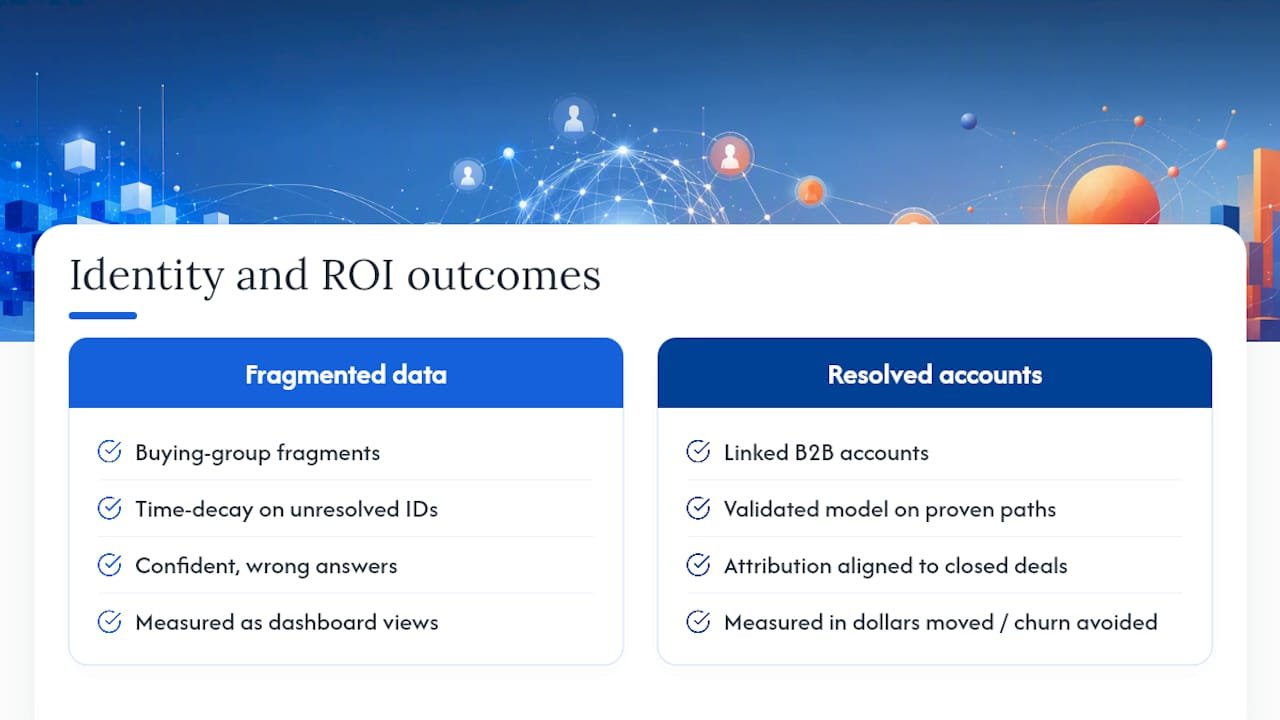
Most teams over-invest in the modelling layer and under-invest in identity resolution, which is backwards. A time-decay model running on unresolved identities just produces a more confident version of the wrong answer.
Start with one or two buyer paths that carry real revenue weight, prove the attribution against deals you already know closed, and only then expand. Measure everything in dollars moved or churn avoided, not in dashboard views, and keep a governance cadence running so the model does not quietly rot as channels shift.
— Don
Get help building buyer journey analytics that holds up
Brainiacconsulting exists because most teams do not need another dashboard vendor. They need someone to stitch identity, fix attribution logic, and connect it to Salesforce or HubSpot without ripping out what already works.
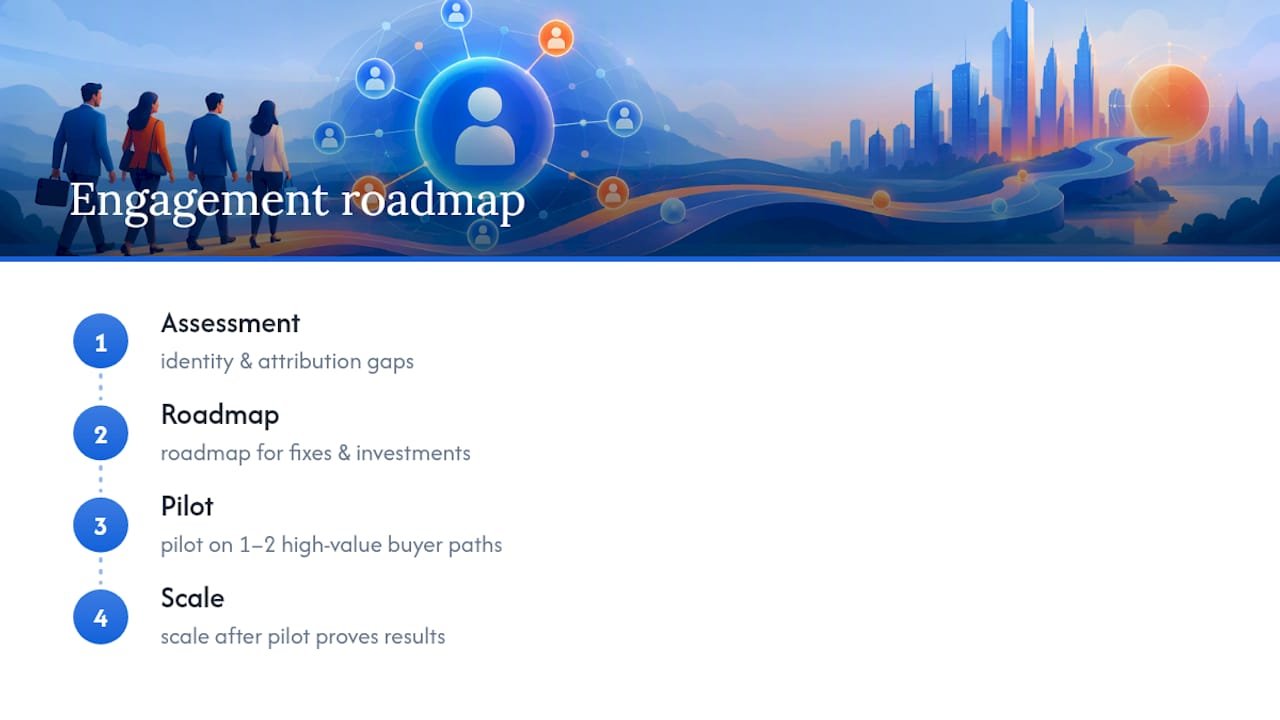
Where a typical analytics vendor sells you a locked platform and asks you to migrate your data into it, our approach builds directly on top of your existing martech stack using open-source methods, so you keep full visibility into how every number is calculated. An initial engagement usually starts with an assessment of your current identity resolution and attribution gaps, followed by a roadmap and a pilot on one or two high-value buyer paths before anything scales further. That mirrors the AI Readiness Assessment and roadmap work we run for teams evaluating where to invest first.
If your attribution numbers do not match what your sales team knows happened, that is the problem worth solving before anything else. Visit Brainiacconsulting to scope an assessment and see where your buying-group data is breaking down.
Sources
For deeper benchmarks and methodology, read Forrester’s case for buying-group measurement, Fairview’s breakdown of multi-touch attribution layers, and Marqeu’s implementation sequencing guide for avoiding the tools-first mistake.
- The verdict is in: it’s buying groups for the win — Forrester
- Customer Journey Analytics: 2026 Guide for 5.7x ROI | ObserviX
- Multi-Touch Attribution: How to Implement It Cleanly | Fairview
FAQ
What are the five stages of the buyer journey?
Most B2B frameworks describe awareness, consideration, evaluation, decision, and retention as the five stages, though buying-group research often blurs the lines since stakeholders move through them at different speeds simultaneously. Journey analytics is what lets you see which stage a whole account is actually stuck in, rather than guessing from one contact’s behaviour.
What is journey analytics?
Journey analytics is the measurement discipline that stitches cross-channel, time-ordered events to a resolved identity so you can trace which touchpoints actually influenced revenue outcomes. It differs from journey mapping, which is a qualitative, workshop-based exercise rather than a measured data record.
What are the three stages of the buyer’s journey?
The simplified three-stage version collapses the funnel into awareness, consideration, and decision, which works for content planning but rarely captures B2B buying-group complexity. For teams tracking account-level engagement, most analytics platforms still model more granular sub-stages beneath those three labels.
What are the essential metrics for buyer journey analytics?
Core metrics include identity match rate, UTM completeness, time-to-conversion by channel, buying-group engagement score, and revenue-attributed touchpoints under whichever model you have back-tested. Teams using revenue attribution services typically track these alongside pipeline velocity to catch stalled deals earlier.
What does Brainiacconsulting charge for buyer journey analytics implementation?
Pricing depends on the scope of the engagement, whether it covers identity resolution, attribution modelling, or full martech integration, and current details are available directly on the Brainiacconsulting site.