
Start with a modular, Kubernetes-native serving stack, then decide between vLLM or SGLang based on your model and modality. Single-node deployment covers most models up to roughly 70 billion parameters; plan multi-node once you outgrow one GPU host. Expect four building blocks in production: an inference runtime, an orchestration layer like KServe, a vector store, and observability tooling.
TL;DR:
- Most models up to around 70 billion parameters can run on a single GPU node, but larger models require multi-node setups with high-performance networking.
- vLLM is ideal for standard text models, while SGLang and Triton serve vision-language, multimodal, or operator-optimized deployments depending on hardware and model type.
- Kubernetes-native serving with KServe offers advanced features like cache-aware routing and token-based autoscaling, crucial for efficient large language model management.
- Proper infrastructure, including RDMA networking and shared storage, is critical for multi-node deployments to avoid latency and stability issues.
- A modular open-source stack combining inference runtime, orchestration, vector stores, and observability tools provides full visibility and control, reducing operational risk.
Table of Contents
- What does open-source AI deployment actually involve?
- Which deployment architecture fits your workload?
- Which inference runtime should you deploy: vLLM, SGLang, or Triton?
- Why is Kubernetes-native serving recommended for production LLMs?
- What infrastructure does multi-node serving require?
- What supporting infrastructure does a production AI stack need?
- How do you secure and govern a self-hosted AI deployment?
- What’s the minimum checklist to move from prototype to production?
- How Brainiac Consulting approaches self-hosted AI deployment
- Common trade-offs we’d prioritize differently
- Ready to deploy your open-source AI stack the right way?
- Sources
- FAQ
What does open-source AI deployment actually involve?
Open-source AI deployment spans four distinct categories, and confusing them is the fastest way to overbuild or underbuild your stack. Each category solves a different problem, and picking the wrong one for your workload wastes engineering hours you don’t have.
Inference runtimes execute the model itself. This is where vLLM, SGLang, NVIDIA Triton, and ONNX Runtime live. They handle tokenization, batching, and GPU memory management for a single model instance.
Serving frameworks wrap the runtime with an API layer, health checks, and autoscaling hooks. Orchestration platforms, like KServe, sit a level above that, managing how many instances run, where they run, and how traffic reaches them across a cluster.
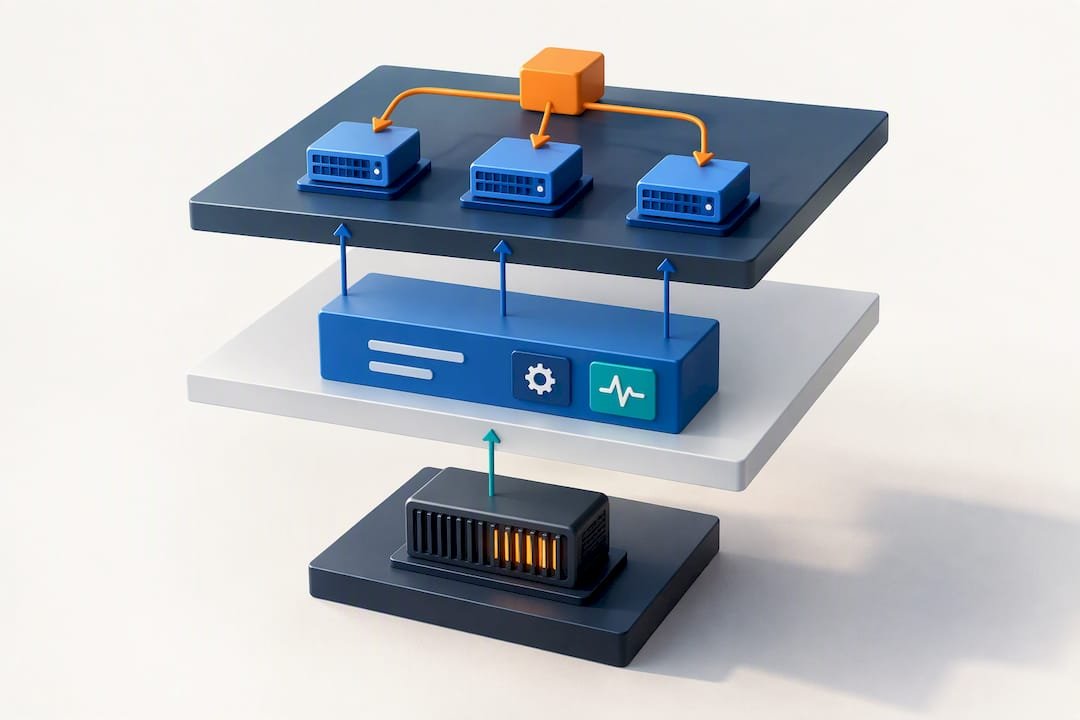
MLOps platforms handle the lifecycle around the model: training pipelines, experiment tracking, and versioning. Kubeflow and MLflow remain the two most commonly cited open-source projects for this layer, and most production teams run one or both alongside their serving stack rather than instead of it.
Your choice depends on three variables:
- Latency tolerance: sub-second chat responses need a different topology than batch scoring jobs that run overnight.
- Throughput needs: a customer-facing chatbot with thousands of concurrent sessions has different memory and batching requirements than an internal research tool.
- Team skill: a team fluent in Kubernetes operators will get more out of KServe than a team that has never written a custom resource definition.
The trade-off underneath all of this is control versus overhead. Self-hosting every layer gives you full visibility into cost and behaviour, but it also means you own every failure mode. That is the calculation worth making before you write a single Helm chart.
Which deployment architecture fits your workload?
The architecture decision comes before the tooling decision, because it constrains everything downstream. Three patterns cover almost every production case.
- Single-node deployment. One machine, one or more GPUs, one model instance (or a few replicas). This handles most models up to roughly 70 billion parameters comfortably on modern multi-GPU servers, and it’s the right starting point for prototypes and moderate-traffic production services.
- Multi-node model-parallel topologies. When a model doesn’t fit in one node’s GPU memory, or when throughput demands exceed what a single node can serve, you split the model across machines using tensor and pipeline parallelism. This is where complexity jumps sharply, because now network performance between nodes determines your latency.
- Disaggregated prefill and decode. Chat-style workloads have two very different compute profiles: prefill (processing the prompt) is memory-bandwidth heavy, while decode (generating tokens one at a time) is compute-bound but lighter. Splitting these onto separate pools of GPUs lets you scale each independently, and KServe’s newest release treats this as a first-class pattern rather than a workaround.
Serverless, scale-to-zero patterns work well for predictive models with spiky or unpredictable traffic. They’re a poor fit for persistent LLM endpoints, though, because cold starts on a multi-gigabyte model checkpoint can take tens of seconds to minutes, which kills the user experience for anything conversational.
Pro Tip: Don’t jump to multi-node because a model “might” grow. Benchmark your actual model on a single beefy node first. A lot of teams add distributed complexity for headroom they never use, and every extra node is another point of failure to debug at 2 a.m.
Which inference runtime should you deploy: vLLM, SGLang, or Triton?
Your runtime choice comes down to model family, hardware, and how much you value ecosystem maturity versus raw throughput on newer architectures.
vLLM is the default choice for most text-based LLM workloads. It has the broadest model compatibility, the most mature Kubernetes deployment documentation, and support for both Helm-based and native manifest deployment with gRPC and HTTP serving modes. If you’re deploying a Llama, Mistral, or Qwen family model and want a well-trodden path, vLLM is where you start.
SGLang earns its place when you’re serving vision-language models or want tighter hardware co-design. NVIDIA’s own multi-node NIM guidance treats SGLang as an equally valid execution engine alongside vLLM for distributed setups, and teams running multimodal pipelines often see better throughput from it on newer GPU generations.
Triton and ONNX Runtime matter when you need operator-level optimization or you’re running a heterogeneous mix of model types (not just LLMs) behind one serving layer. Triton’s strength is NVIDIA-centric environments where you want fine-grained control over batching and kernel selection across CV, recommendation, and language models simultaneously.
A quick reference for backend selection: For a practical tool to compare inference runtimes and ensure model compatibility across various AI models, consider using BabyLoveGrowth’s Multi-LLM Audit.
- Standard text LLM, broad compatibility needed: vLLM
- Vision-language or hardware-optimized multimodal: SGLang
- Mixed model types, NVIDIA-heavy infrastructure, need operator tuning: Triton or ONNX Runtime
- Rapid prototyping with minimal ops overhead: vLLM’s simplicity wins
The practical split practitioners describe most often balances model compatibility against hardware-specific performance gains, and that trade-off, not brand preference, should drive your decision for multimodal deployments.
Why is Kubernetes-native serving recommended for production LLMs?
Kubernetes-native orchestration solves a problem raw model servers don’t: it standardizes how GenAI and traditional predictive models get deployed, scaled, and routed within the same cluster.
KServe is the clearest example of this shift. Its v0.17 release introduced production-ready LLMInferenceService, a custom resource specifically built for generative workloads rather than retrofitted from predictive-model serving. The features that matter most for LLM operators:
- KV-cache aware routing, which sends follow-up requests in a conversation to the node already holding that session’s cache, cutting redundant computation.
- Disaggregated prefill-decode support built directly into the CRD, so you don’t hand-roll this topology yourself.
- A token-driven autoscaling API, scaling replicas based on tokens-per-second and queue depth rather than CPU or memory, which are poor proxies for LLM load.
For distributed execution, LeaderWorkerSet and Ray handle the leader/worker coordination that multi-node serving requires. LeaderWorkerSet, a Kubernetes API for managing groups of pods that need to act as one logical unit, has become the standard pattern for this, and it pairs naturally with Ray’s cluster formation model when you need to distribute a single model’s weights across several machines.
Traffic management is the piece teams underestimate. An Envoy AI Gateway sitting in front of your inference services lets you apply token-based rate limiting instead of simple request counts, which matters enormously when one user’s 8,000-token prompt costs vastly more than another’s 50-token query.
Pro Tip: If you’re new to KServe, don’t start with the full LLMInferenceService feature set. Deploy a single model with basic autoscaling first, confirm your metrics pipeline reports token throughput correctly, then layer in KV-cache routing and disaggregation once the basics are stable.
KServe remains an actively maintained community project with multi-framework support, which matters if your organization runs anything beyond LLMs.
What infrastructure does multi-node serving require?
Multi-node serving fails most often not because of model configuration but because of the network fabric underneath it. This is the section teams read too late.
Inter-node communication is the bottleneck the moment you split a model across machines. NVIDIA’s deployment guidance is blunt about this: production-grade multi-node latency generally requires RDMA over Converged Ethernet (RoCE) or InfiniBand, paired with tuned NCCL settings. Standard TCP/IP networking between nodes introduces enough latency that tensor-parallel communication becomes your critical path, and throughput can drop sharply compared to a properly configured RDMA fabric.
Storage needs to be shared and fast. NVIDIA’s own multi-node NIM deployments rely on ReadWriteMany PVCs or NFS-backed volumes so every node in a leader/worker group can access the same model weights without duplicating multi-gigabyte checkpoints across local disks.
A practical checklist before you commit to a multi-node topology:
- Confirm GPU homogeneity across all nodes. Mixed GPU generations in one tensor-parallel group create straggler effects that tank throughput.
- Check NUMA topology on each host. Poor CPU-to-GPU affinity adds latency that’s invisible until you benchmark under load.
- Validate your specific tensor-parallel and pipeline-parallel split with real token-per-second benchmarks before promoting it to production, rather than trusting a configuration that worked for a different model size.
- Budget extra time for LeaderWorkerSet debugging. Leader/worker coordination failures are among the most common causes of stalled multi-node rollouts.
None of this is optional once you cross the single-node ceiling. It’s infrastructure work, not model work, and it’s usually the part teams budget the least time for.
What supporting infrastructure does a production AI stack need?
A model server on its own is not a product. The systems around it, vector stores, feature stores, and observability, determine whether the deployment actually holds up under real traffic.
For retrieval-augmented generation, your vector store choice depends on scale and existing infrastructure. A Postgres extension like pgvector is genuinely sufficient for many production RAG systems under a few million vectors, especially if your team already operates Postgres and doesn’t want another database to patch and back up. Purpose-built vector databases earn their complexity at larger scale or when you need advanced filtering and hybrid search baked in.
Feature stores matter more for predictive and recommendation models than for pure LLM inference, but if your stack does both, they’re where you catch drift before it reaches production. Monitoring feature distributions over time flags the silent failures that accuracy metrics alone miss.
Observability for LLM serving needs different instrumentation than traditional APM tooling provides:
- Token-level metrics: track tokens-per-second, time-to-first-token, and queue depth separately, since averaging them hides tail latency problems.
- Trace sampling on a percentage of requests, capturing full prompt-to-completion traces for debugging without logging every single interaction.
- Cost monitoring tied to token consumption per endpoint, because LLM inference cost scales with usage in a way that traditional service metrics don’t capture.
Practitioner starter kits consistently recommend keeping these as separate, modular services rather than bundling inference, vector storage, and workflow automation into one monolithic deployment.
How do you secure and govern a self-hosted AI deployment?
Security for open-source AI deployment follows the same principles as any production service, but the specifics differ enough that generic advice falls short.
Model endpoints need the same secrets management discipline as any credentialed API: rotate API keys, avoid embedding tokens in container images, and segment your inference network from your general application traffic. A compromised inference endpoint that shares a network with your customer database is a far worse incident than a compromised endpoint on its own isolated segment.
For retrieval-augmented systems, data governance means controlling what the model can retrieve, not just what it can say. That means:
- Filtering retrieval results by user permissions before they ever reach the prompt context.
- Redacting sensitive fields at the retrieval layer, not relying on the model to withhold information it shouldn’t have received.
- Logging every retrieval and generation pair for audit purposes, since regulated industries increasingly expect this trail.
Operational guardrails round this out. Rate limiting by token count (not just request count) prevents cost overruns from a handful of heavy users. Token accounting per team or endpoint gives finance visibility before the invoice arrives. CI/CD gating, running a smoke test against a canary deployment before promoting a new model version, catches regressions that unit tests miss entirely.
Pro Tip: Treat your prompt templates and retrieval filters as code. Version them, review changes in pull requests, and roll them back the same way you would a broken deployment. Teams that skip this end up debugging “why did the model say that” incidents with no change history to check.
What’s the minimum checklist to move from prototype to production?
Getting from a working notebook to a production endpoint takes fewer steps than most teams expect, provided they’re done in the right order.
- Confirm infrastructure preconditions. A Kubernetes cluster with GPU node pools, Helm installed, an object store for model checkpoints, and a vector database if your workload needs retrieval.
- Size to your model, not your ambitions. Models under roughly 13B parameters run comfortably on a single modern GPU. The 13B to 70B range typically needs multi-GPU single-node setups. Above that, plan for multi-node from the start rather than discovering it mid-deployment.
- Run cold-start tests before launch. Measure how long a fresh replica takes to load weights and serve its first request; this number directly shapes your autoscaling configuration.
- Validate KV-cache warmup under realistic concurrent load, not synthetic single-request benchmarks that hide contention issues.
- Benchmark end-to-end token throughput with your actual model and your actual network configuration before calling the topology final.
Skip any of these and you’ll find the gap the hard way, usually during your first real traffic spike.
How Brainiac Consulting approaches self-hosted AI deployment
We build on the same open-source foundation this article covers, an approach we favour because it gives clients full visibility into how their agents actually behave, rather than a black-box vendor API they can’t inspect or modify. Most engagements combine an orchestration layer, an inference runtime suited to the client’s model mix, a vector store for retrieval, and governance controls layered on from day one rather than bolted on after launch.
The teams that get the most value from open-source deployment aren’t the ones with the most exotic stack. They’re the ones who matched their architecture to their actual traffic pattern, and who built observability in before they needed it, not after an incident forced the question.
Where this gets integration-heavy, deep martech and RevOps expertise matters as much as the model layer, particularly when agent outputs need to flow directly into Salesforce or HubSpot pipelines. That’s usually the point where bringing in a specialist earns back its cost quickly.
Common trade-offs we’d prioritize differently
Most teams over-invest in throughput tuning before they’ve earned the right to care about it. Get your infrastructure reproducible and your observability solid first; a slightly slower endpoint you can debug beats a fast one that fails mysteriously.
The pitfall we see most often in engagements is underestimating networking. Teams design a multi-node topology on paper, skip the RDMA and NCCL validation, and then spend weeks chasing latency they assumed was a model problem. Test the network before you trust the topology.
Full self-hosting isn’t always the right call, either. When a team lacks the bandwidth to own multi-node infrastructure long-term, a hybrid managed approach often gets them to production faster without sacrificing the open-source flexibility they wanted in the first place.
— Don
Ready to deploy your open-source AI stack the right way?
Some consulting firms offer an alternative to black-box AI vendors for teams that want to own their infrastructure without owning every operational headache that comes with it. These firms may design and operate the modular stack, orchestration, inference runtime, vector store, and guardrails, so your team focuses on the model outcomes, not the plumbing underneath them.
Engagements typically move through three phases: an assessment of your current AI readiness and infrastructure gaps, a build phase where we deploy the actual stack against your requirements, and ongoing managed operations if you’d rather not staff that in-house long-term. Our custom agent deployment service covers exactly the Kubernetes-native, open-source patterns this article walks through, integrated with the CRM and analytics platforms your revenue teams already depend on.
If you’re weighing whether to build this internally or bring in support, start with a conversation about where your team’s engineering time is best spent. Get in touch with Brainiac Consulting to scope your deployment.
Sources
- Announcing KServe v0.17 – Production-Ready LLM Serving with LLMInferenceService | KServe
- Using Kubernetes – vLLM
- Multi-Node Deployment — NVIDIA NIM for Large Language Models
- kserve/kserve
FAQ
Is there any AI that is open-source?
Yes. Model weights (Llama, Mistral, Qwen, and others), inference runtimes like vLLM and SGLang, and orchestration platforms like KServe and Kubeflow are all open-source and freely deployable on your own infrastructure. This is distinct from proprietary API-only models that you can only access through a vendor’s hosted endpoint.
Which platform is best for open-source AI deployment?
There’s no single best platform. It depends on your model and scale: vLLM suits most text-based LLM workloads with strong Kubernetes support, SGLang fits vision-language and hardware-optimized cases, and KServe handles the orchestration layer for either one in production.
Is OpenClaw free?
Details on this specific product aren’t publicly listed, so we can’t confirm pricing here. If you’re evaluating it against an open-source alternative, compare it against vLLM or SGLang running under KServe, both of which are free to deploy on infrastructure you control.
Can I run AI locally?
Yes. Models under roughly 13 billion parameters run comfortably on a single modern GPU using runtimes like vLLM, and even larger models can run locally with quantization or multi-GPU setups on one machine. Local deployment trades some throughput for full data control and no per-token API costs.
How do I decide between self-hosting and a managed AI deployment?
Self-host when your team has the engineering bandwidth to own networking, scaling, and governance long-term. Choose a managed or hybrid approach, such as Brainiac Consulting’s agentic AI enablement services, when you want the flexibility of open-source without staffing the full operational load in-house.