

A marketing ops audit gives you a verified map of every tool, workflow, and data pipe touching revenue, then tells you which ones are broken, wasted, or unmeasured. The immediate output is a prioritized evidence register, not a slide deck, tied to a pipeline you can trace lead-to-close without guessing. Start by freezing a baseline inventory before you fix anything.
TL;DR:
- A marketing ops audit verifies the reliability of tools, data flows, workflows, and integrations that support lead-to-revenue processes, identifying broken or unmeasured elements.
- Conducting real scenario tests, not just reviews of documentation, reveals hidden issues like sync delays, duplicate records, or incorrect routing that dashboards and screenshots miss.
- Building a detailed inventory and data map upfront, including key objects, ownership, and integration points, is crucial before making any system changes or repairs.
- Prioritize findings based on business impact, focusing first on revenue-blocking defects and security issues, then plan phased remediation over 30, 60, and 90 days.
- Running a full marketing ops audit annually with quarterly check-ins helps maintain system health, improve attribution accuracy, and avoid costly backlog accumulation.
Table of Contents
- What does a marketing ops audit cover?
- Why run an audit, and what questions must it answer?
- Building the inventory and data map before you touch anything
- How to conduct the audit: a five-phase method
- Testing your measurement and attribution model
- Prioritizing findings into a 30–60–90 roadmap
- How Brainiac Consulting approaches audit-driven remediation
- When and how often should you run an audit?
- What experienced auditors know that checklists miss
- Get your marketing ops audit moving with Brainiac Consulting
- Sources
- FAQ
What does a marketing ops audit cover?
A marketing ops audit differs from a broader marketing audit in one important way: scope. A marketing audit asks whether your positioning, messaging, and channel mix are working. A marketing ops audit asks whether the machinery behind those campaigns, the systems, data, and workflows, is trustworthy enough to act on. That’s the gap this audit closes.
The audit should inspect these tracks:
- Tool inventory: every platform in the stack, who owns it, what it costs
- Data flows: how information moves between systems and where it stalls
- Workflows and automations: what triggers exist and whether they still fire correctly
- Integrations: sync health between your CRM, marketing automation platform, and adjacent tools
- Measurement and attribution: whether reported numbers reconcile with closed-won revenue
- Database health: duplicate rates, field consistency, decay
- Contracts: renewal dates, seat counts, unused licences
Pull in your revenue operations lead, a CRM administrator, a finance partner who can verify contract costs, and at least one sales manager who can confirm whether qualified leads actually convert. Skipping finance is the most common shortcut, and it’s usually the one that costs the later.
Why run an audit, and what questions must it answer?
An audit earns its budget only if it answers three business questions: can we trace a lead from first touch to closed revenue, where is pipeline leaking between stages, and does our reported ROI match what finance sees in the CRM? If you can’t answer these confidently right now, that’s the finding.
The cost of skipping this work compounds quietly. Unused software seats keep renewing. Attribution models keep getting quoted in board decks without anyone checking whether they hold up. And AI initiatives get greenlit on top of data that isn’t ready for them. Gartner’s research found that over a quarter of marketing organizations reported limited or no adoption of generative AI for marketing campaigns in early 2025, a gap that often traces back to unreliable underlying data rather than a lack of ambition.
An evidence-backed audit turns vague “we should fix ops” conversations into a funded roadmap. When every finding carries a dollar impact, a severity rating, and an owner, prioritization stops being political. Budget conversations get shorter because the case is already made in the register itself.
Building the inventory and data map before you touch anything
Before changing a single workflow, capture what exists right now. This is the baseline freeze, and skipping it is the single most common reason remediation projects can’t prove they worked. Practitioner guidance on freezing a baseline before remediation recommends exporting key objects, workflow definitions, field metadata, integration settings, and representative error logs before any cleanup begins.
Your inventory template needs these fields for every tool in the stack:
- Owner (the person accountable, not just the department)
- Purpose (what business problem it solves, in one line)
- Seats and cost (current spend, contract term, renewal date)
- Key objects and fields (what data lives there and how it’s structured)
- Integrations (what it talks to, and how, API, native connector, or manual export)
- Reports that depend on it (so you know what breaks if you touch it)
Once the inventory is captured, build your data map. This means identifying your single system of record (usually the CRM, sometimes a CDP), documenting your campaign ID taxonomy so every channel and campaign can be traced consistently, and drafting an identity stitching plan that explains how a contact record in your marketing platform reconciles with an opportunity in your CRM. A CRM readiness check at this stage also tells you whether the underlying data is clean enough to support AI-driven workflows down the line, which matters more than most teams assume.
Pro Tip: Pull three representative record samples, one clean, one messy, one edge case, from each major object type before you start replaying workflows. You’ll spot inconsistencies in five minutes that would otherwise take a week of ticket triage to surface.
Practical tasks to complete in this phase: snapshot exports of every workflow and automation rule, error logs from the last 90 days, and a sample set of records that show real customer journeys rather than idealized ones. This is tedious work, but it’s the evidence that makes every later finding defensible.
How to conduct the audit: a five-phase method
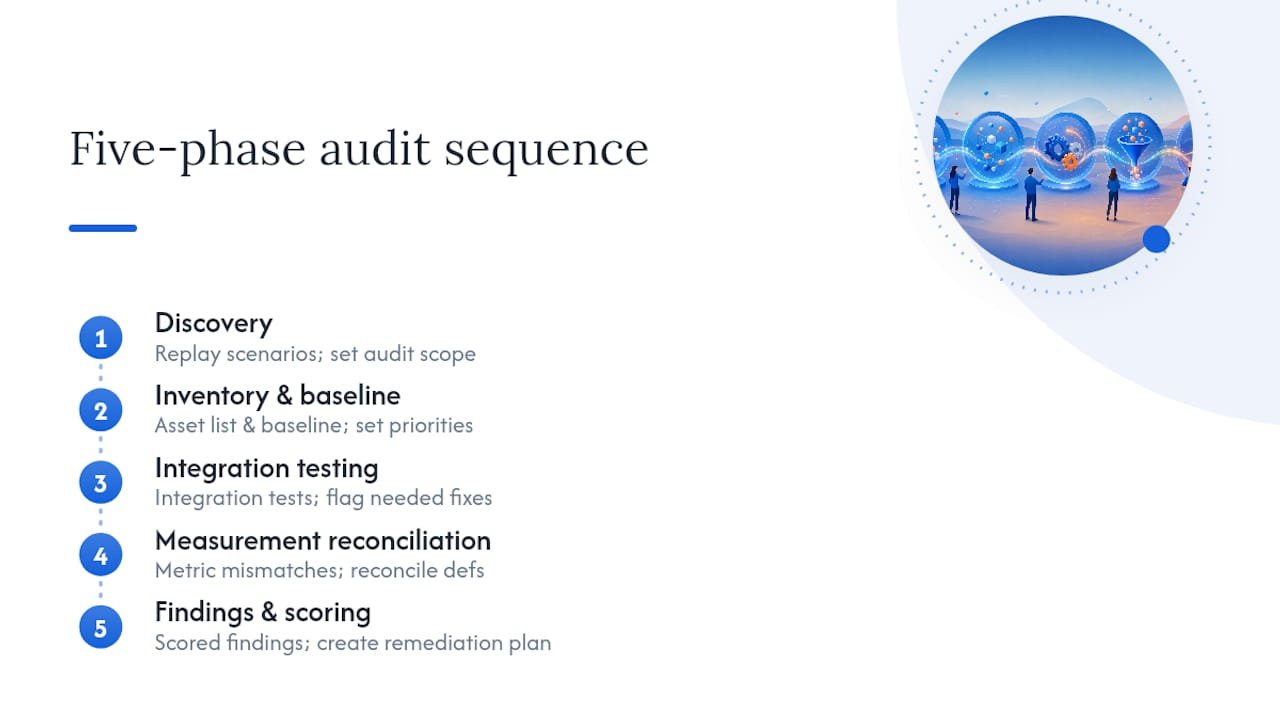
Auditing marketing ops isn’t a document review. It’s closer to a forensic exercise, one where you replay real scenarios and watch what actually happens, rather than trusting what the dashboard claims happens. Here’s the sequence that produces verifiable, reproducible findings.
Phase 1: Discovery
Start with stakeholder interviews across marketing, sales, RevOps, and finance. Ask each person what they think happens when a lead comes in, and compare their answers. Divergence here is itself a finding. Capture the full inventory (covered above) and export your baseline before making any changes. This freeze matters because it gives you a defensible “before” state you can compare against once remediation begins.
Phase 2: Workflow replay
This is where most audits earn their keep or fall flat. Rather than reading workflow documentation or reviewing screenshots, run real scenarios through the live system and record what actually happens. Practitioner guidance on live-record walkthroughs recommends testing these specific paths:
- A brand-new lead entering through your primary web form
- A duplicate submission from an existing contact
- A high-intent action, like a demo request or pricing page visit
- An unsubscribe or opt-out request
- A record that deliberately fails to sync between systems
- A closed-won deal moving backward through the funnel to verify attribution holds
Watch for hidden behaviour: duplicate record creation, asynchronous sync delays that silently overwrite source values, or conditional routing that only misfires under a specific field sequence. Screenshot reviews miss all of this because they show you the intended design, not the actual runtime behaviour.
Phase 3: Integration testing
For every connected system, measure sync latency (how long does it actually take data to move, not how long the vendor claims), field mapping accuracy, error handling behaviour when a sync fails, and how duplicates get resolved when the same contact exists in two systems simultaneously. Integration failures are usually invisible until you specifically look for them, because most fail silently rather than throwing an alert anyone sees.
Phase 4: Measurement reconciliation
Confirm that your campaign ID structure is consistent across every platform touching a lead, then reconcile reported marketing metrics against actual CRM opportunities and closed-won records. This is where you’ll usually find the gap between what a dashboard reports and what finance can verify. Document one authoritative definition for each KPI you track, because “qualified lead” meaning three different things across three teams is a finding in itself, not a footnote.
Phase 5: Findings register and scoring
Every issue you uncover gets logged with severity, the systems and records affected, an owner, estimated business impact, effort to fix, and a recommended disposition, keep, fix, consolidate, replace, retire, or monitor. This structure turns a pile of observations into something a leadership team can actually act on and fund.
Testing your measurement and attribution model
Once workflows and integrations check out, turn to the numbers themselves. Start by reconciling platform-reported metrics, form fills, MQLs, campaign-influenced pipeline, against actual CRM opportunities and closed-won revenue. If the platform says 200 marketing-influenced deals closed last quarter and your CRM shows 140, that gap is your finding, and it’s usually bigger than teams expect.
Document one authoritative definition per KPI and record which attribution model you’re using, along with its known limitations: privacy-driven data loss, sampling gaps, and offline activity that never gets captured digitally. The American Marketing Association notes that multi-touch attribution models should match your channel count and journey complexity, and that more sophisticated models carry real implementation and maintenance costs your audit should disclose, not gloss over.
Watch for these common traps:
- Misleading platform A/B results: ad platform delivery algorithms can confound test outcomes, and a study on A/B testing limitations found this is more common than most teams assume
- Mismatched taxonomies: the same campaign labelled three different ways across three systems
- Opaque platform modelling: a channel claiming credit without disclosing how that credit was calculated
Gartner’s 2025 CMO spend survey found that marketing budgets have flatlined at roughly 7% of company revenue, which makes accurate attribution less of a nice-to-have and more of the difference between funding the right channel and starving it.
Prioritizing findings into a 30–60–90 roadmap
Not every finding deserves the same urgency. Rank issues in this order: revenue-blocking defects first, privacy and security exposures second, data-integrity problems third, customer-impact issues fourth, and pure optimization opportunities last. A broken unsubscribe workflow outranks a slightly inefficient lead-scoring model every time.
Each finding in your register needs: an owner, quantified business impact, the evidence that proves it, estimated effort to fix, a rollback plan if the fix goes wrong, and how you’ll measure whether it actually worked.
Structure remediation across three windows:
- Days 1 to 30: quick wins, duplicate suppression rules, broken sync alerts, fixing an unsubscribe workflow
- Days 31 to 60: taxonomy standardization, integration remapping, KPI definition documentation
- Days 61 to 90: strategic projects, attribution model redesign, identity resolution overhaul, platform consolidation
Pro Tip: Resist the urge to build a 40-item remediation plan. A short, sequenced list with named owners gets executed. A comprehensive one gets filed away and revisited during next year’s audit.
How Brainiac Consulting approaches audit-driven remediation
Once findings are logged, someone has to actually fix them, and that’s usually where internal bandwidth runs out. The approach works from evidence-first logic: no black-box fixes, no changes made without a documented baseline to measure against.
Relevant capabilities include:
- Open-source integrations across Salesforce, HubSpot, and Marketo, including deep Marketo Measure and Bizible expertise for attribution reconciliation
- AI-enabled lead enrichment that improves record quality without requiring a full database rebuild
- Real-time analytics that surface pipeline visibility issues as they happen, not a quarter later
- CRM workflow observability tooling for ongoing logging, alerting, and owner accountability after remediation
The outcomes are framed in terms of improved pipeline visibility and higher-quality lead enrichment, supported by agents that operate inside the client environment rather than a hidden third-party layer. If your audit surfaces more remediation work than your team can absorb, the marketing operations optimization and support service page outlines how that handoff typically works.
When and how often should you run an audit?
Run a full marketing ops audit annually, with lightweight interim checks every quarter to catch drift before it compounds. Waiting two or three years between audits almost guarantees you’ll find a backlog too large to fund in one pass.
Governance matters as much as cadence. Establish a taxonomy steering committee that approves naming conventions before anyone creates a new campaign type, put change control around workflow edits, and assign clear SLAs to system owners so issues get triaged instead of ignored.
Measure audit ROI in concrete terms: hours of manual work eliminated, licence costs avoided from cancelled or downsized contracts, and improvement in lead-to-opportunity conversion rates once broken workflows are fixed.
What experienced auditors know that checklists miss
The biggest blind spot in most audits is trusting screenshots and documentation instead of replaying live scenarios. A workflow diagram tells you what should happen. A live test with a real record tells you what does happen, and those two things diverge more often than most teams expect. Contract misalignments are the second blind spot, seats renewing on autopilot long after a team stopped using the tool.
The fix isn’t more analysis. It’s freezing your baseline, naming an owner for every finding, and running a short sequenced list instead of an exhaustive one nobody will ever fully execute.
— Don
Get your marketing ops audit moving with Brainiac Consulting
Running this audit internally takes real hours: stakeholder interviews, workflow replays, reconciliation work that spans three or four systems. Brainiac Consulting’s advantage isn’t a generic automation platform bolted onto your stack. It’s open-source, production-grade AI agents built inside your actual CRM and marketing automation environment, giving you full visibility into every fix instead of a black-box result you have to trust blindly.

Engagements typically move through four stages: an initial assessment of your current stack, a documented evidence register with severity and ownership assigned to each finding, a sequenced remediation roadmap, and, where useful, ongoing marketing operations optimization and support to keep gains from eroding. If your team lacks the bandwidth for a full internal audit, or you require specialist expertise in marketing automation, attribution, or CRM-integrated AI agents, external consulting services can fill that gap. Visit Brainiac Consulting to request an assessment and see what a prioritized findings register looks like for your own stack.
Sources
- Gartner survey reveals over a quarter of marketing organizations have limited or no adoption of GenAI for marketing campaigns
- Multi-touch attribution in the customer purchase journey
FAQ
What is a marketing ops audit?
A marketing ops audit is a structured review of the tools, data flows, workflows, and measurement systems supporting your marketing function, designed to verify what’s actually working versus what’s assumed to be working. It produces an evidence register with severity ratings and owners rather than a single pass or fail score.
What does a marketing operations person do?
A marketing operations professional manages the systems, data, and processes behind campaigns, things like CRM administration, workflow automation, integration health, and reporting accuracy. Their job is to make sure the infrastructure supporting marketing decisions is reliable enough to trust.
What are the 5 C’s of auditing?
Definitions of the “5 C’s” vary depending on the auditing discipline they’re applied to, and there’s no single version specific to marketing operations. Rather than force-fitting a mismatched framework, focus your audit on the tracks that actually matter here: inventory, data flows, workflows, integrations, and measurement.
What is a marketing audit, and how is it different?
A marketing audit typically evaluates strategy, positioning, and channel performance, while a marketing ops audit evaluates the underlying systems and data that make those campaigns measurable and trustworthy. Many teams need both, but they answer different questions and should be scoped separately.
How often should I run a marketing ops audit?
Run a full audit annually, with lighter quarterly checks to catch drift before it becomes a larger backlog. Waiting longer between audits usually means uncovering more remediation work than one budget cycle can absorb.