

If your team collects California residents’ data through forms, pixels, ad platforms or a CDP, the CCPA almost certainly applies to your marketing. The single most urgent step is to inventory where California personal information flows through your stack, then confirm your privacy notices and opt-out links match what you actually do with that data. Everything else in your compliance programme builds on that foundation.
TL;DR:
- Marketers must regularly update and verify their collection notices, privacy policies, and opt-out links to match current data practices and vendor relationships.
- The law applies if California residents’ data flows through your systems, and violating scope or failing to trace data origins can hinder compliance efforts.
- Consumers have rights to access, delete, correct, and restrict the use of their personal information, requiring operational processes to fully support these requests across all platforms.
- Moving towards server-side tracking and automating GPC signal recognition helps meet the law’s opt-out requirements without disrupting measurement.
- The 2026 regulations introduce new obligations for AI-driven decision-making notices and sensitive data limits, intensifying focus on interface design and data minimization.
Table of Contents
- What the CCPA requires marketers to publish and disclose
- Who the CCPA applies to and how that scope affects marketing teams
- Consumer rights and operational requirements marketers must support
- Practical compliance checklist for marketing teams
- Cookies, trackers and Global Privacy Control: what marketers must change
- CCPA vs CPRA and recent regulatory updates affecting marketers
- Implementing CCPA controls in martech and AI-enabled marketing
- What marketing leaders should prioritise this quarter
- Brainiac Consulting: implementation help for CCPA-compliant martech and AI operations
- Primary legal texts and official guidance for verification
- Sources
- FAQ
What the CCPA requires marketers to publish and disclose
The CCPA regulations effective January 1, 2026 spell out exactly what your privacy policy and collection notices need to say. These aren’t suggestions you can paraphrase loosely. They’re specific disclosure requirements that regulators check against what your marketing systems actually do.
Your privacy policy needs to identify the categories of personal information you collect, where it comes from, why you collect it, which categories of third parties receive it, and how consumers can exercise their rights. For most marketing teams, this means describing the data your forms capture, the cookies and pixels on your site, and the audiences you build for advertising, in plain enough language that a non-technical reader understands what’s happening.
At the point of collection, whether that’s a lead form, a landing page, or a tag firing in the background, you need a Notice at Collection that tells visitors what you’re gathering and why, before or at the moment you collect it. A form that captures email and phone number for lead scoring needs a notice that says so, not a generic policy link buried in the footer.
The rules also require a conspicuous “Do Not Sell or Share My Personal Information” link, or an Alternative Opt-out Link where permitted, placed somewhere a visitor will actually find it.
- State clearly which categories of personal information your forms, pixels and CDP collect.
- Name the categories of third parties who receive that data, including ad platforms and data brokers.
- Place the opt-out link in your header or footer, not three clicks deep in a settings menu.
- Match your notice language to what your tags and vendors actually do, not what they did a year ago.
Marketing teams that treat these notices as a one-time legal task tend to fall out of sync with their tag managers within a few campaign cycles. Review them whenever you add a new pixel or vendor.
Who the CCPA applies to and how that scope affects marketing teams
Not every business, and not every campaign, triggers CCPA obligations. The law applies based on revenue thresholds, data volume, and whether you’re handling personal information tied to California residents, regardless of where your company is headquartered.
- Check your organization’s threshold status. Businesses meeting the CCPA’s revenue or data-volume criteria for California residents are covered, so confirm with legal counsel whether your company qualifies.
- Identify California residents in your funnel. If any meaningful share of your leads, subscribers or site visitors are Californians, your marketing touchpoints for them fall under the law.
- Map your ad tech and CDP data flows. Retargeting pixels, lookalike audiences, and purchased lead lists all count as personal information processing once they touch a California resident’s data.
- Flag cross-context behavioural advertising. If you build audiences using data collected across unrelated sites and apps, that’s the kind of “sharing” the CCPA specifically targets.
- Ask whether a vendor makes you compliant by default. It doesn’t. Your obligations to disclose and honour rights remain yours even when a platform advertises itself as CCPA ready, a distinction confirmed in the 2026 regulatory text.
Purchased lead lists and third-party ad tech are where most marketing teams discover gaps. If you can’t trace where a contact record originated, you can’t honour a deletion request against it.
Consumer rights and operational requirements marketers must support
California residents hold several rights that your marketing operations need to be ready to fulfil, not just acknowledge in a policy document. These rights touch campaign data more directly than most marketers expect.
- Right to know: consumers can ask what personal information you’ve collected and from where, including data pulled into your CDP from third-party enrichment tools.
- Right to delete: a deletion request has to propagate through your CRM, email platform, ad audiences and any analytics warehouse, not just your primary database.
- Right to correct: inaccurate lead data, wrong job titles or outdated contact details, must be correctable across every system that holds a copy.
- Right to opt out of sale or sharing: this covers cross-context advertising and most retargeting and lookalike-audience practices built on shared identifiers.
- Right to limit use of sensitive personal information: precise geolocation, and certain demographic or financial data used for targeting, falls under stricter limits.
- Right to access automated decision-making technology (ADMT): when AI-driven scoring or targeting materially affects a consumer, the 2026 regulations require pre-use notices and, in some cases, an opt-out or access right.
Data minimization is a foundational principle running through the entire framework, and it applies directly to how you verify requests: the CPPA’s enforcement guidance warns against collecting extra personal information just to confirm someone’s identity when a lighter verification method would do.
Building this into martech means giving your support or privacy team an API-connected way to search across CRM, email platform and CDP simultaneously, rather than manually hunting through five systems every time a request lands. A ticketing workflow that auto-routes deletion requests to each connected system cuts fulfilment time and reduces the chance a stray copy of someone’s data survives in an old export file.

Practical compliance checklist for marketing teams
Turning the legal requirements into daily practice means working through your stack system by system. Here’s the sequence that tends to surface the most gaps fastest.
- Inventory every data flow from form fill to ad platform to CDP, and classify each vendor as a service provider or a third party under the CCPA’s definitions.
- Update every notice at collection across landing pages, gated content forms and chat widgets so the language matches current data practices.
- Refresh your privacy policy to reflect any new categories of personal information, third parties or purposes added since the last review.
- Implement a conspicuous opt-out mechanism, whether that’s the standard Do Not Sell or Share link or an Alternative Opt-out Link, and confirm it actually stops downstream sharing when clicked.
- Configure your systems to honour Global Privacy Control signals automatically, without requiring a second manual opt-out step from the visitor.
- Renegotiate vendor contracts to include purpose limitation, deletion and return obligations, and audit rights, particularly for ad tech and data enrichment vendors.
- Apply retention limits to marketing datasets, including anything feeding an AI model or attribution engine, so old records don’t linger past their useful life.
- Audit your consent and opt-out flows for dark patterns, checking that “accept” and “reject” options carry equal visual weight and equal numbers of clicks.
- Monitor opt-out volume and request fulfilment times monthly, treating spikes or delays as signals worth investigating rather than noise.
Pro Tip: Run your opt-out flow as a new visitor would, on mobile, with GPC enabled, at least once a quarter. Broken signal handling is one of the easiest gaps to miss and one of the fastest for regulators to spot.
Vendor contracts deserve particular attention here. A service provider that processes data only on your instructions is treated differently under the law than a third party that uses the data for its own purposes, and mislabelling one as the other in your data map creates real exposure.
Cookies, trackers and Global Privacy Control: what marketers must change
The CCPA takes a different approach to cookies and trackers than the GDPR does. Rather than requiring opt-in consent before any tracking begins, it gives consumers the right to opt out of the sale or sharing of their information after the fact, largely through a working Do Not Sell or Share mechanism.
That distinction changes how you configure measurement. Moving retargeting and analytics to server-side tagging, and prioritizing first-party data collection, reduces how much personal information ever reaches third-party trackers in the first place, lowering your exposure without sacrificing measurement quality.
- Configure your consent management platform to detect and honour Global Privacy Control signals automatically, treating a GPC signal as equivalent to a manual opt-out click.
- Route third-party pixels through server-side tag management where possible, so raw data doesn’t pass directly to ad platforms.
- Test your CMP’s GPC handling regularly. The CPPA’s 2025 enforcement sweep specifically targeted businesses that weren’t honouring the signal correctly.
CCPA vs CPRA and recent regulatory updates affecting marketers
The CPRA amended the original CCPA, and the resulting rules took full effect through the regulations finalized for January 1, 2026. For marketers, the practical changes centre on automated decision-making, sensitive personal information, and enforcement posture rather than a wholesale rewrite of earlier obligations.
- ADMT notices are now required when AI-driven scoring, targeting or profiling materially affects a consumer, with pre-use notices and opt-outs built into the workflow.
- Sensitive personal information limits now cover precise geolocation and certain other categories often used in ad targeting, requiring an explicit right to limit their use.
- Enforcement has shifted toward interface design, with the CPPA’s dark patterns advisory warning that asymmetrical opt-out flows, buttons that make refusal harder than acceptance, will draw scrutiny on their own, separate from policy wording.
A 2025 joint investigative sweep specifically targeted businesses failing to honour Global Privacy Control signals, making GPC handling one of the fastest ways for a marketing team to end up in regulators’ sightlines, according to the CPPA’s own announcement. The quickest mitigation is verifying, this quarter, that your CMP treats a GPC signal exactly like a manual opt-out click.
Implementing CCPA controls in martech and AI-enabled marketing
Most compliance gaps live in the handoffs between systems: the point where a lead moves from a form into your CDP, then into your CRM, then into an activation channel like retargeting or email. Mapping that path, data source to CDP or CRM to activation to retention and deletion, shows you exactly where a deletion hook needs to sit.
- Add retention windows and deletion hooks to any AI model or attribution engine trained on customer data, not just the primary database.
- Build request-handling into existing helpdesk or ticketing tools so a deletion request triggers action across every connected system automatically.
- Log every request and its resolution for audit purposes, since dark patterns enforcement increasingly examines process, not just policy text.
Pro Tip: Before building a new AI-driven segmentation model, confirm the underlying customer data has a documented retention window. Models trained on data that should have been deleted create compliance debt that’s expensive to unwind later.
Preparing a CRM for AI agents or automating request handling through AI-powered CRM consulting are the kinds of technical projects that make these hooks reliable rather than manual and error-prone.
What marketing leaders should prioritise this quarter
If you do nothing else, get your data inventory, opt-out handling and vendor contracts in order first. Privacy isn’t a compliance tax on marketing. Handled well, it builds the kind of trust that keeps your audience engaged over the long run. Start by pulling a current map of every vendor touching California resident data this month.
— Don
Brainiac Consulting: implementation help for CCPA-compliant martech and AI operations
Building the inventory, deletion hooks and governance controls described above takes real engineering time, and most marketing teams are already stretched thin running campaigns. This is where a project-based engagement can compress months of internal effort into a scoped build.
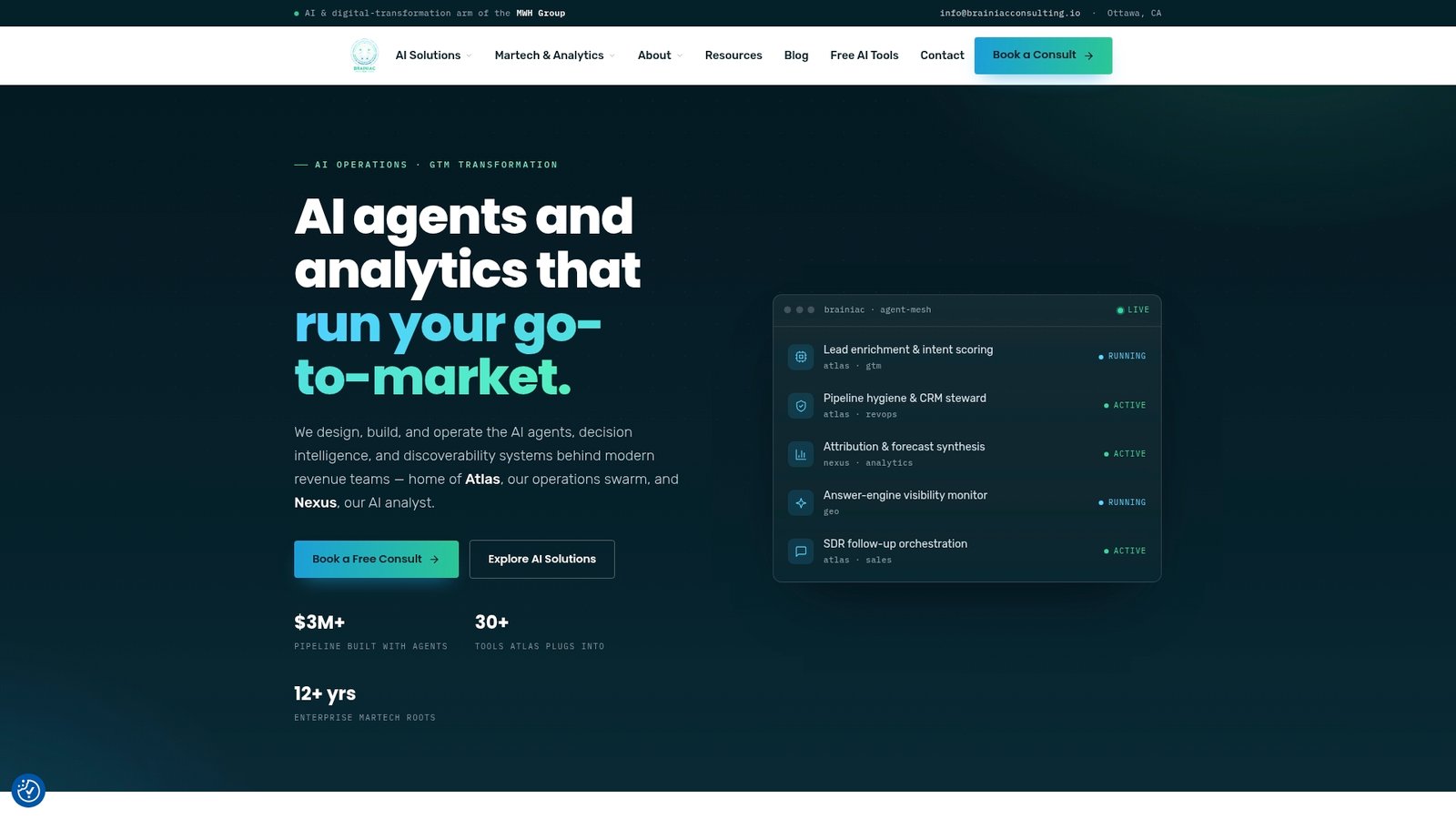
A consulting firm can assist with martech and AI operations problems such as mapping data flows across your CRM, CDP and activation channels, then building the governance and retention rules those systems need.
- Marketing Operations Optimization and Support helps teams tighten the day-to-day systems, including opt-out and retention configurations, that a privacy programme depends on.
- AI Strategy & Readiness Advisory, delivered through AI Readiness Assessment services, scopes governance and guardrails before an AI model touches customer data.
- Custom Agent Deployment and Agentic AI Enablement build the automated request-handling and deletion workflows that keep compliance from depending on manual spreadsheet tracking.
A typical discovery engagement produces a scoped data map, a prioritized list of gaps, and a delivery timeline before any build work starts. Visit Brainiac Consulting to see the full range of services and find the right starting point for your team.
Primary legal texts and official guidance for verification
For direct reference, the CCPA regulations effective 2026, the dark patterns advisory, the data minimization advisory and the 2025 GPC enforcement sweep announcement are the sources marketers should bookmark and revisit as guidance evolves. Additional background on AI adoption in marketing operations appears in this industry analysis of AI’s productivity impact for agencies.
This article is general information, not a substitute for advice from a qualified lawyer. Consult a qualified legal professional about your own circumstances before acting on anything here.
FAQ
Who does the CCPA not apply to?
The CCPA generally doesn’t apply to businesses that fall below the law’s revenue and data-volume thresholds for California residents, or to certain data already governed by other specific federal laws. Nonprofits and government agencies are also generally outside its scope, though a business’s marketing vendor might still be covered independently.
Does the CCPA only apply to businesses in California?
No, the CCPA applies based on whether you handle personal information belonging to California residents, not where your company is headquartered. A business based anywhere in the United States can fall under the law if it meets the thresholds and processes data tied to Californians.
What is the difference between GDPR and CCPA?
The GDPR generally requires opt-in consent before most data collection begins, while the CCPA is built around a right to opt out of the sale or sharing of personal information after collection. The two laws also differ in scope and enforcement structure, since the GDPR covers the European Union and the CCPA covers California residents specifically.
Which three rights are core consumer rights under the CCPA?
Three of the central rights under the CCPA are the right to know what personal information a business has collected, the right to delete that information, and the right to opt out of its sale or sharing. The law also includes rights to correct inaccurate data, limit use of sensitive personal information, and in some cases access details about automated decision-making, as outlined in the 2026 regulations.