SEO, AEO, and GEO are often presented as competing budget lines. That framing encourages teams to fund the newest label before identifying the layer that is actually blocking visibility.
A better sequence starts with dependencies. If an important page cannot be crawled, indexed, or matched to buyer intent, foundational SEO comes first. Once discovery works, improve whether the page answers the question clearly. Then strengthen evidence, source identity, and measurement across generative answer systems.
These are often tests on the same content system, not three disconnected programs.
Use practical definitions, not acronym debates
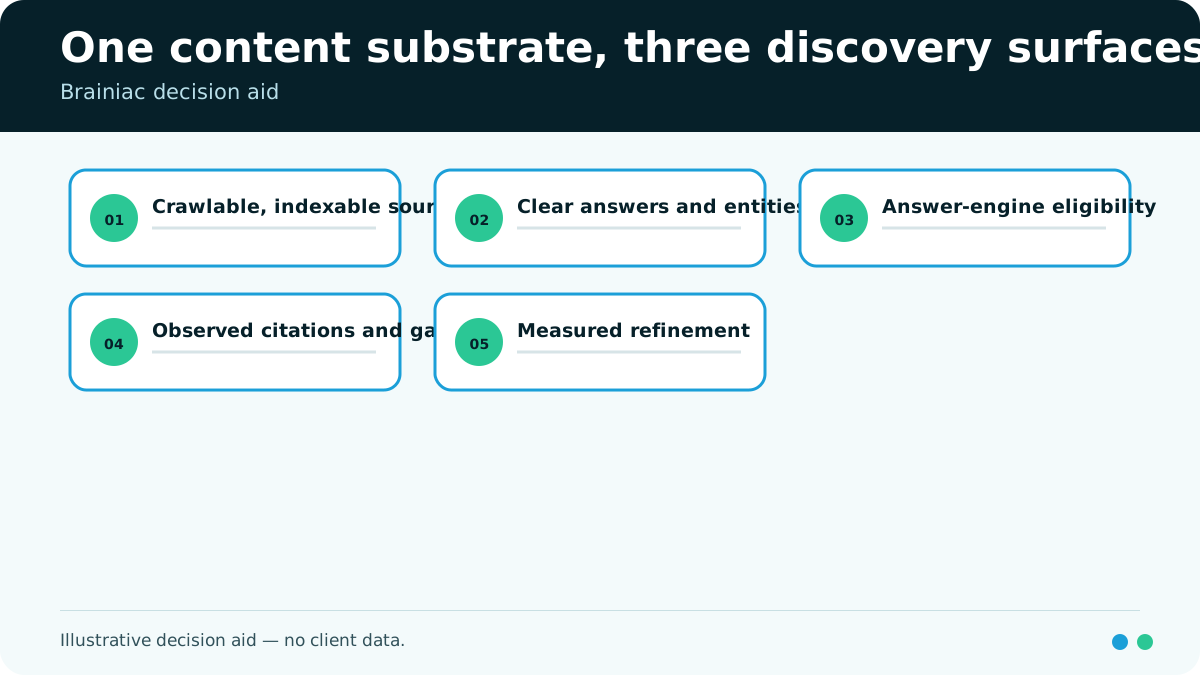
For planning purposes, use these definitions:
- SEO: Technical and editorial work that helps pages be discovered, indexed, understood, and useful in search.
- AEO: An editorial lens that asks whether a page directly and clearly resolves a question.
- GEO: A visibility and evidence lens that asks whether generative answer systems can find, use, describe, and cite a source accurately.
These are practical planning definitions, not universal industry standards. Google does not need to recognize AEO or GEO as separate disciplines for the underlying work to matter.
The useful question is not which acronym wins. It is which dependency is failing.
First, fix discovery and eligibility
Start with foundational SEO when important pages are blocked, missing from the index, poorly aligned with buyer intent, or technically difficult to interpret.
Google says established SEO practices remain relevant to generative AI search. To be eligible as a supporting link in AI Overviews or AI Mode, a page must be indexed and eligible for a snippet. That eligibility does not guarantee inclusion.
Review:
- Crawler access
- Index status
- Canonical and redirect behavior
- Rendering of important content
- Internal linking
- Page purpose and search intent
- Snippet eligibility
- Duplicate or conflicting pages
For ChatGPT search experiences, OpenAI says allowing OAI-SearchBot helps make content eligible for summaries and snippets. Crawler access still does not guarantee that a source will appear or receive a particular placement.
This is why GEO work cannot compensate for a page that systems cannot access. Fix the blocked discovery layer before redesigning the prose for answer inclusion.
Second, make the page resolve the question
Once discovery works, apply the AEO lens. Ask whether a qualified reader can quickly find a clear, complete, and appropriately scoped answer.
A useful answer page should:
- State the core answer directly
- Define important terms
- Explain conditions and limits
- Support claims with appropriate evidence
- Use headings that reflect real reader questions
- Connect the answer to the next useful detail
- Avoid forcing readers to assemble the conclusion from scattered fragments
This does not mean turning every page into a short FAQ. It means designing information around the decision or question the reader is trying to resolve.
Google advises creating unique, helpful, people-first content. It warns against producing large numbers of pages for query variations primarily to manipulate rankings or AI responses. A library of thin pages that repeat the same answer with slightly different wording is not a sound AEO strategy.
Clarity also requires restraint. If the evidence supports a conditional answer, preserve the condition. If the organization cannot substantiate a comparison or claim, better formatting will not make it credible.
Third, strengthen source clarity and generative visibility
After pages are accessible and useful, apply the GEO lens. Evaluate how generative answer systems use, describe, and cite the available source landscape.
Focus on:
- Clear organizational and product identity
- Consistent definitions across owned pages
- Evidence close to the claims it supports
- Original source material where appropriate
- Accurate dates, authorship, and update context
- Pages that resolve important buyer questions
- External sources that shape category understanding
- Cross-engine observation and first-party measurement
Google says no special AI markup is required for AI Overviews or AI Mode. It also says llms.txt, special AI text files, tiny “chunking,” and special schema are not required for its generative AI visibility. Another service may choose to use a file Google ignores, so the conclusion should remain platform-specific.
Normal structured data can still support search features when it accurately represents visible page content. The point is that Google does not require special generative-AI schema.
Do not let speculative technical tactics displace accessible pages, clear answers, and credible evidence.
Measure systems without pretending there is one ranking
Generative answers are not a conventional fixed results page. OpenAI says ChatGPT Search may rewrite a prompt into several targeted queries and may use general location. Google says its AI features may also vary responses and supporting links.
Test a stable set of realistic buyer questions and preserve:
- Exact question
- Engine and date
- Raw response
- Brand or product mention
- Cited and linked sources
- Description accuracy
- Relevant user or location context
Track technical eligibility separately from answer observations. Also keep referrals and qualified actions in a separate measurement view.
OpenAI says ChatGPT referral URLs can be tracked through utm_source=chatgpt.com. That is useful first-party evidence, but it does not expose every interaction or prove that a content change caused a visit.
Avoid replacing these dimensions with one GEO score. A score can support workflow prioritization, but it cannot represent every crawler, retrieval method, question rewrite, source choice, and user context.
Choose the first workstream with a dependency test
Use this order of questions:
- Can systems access and index the important page? If not, prioritize SEO fundamentals.
- Does the page clearly resolve the buyer’s question? If not, prioritize editorial answer quality.
- Are claims, evidence, and source identity clear enough to use accurately? If not, prioritize GEO source improvements.
- Can you observe answer usage and business response? If not, improve measurement.
The sequence can overlap. A page rewrite may improve intent alignment, answer clarity, and source quality at the same time. A technical audit may uncover crawler issues affecting both traditional and generative search.
Buyer behavior can also justify a different emphasis. If reliable evidence shows that a market discovers solutions primarily through a particular answer experience, measurement and content priorities should reflect that behavior. Dependencies still matter, but planning should not ignore the actual journey.
Fund the shared content system
The durable investment is a content system that can be accessed, understood, trusted, and measured. SEO provides discovery foundations. AEO sharpens the answer. GEO examines how generative systems use and represent the source.
Brainiac’s GEO work can diagnose the blocked layer and prioritize shared technical, page, evidence, and measurement improvements. It cannot promise citations or visibility. It can help ensure that the budget follows the dependency most likely to limit useful discovery.
Sources
Primary sources used for the factual claims in this article: