A message saying that an AI agent changed a record is not an approval request. It is a notification.
Human-in-the-loop approval controls an agent only when execution pauses before the protected action, the reviewer sees the exact proposal and consequences, and the decision is bound to that same action. The system must also handle expiry, rejection, resumption, duplicate protection, and audit evidence predictably.
Anything less risks creating the appearance of oversight without an enforced control.
Put the pause in the execution path
The defining question is simple: Can the action execute before approval is granted?
If yes, the approval screen does not control that action. A policy document, chat message, or dashboard cannot compensate for an execution path that remains open.
OpenAI’s Agents SDK provides one implementation example. Tools can be marked as requiring approval, a run can pause, and an interruption can surface the tool name and arguments. A reviewer can approve or reject the request, after which the run resumes from saved state. The SDK can also apply approvals to nested tools and delegated runs.
Those are product capabilities, not a universal standard. Whatever technology you use, the control should enforce the same core sequence:
- The agent proposes an action.
- Execution pauses before the action.
- An authorized reviewer decides.
- The system verifies that the proposal is still valid.
- The approved action executes once, or the run stops.
- The decision and outcome are recorded.
Define when approval is necessary
Not every tool call or write needs approval. Excessive low-value requests can train reviewers to click through without examining the proposal.
Use risk tiers based on the actual action. Consider:
- Sensitivity of the data
- Reversibility
- Financial or customer impact
- Permission scope
- Legal or policy consequences
- Ability to detect and repair an error
- Repeated failure conditions
OpenAI recommends human intervention when failure thresholds are exceeded or when actions are sensitive, irreversible, high-stakes, or otherwise high risk. Translate those categories into explicit triggers for the workflow.
A confidence score should not grant authority. Confidence may inform review, but authorization must come from policy, identity, role, and enforced system rules.
Build an approval contract
Treat approval as a contract between the proposed action, the reviewer, and the execution system. Define each element before implementation.
Trigger
State exactly what requires approval. The trigger might depend on tool, record type, amount, destination, permission level, policy exception, or repeated failure count.
Avoid vague rules such as “important changes need review.” The system needs a condition it can enforce.
Immutable action and parameters
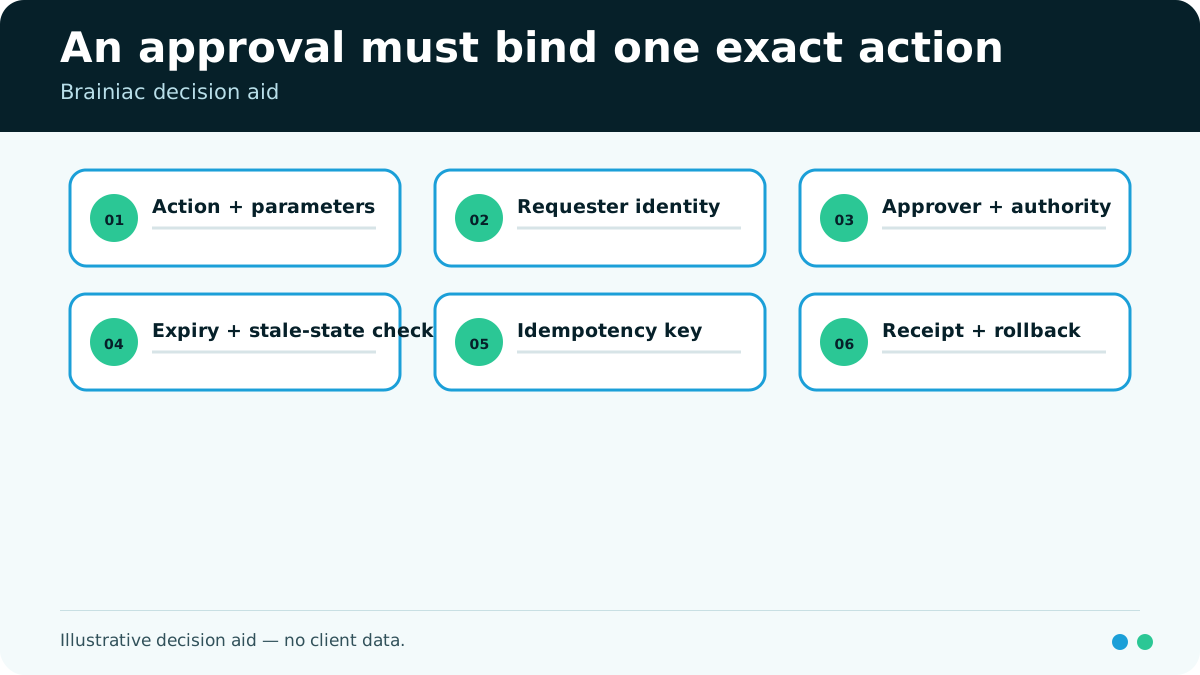
The approval must bind to the exact proposed action. Capture the tool, operation, target, parameters, relevant record version, and a unique action identifier.
If the agent changes the amount, recipient, record, or operation after approval, the prior approval must not carry forward. The changed proposal needs a new decision.
Evidence and consequences
Show the reviewer enough information to make the decision:
- What will change
- Current and proposed values
- Who or what will be affected
- Why the agent proposed it
- Supporting source information
- Known downstream automations or integrations
- Whether and how the action can be reversed
A summary written by the agent may help, but it should not replace the exact executable parameters.
Reviewer role and authority
Name the role permitted to approve the action. Authentication proves who the person is. Authorization determines whether that person can approve this specific action.
NIST calls for human-AI oversight roles and responsibilities to be defined and documented, and for oversight processes to be assessed. Do not leave approval ownership implicit in a shared channel.
Expiry and stale-state checks
An approval should not remain valid indefinitely. Define an expiry period appropriate to the workflow, then verify relevant state immediately before execution.
If the record changed, a dependency failed, the price moved, or the policy context is no longer current, stop and request a fresh decision.
Approve, reject, and modify behavior
Approval should execute only the presented proposal. Rejection should stop that action and send the run down a defined path.
“Modify” is often safer as a new proposal rather than an editable approval. If a reviewer changes a parameter, regenerate the action, revalidate it, and bind a new approval to the revised version.
Timeout and escalation
Define what happens when nobody responds. Safe choices include stopping, keeping the request pending, or escalating to another authorized role. Do not allow silence to become approval by default.
Some systems can leave unresolved approvals pending while other independent approvals proceed. If you permit this, document the dependencies so one action cannot invalidate another.
Audit record
Retain the proposal, evidence shown, reviewer identity and role, decision, timestamp, reason where required, executed parameters, final outcome, and trace identifier.
The audit record should show not only that someone clicked approve, but also what that click authorized.
Idempotency and duplicate protection
Resuming a paused run can encounter retries, timeouts, or uncertain tool responses. Use a unique action key or another duplicate-protection mechanism so one approval cannot unintentionally produce the same effect twice.
Test the full control, including failure paths
A polished approval interface does not prove that the execution path is controlled. Test from proposal through final state.
Verify that:
- The action cannot run while approval is pending
- An unauthorized reviewer cannot approve it
- Rejection prevents execution
- Modified parameters invalidate the decision
- Expired approvals cannot execute
- Duplicate resumes do not duplicate the action
- The final environment matches the approved proposal
- The agent takes only the permitted next step
Also test interruption and recovery. If the process restarts while waiting, the approval must remain connected to the correct saved run and proposal.
Make oversight selective and operational
The best approval design is not the one with the most prompts. It is the one that concentrates attention on actions where human authority materially changes the risk.
Monitor approval volume, rejection reasons, stale requests, escalations, and duplicate-prevention events. Review whether triggers remain aligned with the workflow as tools and permissions change.
Brainiac can help define action risk tiers and implement approval, trace, and recovery controls for a specific Agentic Workforce workflow. That work does not provide certification or regulatory approval. It helps ensure that human review is part of the enforced execution path, not notification theatre.
Sources
Primary sources used for the factual claims in this article: