A launch date can coordinate people, testing, and communication. It cannot prove that an AI agent is ready to act in a production workflow.
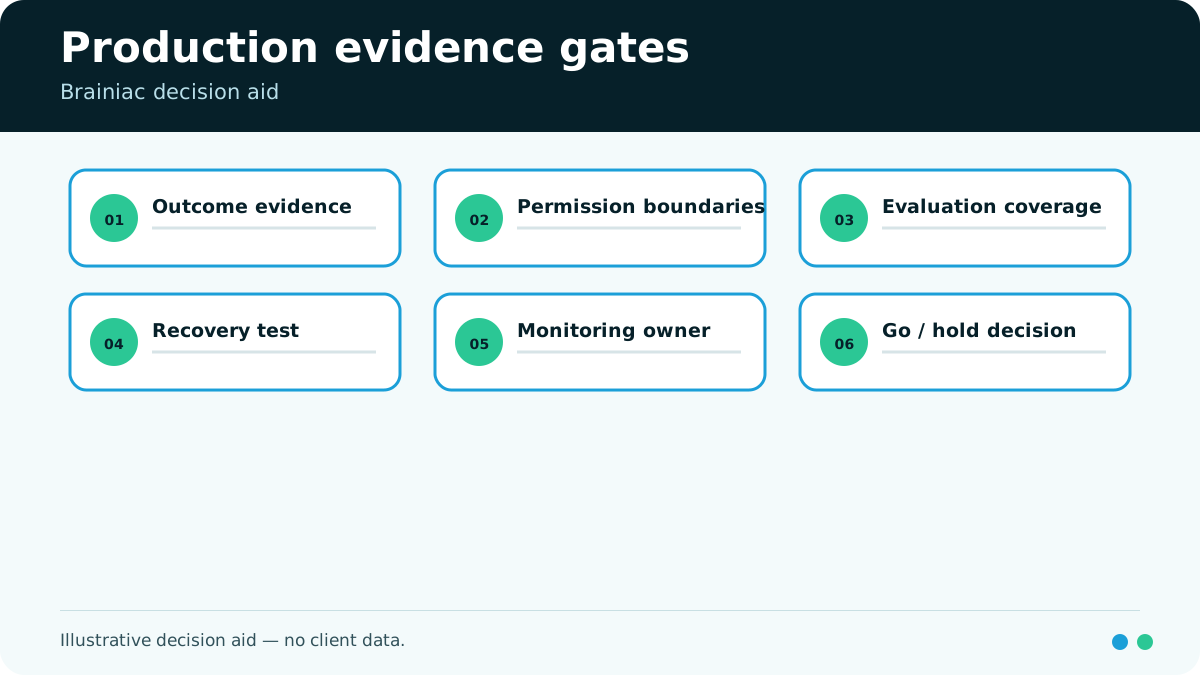
Production access should depend on evidence that the agent performs the intended work within its defined scope, uses appropriate permissions, pauses or refuses when required, recovers safely, and leaves a trace that operators can review. These are evidence gates, not milestones on a calendar.
The important consequence is that readiness cannot be reduced to one maturity score. A missing critical control can block the capability it protects even if every other test looks strong.
Confirm that the workflow needs an agent
Start before the pilot. Determine whether the workflow actually benefits from agentic behavior.
OpenAI recommends considering agents for work involving nuanced judgment, difficult-to-maintain rules, or substantial unstructured data. When rules are stable and the path is predictable, deterministic automation may be sufficient.
That distinction matters because an agent introduces variability and operational responsibilities. If a conventional workflow engine can reliably execute the process, adding an agent may create evaluation and control work without adding useful flexibility.
If you need to pressure-test whether the workflow earns enough operational upside to justify agent evaluation, monitoring, and human-review overhead, the AI Automation ROI Calculator lets you model labor, software, and review assumptions before you move a pilot toward production scope.
Define the workflow boundary in operational terms:
- What event starts the work?
- What information may the agent use?
- What outcome marks completion?
- Which systems and tools are in scope?
- Which decisions remain with a person?
- Who owns the workflow after launch?
Without this boundary, a successful demo can quietly become permission to do work that was never evaluated.
Write expected outcomes before testing
Do not let the agent define success after it acts. Document expected outcomes and unacceptable outcomes before running trials.
Anthropic describes agent evaluations using distinct tasks, trials, graders, traces, and outcomes. It also notes that multiple trials are useful because model outputs vary. NIST’s AI Risk Management Framework similarly calls for documented test sets, metrics, human oversight, roles, monitoring, and incident practices.
The right number of tasks or trials depends on the workflow and its risk. There is no universal passing percentage. What matters is that the test set represents the decisions, inputs, exceptions, and consequences the production agent will encounter.
Evaluate both:
- Capability: Can the agent complete the intended work under representative conditions?
- Regression: Does previously acceptable behavior remain intact after prompts, tools, models, policies, or connected systems change?
Capability testing supports the initial access decision. Regression testing protects that decision over time.
Gate access by action type
Production is not a binary state. Reading a record, drafting a response, making a reversible update, and initiating a high-impact action do not require identical evidence.
Graduate capabilities separately:
- Read access: Verify that the agent retrieves only the information required for the workflow.
- Drafting: Confirm that proposed outputs meet defined quality and policy expectations before anyone relies on them.
- Reversible writes: Test validation, duplicate protection, rollback, and monitoring.
- Higher-impact actions: Require stronger authorization, approval, recovery, and incident evidence.
OpenAI recommends layered guardrails alongside authentication, authorization, strict access controls, and standard software security practices. A content filter or prompt instruction is not a substitute for system-level permission boundaries.
Verify least privilege directly. Inspect the identity used by the agent, the records and fields it can access, and the exact operations each tool permits.
Test approval, refusal, and escalation
An agent is not ready merely because it succeeds on ordinary cases. It also needs predictable behavior when it should not proceed.
OpenAI identifies repeated failure thresholds and sensitive, irreversible, high-stakes, or otherwise high-risk actions as common triggers for human intervention. Translate those categories into workflow-specific rules.
Test whether the agent:
- Requests approval before the protected action executes
- Shows the reviewer the exact action and relevant consequences
- Refuses work outside its authority
- Escalates after defined repeated failures
- Stops safely when required information is missing
- Resumes correctly after an approval or correction
A vague request for confirmation is not enough. The control should be bound to the specific proposed action, parameters, record, and current state.
Inspect outcomes, not claims of success
An agent can say that a task succeeded even when the environment is unchanged or incorrectly changed. Anthropic distinguishes the trace of a trial from its outcome, which is the final state of the environment.
Every critical test should therefore inspect the end state. Confirm the correct record, value, status, message, file, or downstream effect rather than grading only the agent’s narrative.
The retained trace should connect:
- Input and relevant context
- Tool calls and parameters
- Decisions and approvals
- Errors, retries, and recoveries
- Final observed outcome
A trace is not useful merely because it exists. An operator should be able to follow it from request to result without reconstructing the run from unrelated logs.
Prove recovery before granting broader access
Failures will occur in software, integrations, data, and model behavior. Readiness depends partly on whether the workflow can fail safely.
Demonstrate what happens when a tool times out, a write partially completes, a dependency returns stale data, approval expires, or a retry could duplicate an action. The required response may be a safe retry, rollback, stop, escalation, or manual repair.
Assign operational responsibilities before launch:
- Who monitors the workflow?
- Who investigates alerts?
- Who can suspend access?
- Who owns incident communication and recovery?
- Who approves changes to prompts, tools, and permissions?
- Who maintains the regression set?
NIST calls for these oversight and incident responsibilities to be defined and documented. Ownership cannot be postponed until the first production failure.
Make each gate a reviewable decision
For every capability, create a small evidence record containing the scope, tests, results, unresolved failures, controls, owner, and access decision. A critical access failure should not disappear inside an average score.
Pre-launch evaluation is only one part of the operating model. Anthropic recommends combining automated evaluations with production monitoring, trace review, user feedback, and periodic human calibration. Changes to tools, policies, data, and models can alter behavior after the initial release.
Brainiac’s Agentic Workforce work can help map a specific workflow, implement its controls, and gather evidence for staged production access. The goal is not to force a pilot through a calendar. It is to grant each capability only when its outcome, authority, oversight, and recovery are defensible.
Sources
Primary sources used for the factual claims in this article: