
A managed, CRM-integrated AI agent is the fastest, lowest-risk way for B2B revenue teams to automate lead qualification and keep pipeline data clean. Done well, it produces consistent accepted qualified leads (AQLs), frees reps from manual triage, and gets meetings on calendars faster. For teams that want a governed pilot rather than a DIY build, Brainiac Consulting offers one direct path.
TL;DR:
- Effective CRM-integrated AI agents can automate lead qualification, improve data cleanliness, and accelerate meeting scheduling with minimal risk.
- Success depends on proper data flow, including deduplication, enrichment, and consistent field mapping to ensure trustworthy CRM records.
- A conservative auto-accept threshold during initial pilots reduces false positives, with thresholds loosening after validation by sales reps.
- Building governance, including human oversight and clear escalation rules, is critical to prevent pilot failures and manage legal and privacy risks.
- Most failures stem from weak CRM integration and governance rather than chatbot conversation quality, making thorough setup essential for reliable results.
Table of Contents
- What modern sales chatbots do for B2B revenue teams
- How lead qualification actually works: intent signals, scoring, and handoff
- Integration and data flows: making chatbot leads trustworthy in your CRM
- Deployment model, pilot design and realistic cost and timeline expectations
- Governance and risk controls for generative chat: human oversight and testing
- How Brainiac Consulting builds and governs sales AI agents
- Practical cautions for revenue leaders
- Running a compliant pilot with Brainiac Consulting
- FAQ
- Sources
What modern sales chatbots do for B2B revenue teams
Vendor pitches blur together, so it helps to sort capabilities into categories you can actually evaluate. Most sales chatbots combine a few distinct functions, and the best ones let you configure each independently rather than forcing an all-or-nothing bundle.
- Intent detection: flags buying signals in a visitor’s language or browsing behaviour before a human ever sees the conversation.
- Generative versus knowledge-driven replies: some bots generate open-ended answers, others stick to a vetted knowledge base, and the distinction matters for accuracy and risk.
- Qualification flows: structured question sequences that map a prospect to firmographic and intent criteria.
- Meeting booking and routing: automatic calendar scheduling or ticket creation, handed to the right rep or team.
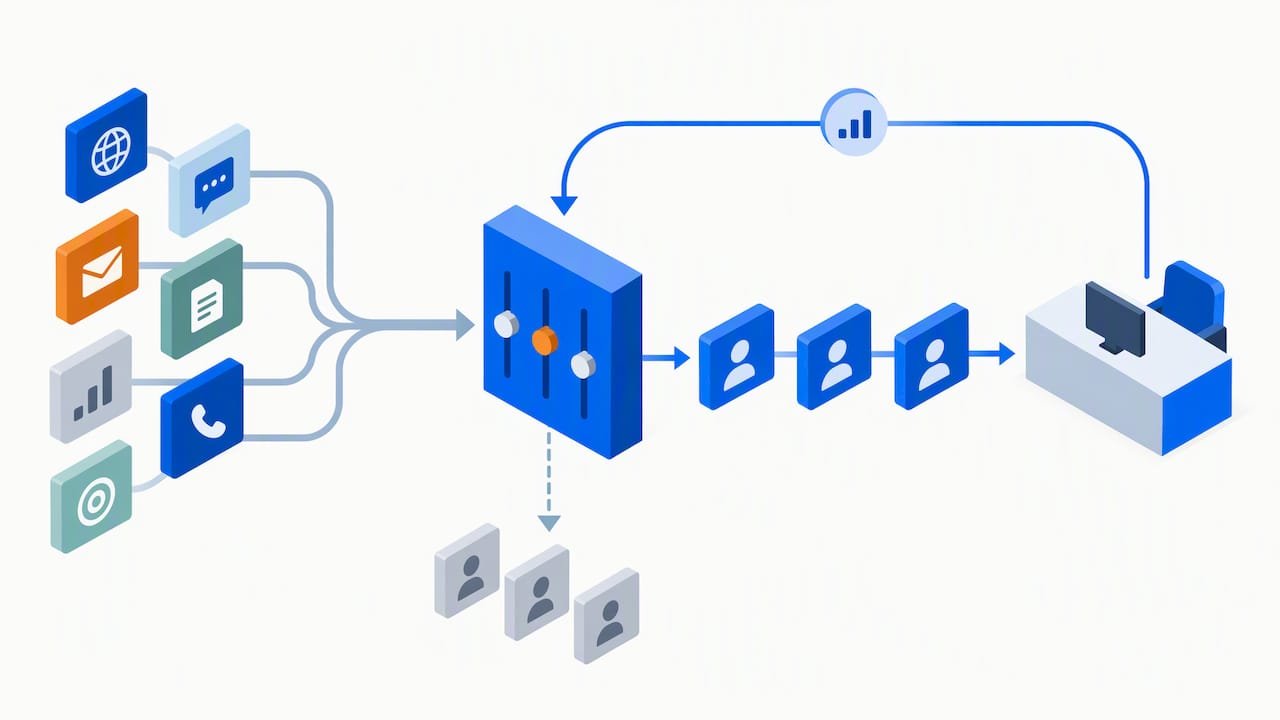
Available around the clock and across site chat and messaging apps, these agents turn after-hours traffic into next-morning pipeline instead of lost visits. Mapped to the core sales jobs, capture, qualify, book, and route, they let you judge any vendor by what each stage actually does, not by demo polish.
How lead qualification actually works: intent signals, scoring, and handoff
A chatbot that only asks “What’s your budget?” is not qualifying leads, it is filling a form. Real qualification blends firmographic signals (company size, industry, role seniority) with behavioural intent (pages visited, content downloaded, specific product questions asked) into a score that determines what happens next.
- Collect signals: capture firmographic data from enrichment and intent cues from the conversation itself.
- Score against thresholds: set an auto-accept bar for high-fit, high-intent leads and a nurture bar for everyone else.
- Trigger the right handoff: auto-accept leads go straight to a rep’s calendar, borderline leads go to a nurture sequence, and ambiguous ones get flagged for human review.
- Confirm before committing: apply a confidence threshold so the bot escalates uncertain cases instead of guessing.
For booking, direct calendar integration (Calendly-style links inside the chat) converts faster than a “we’ll follow up” task, because the prospect commits to a time while engaged. Human-in-the-loop gating on low-confidence scores protects you from the single biggest pilot failure: a flood of false-positive AQLs that erode sales trust in week one.
Pro Tip: Set your auto-accept threshold conservatively for the first month, then loosen it once your reps confirm the AQLs converting to real opportunities.
Integration and data flows: making chatbot leads trustworthy in your CRM
A chatbot that qualifies leads but writes messy records into your CRM creates more cleanup work than it saves. The canonical flow runs capture, enrich, dedupe, then create or update the lead or opportunity record, with every step logged as an activity your sales team can audit.
- Required field mappings: lead source, lifecycle stage, record owner, and timestamp need to sync consistently, or reporting breaks within weeks.
- Deduplication before creation: matching against existing contacts and accounts prevents the same prospect from generating three competing lead records.
- Enrichment on intake: appending firmographic and reverse-IP data at capture time improves scoring accuracy and gives reps context before their first call.
- Attribution preservation: tagging the originating channel and campaign keeps funnel reporting intact, which is the only way to prove the chatbot’s contribution to pipeline.
Readers weighing a build-versus-buy decision can check whether their CRM is ready for AI agents before committing to either path, since most integration failures trace back to incomplete field mapping rather than the chatbot itself.
Deployment model, pilot design and realistic cost and timeline expectations
Budget and governance conversations go smoother when stakeholders know the shape of a typical rollout in advance, rather than discovering it mid-project.
- Discovery (2 to 4 weeks): map your current funnel, CRM fields, and ICP criteria before writing a single qualification question.
- Pilot (4 to 12 weeks): run on a narrow segment, measure AQL rate lift, meeting conversion, and lead-to-opportunity uplift.
- Rollout and optimization: expand scope once the pilot metrics clear your bar, adjusting thresholds as volume grows.
Cost typically breaks into implementation and data integration fees, an ongoing subscription, and, for teams that want it, managed operations rather than in-house maintenance. Staffing a pilot properly means looping in RevOps for data mapping, sales enablement for rep buy-in, and IT for CRM access, well before launch rather than after something breaks.
Governance and risk controls for generative chat: human oversight and testing
Governance is where most pilots quietly fail, not because the technology misbehaves, but because nobody defined what “acceptable” looks like before launch. The NIST AI Risk Management Framework’s Generative AI profile recommends that organizations define acceptable-use policies, require independent evaluation and red-teaming, and set explicit human-in-the-loop rules for risky or ambiguous queries. Teams that build these controls in from the start see fewer escalation incidents and move through internal approval faster.
Human-in-the-loop gating and clear refusal rules for risky queries materially reduce false positives and the legal or privacy exposure that comes with letting a chatbot handle sensitive buyer questions unsupervised.
Source: NIST AI RMF Generative AI Profile
Operationally, that means specifying data retention limits, PII handling rules, and an incident response path before go-live. Add a QA sampling routine and a feedback loop so flagged conversations feed back into model tuning instead of disappearing into a log nobody reads.
How Brainiac Consulting builds and governs sales AI agents
We design AI agents as production systems, not demos, which means deployments include CRM integration, data enrichment, and governance controls from day one. Our open-source methodology keeps clients out of black-box arrangements: you see how the agent scores leads, what data it touches, and where human review sits in the loop. Many engagements focus on common CRM platforms to address pipeline pollution that often originates in incomplete field mapping, not in the chatbot’s conversation logic.
When you evaluate any vendor, ask for:
- A documented integration checklist covering CRM field mapping, deduplication rules, and attribution tagging.
- A governance SLA that specifies acceptable-use policy, escalation rules, and audit log retention.
- Pilot success metrics defined before launch: AQL rate lift, meeting conversion, and lead-to-opportunity uplift.
- Named enrichment sources used to score and route incoming leads.
Practical cautions for revenue leaders
Most teams over-index on chatbot demos and under-index on the two things that actually determine success: CRM integration quality and governance discipline. A polished conversation flow means little if the lead record it creates duplicates three others.
Watch for three red flags in vendor proposals: no mention of human-in-the-loop escalation, vague answers about field mapping, and pricing that bundles “unlimited conversations” without AQL or conversion metrics attached. The single best next step is a narrow pilot, one segment, clear thresholds, measured against AQL lift rather than chat volume.
— Don
Running a compliant pilot with Brainiac Consulting
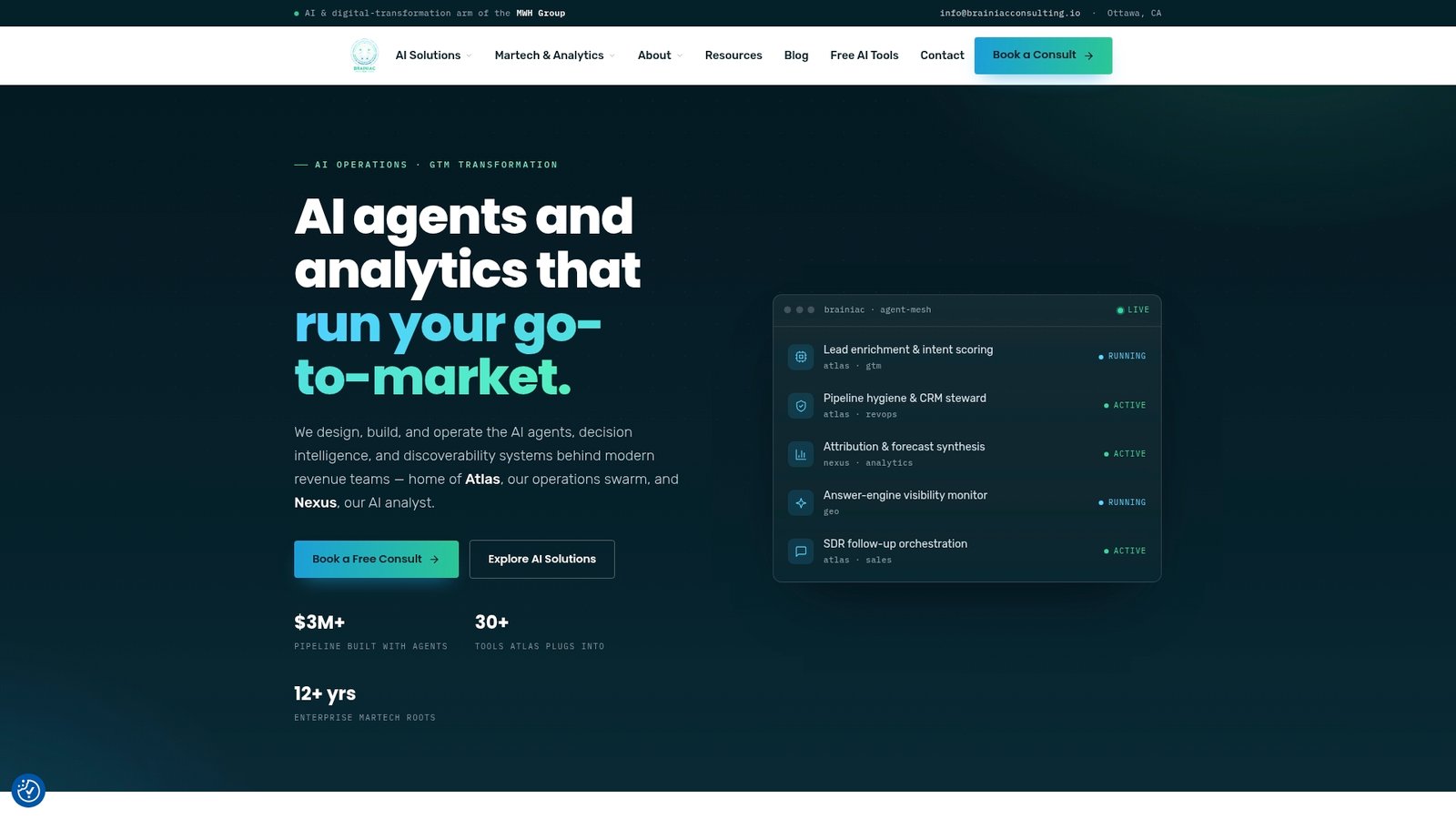
We built our Agentic AI Enablement service around exactly this kind of narrow, measurable pilot, because that is the only version of a chatbot rollout that survives contact with a real sales team. Our starter engagements move through discovery, a scoped pilot against a defined ICP segment, and, where clients want it, managed operations instead of an internal maintenance burden.
What a typical engagement includes:
- Custom agent deployment mapped to your qualification criteria and CRM fields.
- Integration work against Salesforce, HubSpot, or your existing stack, with deduplication and enrichment built in.
- Governance implementation covering acceptable-use policy and escalation rules before go-live.
- Pilot reporting tied to AQL rate, meeting conversion, and lead-to-opportunity movement.
Teams weighing a multi-channel rollout across chat, email, and messaging apps can also review integration patterns for AI assistants on communication platforms before scoping channel coverage. If you want to see what a scoped pilot looks like for your pipeline, visit our site to schedule a pilot conversation.
FAQ
What is the best AI sales bot?
There is no single best option. The right choice depends on your CRM, your ICP, and whether you want a managed, governed deployment or a self-built stack, so evaluate against integration depth, governance controls, and measurable AQL outcomes rather than a ranked list.
What are the top 5 AI chatbots?
Rankings shift constantly and vary by use case, so a fixed top-five list goes stale fast. Industry explainers note that B2B chatbots have moved from simple FAQ tools toward autonomous agents that qualify leads and book meetings, which is a more useful evaluation lens than any single ranking.
What are the four types of chatbots?
Chatbots are commonly grouped into rule-based (fixed decision trees), retrieval-based (pulling from a knowledge base), generative (producing open-ended responses), and hybrid models that combine structured flows with generative replies for flexibility. Most production-grade sales chatbots now use a hybrid approach to balance accuracy with natural conversation.
What is the best AI-powered CRM for sales?
Salesforce and HubSpot remain the two platforms most AI sales agents integrate with directly, since both offer mature APIs for lead and opportunity syncing. The better question is whether your CRM is ready for AI agents in terms of field mapping and data hygiene, not which CRM brand to pick.
How do sales chatbots work?
A sales chatbot captures visitor intent through conversation, scores that lead against firmographic and behavioural criteria, and either books a meeting directly or routes the record into your CRM for follow-up. The strongest implementations pair this with enrichment, deduplication, and human review on low-confidence cases to keep pipeline data clean.