
Predictive lead scoring uses machine learning trained on your closed deals to assign every open lead a conversion probability, plus the top factors driving that number. The immediate payoff is focus: reps stop working leads by gut feel and start working the ones a validated model says are most likely to close. Some firms build these systems to replace static point tables with something that actually learns from outcomes.
TL;DR:
- Predictive lead scoring relies on signals tied to actual buying behavior, such as engagement and intent, rather than demographic data alone.
- A reliable model requires clean, labeled outcomes from sufficient historical data and proper infrastructure for CRM writeback and data management.
- Building and validating the model involves defining conversion targets, assembling relevant features, backtesting, and ensuring explainability to promote sales adoption.
- Continual performance monitoring should focus on metrics like AUC, lift, and calibration, with regular retraining every two to six weeks to prevent model drift.
- Successful deployment depends on integrating scores into CRM workflows with clear visualizations, routing, guardrails, and feedback loops based on sales overrides.
Table of Contents
- What signals actually predict conversion?
- What data do you need before you build a model?
- How do you build, train, and publish a predictive lead scoring model?
- How do you know if your lead scoring model is actually working?
- How do you operationalise scores inside the CRM?
- Brainiac Consulting: real outcomes and how we approach predictive scoring
- When predictive lead scoring is actually worth the investment
- How Brainiac Consulting helps you put predictive scoring into production
- Sources
- FAQ
What signals actually predict conversion?
Not every data point earns a place in the model. The signal categories that consistently move a score are the ones tied to real buying behaviour, not just demographic guesswork.
- Firmographic signals — company size, industry, and revenue band tell you fit, but on their own they rarely separate a buyer from a browser.
- Technographic signals — the tools a prospect already runs, and where they sit in a renewal or upgrade window, often flag timing better than any form field.
- Intent and buying signals — hiring sprees, RFPs, and funding announcements suggest budget is moving, even before a prospect fills out anything.
- First-party engagement — site visits, email replies, and demo requests are the highest-confidence signals a model can use, because they come directly from the buyer’s own actions.
- Relational signals — colleague conversions inside the same account and content progression across a buying committee are harder to capture, but they carry outsized predictive weight once you have the data plumbing to see them.
Weighting matters as much as collecting. First-party engagement and verified fit should carry the most influence, with intent data used mainly to time outreach and third-party inferred signals treated as tie-breakers rather than primary drivers.
What data do you need before you build a model?
A predictive model is only as good as the outcomes it learns from, and most teams underestimate how much cleanup that requires. Run through this before committing engineering time:
- Confirm you have enough labelled outcomes. A model needs a meaningful volume of closed-won and closed-lost records, consistently labelled, so it can learn the difference between the two rather than memorize noise.
- Fix data hygiene first. Deduplicate contacts, map every record to a canonical account, and standardize timestamps and your definition of “closed-won” across teams. Inconsistent definitions here quietly poison training data.
- Check your infrastructure. You need reliable CRM writeback, a connected data store or lake if signals live outside the CRM, and clear permissions covering who can see and act on scores.
- Decide if you’re actually ready. If lead volume is low or labels are sparse, a rules-based scoring system is the smarter short-term move. Predictive scoring rewards volume; it punishes teams that force it too early.
How do you build, train, and publish a predictive lead scoring model?
Once the prerequisites check out, the build itself follows a fairly disciplined sequence.
- Define the conversion target and training window. Decide exactly what counts as “converted” and how far back your training data should reach.
- Assemble the dataset and feature set. Pull firmographic, technographic, intent, and engagement signals into one training table, tagged with outcomes.
- Choose your modelling approach. AutoML tools get you to a working model fast; custom models pay off when you need relational signals like colleague conversions, which flat-table tools miss.
- Backtest against historical quarters. Run the model against deals you already closed and confirm it would have flagged the winners early.
- Evaluate performance and explainability. Check AUC and precision at the top decile, then pull the top driving factors behind individual scores so reps can see why a lead ranks where it does.
- Publish into production. Write scores back into the CRM, connect routing automation, set response SLAs, and lock in a retrain schedule.
Pro Tip: Before you ever show a score to sales, run it against last quarter’s closed-won list and show reps, in a single slide, how many of those wins the model would have flagged early. That one exercise does more for adoption than any amount of documentation.
How do you know if your lead scoring model is actually working?
A model that looks good in a data science notebook can still fail in production if nobody checks whether it holds up over time. Four metrics matter most:
- AUC (area under the curve) tells you how well the model separates converters from non-converters across all thresholds.
- The calibration curve shows whether a “70% probability” lead actually converts around 70% of the time, or whether the number is aspirational.
- Lift measures how much better your top-scored leads perform compared to a random sample.
- Precision at the top decile tells you, of the highest-scoring 10% of leads, how many actually convert. Relational models that read connected account and contact tables can push this three to five times higher than a flat-table model working from random.
Calibration only earns trust once you publish it. Map score bands to observed win rates and share that mapping with the sales floor. Maintenance is not optional either: model drift is a documented failure mode, so cap how much a score can swing week to week, log every rep override, and retrain on a fixed cadence, typically every two to six weeks depending on lead volume.
How do you operationalise scores inside the CRM?
A model earns nothing sitting in a notebook. It earns its keep the moment a rep sees it and acts on it, which means writeback and routing design deserve as much attention as the model itself.
- Writeback UX: show the probability score, the top three driving factors, and a suggested next action directly on the lead record, not buried in a separate report.
- Routing and SLAs: tier leads into bands (A/B/C, or explicit probability thresholds) and assign response-time SLAs and owners to each tier.
- Business-rule guardrails: layer manual override rules for edge cases the model wasn’t trained to catch, and log every override so the next retrain can learn from it.
- Post-deployment KPIs: track time-to-first-touch, conversion rate by score band, and pipeline velocity to confirm the model is actually changing outcomes, not just producing numbers.
Pro Tip: If reps consistently override a specific score band, that pattern is data. Feed those overrides back into the next retrain rather than treating them as noise to ignore.
Brainiac Consulting: real outcomes and how we approach predictive scoring
Brainiac Consulting specializes in AI-driven go-to-market systems, built on an open-source methodology with deep Salesforce and HubSpot integrations. Typical AI pipelines pull firmographic, engagement, and relational signals into one model, backtest against closed-won history, write the score into the CRM, and retrain on a fixed schedule.
- Documented results include multimillion-dollar pipeline impact tied directly to improved lead-to-opportunity conversion.
- Broader outcomes across sectors are catalogued in Brainiac’s case study library.
When predictive lead scoring is actually worth the investment
Predictive scoring pays off once you have enough labelled outcomes and enough lead volume to keep a model fed. Below that threshold, most of the “failures” I see aren’t the algorithm’s fault. They’re dirty data, no CRM writeback, skipped backtesting, or a sales team that was never brought into the process. Split ownership cleanly: RevOps and data engineering own the build, sales enablement owns adoption. Neither side can carry both.
— Don
How Brainiac Consulting helps you put predictive scoring into production
Most teams don’t stall on the math. They stall on getting a model into the CRM, trusted by reps, and retrained without a full engineering sprint every time. Brainiac Consulting closes that gap through the Atlas AI Operations Platform, which runs predictive scoring pipelines alongside custom AI agents and managed CRM integrations, with the open-source visibility to show you exactly how a score gets its number instead of asking you to trust a black box.
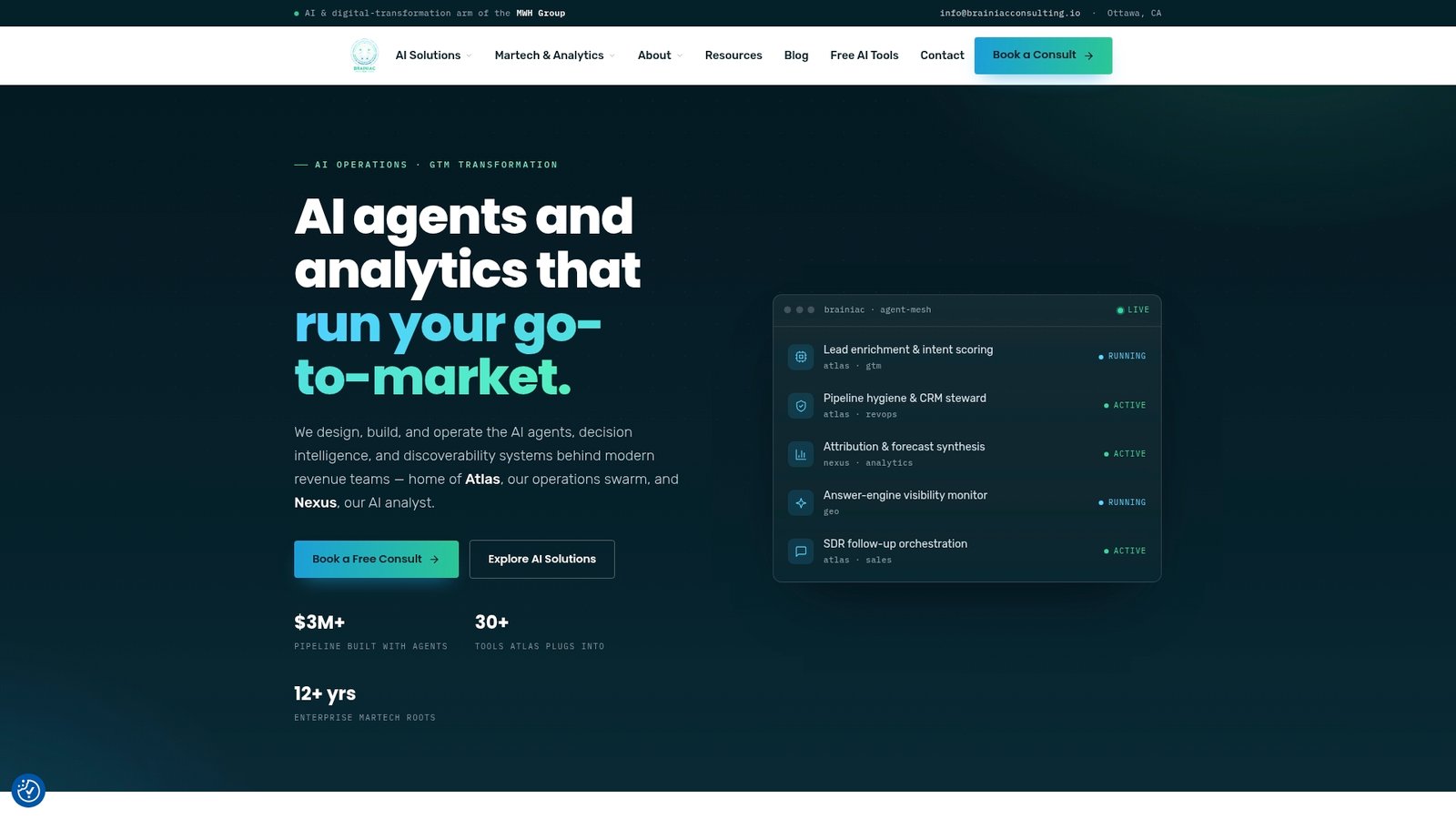
Where a startup or partner ecosystem like Benchmarked focuses on building AI-native go-to-market teams from scratch, Brainiac’s angle is different: taking your existing Salesforce or HubSpot data and turning it into a live, calibrated score within weeks, backed by case studies showing real pipeline lift. If you want to see what that looks like against your own deal history, review the lead conversion case study or get in touch through Brainiacconsulting to scope your data readiness.
Sources
- Predictive and automated lead ranking research (PMC review)
- Kumo
- How to build a lead scoring model that actually predicts conversions | Pecan AI
FAQ
How much data do you need before starting predictive lead scoring?
You need a reliable volume of consistently labelled closed-won and closed-lost outcomes; below that, rules-based scoring is the more sensible starting point.
What’s the difference between rules-based and predictive lead scoring?
Rules-based scoring assigns fixed points to attributes you choose manually, while predictive lead scoring learns which signals actually correlate with conversion from your own historical data.
How do you make a predictive score explainable to sales reps?
Publish the top three factors driving each score alongside the probability itself, and map score bands to observed win rates so reps can see the number checked against reality.
How often should a predictive lead scoring model be retrained?
Most teams retrain every two to six weeks depending on lead volume, with automated monitoring for AUC drop or precision decay triggering an earlier retrain if needed.
Can consulting firms help implement predictive lead scoring?
Yes. Some consulting firms build and manage predictive scoring pipelines through AI operations platforms, with direct CRM writeback into Salesforce and HubSpot.