Event streaming analytics means analyzing events, such as clicks, form fills, payments and CRM updates, continuously as they happen, instead of waiting for a nightly batch job. Google Cloud describes streaming analytics as the continuous ingestion, processing and analysis of data as it is generated, which gives you sub-second to near-real-time insight. For a revenue team, that is the difference between seeing a buying signal while the buyer is still on your site and reading about it in Monday’s report.
This guide explains the moving parts in plain terms, shows where the approach pays off for marketing, sales and finance operations, and lays out a sensible first pilot. It also covers the failure modes that tend to surprise teams: late data, duplicate events and unclear identity.
TL;DR
- Event streaming moves events from source to destination continuously. Event processing interprets and acts on them. Streaming analytics combines both so results arrive in seconds, not the next morning.
- You do not need real time everywhere. Use it where a decision loses value as it ages: lead routing, fraud checks, stock and pricing alerts, on-site personalization.
- Most failures come from the data model, not the tooling: missing event time, no canonical identity, and no plan for late or duplicate events.
- Start with one event type, one decision and one measurable outcome, then expand.
Table of Contents
- What event streaming analytics actually is
- Batch versus streaming: a practical comparison
- The building blocks
- Where it pays off for GTM and finance teams
- Time is the hard part
- Identity and schema: the quiet failure points
- Our perspective: start with the decision, not the platform
- A five-step pilot you can run
- Build, buy or get help
- How we can help
- FAQ
- Sources
What event streaming analytics actually is
Three terms get mixed up, so it helps to separate them.
Event streaming is the transport layer. Practitioners at Confluent draw the line this way: streaming focuses on the continuous, reliable movement of data from source to destination, while event processing focuses on interpreting, filtering and acting on that data to produce business insight.
Event processing is the logic applied to the stream: filtering, enriching, joining and aggregating events, and triggering actions.
Streaming analytics is the outcome. IBM defines it as the continuous ingestion, processing and analysis of streaming data in real time or near real time, in contrast to traditional analytics, where data is analyzed only after it has been routed to a repository.
Think of a batch report as a photograph and a stream as a live camera feed. The photograph is easier to file and audit. The feed is the only one that lets you react while something is still happening.
Batch versus streaming: a practical comparison
Neither model is better in the abstract. The question is how fast a decision decays.
| Question | Batch analytics | Streaming analytics |
|---|---|---|
| When is data analyzed? | After it lands in a warehouse, on a schedule | As each event arrives |
| Typical latency | Hours to a day | Milliseconds to seconds |
| Best for | Board reporting, attribution reviews, forecasting | Routing, alerting, personalization, fraud checks |
| Cost profile | Cheaper per insight, simpler to operate | Always-on infrastructure, more engineering care |
| Main risk | Decisions made on stale data | Wrong answers from late, duplicate or unordered events |
For a broader view of why continuous monitoring beats periodic checks, this real-time monitoring playbook shows the same logic applied to social channels, where the window to respond is short.
Most mature teams run both. Streaming handles the operational layer, and the warehouse keeps the reconciled, auditable record. The two should agree, and checking that they do is part of the job.
The building blocks
A streaming analytics stack has five layers. Whatever tools you pick, you will make a decision at each one.
- Producers. Websites, apps, payment systems, CRMs and marketing platforms that emit events.
- Transport and storage. A durable log, commonly built on Apache Kafka, that holds events in order so many consumers can read them independently.
- Processing engine. A framework such as Apache Flink or Spark Structured Streaming that filters, joins and aggregates events over time.
- Serving layer. Where results land: a dashboard, a feature store, a CRM field, or an alert.
- Governance. Schemas, access rules, retention and monitoring, so people trust what they see.
The engines are mature. Spark’s Structured Streaming guide documents end-to-end exactly-once guarantees through checkpointing and write-ahead logs, with micro-batch latencies as low as 100 milliseconds and continuous mode as low as 1 millisecond. In practice, the limiting factor for a marketing or sales team is almost never engine speed. It is whether the events are well defined.
Where it pays off for GTM and finance teams
The strongest use cases share a trait: someone can act within minutes, and acting early changes the result.
Lead routing and qualification
A pricing-page visit plus a webinar attendance plus a job-title match is a stronger signal in the first ten minutes than it is the next day. Streaming lets you enrich the record, score intent and route it to the right rep before the moment passes. We cover the plumbing in our guide to shipping real-time data sync for RevOps.
Pipeline hygiene and CRM automation
Stale opportunities, missing fields and duplicate accounts are easier to fix when they are flagged on creation than in a quarterly clean-up. An event-driven agent can watch for the change and correct or escalate it.
Ecommerce revenue leakage
Abandoned checkouts, failed payments, coupon abuse and stock-outs are all event patterns. Spotting them as they form is far more useful than discovering them in a month-end variance review.
Attribution and AI influence
Attribution rests on events, so how you instrument them decides the quality of the answer. One published approach for chatbots recommends using a canonical conversation ID across every channel and treating the agent type (AI, human or blended) as a first-class dimension from the start, rather than trying to reverse-engineer it later. The same source suggests pairing an influence window, for example an AI interaction within 15 to 60 minutes of conversion, with confidence weighting that credits accepted AI suggestions more than generic AI messages. Treat those numbers as starting points to test against your own conversion cycle, not as fixed rules.
This is attribution as a map rather than a courtroom verdict: streaming gives you the detailed terrain, and your model decides which routes matter.
Time is the hard part
The most common mistake in streaming projects is treating the moment an event arrives as the moment it happened. They are not the same, and the gap grows with mobile apps, offline devices and retries.
Apache Flink’s documentation distinguishes event time (when the event occurred at the source), ingestion time and processing time. For business metrics, event time is usually the right basis, because a purchase should count on the day it was made, not the day a delayed message landed.
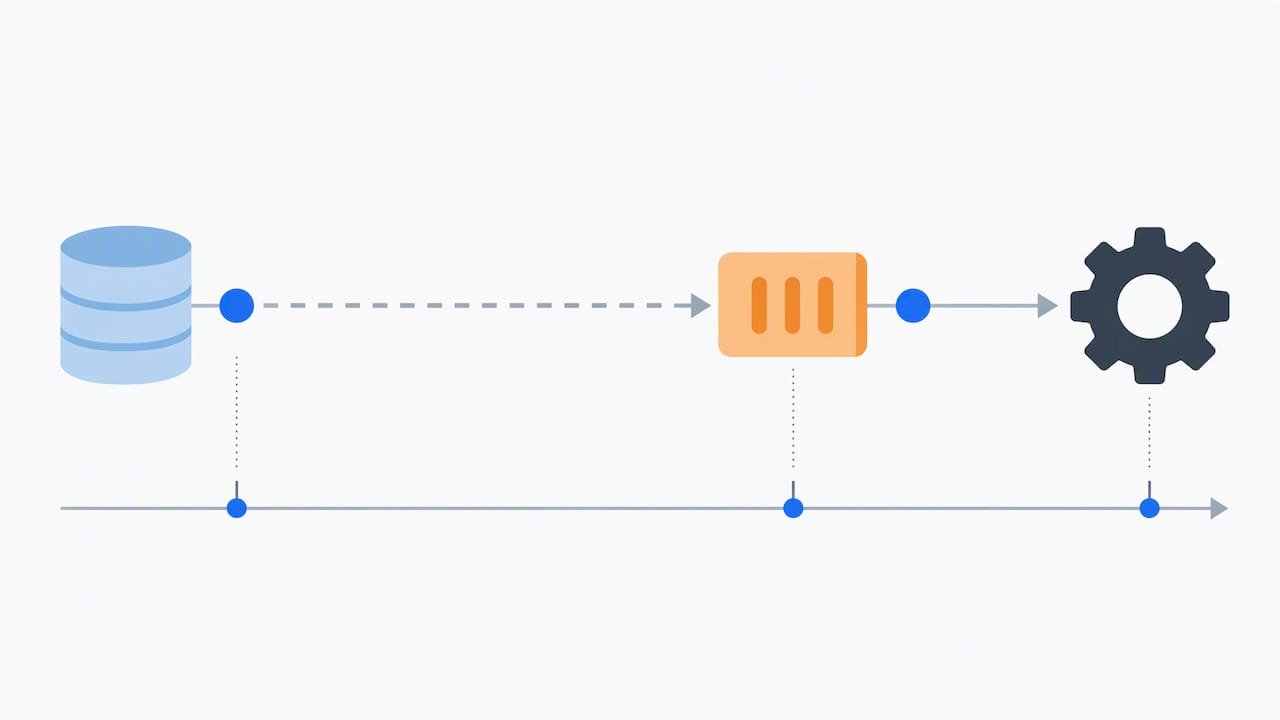
That raises a trade-off: how long do you wait for stragglers? Watermarks answer it. According to Databricks, a watermark is a moving threshold trailing the maximum observed event time. It lets the engine drop state for events that arrive past the lateness limit, balancing accuracy against memory.
Here is how to apply that in a business setting:
- Pick a lateness tolerance per metric. A live lead-alert can tolerate a few seconds. A revenue-by-hour tile may justify waiting minutes.
- Decide what happens to very late events. Drop them from the live view, but make sure they reach the warehouse so the reconciled number is still correct.
- Show the freshness. A dashboard that says “as of 14:32:10” earns more trust than one that pretends to be exact.
Identity and schema: the quiet failure points
Streams are unforgiving of vague data. Before you build anything, settle these:
- A canonical identifier that ties anonymous sessions, known contacts and accounts together, so one buyer is not counted as five.
- A versioned event schema with required fields, names and types, so a renamed property does not silently break downstream logic.
- Idempotency, so a retried event does not double-count revenue.
- Consent and privacy flags carried on the event itself, so downstream systems can respect them.
Our breakdown of marketing data pipelines and their six components goes deeper on governed design, and our whitepaper on behavioral analytics in marketing shows how event data turns into decisions.
Our perspective: start with the decision, not the platform
We see the same pattern across marketing, sales and finance teams. Someone buys or builds a streaming platform first, then goes looking for a use. Six months later, the dashboards update every second and nobody changes what they do.
We work the other way round. Name the decision, the person or agent who makes it, the data it needs, and how quickly the value fades. If the answer is “a week”, a well-run batch pipeline is the honest recommendation. If the answer is “ten minutes”, build the stream.
Three convictions shape how we build:
- No black boxes. We favour open-source methods and integrations with the platforms you already run, such as Salesforce, HubSpot, Marketo, Power BI and Tableau, so you can see how every number is produced.
- Agents belong in the loop, with guardrails. Streaming is what lets an AI agent act on a fresh signal. Governance, such as scoped permissions and human review for risky actions, is what makes it safe to let it.
- Prove it small. One event, one decision, one outcome. If it does not move a number, we learn that cheaply.
We also recommend an accuracy check before anyone trusts an AI-driven analytics layer. Our guide on evaluating whether an AI analytics platform is accurate enough sets out how.
— Don
A five-step pilot you can run
This is a sequence we would be comfortable defending in a steering meeting.
- Choose one decision. For example: route a high-intent lead to a rep within five minutes.
- Define the events. List the three to six events that feed it, with names, owners and required fields. Add event time and a canonical ID to every one.
- Set the tolerances. Agree the maximum acceptable latency and the lateness window. Write them down.
- Build the thinnest path. Ingest, enrich, score, then write the result back to the CRM or alert channel. Keep the warehouse as the system of record and reconcile against it daily.
- Measure against a control. Compare outcomes, such as speed to first touch, meeting rate and pipeline created, for routed and non-routed leads. Keep the pilot only if the difference holds.
Once the first loop works, extend it to pipeline hygiene, then attribution. If you are weighing how AI agents fit around the stream, our 90-day roadmap for AI in RevOps moves from copilot to limited autopilot in stages.
Build, buy or get help
There are three realistic paths, and the right one depends on your team.
- Managed cloud streaming services reduce operations work and suit teams with strong engineering but little appetite for running clusters.
- Open-source stacks give the most control and the least lock-in, at the price of needing people who can operate them.
- Specialist partners fit teams whose real gap is the translation between GTM questions and data design.
A useful test is who will own it in month nine. If nobody can name them, plan for managed operations from the start.
How we can help
Brainiac Consulting designs and operates AI agents and analytics systems for marketing, sales and finance teams. If you want an agent that acts on live signals, our Custom Agent Deployment service builds production-grade agents inside your environment. If you are not yet sure where streaming fits, the AI strategy and readiness work identifies and prioritizes the opportunities first. You can also see everything we offer on our home page.
FAQ
What is an example of streaming data?
Website clickstreams, payment transactions, sensor readings and CRM field changes are all streaming data. Each is a small, time-stamped record that arrives continuously. Google Cloud notes that streaming analytics suits sources that send data in small pieces at high frequency.
How does event streaming work?
Producers publish events to a durable log. Consumers, such as a processing engine, read those events in order and filter, enrich or aggregate them. Results are then sent to a dashboard, a database or an automated action, usually within seconds.
Can Kafka be used for streaming data?
Yes. Kafka is widely used as the transport and storage layer for event streams. It moves and retains events reliably, while a separate engine such as Flink or Spark typically does the analytical processing on top, which matches the split between streaming and processing described above.
Do I need real-time analytics for everything?
No. Use it where the value of a decision fades quickly, such as routing, alerts and fraud checks. Reporting, forecasting and attribution reviews usually work well on batch data, and many teams run both side by side.
Sources
- What is Streaming Analytics? | Google Cloud
- What Is Streaming Analytics? | IBM
- What Is Event Processing? | Confluent
- Structured Streaming Programming Guide, Spark 3.5.9
- Streaming Analytics | Apache Flink
- Event-time Aggregation in Spark | Databricks Blog
- Instrument Chatbots: Track Human vs AI Influence