
A smooth demonstration can show that an AI analytics platform is easy to use. One accuracy percentage can summarize a test. Neither tells you whether the platform is reliable enough for the decisions your organization intends to make.
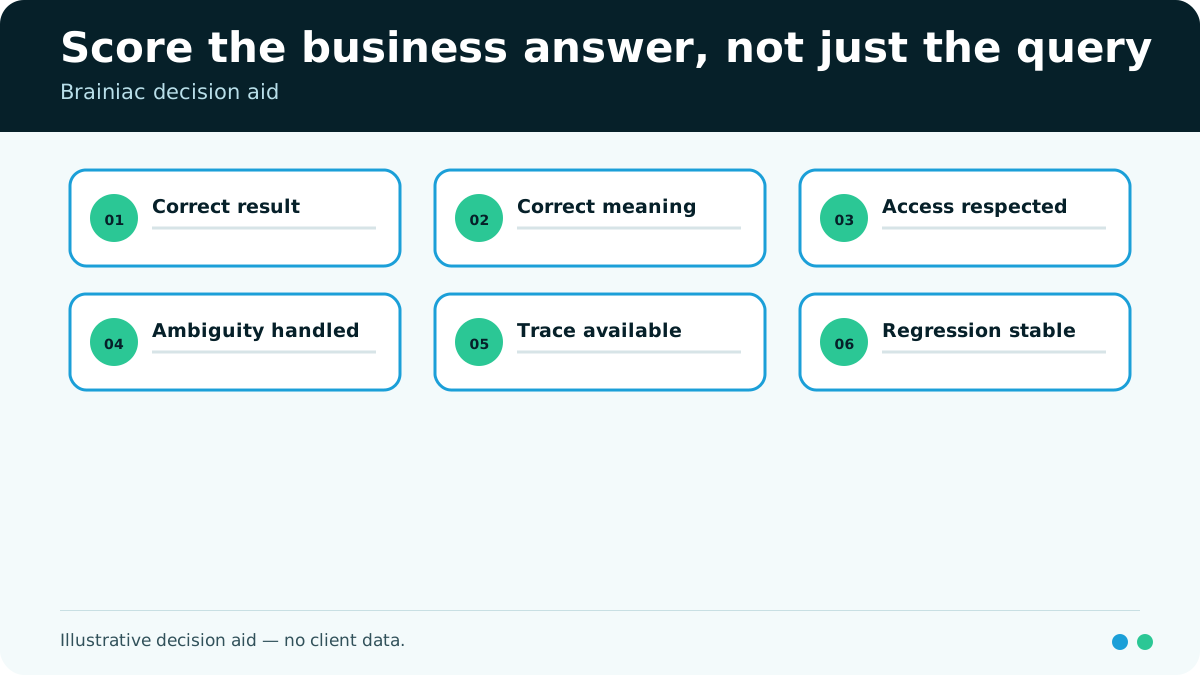
“Accurate enough” is a use-case-specific operating decision. It depends on correct results, governed definitions, access controls, ambiguity handling, traceability, correction behavior, and the human effort required to verify or repair outputs.
These dimensions should remain visible. A critical access or integrity failure should not disappear inside an average.
Define the decisions in scope
Begin with decisions, not generic questions. Identify who will use the system, what they will decide, which data is permitted, and what happens if the answer is wrong.
Separate use cases such as exploratory analysis, recurring management reporting, financial review, pipeline inspection, and operational decision support. They may require different evidence and controls.
For each use case, document:
- Intended user and access role
- Business question or decision
- Approved metric definitions
- Required sources and freshness
- Expected filters, grain, and joins
- Acceptable clarification or refusal behavior
- Required evidence and trace
- Human reviewer and escalation path
There is no universal passing percentage. The acceptable standard must reflect the consequence of each error type.
Build a reference set from real questions
Create a test set that represents the questions users actually need answered. Preserve the original wording, including realistic ambiguity.
For every item, record the expected interpretation, metric definition, effective date, filters, access context, validation method, and any acceptable alternative response. Some questions should have a known numerical result. Others may require clarification or refusal.
NIST calls for documented test sets, metrics, tools, validation methods, contextual interpretation, monitoring, and defined human oversight. That documentation makes the evaluation repeatable and reviewable.
Avoid polishing every prompt into laboratory language. If ordinary users ask incomplete questions, the platform’s ability to identify missing information is part of the capability being tested.
Separate tasks, trials, traces, and outcomes
Anthropic describes agent evaluations through distinct tasks, trials, graders, traces, and outcomes. This separation is useful for analytics evaluation.
- A task is the question and expected behavior.
- A trial is one execution of that task.
- A trace shows the steps, queries, tools, and decisions.
- An outcome is the resulting answer and final data state.
- A grader applies a defined evaluation method.
Run repeated trials where variability could affect the decision. Anthropic recommends multiple trials because outputs vary. Do not assume that one correct response proves stable behavior.
Inspect both the trace and outcome. A plausible narrative can hide an incorrect query, while an inefficient trace can occasionally land on the right number by accident.
Evaluate critical dimensions separately
A useful scorecard describes or scores each dimension without forcing them into one blended result.
Correct end result
Compare the returned value, table, or conclusion with an approved reference or validation method. Use exact comparison where an objectively correct answer exists, while accounting for documented rounding or timing rules.
Correct semantic interpretation
Verify the metric definition, effective date, entity, segment, and comparison period. A numerically consistent answer using the wrong definition is still wrong.
dbt says centralized metric definitions and managed joins can support consistent metrics for downstream applications. A semantic layer can reduce ambiguity, but it does not guarantee correct source data, query behavior, or final interpretation.
Filters, grain, and joins
Inspect generated logic for filters, grouping, aggregation grain, join paths, deduplication, null handling, and calculation order. Do not infer correctness from the final prose.
Permitted access
Run tests under the identities and roles that will use the platform. Confirm that restricted data remains restricted and that permission filters do not silently turn a broad question into a partial answer.
dbt includes access permissions in its Semantic Layer, but each platform’s implementation must be evaluated directly.
Treat unauthorized disclosure as a gate, not a minor error averaged against correct answers.
Clarification and refusal
Test ambiguous questions and unsupported requests. A useful system should ask for missing scope when necessary and refuse when evidence or authority is insufficient.
A forced answer is not more useful than an honest limitation.
Trace completeness and grounding
Determine whether reviewers can connect the answer to its sources, metric definition, query or plan, tool calls, and transformations. Check whether citations or source references genuinely support the claims made.
Correction persistence
Correct an identified error, then rerun the original and related tasks. Determine whether the correction persists across sessions, users, or configuration changes where it is expected to persist.
Repeatability and regression
Distinguish capability tests from regression tests. Anthropic recommends maintaining both, supplemented by production monitoring, user feedback, trace review, and periodic human calibration.
A platform update, metric change, permission change, or new data source can alter previously acceptable behavior.
Operating effort
Measure the analyst or editor effort required to verify, correct, and explain outputs. Include material latency and cost where they affect the use case.
A system that eventually produces the right answer after extensive repair may not be suitable for self-service use, even if its final output passes.
Use layered grading
Anthropic recommends deterministic graders where possible, model-based graders where needed, and human grading for validation. No single layer catches every issue.
Use deterministic checks for exact values, schemas, required fields, permissions, and known control totals. Use model-based grading cautiously for qualities such as explanation coverage or groundedness. Treat it as an evaluation aid, not objective truth.
Human reviewers remain important for disputed definitions, material ambiguity, source quality, and calibration. Document reviewer guidance so judgment is as consistent as practical.
Make the decision capability-specific
Summarize which use cases and action levels are supported, blocked, or require human review. Do not label the entire platform accurate or inaccurate based on one aggregate.
A critical integrity failure might block financial reporting while leaving low-risk exploratory analysis available with review. Weak refusal behavior might block self-service access until corrected. High verification effort may restrict use to analysts rather than executives.
Brainiac’s Nexus work focuses on governed AI analysis. Brainiac can help build the reference set, metric contract, trace requirements, and evaluation process needed for a defensible decision. The objective is not to claim universal accuracy. It is to establish where the platform can be trusted, under which conditions, and with what operating effort.
Sources
Primary sources used for the factual claims in this article: