
Data lineage in marketing is the record of where each number in your reports came from, what happened to it along the way, and who is accountable for it. It lets you answer “why does this dashboard say that?” in minutes instead of weeks. This guide covers what to map, how to keep the map alive, and where governance fits, with a practical path for CMOs, marketing ops leads and analysts.
TL;DR
- Lineage tracks the origin, movement and transformation of data from source systems to the reports, models and campaigns that depend on it.
- In marketing, the hardest part is rarely the software. It is a persistent customer identifier and clear ownership of each metric definition.
- Lineage management (capture and visualization) and lineage governance (roles, policies, enforcement) are different jobs, and you need both.
- For AI-driven attribution and lead scoring, lineage has to include consent basis and collection date, not just pipelines.
- Start small: pick three board-level metrics, trace each one end to end, assign an owner, and review it on a schedule.
Table of Contents
- What data lineage means for a marketing team
- Why it matters more now
- The types of lineage, in plain terms
- Reading a lineage graph
- What to map first in a marketing stack
- The technical hurdles that actually trip teams
- Lineage management versus lineage governance
- Lineage for AI: go beyond pipelines
- Our perspective
- How Brainiac can help
- A 30-day starting plan
- FAQ
- Sources
What data lineage means for a marketing team
Think of attribution as a map rather than a courtroom verdict. A map is only useful if you know where the roads start. Lineage is the surveyor’s notes behind that map.
A technical definition from Actian’s enterprise guide describes lineage as the complete record of how a data asset moves from its original source through every transformation and system to its destination in a report, model or operational tool. For marketing, translate that into concrete questions:
- Which form, ad platform or product event created this lead?
- Which enrichment step changed the company size or industry field?
- Which rule gave this account a score of 82?
- Which dashboards break if we rename a campaign field in the CRM?
If you cannot answer those quickly, you do not have a data problem so much as a map problem. One industry view is that teams struggle to agree on a single source of truth because they cannot consistently identify the origin, owner and transformation logic of their marketing metrics. We agree, and we would add that the fix is a living capability, not a one-off documentation sprint.
Why it matters more now
Three pressures have pushed lineage from a data-engineering topic into the marketing leadership agenda.
Attribution you can defend. When finance asks why paid social was credited with $400,000 of pipeline, “the model said so” is not an answer. A traced path from touchpoint to opportunity is. We explore the common failure modes in what marketers get wrong about attribution.
AI that makes decisions on your data. Lead scoring, intent prediction and agent-driven outreach all consume data. NIST guidance, as summarized by Single Grain, links poor data quality, made worse by unclear lineage, to weaker management of AI and privacy risk. Lineage is the bridge between how data moved and whether you should be using it that way.
Privacy audits. If a California consumer asks what you hold and where it went, you need to follow their data through your stack. Our CCPA checklist for marketers walks through mapping martech data for that purpose.
The types of lineage, in plain terms
Academic and vendor literature use several overlapping labels. Here is how they map to marketing work, drawing on a research paper on lineage in data transformation pipelines.
| Type | What it shows | Marketing example |
|---|---|---|
| Design lineage | What should happen | The documented rule that routes a webinar lead to an SDR queue |
| Operational lineage | What actually happened | The log showing 14% of those leads skipped enrichment last month |
| Coarse-grained (workflow) | Which jobs and systems feed which | HubSpot to warehouse to Tableau |
| Fine-grained (dataflow) | Field-level movement and change | How lead_source is rewritten between CRM and warehouse |
Fine-grained lineage splits further into where-provenance (the source), how-provenance (the transformation) and why-provenance (the business logic behind it). The last is the one marketers often skip, and it is the one that settles arguments. “Why is this account tiered as Enterprise?” is a why question.
The gap between design and operational lineage deserves attention. Most teams document the first and discover the second only when something breaks.
Reading a lineage graph
A lineage graph visualizes how data flows from source systems through transformation pipelines into models, dashboards and activation platforms. Its most practical use is impact analysis. A 2026 roundup of lineage tools describes graphs that show which downstream assets are affected by a change before you make it.
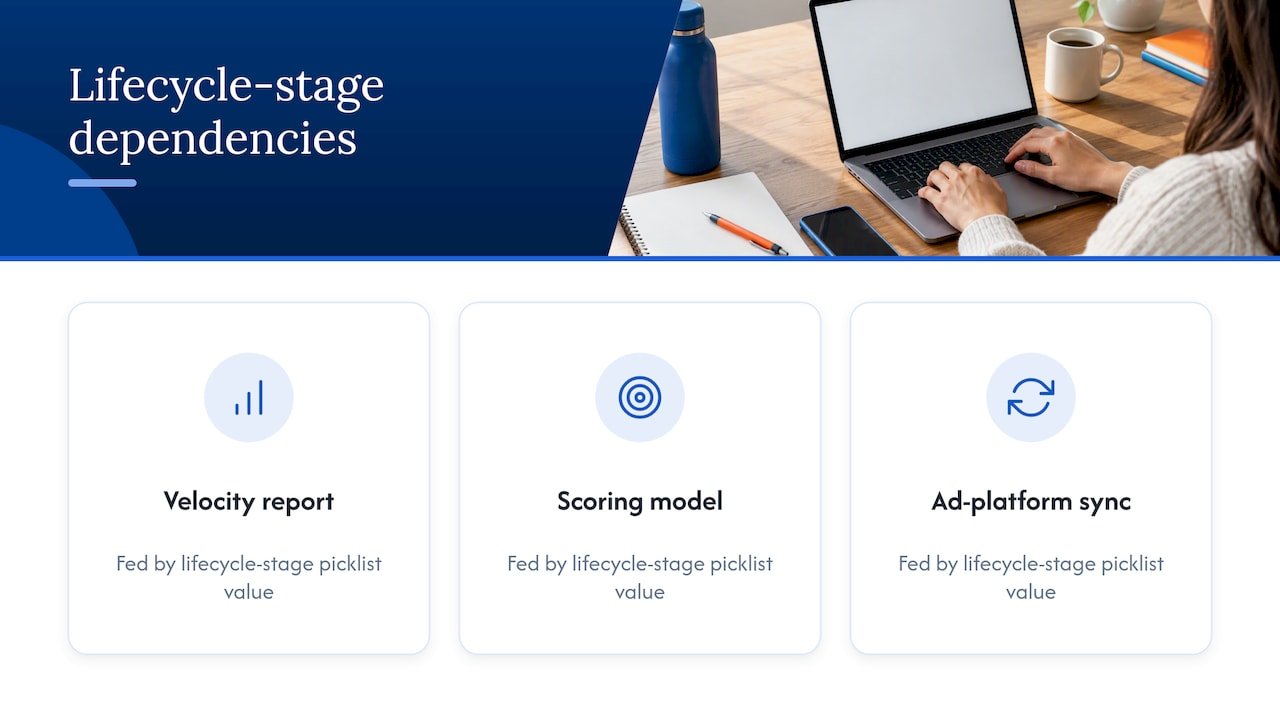
Picture a marketing ops manager who wants to rename a lifecycle stage picklist value. With a graph, she sees that it feeds a pipeline-velocity report, a scoring model and a reverse-ETL sync to the ad platform. Without one, she finds out when the CFO’s dashboard goes blank.
What to map first in a marketing stack
Do not try to map everything. Start where the money and the risk meet.
- Pick three metrics leadership actually uses. Typically marketing-sourced pipeline, cost per qualified opportunity and a forecast figure.
- Walk each one backwards. From the dashboard tile to the query, the warehouse table, the ingestion job, and the originating system.
- Record the owner and definition at every hop. A name, not a team.
- Flag every manual step. Spreadsheets and one-off exports are where lineage usually breaks.
- Note the consent and collection basis for any personal data in the path.
- Decide how changes get announced. A change to an upstream field should notify the owners of everything downstream.
Our five-phase marketing ops audit follows a similar spine for tracing leads to revenue, and it is a good way to run steps 1 to 4 across a whole funnel.
The technical hurdles that actually trip teams
Keep transformations out of the CRM
Many enterprise teams try to build multi-touch attribution directly inside Salesforce or HubSpot. CaliberMind’s enterprise guide advises pulling data into a warehouse such as BigQuery or Snowflake first and transforming it there, because CRMs were not built to run that math and forcing it breaks pipelines and trust in the numbers. The lineage benefit is real: transformations in one governed layer are visible, versioned and testable, while logic scattered across CRM workflows is not. For a worked example, see our piece on Snowflake marketing analytics and a production pilot.
The identifier problem
A lineage tool can only stitch a journey together if the same customer key persists across systems. The identifier on a CRM contact should match what web analytics and payment systems use. Without that, the graph has gaps, and an attribution model built on it is incomplete or wrong. Before you buy anything, audit your keys: email hash, CRM ID, account ID, order ID. Decide which is canonical and how the others map to it.
Pipeline integrity
Lineage tells you where data went. It does not guarantee the data arrived intact. Validation at each hop matters, especially when AI-generated or semi-structured payloads are involved. This engineering guide to AI data pipeline integrity is a useful read for the technical members of your team. We cover the broader design in marketing data pipelines: six components, governed by design.
Lineage management versus lineage governance
This distinction is where many programs stall. OvalEdge’s governance framework guide separates the two: management is the technical capture and visualization of data flow, while governance covers accountability, policy enforcement and decision authority, such as data stewards, that keep the lineage accurate and trustworthy.
A tool gives you the first. People and process give you the second.
| Lineage management | Lineage governance | |
|---|---|---|
| Core question | Where did this data go? | Who is responsible for it being right? |
| Typical output | Graphs, field-level traces | Roles, policies, review cadence |
| Failure mode | A beautiful graph nobody trusts | Policies with no visibility behind them |
| Marketing owner | Marketing ops, analytics engineering | CMO sponsor, named data stewards |
In practice, governance for marketing lineage needs four things:
- A named owner for every critical metric, with authority to approve definition changes.
- A change process, so a renamed field triggers review rather than surprise.
- A validation schedule, because lineage drifts as tools, campaigns and integrations change.
- An escalation path when lineage and reality disagree.
If your team is also thinking about how responsible data use connects to marketing performance, this analytics and ROI article is a helpful companion read.
Lineage for AI: go beyond pipelines
When a model scores a lead or an agent chooses a next action, the question moves from “where did the data flow” to “what was this prediction built on?” Golden Path Digital’s privacy playbook recommends logging, for every model input, its origin, consent basis and collection date, for example in a training dataset manifest. Without it, you cannot defend the provenance of data behind a specific prediction in a formal compliance audit.
The same playbook suggests starting with an AI use-case inventory with named owners within 30 to 60 days, and aligning controls to the NIST AI Risk Management Framework and the NIST Privacy Framework. It frames the Privacy Framework as a cycle of Govern, Identify, Protect, Detect and Communicate. Those functions map neatly to lineage work: govern who owns it, identify what exists, protect it, detect drift, communicate changes.
A short checklist for any AI use case in marketing:
- List every data source the model or agent reads.
- Record the consent or legal basis for each.
- Version the training or reference dataset.
- Log which model version produced which output.
- Name a human who can explain and override the result.
None of this replaces advice from your privacy counsel on the specific laws that apply to you, such as state privacy statutes. It gives counsel something concrete to review.
Our perspective
We build and operate AI agents and analytics systems for marketing, sales and finance teams, and lineage is the first thing we look for when a client says their numbers are not trusted. In nearly every case the issue is not a lack of dashboards. It is that nobody can show how a figure was produced.
That is why we favour open-source, no-black-box builds that run inside the client’s environment. If an agent enriches a lead or a model predicts intent, you should be able to inspect the logic, the inputs and the integration path through Salesforce, HubSpot, Marketo, Power BI or Tableau. Lineage is not an add-on to that approach. It is what makes the approach auditable.
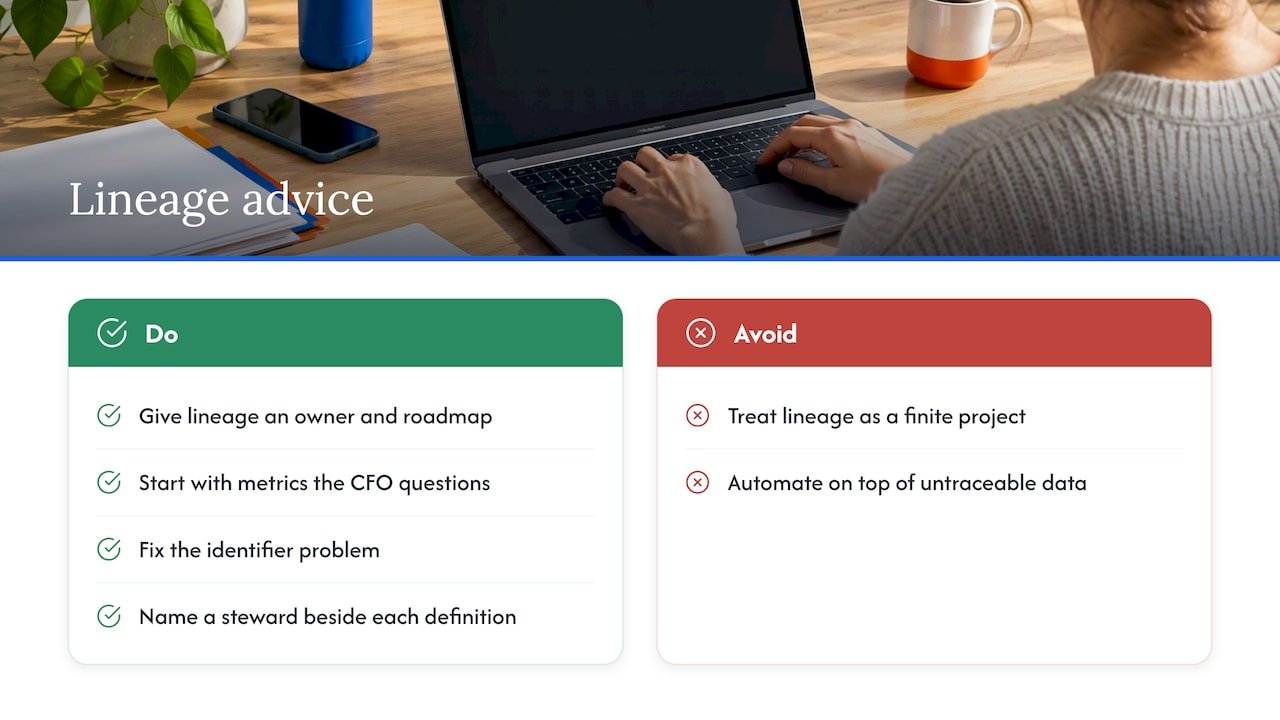
Our advice is to treat lineage as a product with an owner and a roadmap, not a project with an end date. Start with the metrics your CFO already questions, fix the identifier problem, and put a steward’s name beside every definition. Add AI use cases only once the underlying trail is clean. Automation on top of untraceable data simply makes the confusion faster.
— Don
How Brainiac can help
If you want lineage built into your stack rather than documented after the fact, our team designs and operates analytics systems and AI agents with traceability from the start. For readiness and prioritization, see our AI strategy and readiness advisory. For hands-on pipeline and platform work, see marketing operations optimization and support, or talk to us about a scoped engagement. Pricing is set per engagement, so there is no published rate card.
A 30-day starting plan
| Week | Focus | Output |
|---|---|---|
| 1 | Choose three metrics and name owners | One-page metric register |
| 2 | Trace each metric backwards | Hand-drawn or tool-generated lineage map |
| 3 | Audit customer identifiers and manual steps | List of gaps ranked by risk |
| 4 | Set change process and review cadence | Governance charter, first review on the calendar |
Once that is in place, you can decide with evidence whether a dedicated lineage tool is worth the investment, and which of your gaps should be closed first. Teams planning wider automation may also find our AI for RevOps 90-day roadmap useful as a next step.
FAQ
What is data lineage in marketing?
It is the documented path of marketing data from its origin, such as a form, ad platform or purchase, through every transformation to the report, model or campaign that uses it. It shows what changed the data and who owns each step. That makes metrics explainable and defensible.
What is the difference between data lineage and data governance?
Lineage shows how data moves and changes. Governance sets the roles, policies and decision rights that keep that information accurate and enforced. You can have a detailed lineage graph and still lack governance if nobody owns the definitions or approves changes.
Do we need a lineage tool to start?
No. You can trace your first three metrics with documentation and a few working sessions between marketing ops, analytics and sales ops. A tool becomes valuable when the stack is large enough that manual tracing cannot keep up with change.
How does lineage help with AI lead scoring?
It shows exactly which inputs fed a score, where they came from and under what consent basis. That lets you explain a score to sales, debug a drifting model and answer an audit. Without it, a score is a number nobody can fully defend.
Sources
- What is Data Lineage? Snowflake
- Data Lineage: A Complete Guide for Enterprise Teams, Actian
- Single Source of Truth for Marketing, Iriscale
- AI Data Provenance for Trustworthy Marketing AI, Single Grain
- Understanding and Visualizing Data Lineage in Health Data Transformation Pipelines
- 7 Best AI Data Lineage Solutions in 2026, bigwritehook
- Enterprise Guide to Implementing Multi-Touch Attribution, CaliberMind
- What Is a Data Lineage Governance Framework? OvalEdge
- AI Privacy Compliance: A Playbook for Privacy Officers, Golden Path Digital