
LlamaIndex is built to get your own documents and data into a form a language model can retrieve from. LangChain is built to orchestrate what happens around the model: tools, multi-step agent logic and state. If your hard problem is retrieval quality, start with LlamaIndex. If it is agent behaviour, start with LangChain. Many production systems use both. For a marketing, sales or finance team, though, the framework is the smaller decision. The larger one is who designs, connects to your CRM and operates the agent once it is live, and how much of it you can see.
This guide explains the difference in plain terms, compares the two where it matters for business automation, and shows how to choose.
TL;DR
- LlamaIndex is a data framework: it loads, chunks, indexes and retrieves your documents. It suits document-heavy, retrieval-first applications.
- LangChain (with its LangGraph runtime) is an orchestration framework: it suits agents that branch, loop, call tools, keep state and wait for approvals.
- Both overlap on retrieval-augmented generation (RAG), meaning the model answers from your own documents instead of from memory. Both can be combined in one system.
- Both open-source cores are free to use. The real cost is engineering time, integration work and running the system in production.
- Pick by where the hard part of your project sits, then decide who builds and operates it. That second decision drives your results more than the first.
Table of Contents
- What each framework is for
- How they compare at a glance
- RAG: where LlamaIndex has the edge
- Agents and workflows: where LangChain has the edge
- Integrations, observability and cost
- Can you use both?
- How to choose for your team
- Where Brainiac fits
- Our point of view
- FAQ
- Sources
What each framework is for
A language model on its own knows nothing about your pipeline, contracts or product catalogue. Both frameworks exist to close that gap, but they start from different ends.
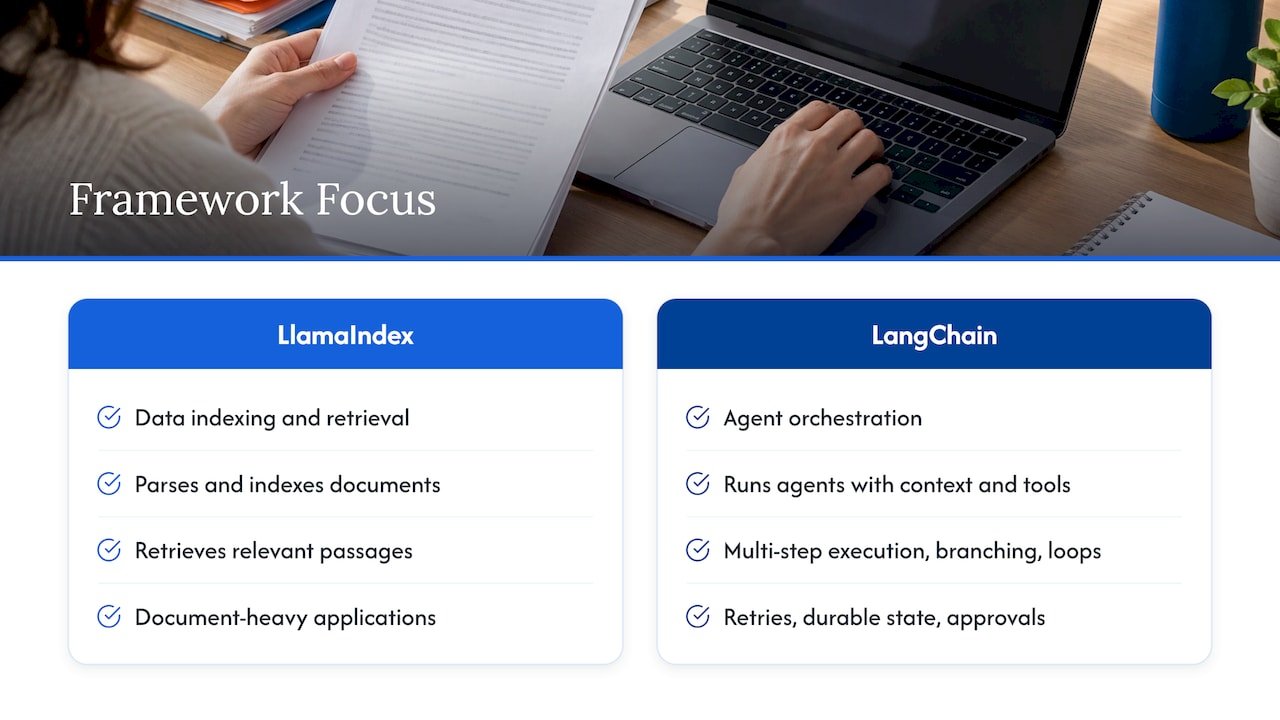
LlamaIndex focuses on the data layer. DigitalOcean’s explainer describes it as specializing in data indexing and retrieval: it parses and indexes your documents, then retrieves the right passages. AWS Prescriptive Guidance lists it as well suited to document-heavy applications such as contracts, reports, manuals and regulatory filings.
LangChain focuses on orchestration. The same DigitalOcean piece puts it as the layer that runs an agent using that context together with tools, prompts and model calls. LangChain’s own comparison guide recommends LangChain and LangGraph for agents that need multi-step execution, branching, loops, durable state, retries and approvals.
A useful picture: LlamaIndex is the librarian who knows where everything is filed. LangChain is the operations manager who decides which task happens next, which system gets called and when a person must sign off.
How they compare at a glance
| Question | LlamaIndex | LangChain |
|---|---|---|
| Center of gravity | Documents, indexes, retrievers, query engines | Models, tools, agent loops, workflows |
| Best first use | Knowledge search over large or messy document sets | Agents that act across several systems |
| Retrieval | Advanced patterns built in as first-class objects | Primitives you compose yourself in chains or graphs |
| Agent orchestration | Workflows and AgentWorkflow for event-driven apps | LangGraph for long-running, stateful agents |
| Open-source core | Free, MIT-licensed | Free, MIT-licensed |
| Managed extras | LlamaCloud for parsing and indexing | LangSmith for tracing and evaluation |
The lines are blurring. LangChain’s guide notes that both frameworks have expanded beyond their original scope, so the question is which capability sits at the center of your project, not which tool “does agents” or “does RAG”.
RAG: where LlamaIndex has the edge
If your use case is answering questions from your own content, retrieval quality decides whether the answer is right. LlamaIndex’s production RAG documentation is frank that prototyping is easy while making it performant and scalable across large document sets is hard. It provides a router module, a data agent module, advanced query engine modules and ways to join structured and unstructured data.
Vercel’s comparison explains the practical difference. LlamaIndex organizes RAG into loading, indexing, storing, querying and evaluation, with hybrid dense and sparse retrieval, rerankers and query fusion available out of the box. LangChain gives you loaders and splitters as building blocks and leaves you to wire retrieval inside chains or graphs, where the agent loop decides when to retrieve.
What that means for you:
- Less to tune with LlamaIndex. Chunking, index types and routing come with sensible structure, so a retrieval-first project gets to decent quality with less custom code.
- More control with LangChain. You decide chunking, embeddings, storage and reranking. That is flexibility, and also responsibility.
- Worked example. A services firm wants staff to ask questions across 4,000 proposals and statements of work. The hard part is parsing messy PDFs and returning the right clause. That is a LlamaIndex-shaped problem.
Retrieval also matters outside internal tools. The way content is structured and indexed shapes whether AI search engines can find and cite it, which is covered in this overview of the role of LLMs in SEO.
Agents and workflows: where LangChain has the edge
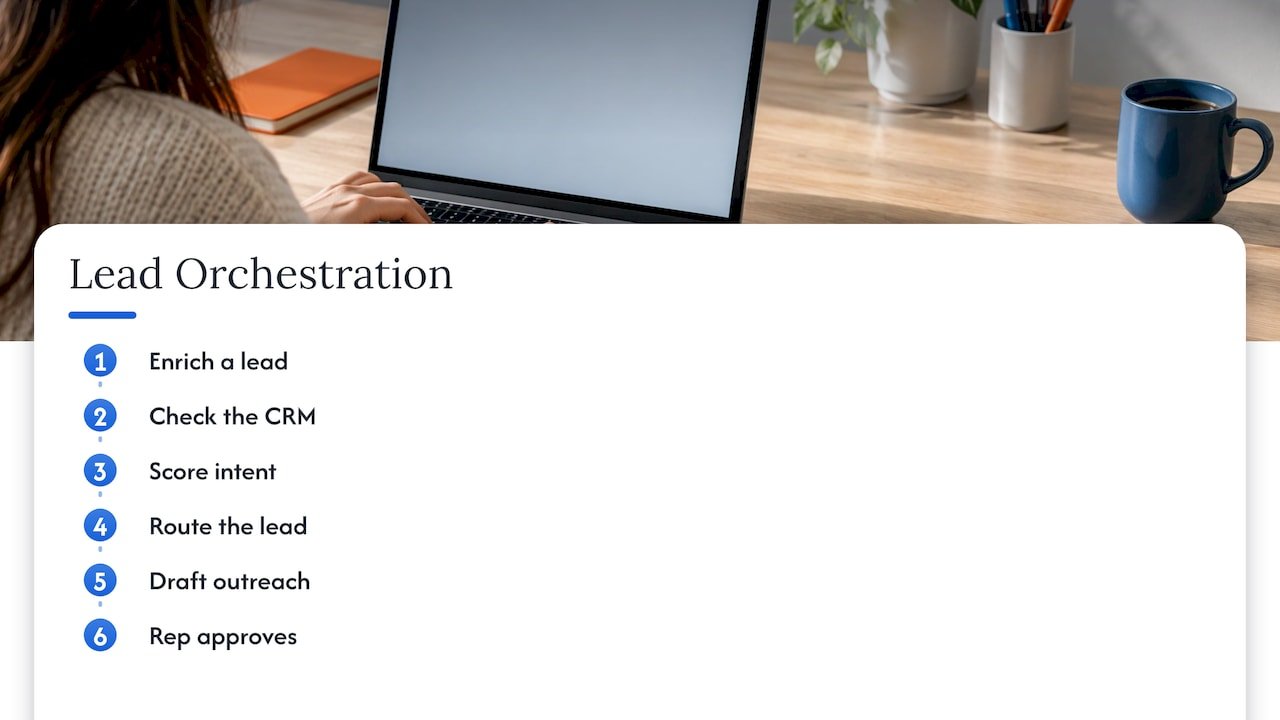
Most revenue-operations automation is not a question-and-answer problem. It is a sequence: enrich a lead, check it against the CRM, score intent, route it, draft an outreach, and pause for a rep to approve. That is orchestration.
LangChain’s guide describes LangGraph as the runtime for long-running, stateful agents, covering retries, approvals and complex tool use. LlamaIndex has answered with Workflows, which AWS describes as an event-driven, async-first engine supporting loops, parallel execution, conditional branching and stateful resumption. Both can run an agent. LangChain’s ecosystem is broader on the orchestration side, and LlamaIndex’s is deeper on the data side.
The orchestration pattern you choose matters as much as the library. Our guide to agent orchestration patterns explains how to choose and measure them, and our piece on human-in-the-loop approval shows how to make an approval step control the agent instead of decorating it.
Integrations, observability and cost
Both cores are open source under the MIT license, so there is no license fee to start. Each has a commercial layer for teams that want managed services: LlamaIndex offers LlamaCloud, including the LlamaParse document parser, while LangChain offers LangSmith for tracing and evaluation. LangChain’s guide cites more than 1,000 integrations for LangChain across models, vector stores, tools, embeddings and loaders, and more than 300 integration packages for LlamaIndex, with LlamaParse covering 130+ file formats. Counts like these change with each release, so check the current registries before you commit.
Neither count tells you the thing a business team cares about most: does the agent connect cleanly to Salesforce, HubSpot, Marketo, your warehouse and your BI layer, and does someone watch it after launch? A framework is a set of parts. The cost of a working system is mostly integration, evaluation and operation, and those stay with you when you build directly on a framework.
Can you use both?
Yes, and it is a common pattern. pythonresources.com’s guidance describes LlamaIndex handling ingestion and retrieval while LangChain handles the surrounding agent logic. Vercel makes the same case: keep the data pipeline focused on accuracy and the agent definition focused on behaviour, which is easier to debug than one framework owning both.
The trade-off is more moving parts: two dependency sets to keep in sync, an extra hop on each retrieval, and tracing that spans two systems. For a single-document FAQ bot, one framework is plenty. For an agent that reasons over documents and also acts in your CRM, the split can earn its place.
How to choose for your team
- Name the hard part. Is it retrieval quality (chunking, index structure, structured versus unstructured data) or everything around retrieval (multi-step logic, tools, conversation state)? The first points to LlamaIndex, the second to LangChain.
- Write the workflow on one page. List the systems touched, the decisions made and the points where a human approves. If the page is mostly steps and handoffs, you need orchestration. If it is mostly “find the right passage”, you need retrieval.
- Check your data’s readiness. Agents are only as good as the CRM fields and documents they read. Our checklist on whether your CRM is ready for AI agents covers this.
- Test one hard case, not hello-world. Take one difficult document set, one real question and one failure path, and run them through your shortlist. Line counts of a demo tell you little.
- Set guardrails before launch. Decide what the agent may do alone and what it escalates. See our AI agent governance framework.
- Decide who operates it. Someone has to own versions, monitoring, evaluation and change requests after launch. This is where most projects are won or lost.
A caution on scope: raw API calls with no framework are increasingly a sound choice for simple workloads, according to MachineLearningMastery’s comparison. The best framework is the lightest one that solves your problem.
Where Brainiac fits
Choosing LangChain or LlamaIndex is an engineering decision. What a CMO, sales leader or ecommerce owner wants is a lead enrichment agent, cleaner pipeline data, intent prediction or reliable attribution that works inside the stack already in place.
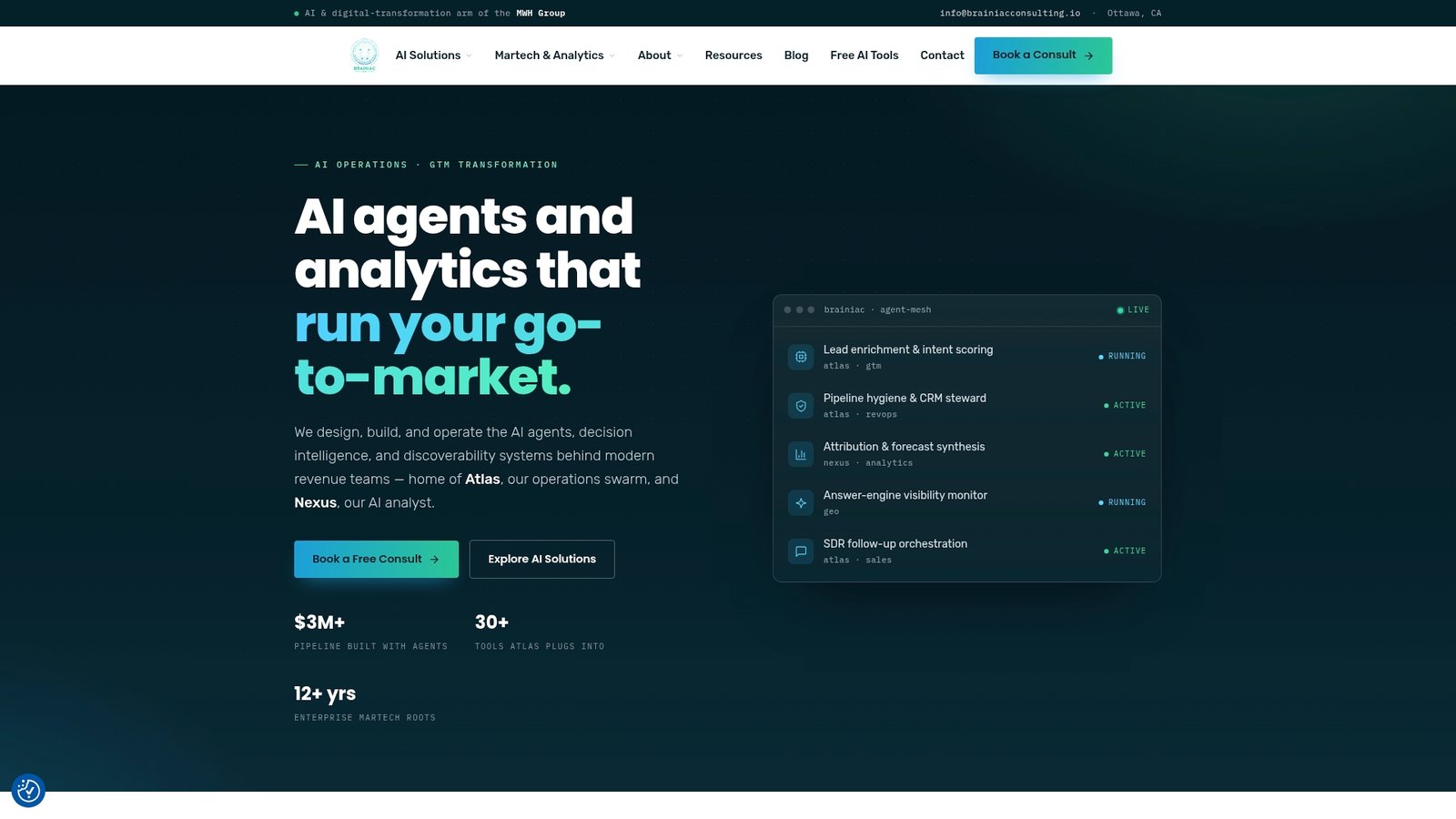
Brainiac Consulting, the AI and digital-transformation division of the MWH Group, designs and operates AI agents and analytics systems for marketing, sales and finance teams. Our builds are open source, so you keep full visibility into how they work, and we integrate with platforms including Salesforce, HubSpot, Marketo, Power BI and Tableau. If you are earlier in the journey, our AI strategy and readiness work covers readiness assessment, opportunity mapping, a roadmap and business case, and governance. When you are ready to put an agent into production, see custom agent deployment.
Our point of view
Teams often ask us which framework to pick before they have named the job the agent is supposed to do. We would turn the question around. Start with the revenue problem: leads that stall, pipeline data nobody trusts, reports that take a week to assemble. Then work back to the smallest system that fixes it.
Frameworks will keep converging. LlamaIndex adds orchestration, LangChain deepens retrieval, and the comparison articles will keep changing. What does not change is that an agent has to live inside your CRM, your marketing platform and your governance rules, and somebody has to run it every week.
That is why we build in the open. When the agent is production-grade, runs end to end in your environment and has no black box in it, your team can see what it does and why. We would rather you understand your system than depend on it blindly.
Don
FAQ
Is LlamaIndex better than LangChain?
Neither is better across the board. LlamaIndex is stronger when retrieval over your own documents is the core problem. LangChain is stronger when the core problem is orchestrating agents, tools and state. Many teams use both.
Is LlamaIndex completely free?
The open-source core is MIT-licensed and free to use. Managed services such as LlamaCloud are a separate, paid layer. Your larger costs are usually engineering, integration and operating the system.
Which is better for RAG, LangChain or LlamaIndex?
For retrieval-first work, LlamaIndex gives you more advanced patterns, such as hybrid search, reranking and query decomposition, as built-in components. LangChain can do RAG too, but you compose more of it yourself. If retrieval is one capability inside a broader agent, LangChain is a natural home.
Do I need either framework to add AI agents to my business?
Not necessarily. Your workflow decides it: a simple, predictable task may need only direct model calls, while multi-system agents benefit from a framework. A readiness assessment can map which of your workflows justify an agent before any build starts.
Sources
- AWS Prescriptive Guidance: Agentic AI frameworks
- LangChain vs LlamaIndex: from retrieval to reliable AI agents
- Building Performant RAG Applications for Production, LlamaIndex documentation
- What Is LlamaIndex? DigitalOcean
- LlamaIndex vs. LangChain: Key differences, Vercel
- LangChain vs LlamaIndex: What’s the Difference, pythonresources.com
- LLM Orchestration Frameworks Compared, MachineLearningMastery