

The models that matter are firmographic, technographic, behavioural and intent, needs or use case, and ICP driven tiering. None of them wins alone. The best results come from combining all five into a single operational profile, often called a 4D ICP, and wiring that profile directly into your CRM so it shapes routing, scoring, and messaging. The sections below walk through each model, then show you how to assemble and test the combined version.
TL;DR:
- Combining firmographic, technographic, behavioral, needs, and tiering models into a unified 4D ICP enhances targeting accuracy and operational efficiency.
- Building a solid, data-driven ICP involves setting scoring thresholds, validating against historical deals, and integrating into CRM workflows for continuous refreshes.
- Effective segmentation requires linking definitions to real-time data sources and automating updates across marketing, sales, and attribution systems.
- Geographic modifiers should be layered onto core profiles to account for regional regulation, currency, language, and operational differences.
- Psychographic insights, drawn from messaging and team discussions, help tailor communications but should complement, not replace, quantitative signals.
Table of Contents
- 1. Understand the core segmentation models before you combine them
- 2. Build a 4D operational ICP and pressure-test it
- 3. Turn segment definitions into working systems
- 4. How Brainiac Consulting operationalizes segmentation with AI
- 5. Geographic segmentation for B2B markets
- 6. Psychographic segmentation in B2B contexts
- 7. Challenges and limitations of B2B segmentation models
- 8. When to simplify segmentation and when to invest in depth
- 9. Build your segmentation model with Brainiac Consulting
- Sources
- FAQ
1. Understand the core segmentation models before you combine them
Each model answers a different question, and knowing which question you’re asking keeps you from building a segment that looks tidy on a slide but does nothing for your pipeline.
Firmographic segmentation is the foundation most teams start with: industry codes such as NAICS or SIC, employee count, ownership structure, and revenue band. It’s efficient because the data is easy to source and easy to explain to a sales team. Firmographic criteria are typically the twelve variables practitioners lean on most, according to SurveyMonkey’s guide to firmographic segmentation, but the same guide warns against stopping there. Two companies in the same industry and revenue band can have wildly different buying behaviour, which is why firmographic segmentation works best as a filter, not a finish line.
Technographic segmentation looks at the tools a company already runs: its CRM, ERP, cloud provider, or marketing stack. This tells you whether your product is technically feasible to deploy and whether you’re walking into a displacement sale against an incumbent vendor or filling a genuine gap. Combining technographic data with intent and behavioural signals helps you identify accounts that are both a fit and actively in-market, which cuts wasted outreach according to ZoomInfo’s guide to B2B customer segmentation.
Behavioural and intent segmentation tracks what accounts are doing right now: search spikes on relevant terms, spikes in page visits, and the type of content they’re consuming. Buyers increasingly self-educate before ever speaking to a salesperson, a shift documented in Forrester’s 2021 B2B buying survey, which makes these signals some of the most current information you have about buying readiness. Prioritize intent feeds by recency and by whether the topic maps directly to your offer, not just by volume.
Needs or use case segmentation maps the job a buyer is trying to get done to your messaging and packaging. A finance team automating month-end close needs different language than an operations team trying to cut manual data entry, even if both sit inside the same firmographic band.
ICP, TAM, and personas get confused constantly, so here’s the short version: TAM is the entire addressable market, ICP is the narrower slice of accounts most likely to buy and succeed, and personas describe the individual roles inside those accounts. Reviewing how to build buyer personas for targeted marketing is a useful complement once your account-level ICP is set, since personas answer the “who” question inside the “which accounts” answer.
Tiering or value-based segmentation ranks accounts by lifetime value potential and expansion room, then assigns an engagement model, from high-touch enterprise coverage to scaled digital nurture.
The common failure pattern looks like this:
- Building an ICP from firmographics alone and ignoring intent or fit signals
- Letting segment lists go stale because no one owns refresh cadence
- Defining segments that never get activated in a campaign, a score, or a routing rule
2. Build a 4D operational ICP and pressure-test it
Start with the objective, not the framework. If you’re prioritizing outbound targeting, weight firmographic and technographic fit heavily. If you’re scoring inbound leads, weight behavioural and intent signals more.
Miller’s guide to ICP development. The four dimensions break down like this:
- Firmographic: industry, employee count, revenue band, geography
- Behavioural: content consumed, pages visited, webinar attendance, response rate to outreach
- Technographic: current stack, integration compatibility, migration signals
- Situational: trigger events such as funding rounds, leadership changes, or expansion announcements
Once the dimensions are weighted, turn the profile into rules your systems can act on:
- Draft scoring criteria for each dimension and assign point values based on historical deal patterns.
- Set a minimum combined score as the inclusion threshold for CRM tagging.
- Wire the threshold into lead scoring and routing rules inside your CRM.
- Assign qualifying accounts to a GTM tier that determines coverage model and cadence.
- Schedule a recurring review, typically quarterly, to re-test thresholds against new closed deals.
Operationalizing an ICP means wiring it into CRM rules, lead scoring, ABM tiers, and territory planning rather than leaving it in a document nobody opens, a point Miller’s framework makes directly. A CRM built on solid data hygiene is what makes that wiring possible in the first place.
For validation, Miller’s guide suggests a useful pair of targets: a well-built ICP should capture a large majority of closed-won deals and exclude a substantial portion of closed-lost deals when tested against the prior 12 to 24 months of opportunities. Treat these as starting goals, then refine based on your own win-rate patterns. Track your inclusion rate, your exclusion rate, and the percentage of closed-won revenue your model would have flagged as a fit.
Pro Tip: Set your inclusion thresholds slightly conservative in the first pass. It’s easier to loosen criteria once you see false negatives than to unwind a segment that’s already flooded your sales team’s queue with poor-fit accounts.
3. Turn segment definitions into working systems
A segmentation model only earns its keep once it changes what your team does next. That means connecting definitions to data sources, tools, and daily workflows.
You’ll need several data inputs working together: your CRM for historical deal and account data, third-party technographic providers for stack visibility, intent data feeds for in-market signals, and product or usage analytics if you sell a freemium or trial-based product. Verified contact data and enrichment pipelines are what separate a segment that’s analytically interesting from one that’s actually operational, a distinction ZoomInfo’s segmentation guide makes explicitly.
On the tooling side:
- Feed enrichment data into your CRM so segment membership updates automatically rather than through quarterly manual exports.
- Connect marketing automation to segment tags so nurture tracks trigger on entry, not on a static list.
- Route qualifying accounts to the right rep or team through CRM assignment rules tied to tier.
- Layer ABM orchestration on top for your highest-value tier so ads, outreach, and sales plays stay coordinated.
Activation examples might include serving different ad creative to accounts flagged as in-market versus those still in early research, building a nurture track specific to a use case segment, or triggering a sales play the moment a technographic signal shows a competitor’s contract is up for renewal. Marketo-based personalization is one practical route to executing that kind of tailored activation at scale.
Track segment-level conversion rate, deal velocity, and customer lifetime value on a monthly cadence, with a deeper quarterly review tied to your ICP refresh.
Buyers now do far more independent research before engaging a vendor, a shift Forrester’s B2B buying research documents directly. That shift is exactly why intent and behavioural signals belong in your scoring model, not just firmographic fit.
4. How Brainiac Consulting operationalizes segmentation with AI
A consulting firm specializing in AI and digital-transformation focuses on designing AI agents and analytics systems that remove manual data handling from marketing, sales, and finance teams. Two patterns show up often in segmentation work: dynamic enrichment, where an AI agent continuously updates firmographic and technographic fields as accounts change, and predictive intent scoring, where behavioural signals feed a live score that adjusts routing without a human rebuilding the list.
Operationally, this means integrating with widely used platforms so scores and tags live where reps already work, and establishing clear naming and ownership conventions so account tiers mean the same thing across marketing, sales, and finance.
A segmentation model that lives outside the systems your team touches every day never gets used long enough to prove its value.
— Don
5. Geographic segmentation for B2B markets
Geography still shapes how B2B segments behave, even in a digital-first buying environment. Regulatory regimes differ by country and sometimes by state or province, which affects everything from data privacy requirements to procurement rules a vendor must meet before a deal can close. Currency and contracting norms shift too: a segment built around enterprise accounts in one region might need different payment terms or legal review cycles than the same tier elsewhere.
Time zone coverage matters operationally as much as it does strategically. A sales team built to serve one region will struggle to hit response-time targets on inbound leads from accounts several time zones away, which quietly degrades the same conversion metrics you’re using to validate your ICP.
Language and localization needs also belong in a geographic layer. An account in a non-English-speaking market may need localized content and a rep who can run a call in the buyer’s own language, and skipping that step often shows up later as slower deal velocity rather than an outright lost deal.
The practical move is to treat geography as a modifier on top of your other dimensions rather than a standalone segment. Pair it with firmographic and technographic criteria so you’re not building separate ICPs by country, but rather adjusting routing, compliance checks, and content localization within a single operational model. That keeps your core segmentation logic consistent while still respecting the real operational differences that geography introduces.
6. Psychographic segmentation in B2B contexts
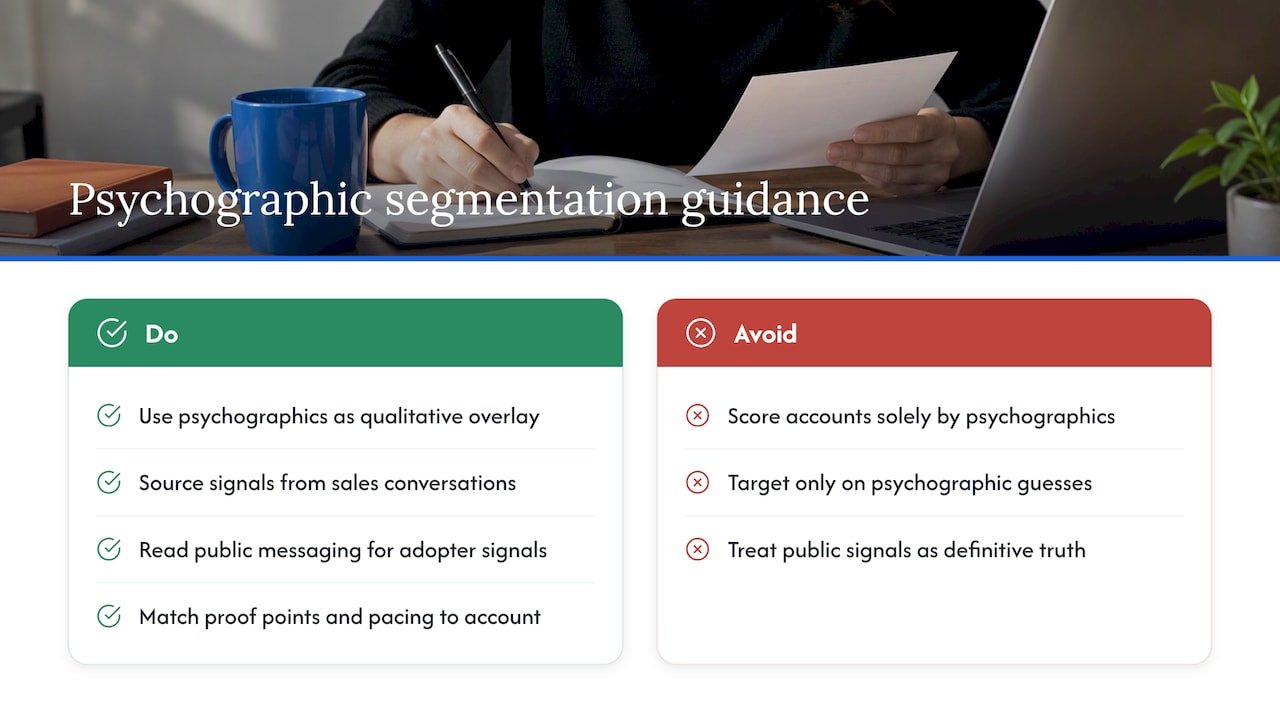
Psychographic segmentation looks past firmographics and technology stacks toward how a buying committee actually thinks: its risk tolerance, its appetite for change, and the values that shape how it evaluates vendors. A buyer culture that rewards fast, low-risk pilots responds to a different pitch than one built around exhaustive procurement processes and multi-quarter evaluations.
In practice, this shows up in a few observable proxies rather than a survey you send prospects. A company’s public messaging often signals whether it positions itself as an early adopter or a fast follower. The structure of its buying committee, whether decisions run through a single champion or a wide consensus group, tells you how long your sales cycle will realistically run. Its stated priorities around sustainability, security, or innovation, visible in investor materials or leadership commentary, hint at which value proposition will land.
Psychographic signals are harder to source cleanly than firmographic or technographic data, which is exactly why they work best as a qualitative overlay on your quantitative model rather than a scored dimension on their own. Sales conversations, discovery call notes, and win-loss interviews are often better sources of psychographic insight than any data provider, since they capture how a committee actually talks about risk and priority rather than how it presents itself publicly.
Used well, psychographic context helps a rep choose the right proof points and pacing for a specific account. Used poorly, as a stand-in for real behavioural data, it becomes guesswork dressed up as insight. Treat it as the layer that shapes tone and sequencing, not the layer that decides who gets targeted in the first place.
7. Challenges and limitations of B2B segmentation models
Every segmentation model carries a cost, and the biggest failure mode is treating the model as a one-time project rather than a living system. Data decays fast: employee counts shift, tech stacks change vendors, and intent signals go stale within weeks, so a segment built in January can misrepresent an account by summer if nobody owns the refresh.
Overfitting is a related risk. Pile on enough dimensions and thresholds, and you can build a model that perfectly explains last year’s closed-won deals while missing next quarter’s, because you’ve tuned it to noise rather than signal. The nested approach to segmentation, an academic framework from Bonoma and Shapiro, addresses this directly: start with broad, observable variables and only invest in inner, costlier signals once deal economics justify the added precision.
Data availability is uneven across dimensions. Firmographic data is cheap and abundant. Technographic and intent data cost more and vary in coverage by region and industry. Psychographic insight is the hardest to source at scale and often depends on sales team input rather than a purchasable feed, which means smaller teams may need to accept a simpler model than a well-resourced enterprise can run.
Finally, a segmentation model with no owner and no activation plan is just a spreadsheet. Segments that never connect to a scoring rule, a routing decision, or a campaign trigger produce reports nobody acts on, and that gap between documentation and operation is where most segmentation projects quietly fail.

8. When to simplify segmentation and when to invest in depth
Match complexity to deal value. Smaller, high-volume deals rarely justify a full 4D build. Invest in depth when you have repeatable plays, measurable revenue levers, and clean underlying data to score against. Pause and simplify when there’s no activation plan, no data owner, or no one accountable for keeping thresholds current, since an unmaintained model does more harm than a simple one.
— Don
9. Build your segmentation model with Brainiac Consulting
If your segmentation work is stuck in spreadsheets while your CRM keeps scoring leads on stale fields, that gap is exactly where Brainiac Consulting’s engagements start.
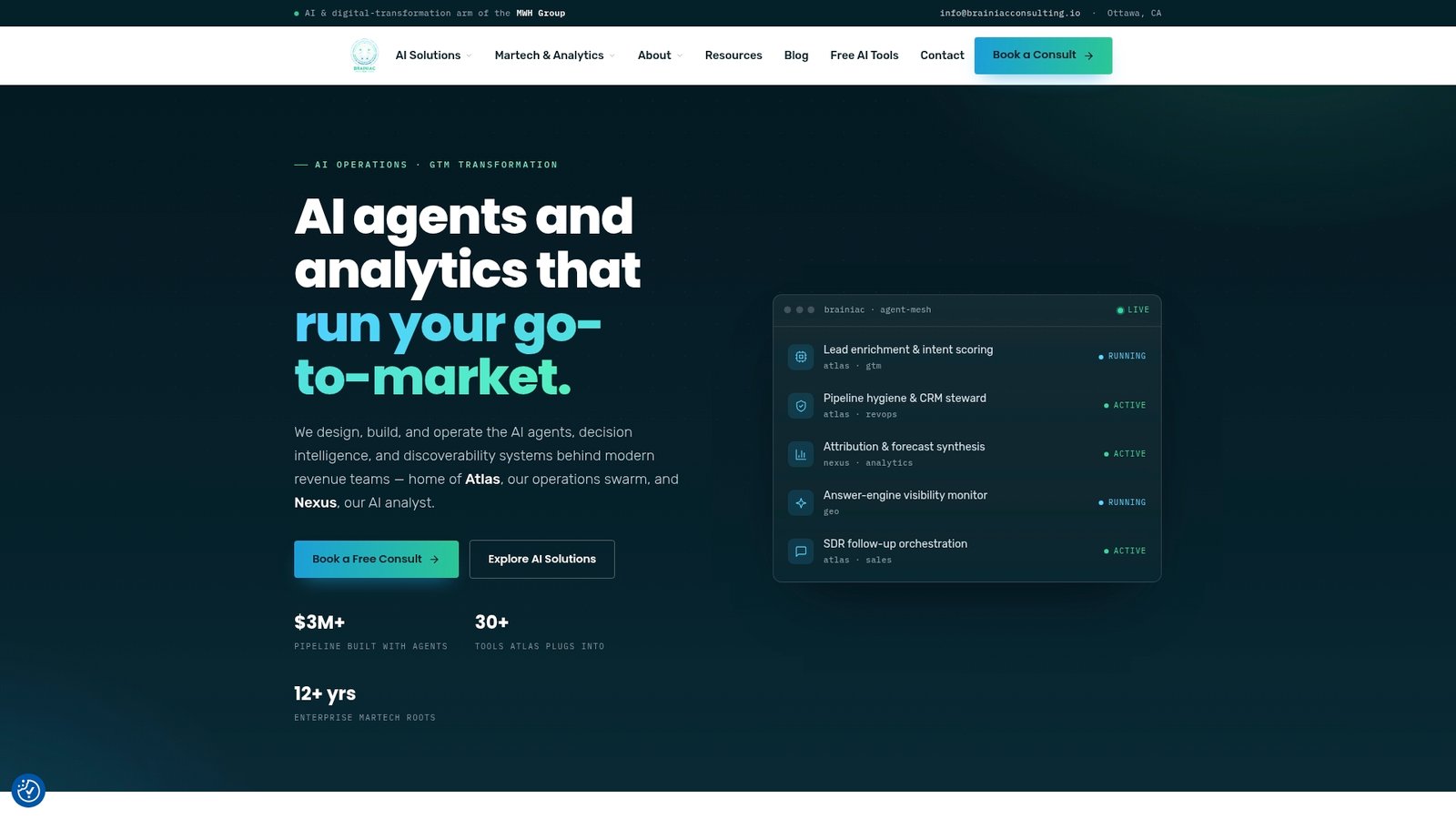
Engagements typically move from a working prototype through rollout into managed operations, using AI-enabled enrichment and intent scoring to keep segment membership current without manual rebuilds. Clients report benefits such as:
- Faster lead qualification once scoring runs on live enrichment instead of quarterly exports
- Improved win rates when routing follows a pressure-tested tier instead of a static list
- Less manual data cleanup for RevOps teams once CRM rules take over segment maintenance
Explore Brainiac Consulting’s AI-enabled analytics and GTM services to see where a segmentation engagement fits your stack, or start with an AI readiness assessment if you’re not yet sure how much of this you can operationalize today.
Sources
For a deeper look at the shifts driving these models, Forrester’s B2B buying survey and Gartner’s B2B buying journey research cover buyer behaviour in detail, while Erik R. Miller’s ICP guide and ZoomInfo’s segmentation guide walk through framework mechanics.
- Three seismic shifts in buying behavior from Forrester’s 2021 B2B buying survey
- ICP development: The Complete Guide | Erik R. Miller
- B2B Customer Segmentation: A Complete Guide to Targeting Your Best-Fit Accounts
- 12 essential firmographic variables | SurveyMonkey
FAQ
What are the different types of B2B segmentation methods?
The core methods are firmographic, technographic, behavioural or intent-based, needs or use-case, and ICP-driven tiering. Most effective programs combine several of these into a single operational profile rather than relying on just one, as outlined in ZoomInfo’s segmentation guide.
What are the four types of B2B?
There’s no single standardized “four types of B2B” framework in wide use, so definitions vary by source. A common approach in ICP work groups criteria into four dimensions instead: firmographic, behavioural, technographic, and situational, as described in Erik R. Miller’s ICP framework.
What are the four types of segmentation?
Classic marketing theory usually names demographic, geographic, psychographic, and behavioural segmentation as the four broad types. In a B2B context, these translate into firmographic data in place of demographic, plus technographic and intent signals layered on top, as covered earlier in this article.
What is B2B, B2C, C2C, and D2C?
B2B means one business sells to another business, while B2C means a business sells directly to individual consumers. C2C describes consumers selling to other consumers, often through a marketplace, and D2C means a manufacturer sells directly to consumers without a retail intermediary.
How do I combine segmentation models into one ICP?
Weight each dimension, firmographic, behavioural, technographic, and situational, based on your specific objective, then test the combined score against your historical closed-won and closed-lost deals. Erik R. Miller’s guide suggests aiming to capture at least 80% of closed-won deals and exclude at least 70% of closed-lost deals as an initial validation target.