
An effective AI agent strategy starts small: one clearly scoped agent, one measurable outcome, and tool integrations you can actually monitor. Success depends less on choosing the fanciest model and more on defining objectives up front, wiring in reliable tools, and tracking task success rate from day one. Get those three priorities right before you think about autonomy or scale.
TL;DR:
- Use case complexity, clear success metrics, and integration scope determine whether building an agent is justified over a workflow.
- Effective model choice involves balancing reasoning, tool use, and multimodal tasks, with cost-conscious model layering to control expenses.
- Instrumentation of decision-making, tool calls, and outcomes is crucial before scaling or adding more agents, to ensure reliability and debuggability.
- Early AI agent deployment should focus on measurable wins in marketing and sales, such as lead enrichment, intent scoring, and automated reporting.
- Ongoing governance, cost-aware architecture, and disciplined monitoring are shaping agent strategies toward standardized, scalable, and compliant operations.
Table of Contents
- What is an AI agent strategy built on?
- When should you build an agent instead of a workflow?
- Agent design foundations: models, tools, and instructions
- Which reasoning pattern fits your agent’s task?
- How do you scale an agent architecture without breaking it?
- What should you monitor once an agent is live?
- Where does an AI agent strategy pay off first?
- How Brainiac Consulting approaches agent strategy in practice
- Best practices for training and fine-tuning AI agents
- What’s the best way to connect agents to existing systems?
- What comes next for AI agent strategy?
- An editorial take on where agent strategies actually break
- How Brainiac Consulting can help you operationalize agents
- Sources
What is an AI agent strategy built on?
An artificial intelligence agent is a system that pursues a goal by reasoning about what to do next, calling tools to act, and remembering context across steps, without a human writing out every instruction in advance. That autonomy is the whole point. A chatbot answers what it’s asked. An agent decides how to get from a request to a result, sometimes across several tool calls and decision points nobody scripted individually.
Four components show up in nearly every working agent, regardless of the vendor or framework behind it:
- Planner — the reasoning layer that breaks a goal into steps and decides what to do next based on the current state.
- Executor and tools — the APIs, database queries, or action endpoints the agent actually calls to move work forward (send an email, enrich a lead record, query a CRM).
- Memory or store — short-term context for the current task plus longer-term memory for facts, preferences, or prior outcomes worth reusing.
- Observation interface — the mechanism that feeds results back to the planner so it can adjust, retry, or escalate.
Where this gets confused is the line between agents, assistants, and orchestrated workflows. An assistant (think a copilot embedded in a CRM) suggests actions but waits for a person to approve them. An orchestrated workflow (think a Zapier chain or a Marketo campaign flow) executes a fixed sequence with no real decision making inside it. An agent sits between the two: it has latitude to choose its own path toward a goal, within guardrails you define. Confusing these three is the single most common reason AI agent strategy documents overpromise and underdeliver. If the task doesn’t need independent decision making, you don’t need an agent. You need a workflow, and a workflow is cheaper to build, easier to audit, and far less likely to go wrong at 2 a.m.
When should you build an agent instead of a workflow?
Not every automation candidate deserves an agent. The decision comes down to four criteria: how complex the task actually is, whether it needs independent judgment mid-task, whether it runs long or spans multiple steps with branching logic, and how large its integration footprint is. A task that touches one system, follows one path, and has a predictable input and output is a workflow problem, not an agent problem.
Watch for these red flags before committing engineering time to an agentic build:
- High regulatory or financial risk. If a wrong action could trigger a compliance violation or an irreversible charge, autonomy is a liability, not an efficiency gain.
- Limited observability. If you can’t log what the agent decided and why, you can’t debug it, and you definitely can’t defend it to an auditor.
- Trivial automation candidates. If the task is a fixed if/then sequence, an agent adds complexity without adding capability.
- No clear success metric. If you can’t define what “done correctly” looks like, you have no way to know if the agent is working.
- Single point of integration. If the task only touches one system with a stable API, a scripted workflow will outperform an agent on cost and reliability.
Run a candidate use case through this checklist before scoping any build. Lead enrichment across five data sources with conditional routing logic clears the bar easily. A simple form-to-CRM sync does not. Brainiac Consulting’s AI strategy and readiness work exists largely because teams skip this filtering step and build agents for problems a workflow would have solved for a fraction of the cost.
Agent design foundations: models, tools, and instructions
Once a use case clears the bar for an agent, the real design work begins. Three decisions determine whether the system holds up under production load: which models to use, how tools are structured, and how instructions are written.
Model selection isn’t a single choice. Reasoning-heavy tasks (multi-step planning, ambiguous requests) benefit from models optimised for chain-of-thought performance. Tool-use tasks (structured API calls, data extraction) often perform better on models tuned for function calling, even if their raw reasoning benchmark is lower. Multimodal tasks (parsing a PDF invoice, reading a screenshot) need vision-capable models. Many production agents combine two or three models: a cheaper, faster model for routing and simple lookups, and a stronger model reserved for the steps that actually require judgment. Paying premium-model prices for every step of every task is one of the fastest ways to make an agent pilot fail on cost before it fails on capability.
Tool design is where most agent projects quietly break. A tool interface should be narrow, well-documented, and testable in isolation, the same discipline you’d apply to any internal API. Vague tools (“update the record”) invite the model to guess at parameters. Precise tools (“update_lead_status(lead_id, new_status, reason)”) constrain the agent to actions you can validate and roll back. If a tool touches production data or triggers a customer-facing action, it needs its own test suite, separate from the agent’s overall evaluation.
Instruction architecture is the piece teams underestimate most. The naive approach writes a custom prompt for every scenario, and within a few months you’re maintaining hundreds of near-duplicate prompts that drift out of sync. OpenAI’s guidance on building agents recommends the opposite: build a flexible base instruction template and inject policy variables for the details that change (tone, escalation thresholds, brand voice, compliance language). One template, many configurations, one place to fix a bug.
Pro Tip: Version your instruction templates the same way you version code. When an agent starts behaving oddly, the first question should be “what changed in the prompt,” and you can’t answer that without a changelog.
On orchestration, start with the simplest pattern that could plausibly work:
- Single agent — one model handles planning, tool calls, and memory for a bounded task. Easiest to debug, cheapest to run, and the right default for most first builds.
- Orchestrator-worker — a lightweight coordinator routes subtasks to specialised agents, each with a narrow mandate. Better for tasks that genuinely span distinct domains (say, enrichment plus scoring plus notification).
- Fully autonomous multi-agent swarms — multiple agents negotiate and coordinate with minimal human-defined structure. Powerful in demos, notoriously hard to debug in production, and rarely worth the operational overhead for a first deployment.
Which reasoning pattern fits your agent’s task?
Agents don’t reason in one universal way. The pattern you choose should match the shape of the task, not the pattern that’s trending in a conference talk.
- Chain-of-Thought (CoT) breaks a problem into explicit intermediate steps before producing an answer. It works well for multi-step logic where each step depends on the last, like calculating a lead’s fit score from several weighted attributes.
- ReAct interleaves reasoning with action: the agent thinks, calls a tool, observes the result, and thinks again. This is the backbone of most practical agents because real tasks require checking something before deciding the next move. Anthropic’s engineering guidance treats ReAct-style loops as a default building block rather than an advanced technique.
- ReWOO (reasoning without observation) plans the full sequence of tool calls up front, then executes them, which cuts latency and cost when the plan doesn’t need to adapt mid-execution.
- Prompt chaining passes output from one focused prompt into the next, useful when a task naturally decomposes into stages (draft, then critique, then finalize).
- Routing sends a request to the right specialised handler based on intent classification, which is how a single support agent might dispatch billing questions one way and technical questions another.
A marketing example makes the mapping concrete: lead scoring benefits from CoT (explicit weighted reasoning), a research agent gathering firmographic data benefits from ReAct (look something up, decide what to check next), and a content pipeline that drafts, checks brand voice, and revises benefits from an evaluator-optimizer loop.
How do you scale an agent architecture without breaking it?
Every credible source on agent engineering converges on the same starting point: build one well-instrumented agent before you build a network of them. Anthropic’s own engineering team frames this as a discipline problem, not a capability problem. Reliable, measured performance on a narrow task beats an ambitious multi-agent system that nobody can debug when it misfires.
- Ship a single-agent baseline first. Constrain it to one task, one primary tool set, and one success metric. Resist the urge to make it “smart enough for anything” before it’s proven reliable at one thing.
- Instrument before you optimise. Log every decision, every tool call, and every outcome from the first deployment, not after the first incident. You need traces to know why an agent failed, not just that it failed.
- Watch for a specific bottleneck before adding a second agent. Practitioner guidance from OpenAI is explicit that additional agents should appear only after a measurable constraint shows up in one, not as a preemptive architecture choice.
- When you do scale, compose rather than entangle. Anthropic recommends specialised agents with clearly defined contracts, coordinated by a lightweight orchestrator, over a single monolithic agent trying to handle every responsibility. Entangled responsibilities are what make debugging a multi-agent system miserable.
Pro Tip: *If you can’t explain in one sentence why a second agent is needed, you’re not ready to add one. “It would be more scalable” is not a bottleneck.
Brainiac Consulting’s Atlas AI Operations Platform is built around exactly this progression: host a single agent with full tracing, then layer in orchestration only once the data justifies it.
What should you monitor once an agent is live?
Operating an agent is a different discipline from building one, and it’s the part most AI agent strategy documents skip entirely. Four metrics deserve a dashboard from week one:
- Task success rate — the percentage of runs that achieve the defined goal without human correction.
- Hallucination or error rate — how often the agent produces an output that’s factually wrong or a tool call that fails.
- Latency — end-to-end time per task, which matters enormously once an agent sits in a customer-facing flow.
- Cost per task — token spend plus tool call costs, tracked per task type so you know which use cases are economically sound.
MIT Sloan’s analysis of agentic AI makes the point that governance here isn’t a compliance afterthought. It’s a design requirement. That means defined roles (who owns the agent’s behaviour), documented policy variables (what the agent is and isn’t allowed to do), an audit trail for every consequential action, and an escalation path when the agent hits a case it can’t resolve confidently.
On testing, three approaches cover most deployment stages: synthetic test suites that run known scenarios against the agent before every release, shadow mode where the agent runs alongside a human process without taking real action, and small-batch rollouts that expose the agent to a limited slice of real traffic before a full launch. Set SLA expectations conservatively at first.
Brainiac Consulting’s governance implementation framework lays out these roles and escalation paths in more operational detail than a single article can cover.
Where does an AI agent strategy pay off first?
The clearest early wins sit in marketing and sales operations, where the tasks are repetitive, data-rich, and painfully manual today.
- Lead enrichment automation pulls firmographic and behavioural data from multiple sources and populates CRM fields without a rep copying and pasting between tabs.
- Predictive intent scoring watches engagement signals across channels and flags which accounts are actually close to a buying decision, versus which ones just opened an email.
- Automated multi-channel reporting consolidates campaign performance across platforms into a single view, replacing the weekly manual pull from four dashboards.
- Scaled content generation drafts and adapts campaign assets across channels at a volume no manual team could sustain.
That last category has documented upside worth grounding a business case in. BCG reported a marketing case where intelligent agents cut content production costs by 95% and increased production speed by 50 times over the manual baseline. That’s not a universal guarantee for every content workflow, but it’s a real anchor point for estimating what a well-scoped pilot could plausibly return.
| Use case | Primary metric to track | Typical team involved |
|---|---|---|
| Lead enrichment | Data completeness rate, time to enrich | RevOps, sales operations |
| Intent scoring | Lead-to-opportunity conversion rate | Marketing analytics, sales |
| Multi-channel reporting | Report generation time, data accuracy | Marketing operations, BI |
| Content generation at scale | Cost per asset, production speed | Content, brand, growth marketing |
When scoping a pilot, keep the minimum viable version genuinely minimal: one use case, one success metric tied to a business outcome (not just “the agent worked”), and a small cross-functional team that includes someone who owns the data source, not just someone who owns the model. Brainiac Consulting’s ROI calculator is a reasonable starting point for modelling what a pilot’s return could look like before you commit engineering time to it.
How Brainiac Consulting approaches agent strategy in practice
An AI and digital transformation consulting division operates with an open-source methodology rather than a closed black box. That matters practically: clients can see how an agent reasons, audit its tool calls, and modify its logic without being locked into a single vendor’s proprietary framework. Integrations with platforms like Salesforce and HubSpot mean agents plug into the systems marketing, sales, and finance teams already run on, rather than requiring a parallel data environment nobody trusts.
Some consulting outcomes focus on pipeline growth and lead quality, the same metrics this article has been arguing you should instrument from day one of any agent deployment.
A few resources worth using directly if you’re past the theory stage:
- The AI Agent Job Description Template for defining internal ownership before a build starts.
- The governance implementation framework for the audit trail and escalation structure that MIT Sloan’s research says agentic AI requires.
- The Atlas AI Operations Platform for hosting and instrumenting agents once they move past a proof of concept.
Best practices for training and fine-tuning AI agents
Fine-tuning is not the first lever to pull. Most agent failures trace back to weak tool design or vague instructions, not an undertrained base model, so exhaust prompt and tool fixes before touching model weights. When fine-tuning does make sense, three practices consistently separate agents that hold up in production from ones that don’t.
Curate training examples from real failure modes, not synthetic ones. An agent’s actual production logs, especially the cases where it got something wrong, are far more valuable training signal than a generic dataset built to resemble the task in the abstract.
Fine-tune narrowly, not broadly. A model tuned to do one task extremely well (extracting structured data from a specific document type, for instance) tends to outperform one tuned loosely across many tasks, and it’s far easier to evaluate.
Keep a held-out evaluation set that mirrors production traffic distribution. If your evaluation examples don’t reflect the actual mix of easy and hard cases the agent will face live, your fine-tuning results will look better on paper than they perform in the field.
Re-evaluate after every fine-tuning pass against the same metrics you’re already tracking in production: task success rate, error rate, latency, and cost per task. A fine-tuned model that improves accuracy by a few points but doubles latency or cost hasn’t necessarily improved the system, it’s shifted the tradeoff, and you need the instrumentation in place to know which way it moved.
What’s the best way to connect agents to existing systems?
Most agent projects don’t fail because the model is weak. They fail because the integration layer connecting the agent to real systems was an afterthought. Treat integration as a first-class design problem, not a plumbing task to hand off at the end.
Start by mapping which systems the agent actually needs to touch and in what direction. A lead enrichment agent might only need read access to a data enrichment API and write access to CRM fields, a much smaller footprint than a “do everything” agent that touches finance, support, and marketing systems simultaneously. Narrower integration footprints are easier to secure, easier to test, and easier to roll back if something goes wrong.
For CRM-heavy use cases specifically, the readiness question comes up early: is your CRM actually structured to support an agent reliably reading and writing to it, or will the agent inherit years of inconsistent field naming and duplicate records? Fixing data hygiene issues after an agent goes live is far more expensive than fixing them before.
Where possible, integrate through existing API layers and webhook infrastructure rather than building custom connectors from scratch for every system. This keeps the integration maintainable as the underlying systems get upgraded, and it means your engineering team isn’t rebuilding a Salesforce connector every time Salesforce changes its API version. Build a staging environment that mirrors production data structure (not necessarily production data itself) so integration bugs surface before an agent ever touches a live customer record.
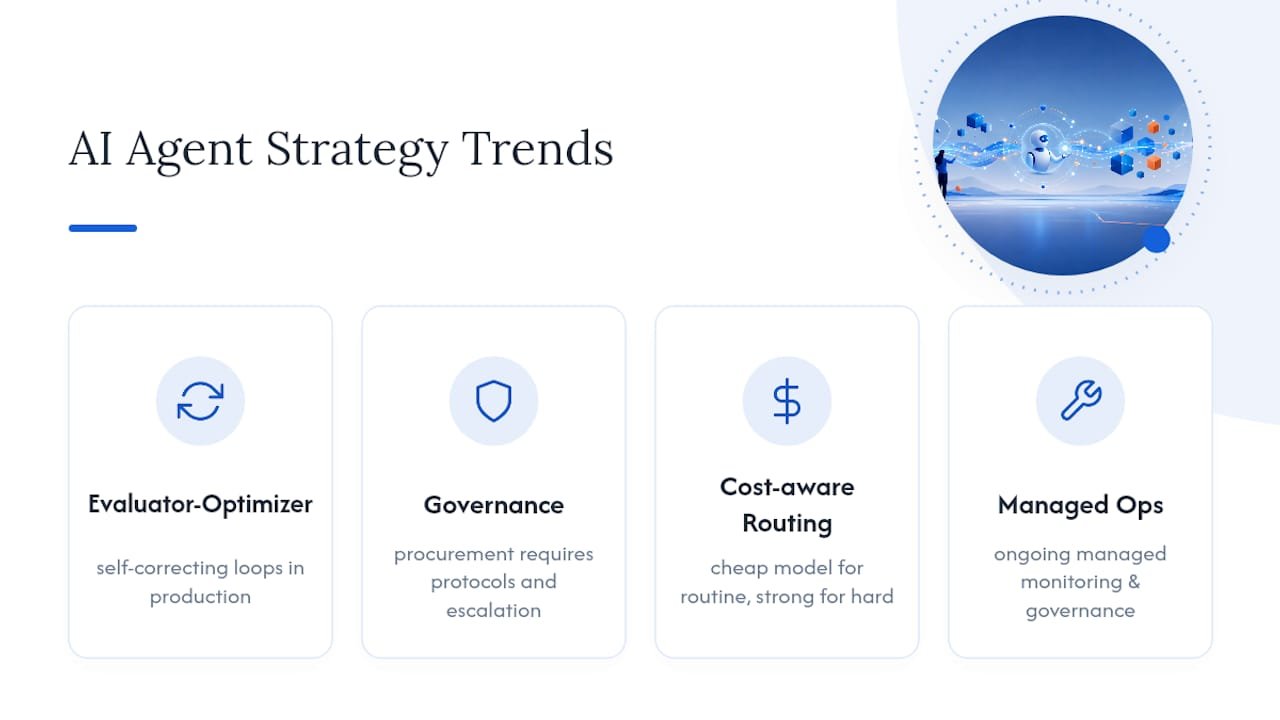
What comes next for AI agent strategy?
A few shifts are already visible in how teams approach agent strategy heading into 2026, and they’re worth planning around rather than reacting to later.
Evaluator-optimizer patterns are moving from research to standard practice. The hybrid coordination patterns documented in recent arXiv preprints are showing up in production orchestration frameworks, not just academic benchmarks, which means the tooling for building self-correcting agent loops is getting considerably less custom to build.
Governance is becoming a procurement requirement, not an internal nice-to-have. As MIT Sloan’s research on agentic AI points out, organisations deploying agents at scale are being asked by their own customers and regulators to demonstrate decision protocols and escalation paths, not just describe them internally.
Cost-aware model routing is becoming standard architecture, not an optimisation afterthought. Combining a cheap, fast model for routine steps with a stronger model reserved for genuinely hard decisions is shifting from a clever trick to an expected design pattern, mostly because the cost difference at scale is too large to ignore.
Managed operations are gaining ground over one-off custom builds. As more organisations realize that building an agent is the easy part and operating it reliably is the hard part, interest is shifting toward ongoing managed arrangements that keep monitoring and governance current, rather than a single build that’s left to drift once the engagement ends.
None of these trends change the fundamentals covered above. They raise the floor for what “good” looks like, which is exactly why starting simple now matters more, not less.
An editorial take on where agent strategies actually break
The gap between agent strategy on paper and agent strategy in production almost never comes down to model quality. It comes down to organisations skipping the boring instrumentation work because it doesn’t feel like progress. Teams want to talk about autonomy and multi-agent orchestration before they’ve proven a single agent can hit a defined success rate on a narrow task, and that ordering problem is what kills most pilots quietly, months in, with nobody quite sure why the numbers never materialized. Pick one use case, define success in a number you can measure weekly, and instrument it before you write a line of orchestration logic. Everything else in this article is easier once that discipline is in place.
— Don
How Brainiac Consulting can help you operationalize agents
If you’ve read this far, you already know the hard part isn’t picking a model, it’s building the discipline around it: clear ownership, real instrumentation, and integrations that don’t fall over the first time your CRM data gets messy. Brainiac Consulting exists to carry that operational weight so your team isn’t learning agent governance by trial and error on live customer data.
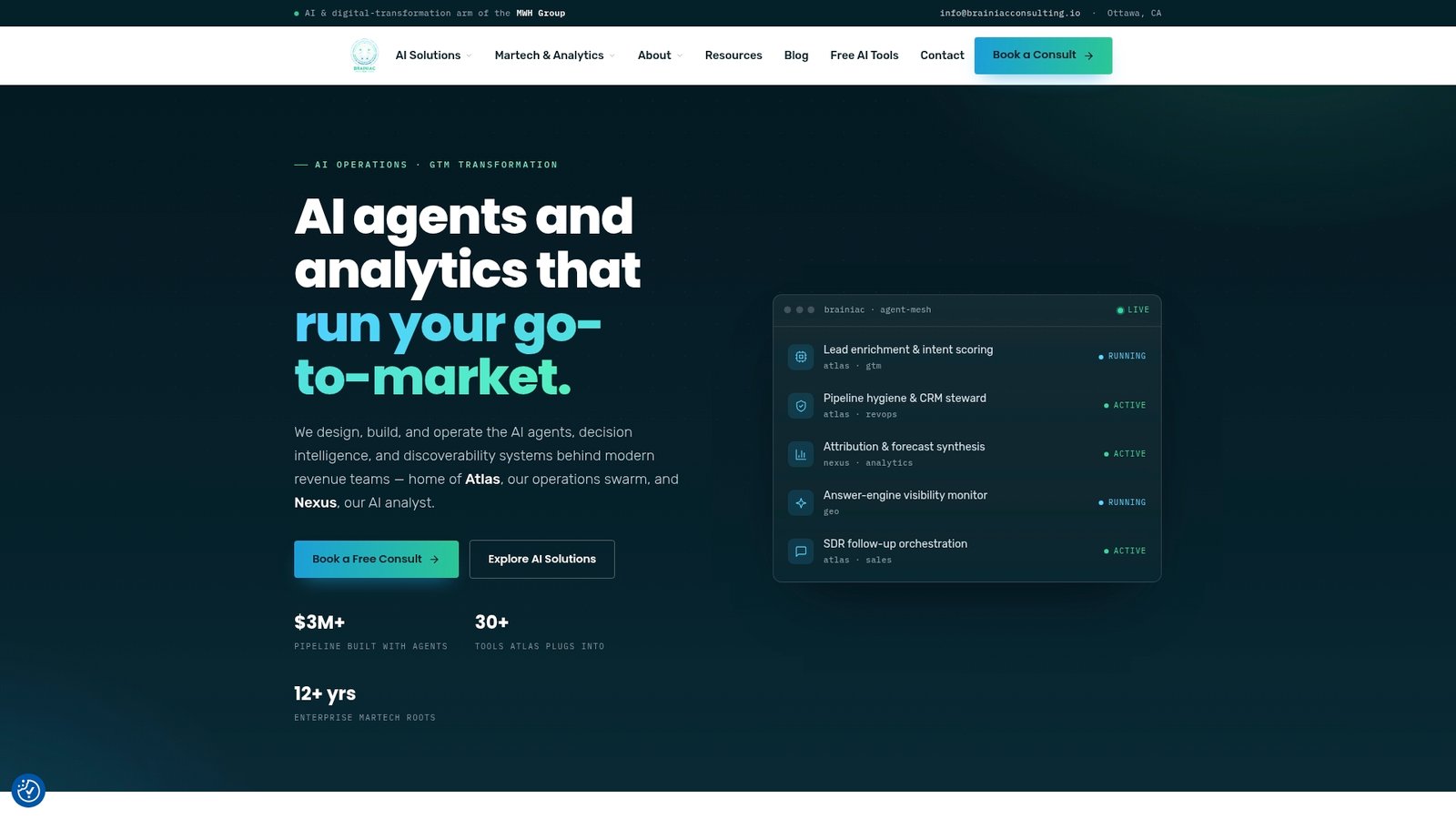
This is solved at three levels: strategy work to scope which use case deserves an agent first, custom agent builds for organisations with specific integration or compliance needs, and managed operations for teams that want ongoing monitoring without hiring an internal team to own it. The Managed AI Agents vs Custom Build breakdown is the right starting point if you’re still deciding which engagement model fits your team’s capacity. If you’re ready to see how instrumentation and orchestration work together in production, the Atlas AI Operations Platform page walks through what a properly monitored agent deployment actually looks like. Book a conversation with the team to scope your first pilot before you commit engineering hours to the wrong architecture.
Sources
- OpenAI — A practical guide to building agents
- Anthropic — Building effective agents
- BCG — AI agents (business impact)
- MIT Sloan — Agentic AI: nine essential questions