
Braze suits larger, engineering-supported teams that need deep real-time orchestration across many channels. Iterable suits lean or mid-sized lifecycle teams that want to build and launch journeys without waiting on developers. Both are mature cross-channel engagement platforms, so the right pick depends less on a feature checklist than on your team, your data and your budget.
We work on the layer around these tools: data pipelines, attribution, reporting and automation. That vantage point shapes this comparison. It covers what each platform does, what it costs, how long it takes to launch and where the decision usually turns.
TL;DR
- Pick Braze if you run a mobile-first or high-volume consumer business, need many channels and real-time orchestration, and have engineers to support it.
- Pick Iterable if your lifecycle team is lean, wants marketer independence and needs to get live quickly.
- Budget differs sharply: Vendr benchmarks put typical Braze contracts at $30,000 to $1,000,000+ a year, while Iterable Growth deals often start around $3,000 to $5,000 a month.
- Support and usability reviews are close: Braze leads on A/B testing and mobile scores, Iterable on quality of support.
- Either way, your data model decides the outcome, so plan attribution and warehouse sync before you sign.
Table of Contents
- How the two platforms are alike
- Channels, orchestration and AI
- Data, integrations and warehouse fit
- Reporting, attribution and revenue insight
- Implementation: how long and how heavy
- What each costs
- What reviewers say
- Which one fits your team
- Our perspective
- How we can help
- FAQ
- Sources
How the two platforms are alike
Both are customer engagement platforms built around real-time journeys, customer profiles, dynamic segmentation, cross-channel messaging and AI-assisted decisioning. A marketer logging into either one will recognize the basic building blocks: audiences, triggers, journeys, templates and experiments.
The difference is in emphasis. Braze describes itself as a platform that brings together first-party context and delivers personally relevant interactions across channels. At the end of its fiscal year in January 2026 it counted 2,609 customers and 8.0 billion monthly active users on the platform. Iterable automates personalized journeys across email, SMS, RCS, push and in-app, and connects customer data through APIs, SDKs and native integrations.
In buyer interviews, Alium Research finds a consistent split. Braze buyers talk about orchestration depth, advanced channels and personalization at scale. Iterable buyers talk about a simpler interface, marketer independence and onboarding.
Channels, orchestration and AI
Messaging channels
Braze has the wider channel list. Its annual report names email, SMS, MMS, RCS, WhatsApp, LINE, webhooks, in-app messages (including connected TV and gaming platforms), in-browser messages, surveys, mobile and web push, Content Cards, Banners, Landing Pages and Feature Flags. That breadth matters if your app is a main revenue surface or you operate in markets where LINE is a primary channel.
Iterable covers the core set: email, SMS, mobile push, in-app, web push, embedded messages and in-browser campaigns, plus WhatsApp, launched in 2025. For most North American email, SMS and push programs that is enough. It becomes a constraint only when you need the long tail of channels.
Journey building
Braze’s Canvas connects events, dynamic audiences, channels and experimentation in one journey, and reviewers often single it out for usability. Iterable’s drag-and-drop Studio lets teams trigger messages from events, schedules or API calls, then add conditions, delays and split paths. Both approaches work. Canvas rewards teams who want fine control, and Studio rewards teams who want to ship quickly.
AI and decisioning
Both vendors have invested heavily here, and both stories are recent. Braze’s Decisioning Studio was built from the $325 million OfferFit acquisition completed in June 2025. Iterable’s Nova covers insights, decisioning and agents, including a Nova Agent and a Command Center announced in April 2026. Iterable says its Nova Intelligence picks send time, channel and frequency per person, and that each decision is explainable.
Our advice: treat AI features as an accelerant, not a selection criterion. Features that landed this year have a short track record, so judge them against your own use cases and data quality.
Segmentation in practice
Whichever tool you choose, segmentation quality sets the ceiling on personalization. If your team is still building its audience logic, a primer on email segmentation in campaigns will help you define the cuts before you configure either platform.
Data, integrations and warehouse fit
This is where many migrations succeed or stall. Think of the platform as a city and your data warehouse as the road network: the buildings matter, but nothing moves without the roads.
| Area | Braze | Iterable |
|---|---|---|
| Data out | Currents connectors, Snowflake Data Sharing and enterprise APIs | Data Sync, a managed ETL that copies enriched data to your warehouse |
| Data in | Cloud Data Ingestion from Snowflake, BigQuery, Redshift, Databricks, Microsoft Fabric and Amazon S3 | Smart Ingest (reverse ETL) and Snowflake Secure Data Sharing |
| Integration ecosystem | 140+ to 165+ pre-built partner integrations, depending on the count | APIs, webhooks, data feeds and custom HTML blocks |
Sources for the table: Braze data platform announcement, Iterable Support Center, Rework’s comparison and MoEngage’s comparison.
In plain terms, Braze offers a bigger partner network. Iterable connects directly to a cloud data warehouse or CDP and syncs audiences with Facebook and Google, which suits teams that already treat the warehouse as the source of truth. Snowflake-centred teams in particular may prefer sharing data to copying it.
Reporting, attribution and revenue insight
Neither platform is a full attribution system, and that is by design. Both report on campaign performance, experiments and engagement. Both also export enriched engagement data to your warehouse through the routes above, so you can join it with CRM, ad and revenue data.
That join is where attribution accuracy comes from. Treat attribution as a map rather than a courtroom verdict: messaging touches are one set of paths among many, and you need the whole terrain to see which ones lead to pipeline or revenue. For B2B teams, that means connecting engagement data to your CRM and marketing automation records. For ecommerce teams, it means tying sends to orders, returns and margin, not only clicks.
Practical steps, whichever platform you choose:
- Define which events (purchase, qualified lead, renewal) the platform must receive and send back.
- Agree on one customer identifier across messaging, CRM and warehouse.
- Export engagement data on a schedule to your warehouse.
- Build reporting in your BI layer, so it does not depend on one vendor’s dashboards. Our guide to marketing reporting automation without vendor lock-in lays out a three-phase plan.
Implementation: how long and how heavy
Iterable has the quicker reputation. Its Technical Data Integration Guide estimates about 60 days, roughly eight weeks, for a basic implementation, with milestones from kick-off and subscriber migration to go-live and follow-up consulting. Its Bronze package includes up to 18 hours of consulting within three months, covering schema planning, integration planning, channel setup and an IP warm-up plan.
Braze integrations need more developer involvement. MoEngage estimates one to six weeks of engineering time for API keys, field mapping and sync testing, depending on complexity.
Speed is not the whole story. Buyer data cited by Maestra shows a three-month average implementation on Iterable and 11 months to ROI, and one reviewer described spending time and money undoing early data-model mistakes. Whatever you buy, the expensive decisions are the early ones: identity, event naming and how profiles are structured. Settle those on paper before anyone builds a journey.
What each costs
Neither vendor publishes a full price list, so use benchmarks as a starting range and expect quotes to differ.
| Braze | Iterable | |
|---|---|---|
| Small to mid-market | $30,000 to $120,000 a year (50K to 500K MAUs) | Growth: about $3,000 to $5,000 a month (10,000 to 50,000 MAUs) |
| Growth stage | $120,000 to $300,000 a year (500K to 2M MAUs) | Premier: often $6,000 to $15,000+ a month |
| Enterprise | $300,000 to $1,000,000+ a year (2M+ MAUs) | Custom, frequently $20,000+ a month |
Those figures come from Vendr’s Braze benchmarks and Vendr’s Iterable benchmarks, both for 2026. A second benchmark set puts Braze discounts between 5% and 50%, with a standard three-year term. Iterable pricing is based on monthly active users, and buyers who commit to multi-year terms and compare alternatives often land below list.
Two cost drivers deserve attention. Braze buyers describe a data-point pricing model they find high and hard to manage. Iterable buyers cite cost and limits at scale. In both cases, forecast your MAUs and channel mix for the contract term, not just for launch.
What reviewers say
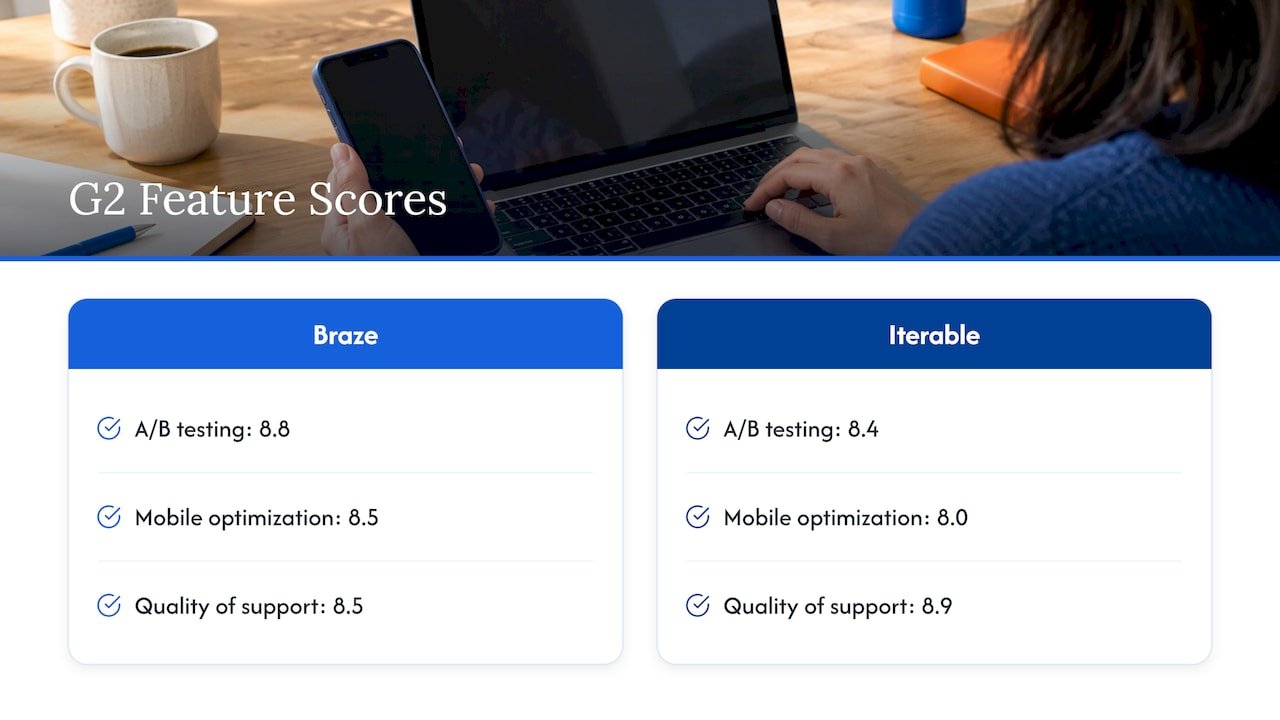
G2 lists Braze at 4.5 stars from 1,167 reviews and Iterable at 4.4 stars from 669 reviews, and mid-market buyers are the largest segment for both. On feature scores, Braze leads on A/B testing (8.8 against 8.4) and mobile optimization (8.5 against 8.0), while Iterable leads on quality of support (8.9 against 8.5). GetApp shows a similar picture, with Braze at 4.7 stars from 168 reviews and Iterable at 4.3 from 63.
One more data point from Alium Research: of eleven companies leaving Iterable in buyer interviews, five went to Braze, and none described moving the other way. Some buyers choosing fresh did pick Iterable. The pattern suggests teams often outgrow simplicity, though plenty never need to.
Which one fits your team
| If you are… | Lean toward |
|---|---|
| A mobile-first consumer brand with the app as a main revenue surface | Braze |
| A team with engineering support and complex real-time journeys | Braze |
| A lifecycle team that wants to ship without developers | Iterable |
| A Snowflake shop that would rather share data than copy it | Iterable |
| A company with a tight first-year budget | Iterable, based on the benchmarks above |
This mirrors how Rework describes the two platforms’ fit. Four questions settle most decisions:
- How many channels do you need in 18 months, not today?
- Who builds journeys: marketers or engineers?
- Where does your source-of-truth data live?
- What will your MAUs and contract term cost at scale?
Our perspective
We rarely see a messaging platform fail because of its feature list. We see it fail because the data underneath was never agreed: identities that do not match, events named three ways, reporting that lives only inside the tool.
That is why we start with the data model and the reporting layer, then choose the platform. Our approach is open and visible: we integrate with the marketing platforms you already run, such as Salesforce and HubSpot, and we build analytics so you can see how every number is produced. No black boxes.
Once either platform is live, the next gains come from the layer around it: automating lead enrichment, predicting customer intent, keeping pipeline data clean and tying engagement to revenue. Agents and analytics built for your environment turn a messaging tool into a revenue system.
Don
How we can help
Choosing between these platforms is one decision. Getting value from either one is a longer project: integration, data modelling, attribution and reporting. We design and operate AI agents and analytics systems for marketing, sales and finance teams, and we implement martech so it connects to your CRM and warehouse.
If you want a second opinion before you sign, start with our AI strategy and readiness work or see how we handle marketing operations optimization and support. Our case studies show the kind of results we aim for, and you can reach us through our main site.
FAQ
Is Braze similar to Iterable?
Yes. Both are cross-channel customer engagement platforms with real-time journeys, segmentation, personalization and AI decisioning. Braze leans toward orchestration depth and breadth of channels, while Iterable leans toward ease of use and marketer independence.
Which is cheaper, Braze or Iterable?
Benchmarks suggest Iterable is usually cheaper at smaller scale, with Growth deals starting around $3,000 to $5,000 a month. Braze contracts typically begin near $30,000 a year and climb with MAUs and channels. Both are quote-based, so negotiate on term length and volume.
Which is easier to implement?
Iterable is generally described as quicker to ramp, with a standard basic implementation of about 60 days. Braze usually needs more developer time for integrations. Either way, define your data model before building.
Is Braze doing well as a company?
Braze reported revenue of $738.2 million for the fiscal year ended January 31, 2026, up from $593.4 million the year before, according to its annual report. It is headquartered in New York and had 1,988 full-time employees at that date.
Sources
- Braze FY2026 Annual Report
- Braze data platform announcement
- Iterable marketing automation platform
- Iterable platform overview
- Iterable Support Center product overview
- Iterable Technical Data Integration Guide
- Iterable professional services packages
- Alium Research: Braze vs Iterable
- G2 comparison of Braze and Iterable
- GetApp comparison
- Vendr Braze pricing
- Vendr Iterable pricing
- Braze pricing benchmarks
- Rework comparison
- MoEngage feature comparison
- Maestra comparison