
A data contract is a written, enforceable agreement between the team that produces a dataset and the team that depends on it. In marketing, it says what a field means, what shape it arrives in, how fresh it will be and who fixes it when it breaks. Put one around the handful of fields that drive your attribution, lead scoring and reporting, and you stop discovering broken numbers in the Monday pipeline meeting.
The idea comes from data engineering, but marketing operations feels the pain first. A web form changes a field name, a CRM admin adds a lifecycle stage, an ad platform changes a currency format, and your dashboards quietly drift from reality. Below, we explain what to put in a contract, how to enforce it, and how to start small.
TL;DR
- A data contract defines the structure, meaning, quality and availability of a dataset, plus what happens when those promises are broken.
- Start with the five to ten fields that feed attribution, lead qualification and revenue reporting, not with every table you own.
- Every contract needs a named owner, a change process and a deprecation policy, or it will not survive its first disagreement.
- Validate before changes ship and monitor after, and tie both to freshness and availability targets.
- If AI agents act on your data, the contract should also state what an agent may do based on each attribute.
Table of Contents
- What a data contract is, and what it is not
- Why marketing needs them more than most teams
- What to put in a marketing data contract
- A worked example: the lead-to-opportunity handoff
- How the contract improves reporting, attribution and lead qualification
- How to enforce and monitor contracts
- Challenges to plan for
- Data contracts for AI agents
- How to start in a US marketing organization
- Our perspective
- Put contracts to work with Brainiac
- FAQ
- Sources
What a data contract is, and what it is not
A data contract specifies a dataset’s shape, its quality standards and its operational guarantees, and it establishes what happens when those guarantees are not met, according to DataHub’s practical guide. The same source draws a useful line between a contract that is enforced and documentation that may go stale. A wiki page describing your lead fields is documentation. A check that blocks a change to those fields is a contract.
It also helps to separate a contract from a data product. Collibra’s product documentation describes data contracts as an essential element of data products, covering structure, format, service level, quality and terms of use. The contract is the governing agreement. The data product is the thing people actually use, such as a clean “qualified leads” table that sales operations queries every morning.
For a marketer, the practical reading is this:
- The producer is whoever creates or changes the data: a web developer, a CRM admin, a form vendor, an ad platform integration.
- The consumer is whoever relies on it: your attribution model, your lead scoring, your finance forecast, your AI agents.
- The contract is the promise between them, written down and checked automatically.
Think of it less as a legal document and more as a trail map posted at the trailhead: it tells everyone where the path goes, what condition it is in, and who to call when a bridge is out.
Why marketing needs them more than most teams
Marketing data is assembled from many hands. Web analytics, a marketing automation platform, a CRM, an ad network, an enrichment vendor and a billing system all write into the same story of a customer. Each has its own owner, its own release rhythm and its own idea of what a “lead” is.
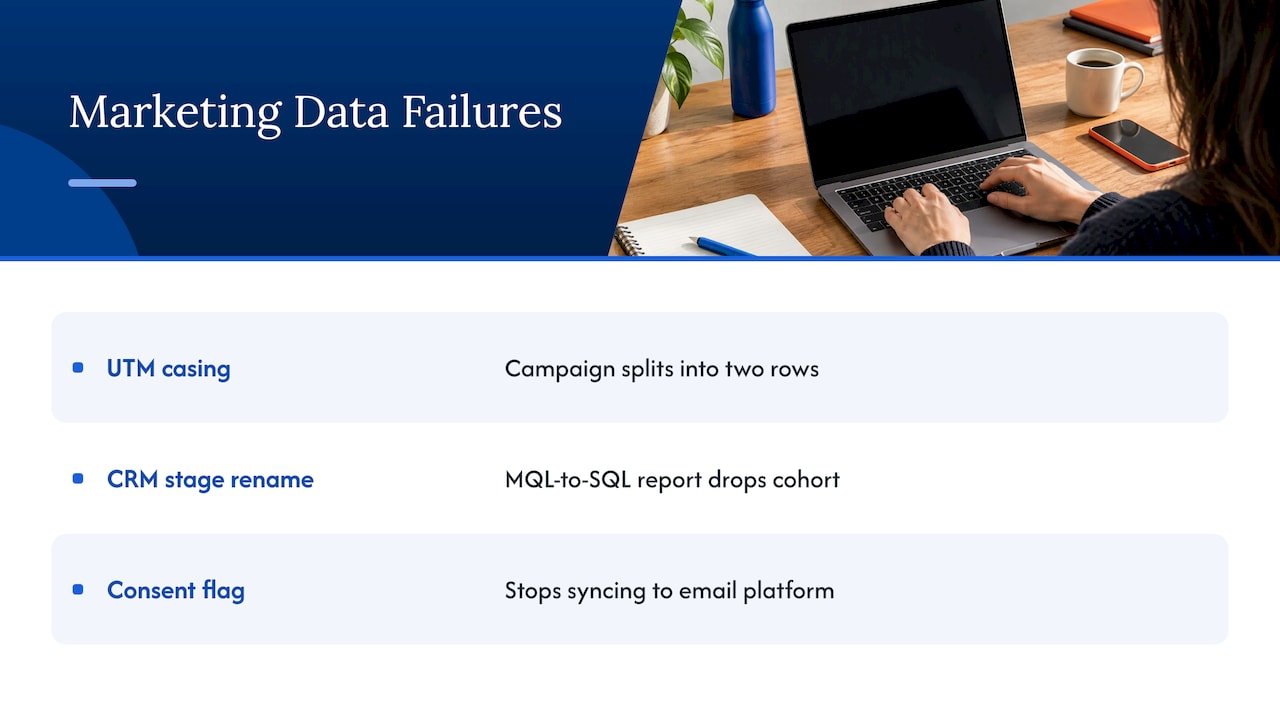
That is why the damage is rarely dramatic. It is a UTM parameter that starts arriving in mixed case, so a campaign splits into two rows. It is a lifecycle stage renamed in the CRM, so the conversion report from MQL to SQL silently drops a cohort. It is a consent flag that stops syncing to your email platform. None of these throws an error. All of them change a decision.
We see the same pattern in attribution work. Teams argue about models when the real problem is that the inputs are inconsistent. Attribution is a map rather than a courtroom verdict, and a map drawn from unreliable survey data will lead you confidently to the wrong place. If you want the modelling side, our piece on what marketers get wrong about attribution covers it. Contracts fix the layer underneath.
What to put in a marketing data contract
A good contract is short enough that people read it. For marketing, sales and customer data, we include the following elements.
Schema and meaning
List each field with its name, type, allowed values and whether it can be empty. Then add the part most teams skip: a plain-language definition. “Lead source” means little until the contract says whether it records the first touch, the last touch or the form that created the record.
The Linux Foundation’s Bitol project maintains the Open Data Contract Standard, an open YAML format that covers fundamentals, schema, quality rules, ownership, SLA and support. You do not have to adopt it on day one, but borrowing its headings gives your first draft a proven skeleton, and it keeps your contracts portable between tools.
Quality rules
Write the rules a human would check by eye, then automate them:
- Email must be present and well formed for any record flagged as a contact.
- Country must be a valid ISO code, since territory routing depends on it.
- Revenue amounts must be positive and carry a currency code.
- Campaign identifiers must match your naming convention.
- Lifecycle stage must be one of the approved values.
Freshness and availability
Say how current the data will be. A paid media spend table that lands daily by 6 a.m. Eastern supports a morning pacing review. A lead table that lags by a day makes speed-to-lead reporting meaningless. Pair each dataset with a freshness target and an availability target so that “late” has a definition.
Ownership and escalation
Name a person or a team, not a department. Add where to raise a problem and how quickly the owner responds. The company blog at DataDef puts it bluntly: a contract with no owner or deprecation policy may not survive its first disagreement. We agree, and it matches what we see in practice.
Change and deprecation policy
Decide how much notice a producer gives before renaming, removing or redefining a field. Separate breaking changes (renaming a column, changing a type) from non-breaking ones (adding an optional field). Say how long an old field stays alive after its replacement ships.
Consent and usage terms
For US marketers, privacy rules belong in the contract, not in a separate binder. California’s Attorney General summarizes the CCPA rights consumers hold, including the right to opt out of the sale or sharing of their personal information, including through a global privacy control signal. If a consent field drives who may be targeted or synced to an ad platform, the contract should define that field, require it on every record, and state which downstream uses depend on it. Our CCPA checklist for marketers walks through mapping where that data lives.
A worked example: the lead-to-opportunity handoff
Take a mid-sized SaaS or services business with a web form, a marketing automation platform and a CRM. The contract on the “new lead” record might read, in plain terms:
| Element | What the contract says |
|---|---|
| Producer | Web team (form) and marketing operations (automation platform) |
| Consumers | Lead scoring, sales routing, attribution, weekly pipeline report |
| Required fields | Email, company, country, lead source, consent status, created timestamp |
| Quality rules | Valid email format; country as ISO code; lead source from approved list |
| Freshness | Record visible in CRM within 15 minutes of submission |
| Change policy | 30 days’ notice for breaking changes; old field retained for 60 days |
| Owner | Marketing operations manager |
The numbers above are an illustration of how to set targets, not a benchmark. Choose figures your sales team can actually live with. The point is that a sales rep who gets a lead with no country, or a model that receives a new lead source value nobody told it about, now has a rule that catches it and a person to call.
How the contract improves reporting, attribution and lead qualification
The benefits show up in three places.
Reporting. When definitions are fixed and checked, two dashboards stop disagreeing about pipeline created. Analysts spend less time reconciling and more time interpreting. That is also the foundation for self-serve analytics, where business users ask questions of governed data without opening a ticket.
Attribution. Multi-touch models need consistent touchpoint records: timestamps, channels, campaign identifiers and account or contact keys. A contract on those inputs means a change to your tagging does not quietly rewrite last quarter’s results. If you build your own measurement, our guide to open source marketing attribution shows where those inputs enter the model.
Lead qualification. Scoring and intent prediction are only as good as the fields they read. If enrichment data arrives late or with unexpected values, a score shifts for reasons that have nothing to do with buyer behaviour. A contract on enrichment output keeps the score stable, and tells you quickly when a vendor changes something.
How to enforce and monitor contracts
A contract nobody checks is a wish. Practitioners describe a layered approach. One published account of real-time attribute governance in a US local commerce platform describes pre-merge validation checks such as referential integrity and value-range boundaries, which keep bad data out of production. The same piece describes post-merge anomaly detection, automated profiling and tiered contracts with freshness, availability and validation targets.
Translated for a marketing stack:
- Before a change ships. When someone edits a form, a field mapping or a CRM picklist, run the contract checks first. A failing check blocks the change or alerts the owner.
- When data lands. Test each load for nulls, allowed values, duplicates and volume. A form that normally produces 400 records a day and suddenly produces 12 is a signal.
- Over time. Profile distributions weekly. A slow shift, such as one lead source growing from 5% to 40% of volume, may be real, or may be a tagging bug.
- Tier your contracts. A table feeding board-level revenue reporting deserves strict targets and paging. A table feeding an experimental dashboard can get lighter ones.
Tools matter less than habit. Many teams begin with tests inside their warehouse transformation layer or CRM validation rules, and graduate to a dedicated catalogue later.
Challenges to plan for
Expect these, and design around them:
- Missing owners. If nobody is accountable, alerts go unread. Assign before you automate.
- Semantic changes. DataDef notes that automated compatibility checks can miss changes in meaning. If “MQL” is redefined but the column keeps its name and type, no schema test will complain. Pair automated checks with a human review step for definitions.
- Scope creep. Contracts on every table drown the team. Cover the critical few first.
- Political friction. Producers may see contracts as extra work. Show them the cost of the last broken report, and keep the process light.
Data contracts for AI agents
This is where contracts move from good hygiene to necessity. An agent that enriches leads, routes them or adjusts spend acts on data without a person reading each record. If a field is wrong, the agent acts wrongly, quickly and at scale.
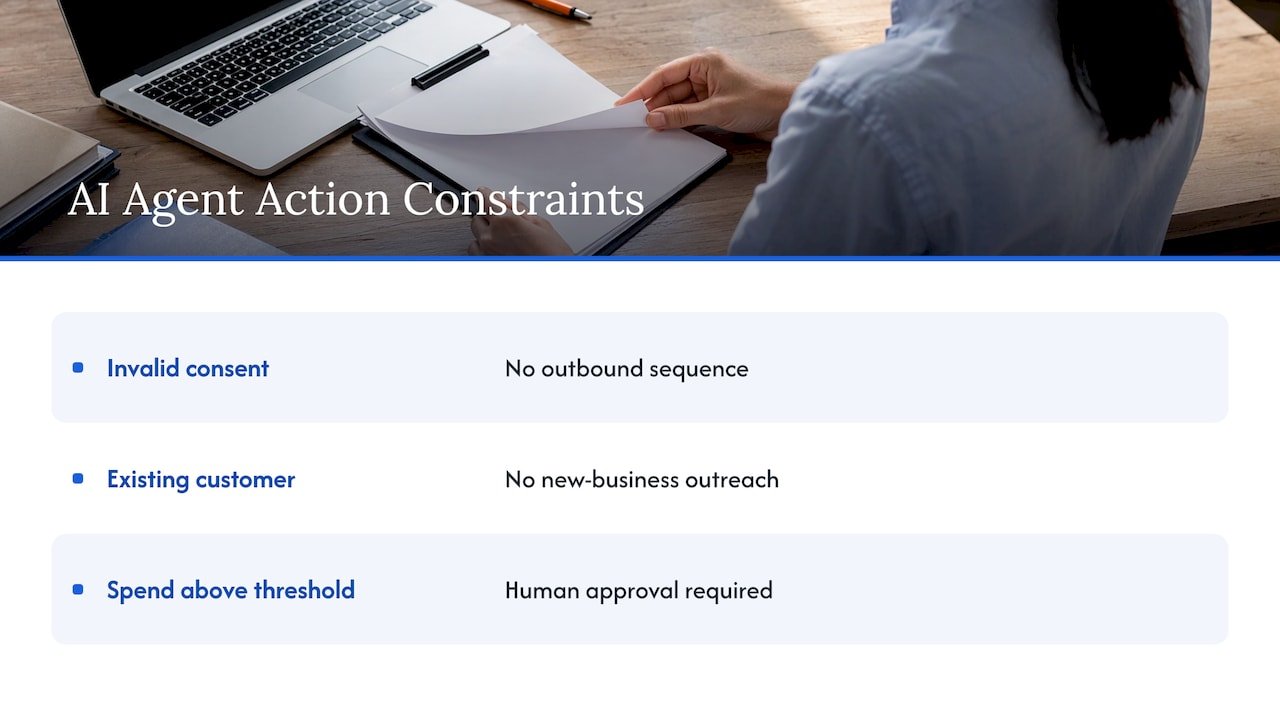
One practitioner argues that, for AI-ready systems, contracts should state action constraints: what an agent may do based on a given attribute. For example: a contact without a valid consent status may not be added to an outbound sequence; an account flagged “existing customer” may not receive new-business outreach; a spend change above a set threshold needs human approval. That is one person’s view rather than an industry standard, but it is a sound design principle, and it fits how we build.
Authorization is the other half. Questions of what an agent is allowed to do, and how it proves it, are covered in writing on AI agent authorization in identity verification. For your marketing stack, the same thinking applies: data contracts say what the data guarantees, and governance says what the agent may do with it. Our AI agent governance framework and our approach to human-in-the-loop approval cover the control side. If you are checking your readiness, start with whether your CRM is ready for AI agents.
How to start in a US marketing organization
A workable first quarter looks like this.
- Pick one decision that matters. Choose a report or process the business trusts, or should trust: weekly pipeline created, MQL to SQL conversion, or channel-level revenue.
- Trace its inputs. List every field and system feeding it. Most teams are surprised how many hands touch a single number.
- Draft one contract per critical dataset. Use the headings above: schema, meaning, quality, freshness, owner, change policy, consent terms.
- Get producer sign-off. A contract that only consumers wrote is a complaint. Walk the producers through it and adjust what is unrealistic.
- Automate the cheapest checks first. Required fields, allowed values and freshness catch most real incidents.
- Review monthly. Count incidents caught, incidents missed, and contracts that need amending. Add the next dataset only when the first one runs smoothly.
- Extend to agents. Once the data is dependable, add action constraints and approval steps for any automated workflow that reads it.
Where your privacy obligations differ by state, involve your counsel when drafting the consent and usage section; the contract records the rules, and it does not replace legal advice.
Our perspective
Most of the marketing analytics projects we are asked to rescue did not fail because of the model. They failed because nobody could say, with confidence, what the inputs meant on a given day.
We build agents and analytics systems that sit inside your environment, on open-source foundations, so you can see every rule they follow. A data contract is the natural companion to that approach: it turns “trust us” into something you can read, test and audit. We would rather write the contract with your team in week one than explain a broken forecast in month six.
Our advice is to treat contracts as the first deliverable of any agent project. Define the fields, name the owners, set the action limits, then let the automation run. Teams that do this deploy faster, because approvals stop being a debate about whether the data can be trusted.
Don
Put contracts to work with Brainiac
We design and operate AI agents and analytics systems for marketing, sales and finance teams, with integrations into platforms such as Salesforce, HubSpot and Marketo. If you want to know whether your data is ready for automation, our AI readiness work is the place to begin, and we can turn the result into contracts, checks and a rollout plan.
See our AI strategy and readiness services, or explore custom agent deployment if you already know what you want automated. Pricing is scoped per engagement, so get in touch through our site to discuss yours.
FAQ
What is the difference between a data contract and data governance?
Governance is the wider set of policies on who owns, accesses and may use data. A data contract is a specific, enforceable agreement about one dataset between its producer and its consumers. Contracts are one of the tools through which governance gets applied in practice.
Do small marketing teams need data contracts?
Yes, in a lightweight form. A one-page agreement on your lead fields, an owner and two or three automated checks in your CRM or automation platform is enough to begin. The need grows as you add integrations, enrichment vendors or AI agents that act on the data.
Who should own a marketing data contract?
The team that produces the data should own it, usually marketing operations for automation and CRM fields, or the web team for form and tracking data. Consumers such as analytics and sales operations review and sign off. Whatever the split, name a person, and write down how to escalate.
How is a data contract different from a data product?
The contract is the agreement that defines structure, quality and availability. The data product is the finished asset people use, such as a governed table of qualified leads. Contracts sit inside products as the part that makes them dependable.
Sources
- What Are Data Contracts? A Practical Guide (DataHub)
- About data products and data contracts (Collibra)
- Open Data Contract Standard (ODCS)
- Data Contracts: What They Are, Who Needs Them, and How to Start (DataDef)
- Data Contracts at Scale: Real-Time Attribute Governance (AI Journal)
- AI-Ready Customer Data Architecture for GTM and AI Agents
- California Consumer Privacy Act (California Attorney General)
- AI Agent Authorization: Inside Daon’s Patented Trust Stack