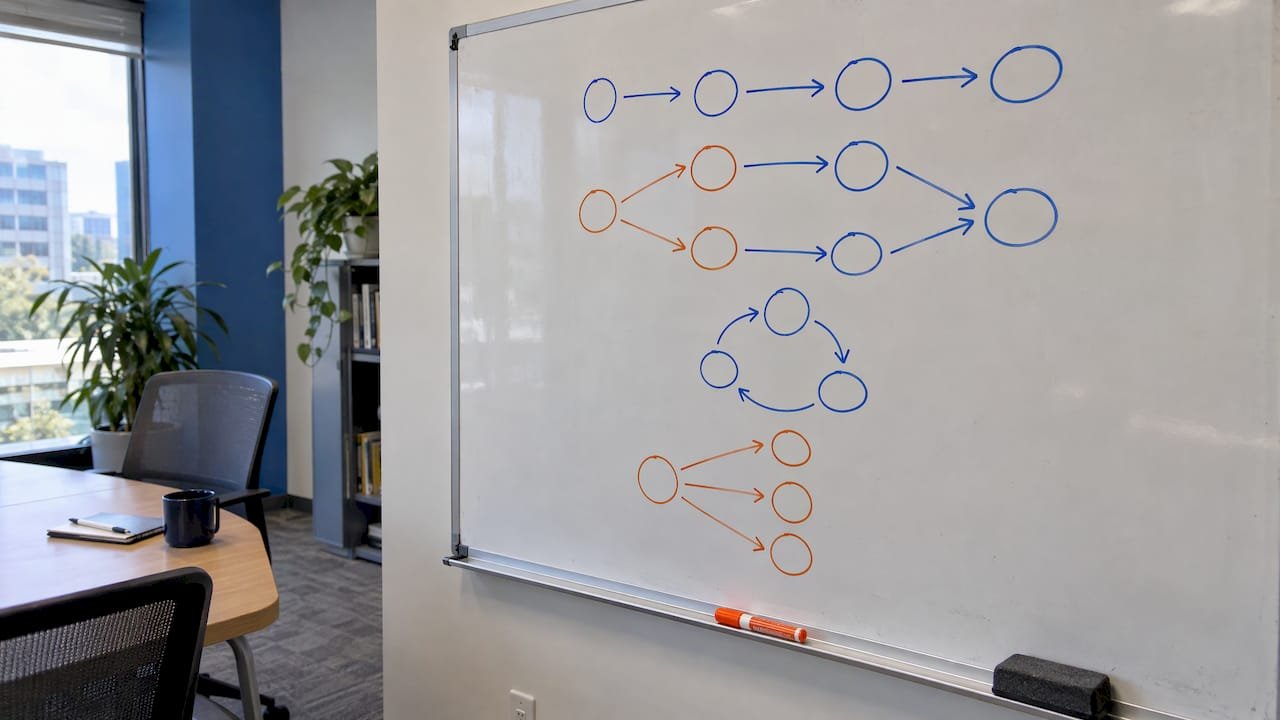
Agent orchestration is the logic that decides which AI agent works on what, in what order, with which tools, and when a person steps in. The pattern you pick should follow the shape of the business process: sequential when steps depend on each other, concurrent when work can run side by side, handoff when the right specialist only becomes clear midway. Start with the simplest design that works, and add agents only when you can measure the gain. At Brainiac Consulting we design and operate production agents for marketing, sales and finance teams, and this is the order we work in.
TL;DR
- Orchestration covers work distribution, shared context, retries, handoffs, approvals and stopping rules, not just “more agents”.
- Five patterns cover most business workflows: sequential, concurrent, group chat (review), handoff and orchestrator-subagent.
- Every extra agent adds cost, latency and a new way to fail, so use one agent with bounded tools until a measurable benefit justifies more.
- Judge any design on task success, cost per completed task, latency, escalation rate and the business outcome it moves, such as qualified leads or reporting hours saved.
- Combine two or three patterns in production, and keep a human approval point wherever money, customers or compliance are touched.
Table of Contents
- What orchestration actually controls
- One agent or several?
- The core orchestration patterns
- Choosing a pattern: a decision table
- What more agents cost: the evidence
- Metrics that show an orchestrated system is working
- Governance belongs in the pattern
- Our perspective
- Where Brainiac fits
- FAQ
- Sources
What orchestration actually controls
An AI agent is a model that can use tools (a CRM lookup, a spreadsheet, an email draft) to reach a goal. Orchestration is the runtime layer around it. Snowflake’s guide describes it as the logic governing model and tool execution, context, state, transitions, retries, handoffs, approvals and termination. Microsoft’s Azure Architecture Center frames the same job as distributing work, sharing context and aggregating results.
For a marketing or revenue team, that translates into plain questions. Who enriches a new lead? Who scores it? What happens when the CRM record is incomplete? Who approves the message before it goes out? A pattern is a repeatable answer to those questions.
Think of orchestration as the org chart and the escalation rules for your software workforce. The agents are the staff; the pattern decides who reports to whom.
One agent or several?
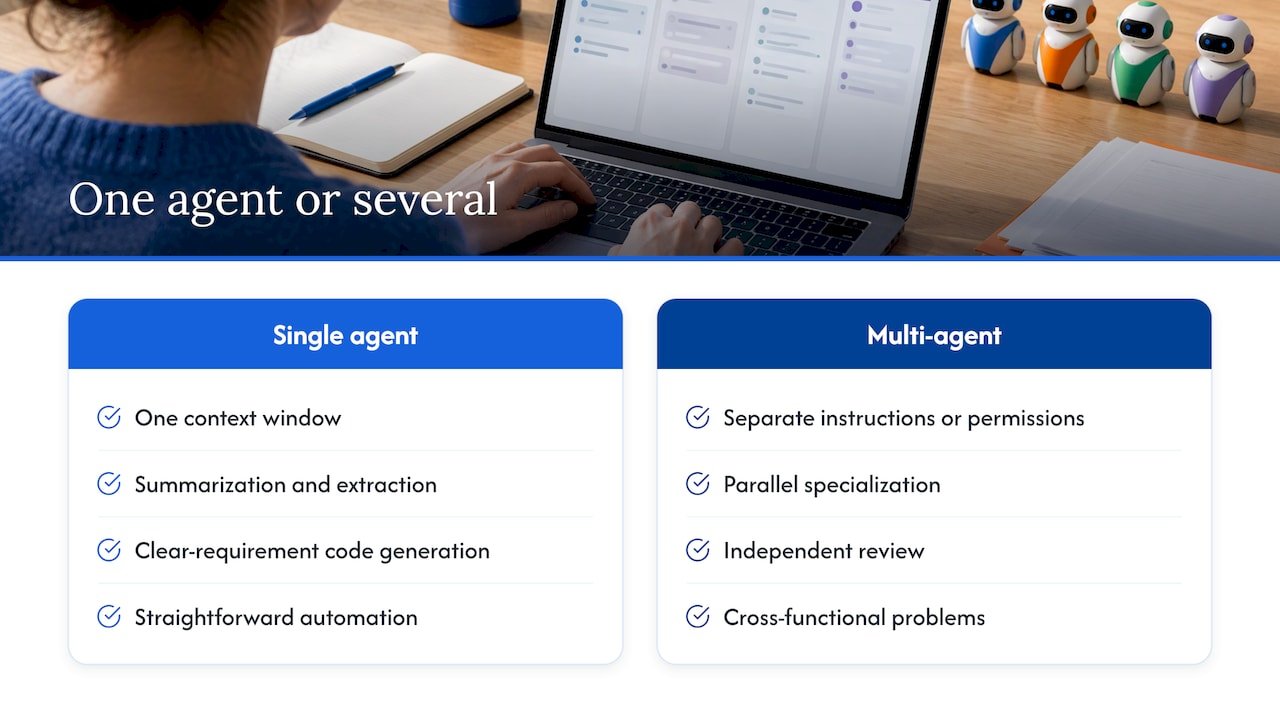
Before choosing a pattern, decide whether you need more than one agent at all. The guidance from the people building these platforms is consistent here.
Snowflake treats each additional agent as an architectural cost: another model interaction, another context boundary, another state transition, and more nondeterminism. Multiple agents earn their place when you need separate instructions, separate permissions, parallel work, specialist ownership or independent review. Microsoft adds that multi-agent designs bring coordination overhead, latency and new failure modes, and recommends them for cross-functional problems, distinct security boundaries or parallel specialization. Oracle’s documentation says to begin with the smallest design that meets requirements.
Redis’s production guidance lists the jobs a single agent generally handles well: summarization, basic extraction, clear-requirement code generation and straightforward automation that fits in one context window.
In revenue operations, that means a first agent that enriches inbound leads and writes the result to the CRM probably does not need a team. A workflow that enriches leads, checks them against compliance rules, drafts outreach and reconciles pipeline data across systems probably does. We cover the one-agent starting point in more detail in our note on starting with one agent until you need more than five tools.
The core orchestration patterns
The patterns below come from Microsoft’s and Anthropic’s published guidance, translated into the revenue workflows our readers run.
Sequential: the assembly line
Agents run in a fixed order, and each one works on the previous agent’s output. Microsoft describes this as a predefined linear pipeline suited to step-by-step refinement. The trade-off: early mistakes travel down the line, and nothing runs in parallel.
Business example: a new form fill is enriched, then scored, then routed to the right rep. If enrichment pulls the wrong company, scoring and routing inherit the error. Put a validation check right after the step most likely to go wrong.
Concurrent: fan-out and fan-in
Several agents analyze the same task independently, and a final step combines their results. Microsoft notes this cuts wall-clock time for independent work but needs a way to resolve conflicts and uses more resources.
Business example: before a quarterly review, one agent pulls paid media performance, one pulls email engagement, one pulls CRM pipeline movement, and a summarizer merges them. The agents do not depend on each other, so waiting in line adds nothing. The merge step is where discrepancies between systems show up, so define up front which source wins.
Group chat: structured review
Agents discuss a draft or decision in a shared thread, often with a reviewer role. Microsoft positions it for collaboration and validation. Anthropic’s coordination guide names a close cousin, generator-verifier, for quality-critical outputs where the checking criteria are explicit.
Business example: one agent drafts a customer-facing pricing summary, another checks it against approved terms. The criteria must be written down, such as “no discount above the approved band”, or the reviewer has nothing to enforce.
Handoff: the right specialist, found midway
One agent starts the work and passes it on when it discovers the task needs someone else. Microsoft recommends handoff when the needed expertise emerges during processing.
Business example: a support-style agent on an ecommerce store answers order questions, then hands refund disputes to a finance agent with the order history attached. The quality of the handoff note matters as much as the specialist. The same logic applies when the “next specialist” is a person; see our guide to building an escalation policy.
Orchestrator and subagents: the manager model
A lead agent breaks a goal into bounded subtasks, assigns them and assembles the answer. Anthropic lists orchestrator-subagent for bounded decomposition, and agent teams for parallel, long-running subtasks. It also describes message buses for event-driven ecosystems and shared state for collaborative work, both of which matter once many agents react to the same stream of events, such as every new order or every stage change in the CRM.
Business example: a campaign-reporting orchestrator asks a data agent for spend, an attribution agent for influenced pipeline, and a narrative agent for the summary. One agent owns the plan, which makes the workflow easier to trace than an open conversation.
Dynamic, open-ended planning
For problems where nobody can write the steps in advance, Microsoft describes a “magentic” approach in which a manager builds the plan as it goes. Research surveys sort workflows into static or dynamic graphs according to when the structure is decided. Most business processes are better served by a static or mostly static structure you can audit, with dynamic planning reserved for genuinely exploratory work.
Choosing a pattern: a decision table
| If your process looks like this | Start with | Watch for |
|---|---|---|
| Clear steps, each needs the last | Sequential | Errors propagating; add a check after the riskiest step |
| Independent analyses of the same input | Concurrent | Conflicting results; define the source of truth |
| Output must meet written quality criteria | Group chat or generator-verifier | Reviewer with vague criteria |
| Specialist need only appears midway | Handoff | Lost context in the handoff note |
| Big goal that splits into bounded tasks | Orchestrator and subagents | Orchestrator becoming a bottleneck |
| Unknown steps, exploratory work | Dynamic planning | Cost and traceability |
Microsoft’s rule is to start with the lowest level of complexity that meets requirements. Anthropic gives the same advice: begin with the simplest coordination pattern that could work, watch how it fails, and add structure only when the problem demands it. Production systems usually end up composing two or three patterns, for example a sequential pipeline whose scoring step fans out to concurrent checks and ends with a human approval.
What more agents cost: the evidence
Teams often assume more agents mean better answers. Two 2026 studies show why that needs testing.
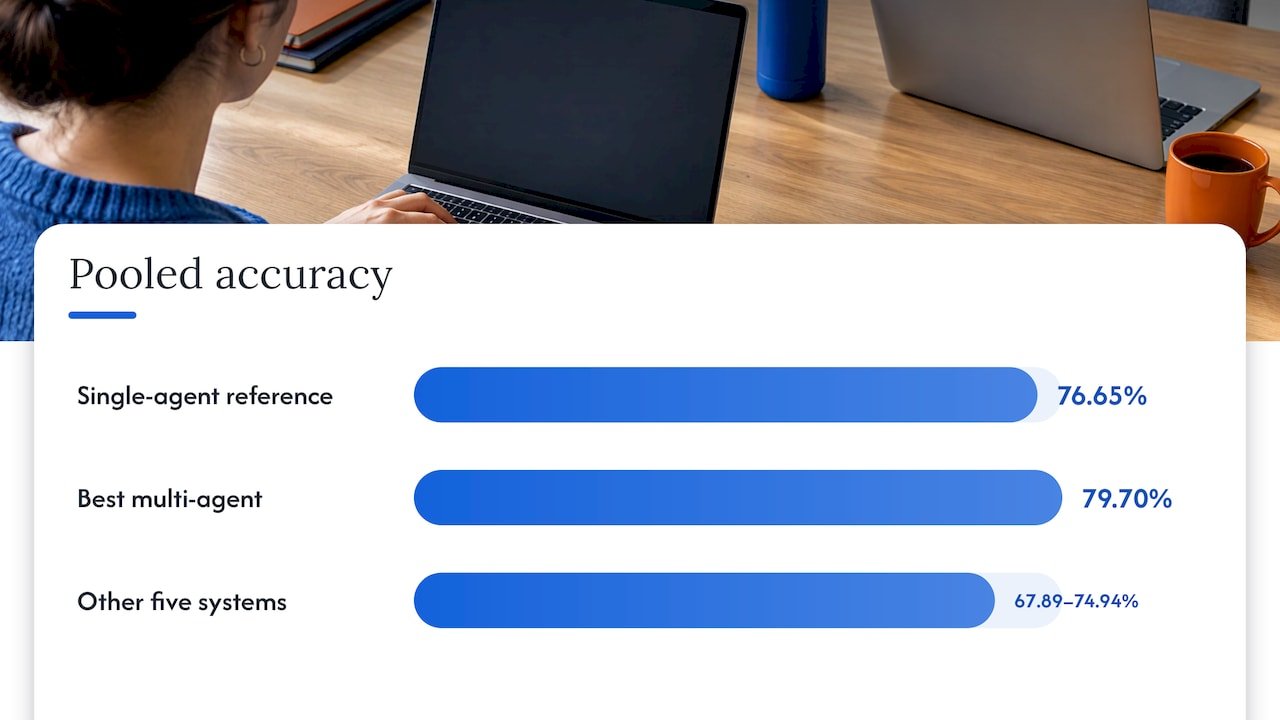
The BenchAgent study compared six multi-agent configurations against a single-agent GPT-4.1 reference across ten reasoning, coding and tool-use benchmarks. The single-agent reference scored 76.65% mean pooled accuracy. One multi-agent system reached 79.70%, while the other five scored between 67.89% and 74.94%, below the single agent in every run. Some workflows that won individual benchmarks lost on pooled accuracy while using far more tokens. The lesson is to optimize accuracy and resource use together, and to compare against a one-agent baseline on your own tasks.
The MAFBench paper held the underlying model fixed across nine frameworks and still found orchestration-related latency from 1.1 times to 62 times the latency of calling the model directly, with throughput from 7.0 down to 0.12 requests per second. It also found that schema-constrained planning interfaces cost as much as 32.3 points of accuracy through formatting failures. The framework and the pattern you choose are engineering decisions with measurable consequences, not neutral plumbing.
The same applies to the model behind each agent. If you are deciding which model should power which role, a side-by-side view of comparing leading AI models helps you match capability to the job before you commit to a design.
Metrics that show an orchestrated system is working
Benchmarks on public datasets tell you how a model or framework behaves in general. They do not tell you whether your lead-routing workflow is better than last quarter’s. A business benchmark has three layers.
Reliability
- Task success rate: the share of runs that finish correctly, judged against a checked sample or a rule you wrote in advance.
- Error propagation: in sequential designs, how often a bad output at step one corrupts the final result.
- Escalation rate: how often the agent hands a case to a person, and whether those escalations were warranted. A rate near zero can mean the agent is overconfident, not excellent.
Efficiency
- Cost per completed task: total model, tool and infrastructure spend divided by tasks finished successfully. This is the figure the BenchAgent token findings point to.
- End-to-end latency: time from trigger to finished output, read at the median and at the slow tail, since the slowest runs are the ones users notice. MAFBench shows how widely this varies by design.
- Tool calls per task: a rising count is an early sign of looping or poor planning.
Business outcome
- Revenue workflows: speed to lead, share of leads that pass qualification, pipeline created, attribution coverage, data completeness in the CRM.
- Reporting workflows: analyst hours saved, time from period close to published report, number of corrections after publication.
- Ecommerce workflows: recovery of lost revenue, order exception handling time, refund accuracy.
The EMNLP survey recommends going beyond task outcomes to graph-level properties, execution cost, robustness and how the structure varies across inputs. For a business team, the practical version is simple: log each run’s path, cost and outcome, so you can see which pattern step produced a failure.
A simple benchmarking routine
- Pick one workflow with a clear owner and a measurable outcome.
- Collect 50 to 100 real past cases and write down the correct result for each.
- Run the one-agent baseline and record success rate, cost and latency.
- Run the multi-agent pattern on the same cases.
- Adopt the more complex design only if the gain in outcome beats the added cost and delay.
- Re-run the set whenever you change a model, a prompt or a tool.
A stable test set is what makes a comparison honest. Without it, every redesign looks like an improvement.
Governance belongs in the pattern
Every pattern needs three controls written into it, not added afterward: permissions per agent (an agent that drafts should not also send), approval points before irreversible actions, and a stop condition so a loop cannot run indefinitely. Oracle’s documentation describes giving each participant its own role, instructions, memory policy and allowed tools, which is the same idea. Our governance implementation framework and our approach to deployment with shadow validation show how to run agents alongside existing processes before they act on live data. Data quality matters just as much: agents orchestrated over a messy CRM inherit its errors, which is why we suggest checking whether your CRM is ready for AI agents first.
Our perspective
Most orchestration problems we see in revenue teams are not model problems. They are process problems: unclear ownership, unwritten approval rules, and data that disagrees with itself across the CRM, the marketing platform and the finance system.
That is why we build agents as open-source, inspectable systems inside the client’s own environment, integrated with the platforms the team already runs, such as Salesforce and HubSpot. No black box means you can see which agent did what and why, and that visibility is what lets you measure a pattern instead of trusting it.
Our advice is to prove one workflow first, with a baseline, a metric and a named owner, then widen the design only where the numbers support it. Orchestration is a map of how work should flow, not a verdict handed down in advance. You redraw it as you learn.
Don
Where Brainiac fits
If you want a workflow like this designed and run in your own stack, our Custom Agent Deployment service builds production-grade agents that operate end to end within your environment, integrated with the martech and CRM tools you already use. If you are still deciding where agents belong, the AI Readiness Assessment and roadmap work maps opportunities, prioritizes them and sets governance guardrails first.
To talk through which pattern fits your pipeline, reporting or store operations, start at Brainiac Consulting.
FAQ
What is the most common agent orchestration pattern?
The sequential pipeline is the most common starting point because the steps map directly to existing processes, such as enrich, score, route. Production systems often combine it with a concurrent step or a review step, and Microsoft’s guidance advises starting at the lowest complexity that meets requirements.
When do I need multi-agent orchestration instead of one agent?
When you need separate permissions, parallel work, specialist ownership or independent review, and you can show a measurable gain over a single agent. Simple extraction, summarization and straightforward automation that fits in one context window generally do not need it.
How do I benchmark AI agents on my own workflows?
Build a test set of real past cases with known correct results, run a one-agent baseline, then run the multi-agent design on the same cases. Compare task success, cost per completed task and latency, and tie them to a business outcome like qualified leads or analyst hours saved.
Which metrics matter most for agent performance?
Task success rate, escalation rate, cost per completed task and end-to-end latency show reliability and efficiency. Add one outcome metric owned by the business, such as speed to lead or report turnaround, so the system is judged on results.
Sources
- AI Agent Orchestration: A Practical Guide, Snowflake
- AI Agent Orchestration Patterns, Azure Architecture Center
- Agent Creation, Oracle documentation
- AI agent orchestration for production systems, Redis
- Multi-agent coordination patterns: Five approaches and when to use them
- Do More Agents Help? Evaluating Accuracy and Cost in LLM Multi-Agent Systems (BenchAgent)
- Architectural Design, Not Only Model Intelligence, Governs Multi-Agent Frameworks (MAFBench)
- From Static Templates to Dynamic Runtime Graphs: A Survey, EMNLP Findings 2026
- Comparing leading AI models