

Choose Klaviyo if you run an ecommerce store and want revenue-led segmentation built on purchase and browsing data. Choose Mailchimp if you send newsletters and simple automations and want the easier start. Either way, the platform is only half the decision. The other half is whether you can trust and connect the revenue numbers it reports, and we cover that at the end.
TL;DR
- Klaviyo is built around unified customer profiles and ecommerce behaviour. It suits stores that want deep segmentation and cross-channel automation.
- Mailchimp is the more general, easier-to-learn platform. It suits newsletters, content creators and small businesses that are not store-driven.
- Pricing works differently. Klaviyo prices on active profiles. Mailchimp counts total contacts, including unsubscribed ones.
- Reported revenue is an estimate. Both tools attribute sales to messages, so check windows and run incrementality tests before you act on the totals.
- Your stack matters. If the CRM, BI and ad data live elsewhere, plan the integration before you pick.
Table of Contents
- The core difference: a data-centric tool vs an all-in-one
- Side-by-side comparison
- Segmentation, automation and customer data
- Analytics and revenue reporting
- AI features and integrations
- Ease of use, support and channels
- US pricing as your list grows
- Why teams switch, and how to choose
- Measuring what the platform reports
- Our perspective
- Put the platform inside a revenue view you can trust
- FAQ
- Sources
The core difference: a data-centric tool vs an all-in-one
Most of the confusion in this comparison comes from the fact that the two products were built for different jobs. Mailchimp is a versatile, all-in-one marketing platform for general businesses and content creators, while Klaviyo is a specialized, data-centric tool for ecommerce brands. That one sentence predicts most of what follows.
Klaviyo describes itself as a B2C CRM and AI marketing platform that unifies customer data and automates email, SMS, RCS, WhatsApp and mobile push from real-time signals. Mailchimp presents itself as an email and SMS marketing platform. Its Standard offer includes generative AI, audience-growth and conversion-funnel insights, and enhanced automations.
For small, non-ecommerce businesses, Mailchimp combines website building, social scheduling and email in one place. That breadth is the reason many teams start there.
If you are still working out what role email should play in your growth plan, this guide to what email marketing is covers the fundamentals before you compare tools.
Side-by-side comparison
| Criteria | Klaviyo | Mailchimp |
|---|---|---|
| Best fit | Ecommerce brands that want revenue-led personalization | Newsletters, content creators, small non-ecommerce businesses |
| Data model | Unified customer profiles with behavioural history | List and contact based, with plan-tier limits |
| Segmentation | Predictive and behaviour-driven | Effective, less granular |
| Channels | Email, SMS, MMS, WhatsApp, push, RCS | Email, plus SMS as an add-on in select countries |
| Pricing basis | Active profiles | Total contacts, including unsubscribed |
| Learning curve | Steeper | More guided onboarding |
| Integrations | 400+ | 300+ |
The sections below unpack each row.
Segmentation, automation and customer data
Klaviyo treats customers as unified profiles with deep behavioural history, which supports predictive segmentation and complex cross-channel flows. Mailchimp takes a more standard list-based approach. Its segmentation and automation work well, but they are less granular and largely depend on plan tier.
The integration depth with ecommerce platforms follows the same pattern. Klaviyo syncs granular purchase and browsing behaviour from platforms like Shopify for advanced automation, while Mailchimp’s integration tends to focus on core order and contact syncing. Klaviyo also positions email, SMS, RCS, mobile push and WhatsApp on one customer record, so behaviour in one channel can shape messages in another.
Mailchimp has been closing the gap. Its February 2026 announcement describes an enhanced Shopify integration, a Site Tracking Pixel and review-platform connections. The company says these support segments such as high-value buyers, at-risk customers and likely next purchasers.
What this means for you: if your segments depend on what people bought and browsed, Klaviyo’s data model is the closer match. If your segments are mostly “subscribed” and “engaged”, Mailchimp’s model is enough.
Analytics and revenue reporting
Both platforms now say they can show which messages produce revenue.
Klaviyo’s own guidance says its Marketing Analytics and centralized reporting show revenue by campaign and flow. Merchants use that to identify VIP customers, build RFM segments and refine automations. Klaviyo also supports personalization using browsing behaviour, purchase history, engagement trends and predicted values.
Mailchimp’s revamped omnichannel dashboard combines email, SMS, automation performance and ecommerce events, so marketers can see which messages and journeys generate revenue and where customers drop off.
There is a caution that applies to both. Platform-reported revenue is a configured estimate, not proof that a message caused a sale. An independent 2026 ecommerce comparison recommends checking attribution windows and running incremental tests before treating reported revenue as fully caused by a message. We return to this below, because it is where most teams make expensive decisions.
AI features and integrations
The AI story differs in emphasis. Mailchimp’s Intuit Assist is designed around content generation, email design and ease of use, while Klaviyo’s AI, including Composer and predictive models, focuses on ecommerce performance, predictive analytics and automated personalization.
Prediction is where Klaviyo is most often singled out. It is well regarded for predicting churn risk and next purchase date, and those predictions can trigger automated flows. Mailchimp does not offer the same depth there.
On integrations, Klaviyo’s site states more than 400 integrations across ecommerce, payment, CRM, analytics and messaging. Mailchimp’s pricing page lists 300+ integrations. Both numbers are large enough that the real question is not the count but whether your specific CRM, warehouse and BI tool connect cleanly.
Ease of use, support and channels
Mailchimp offers a more guided and intuitive onboarding experience, while Klaviyo has a steeper learning curve because of the depth of its data and automation tools. If one person runs marketing part-time, that difference is real. If you have an analyst or marketing operations owner, the depth pays back.
Support differs too. Klaviyo provides 24/7 email support for the first 60 days and 24/5 live chat on paid plans. Mailchimp provides 24/7 email and live chat on paid plans, with phone support reserved for Premium users.
On channels, Klaviyo offers native SMS, MMS and WhatsApp in multiple countries on a shared credit system. Mailchimp limits SMS to an add-on for paid plans in select countries.
US pricing as your list grows
The billing logic matters more than the entry price.
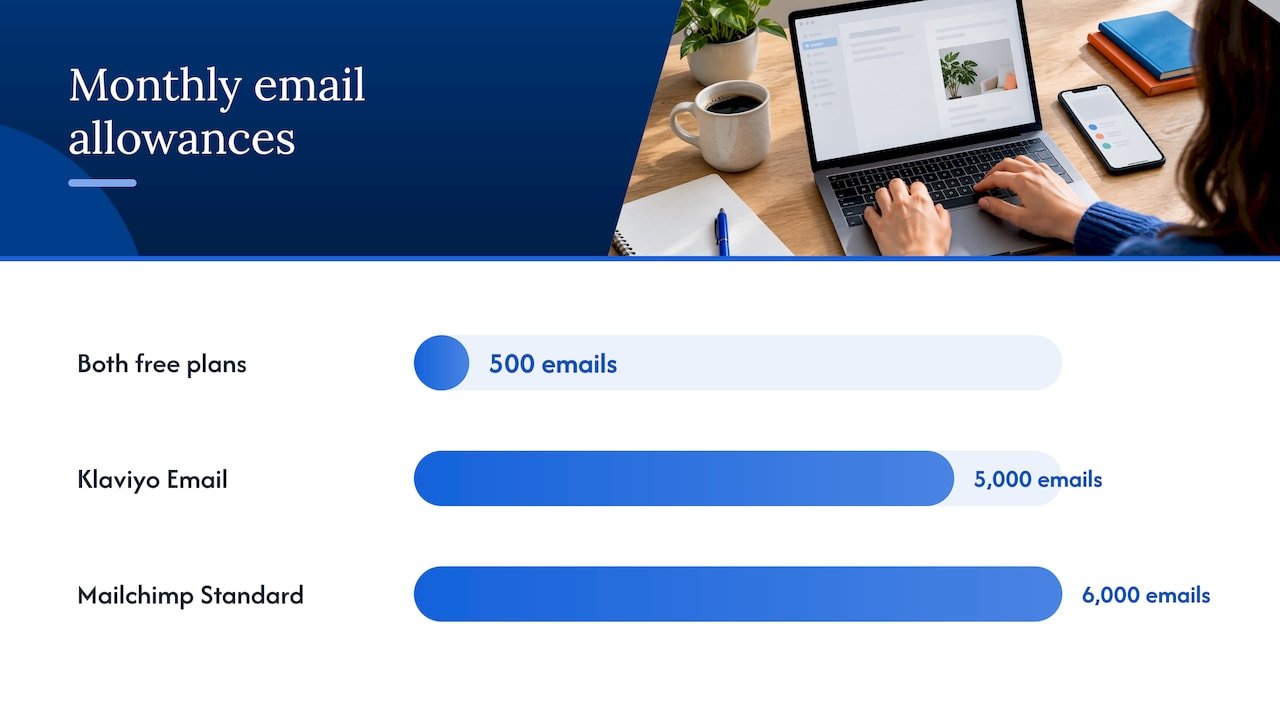
- Free plans. Both free plans allow 250 contacts or profiles and 500 emails per month. Mailchimp’s free plan also caps sending at 250 emails per day, per its US pricing page.
- Klaviyo paid. The Email plan starts at $20/month for 500 active profiles and 5,000 emails per month. The Marketing plan starts at $25/month. Custom plans apply above 150,000 active profiles.
- Mailchimp paid. Standard comes with a 14-day free trial, then pricing depends on your contact tier. Larger lists can require contacting sales for custom pricing. Standard supports up to 6,000 emails per month and 200 automation flows.
Two structural differences stand out. First, Klaviyo prices by active profiles, and suppressed and opted-out profiles do not count toward the total. Mailchimp counts total contacts, including unsubscribed users. Second, Klaviyo uses a flat-feature model with marketing tools and predictive analytics on all paid plans, while Mailchimp restricts advanced functionality to higher-priced tiers.
Prices change, so confirm current figures on each vendor’s pricing page before you budget. Model your cost at today’s list size and at double that size, because the two billing models diverge as the list grows.
Why teams switch, and how to choose
Teams tend to outgrow Mailchimp when lifecycle marketing gets more complex or email is no longer the only system needing customer data. Mailchimp suits newsletters and simple automations. Klaviyo is a stronger fit for ecommerce retention and store-driven segmentation.
Use this decision path:
- Do you sell products online through a store platform? If yes, and retention drives your margin, shortlist Klaviyo.
- Is your main output newsletters, content or service-business updates? Shortlist Mailchimp.
- Who will run it? A part-time generalist favours the guided onboarding. A dedicated marketing ops owner can use the depth.
- Which channels do you need? If SMS and WhatsApp are core, check native coverage in your countries.
- Where does the revenue data have to end up? If finance, sales and BI need the same numbers, plan that connection first.
Measuring what the platform reports
Whichever tool you pick, its dashboard answers one question: what did this platform get credit for? It does not answer what your business would have earned without the message. Closing that gap takes three habits.
Set attribution windows on purpose. A long window credits email for purchases that were already coming. Document the window and keep it fixed when you compare periods.
Run holdouts. Withhold a flow from a random slice of customers and compare revenue. This is the practical form of the incrementality testing we recommend for marketers who need an always-on, privacy-first approach.
Combine sources. Ad platforms, the store and the email tool each over-claim. Our guide to ecommerce attribution models shows how to test models before trusting one. For Shopify stores, we also cover analytics errors that waste ad budget.
If churn is your concern, churn prediction for ecommerce explains how at-risk customers are found. For B2B teams, customer intent prediction and predictive lead scoring cover the qualification side that a store-focused email tool does not.
Our perspective
We treat the Klaviyo vs Mailchimp question as a data question before it is a feature question. Both tools can send a good email. The harder problem is that the revenue each one reports sits in its own silo, with its own attribution window, away from your CRM, your ad platforms and your finance numbers.
That is why our work centres on visibility. We build open-source, integrated analytics and AI agents that run inside your environment, connect to platforms such as Salesforce, HubSpot, Marketo, Power BI and Tableau, and leave no black box between a number and its source.
Our view of attribution is a map, not a courtroom verdict. It shows you where to look, and incrementality tests tell you what to believe. A team that picks the right email platform and then wires it into one trusted view of revenue gets far more from the choice than a team that argues about features.
Don
Put the platform inside a revenue view you can trust
Once you have chosen between Klaviyo and Mailchimp, the next job is making its numbers agree with the rest of your business. Our Revenue Attribution Services trace leads and orders to revenue. Our AI-enabled analytics and custom agents automate the reporting and enrichment around it. For a broader view of what we deliver, see our services overview.
If you are early in adopting AI across marketing, sales or finance, our AI strategy and readiness work is the place to begin. If you already know the workflow you want automated, custom agent deployment is the direct route.
FAQ
Is Klaviyo better than Mailchimp for ecommerce?
For most stores, yes. Klaviyo is designed for ecommerce, syncs granular purchase and browsing data from platforms like Shopify, and includes predictive analytics on all paid plans. Mailchimp has added ecommerce features, so a small store with simple needs can still run well on it.
Why do people leave Mailchimp?
Usually because lifecycle marketing grows more complex, or because customer data has to feed more systems than email. Plan-tier limits on segmentation and automation can also push growing teams toward a more data-centric tool.
Which is cheaper, Klaviyo or Mailchimp?
It depends on your list. Klaviyo’s Email plan starts at $20/month for 500 active profiles, and it counts only active profiles. Mailchimp counts all contacts, including unsubscribed ones. Compare both at your current list size and at double it using each vendor’s pricing page.
Is Klaviyo harder to learn?
Yes, somewhat. Mailchimp’s onboarding is more guided, while Klaviyo’s depth in data and automation takes longer to learn. Klaviyo supports that with documentation and training aimed at self-reliant ecommerce marketers.
Can I trust the revenue numbers either platform shows?
Treat them as attributed estimates. Check the attribution window and confirm important results with holdout or incrementality tests before reallocating budget.
Sources
- Klaviyo vs Mailchimp: Features, Pricing & Winner
- Klaviyo: AI Email Marketing & SMS | B2C CRM
- Email & SMS Marketing Platform | Mailchimp
- Klaviyo vs. Mailchimp: Which Is Best? [2026]
- Klaviyo vs. Mailchimp: I Tested Both Email Platforms
- Klaviyo vs Mailchimp (2026) comparison
- Intuit Mailchimp ecommerce announcement
- How to Use WooCommerce & Klaviyo for Marketing Automation
- Klaviyo vs Omnisend vs Mailchimp: Best Email Marketing for Ecommerce
- Omnisend vs. Mailchimp vs. Klaviyo: 2026 Comparison
- Mailchimp Pricing Plans
- Klaviyo vs Mailchimp: Which Is Better for Ecommerce in 2026?
- Klaviyo Pricing
- Brevo vs Mailchimp vs Klaviyo
- What is email marketing? Guide to cost-effective growth