
AI answer engine optimization is the work of making your content easy for AI systems to find, extract, trust and cite, so your brand appears inside the answers buyers read in ChatGPT, Gemini, Perplexity and Google’s AI features. It sits on top of SEO rather than replacing it, and it is measured by mentions, citations and the pipeline they influence, not by rankings alone. Teams that treat it as an operating process, with an owner, a prompt set and a reporting loop, are the ones that turn it into revenue. That is the work we build and run at Brainiac Consulting through our Generative Engine Optimization service.
TL;DR
- Answer engine optimization (AEO) means structuring content so AI engines can extract and cite it. Google’s own documentation says that for its AI features, core SEO practices still apply.
- Buyers have moved: a March 2026 G2 poll of B2B software buyers found 51% start research with an AI chatbot more often than Google.
- Write answer-first, keep key facts in plain HTML, and make structured data match what the page shows.
- Track a fixed prompt set weekly: brand mentions, citations, share of voice and sentiment, then tie them to demo requests and opportunities.
- Most teams lack an owner and a cadence. Fixing that is a bigger lever than any single tactic.
Table of Contents
- What AI answer engine optimization actually is
- Why it matters now: buyers start in the chat window
- How answer engines pick what to cite
- What to change on your site
- A worked example: one page, rewritten for extraction
- How to measure it
- Fitting AEO into the workflows you already have
- Our perspective
- Where we can help
- FAQ
- Sources
What AI answer engine optimization actually is
An answer engine is any system that responds to a question with a composed answer rather than a list of ten links. That covers chat assistants and the AI summaries that now appear above Google results. AEO is the discipline of being the source those answers draw on.
The vocabulary is crowded. You will see AEO (answer engine optimization), GEO (generative engine optimization) and LLM SEO used almost interchangeably. Google’s documentation notes that AEO and GEO are third-party terms and that, from its perspective, optimizing for generative AI search is still SEO, because its AI features are rooted in core Search ranking systems.
For a business, the practical reading is simple:
- SEO earns discovery and authority, and is judged on rankings and clicks.
- AEO and GEO earn interpretation, extraction and citation, and are judged on whether your brand is named and linked in answers.
- Strength in one does not guarantee strength in the other, so you need both disciplines working from the same content foundation.
If you are deciding what to do first, our note on GEO, SEO and AEO sequencing walks through the order of work.
Why it matters now: buyers start in the chat window
The case for AEO is a buying-behaviour case. G2’s March 2026 poll of 1,076 B2B decision-makers found that AI chatbots changed the final vendor choice for 69% of buyers, and 33% bought from a vendor they had never heard of before an AI surfaced it. If your brand is not in the answer, a shortlist can form without you.
The corporate response is already under way. A Conductor survey of more than 250 US enterprise digital leaders, run in late 2025, found 97% reporting a positive AEO impact on their funnel, an average AEO and GEO budget of 12% of marketing spend, and 94% planning to raise investment in 2026. The same survey found 64% plan to upskill existing SEO and marketing staff rather than hire externally.
For small and mid-sized service businesses and ecommerce stores, the logic is the same at a smaller scale. A buyer asking an assistant for the best option in a category gets a handful of names. Being one of them is the new first page.
How answer engines pick what to cite
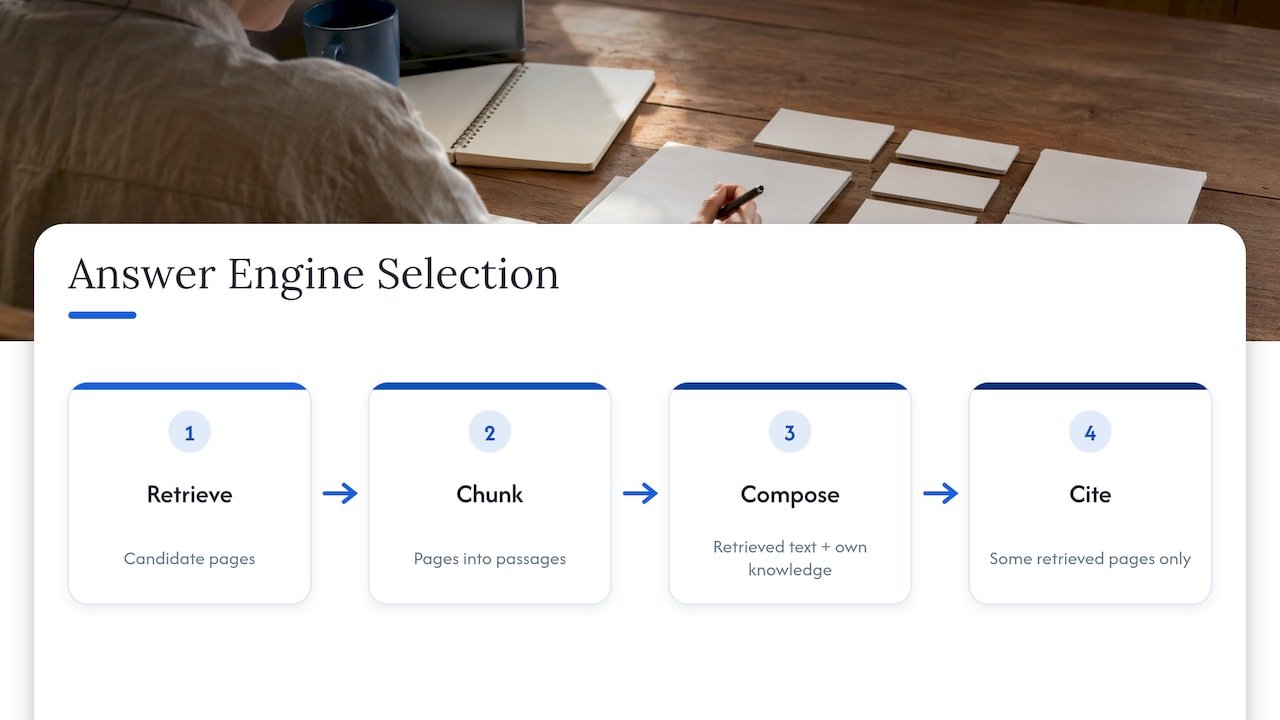
You cannot optimize for a system you do not understand, so start with how the selection works. In broad terms, an assistant retrieves candidate pages, breaks them into passages, and writes an answer that blends its own knowledge with what it retrieved. Not every retrieved page is cited.
Two findings from research are worth keeping in mind.
Engines disagree with each other. An academic study of 11,000 real queries across five generative search systems found that Search GPT’s top 100 cited domains overlapped only 24% with Google AI Overviews and 25% with organic Google. The same study found Wikipedia was the most cited domain across systems, and that longer sources were overrepresented. A single optimization pass for one engine will not carry across them all, so you measure each engine you care about separately.
Google’s AI features run on Search foundations. Google describes them as using retrieval-augmented grounding and query fan-out, meaning one question can trigger several related searches. That is why pages that answer the follow-up questions around a topic tend to be the ones pulled in.
The takeaway: write for the question a buyer asks, then for the three or four questions that naturally follow it.
What to change on your site
The tactics below come from Google’s own guidance and from technical practitioners. They are ordered by how often they decide the outcome.
1. Get the technical basics right
Google’s guidance says your content must meet Search’s technical requirements: Googlebot is not blocked, pages return HTTP 200, and the content is indexable. Many B2B sites fail here for mundane reasons, such as a robots rule or a script-rendered page that crawlers read as empty. Our guide to fixing crawler access for LLM SEO covers this check in detail.
2. Put the answer first
Lead each page, and each section, with the direct answer in the first sentence or two. Use clear headings, short sections that make sense on their own, and lists or tables where the content is a comparison or a process. Google recommends clear headings and sections as part of its generative AI optimization guide. A passage that can be lifted without its neighbours is a passage that can be cited.
3. Publish what only you can say
Google recommends non-commodity, first-hand content with a unique point of view. For a services firm that means your own process, your own data, named examples and specific numbers. For a store it means real product detail, sizing, compatibility and returns information rather than copied manufacturer text.
The same guide warns against creating many near-duplicate pages for query variations to manipulate AI responses, which falls under its scaled content abuse policy. Depth on a topic beats volume of variants.
4. Make structure explicit
Search Engine Land’s technical guide recommends entity-focused content, Organization and sameAs markup, FAQPage and HowTo schema, and visible last-updated signals. Google adds that structured data must match the visible content. Markup that describes something the page does not show is a liability, not an advantage.
5. Build the footprint beyond your own site
Because engines draw on many sources, third-party mentions matter. In the G2 poll, review-site citations were the top trust signal buyers wanted to see in AI answers. Review profiles, press coverage and community presence all feed the picture an engine forms of your brand. If you want to see which outside sources engines choose instead of you, an AI search citation gap analysis maps them.
A worked example: one page, rewritten for extraction
Take a services page titled “Our Bookkeeping Packages” that opens with a paragraph about the firm’s history. A buyer asks an assistant, “What does bookkeeping for a 10-person company include?”
The rewrite changes five things:
- The heading becomes a question a buyer would actually ask.
- The first two sentences state what is included, for which size of business.
- A short table lists the deliverables and the cadence.
- An FAQ block with matching markup answers three follow-ups: onboarding time, software compatibility, what changes at tax time.
- A visible last-updated date and a named author are added.
None of it needs new tools. It needs an editor who thinks in questions and answers, and a developer who confirms the page renders in plain HTML.
How to measure it
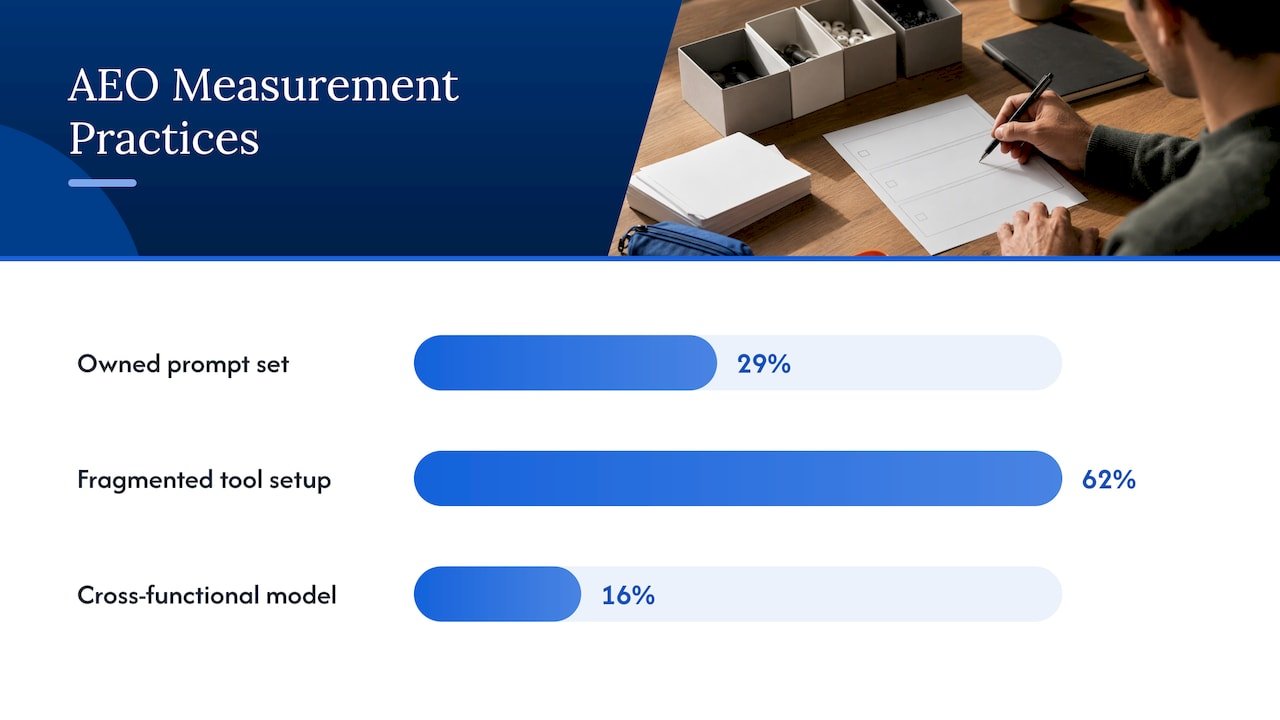
Measurement is where most programs stall. G2’s State of AEO 2026 study found that only 29% of marketing respondents maintain a structured prompt set with a named owner and refresh cadence, 62% use a fragmented multi-tool setup, and just 16% run a cross-functional or centralized AEO model.
A workable measurement routine looks like this:
- Build a prompt set. Take the questions buyers ask, drawing on sales calls and prospect emails, and group them by topic and funnel stage. Search Engine Land suggests tracking the top 50 intent-driven queries weekly.
- Run it across the engines that matter. Because overlap between engines is low, report each one separately.
- Score visibility. Brand visibility is the number of answers that mention you divided by total answers for your space, times 100. If you appear in 22 of 100 prompts, your score is 22%.
- Add citation rate, share of voice and sentiment. Mentions say you were named, citations say you were linked, share of voice says how you compare with named competitors on the same prompts.
- Connect to revenue. Search Engine Land recommends tying visibility trends to demo requests, sourced opportunities and closed-won deals, and a dashboard guide from the same publication adds referral traffic from AI channels and assisted conversions.
For a structured approach to the first quarter of reporting, this 90-day AI search visibility plan is a useful frame for what to prove and when. And if you need a starting reference point, our AI visibility benchmark for B2B brands describes a practical baseline.
One caution on interpretation: AI answers vary between runs and between engines. Treat a single day’s result as a sample, and judge trends across repeated runs.
Fitting AEO into the workflows you already have
AEO fails as a side project and works as a loop. G2’s recommendations point the same way: govern a buyer-led prompt set with an owner and refresh cadence, formalize the workflow that turns findings into content, benchmark named competitors with the same prompts, and connect the cycle to pipeline.
Here is how that splits by team.
| Team | What AEO adds to their work | Metric to watch |
|---|---|---|
| Marketing and content | Question-led briefs, answer-first drafts, schema and refresh schedule | Citation rate, prompt coverage |
| Sales and revenue operations | Real buyer questions feed the prompt set; AI-sourced leads are tagged in the CRM | Sourced opportunities, lead qualification rate |
| Analytics and attribution | AI referrals and assisted conversions added to reporting | Assisted conversions, pipeline by source |
| Ecommerce | Product data, reviews and policies kept clean and extractable | AI referral revenue, share of voice by category |
| Leadership | One scorecard linking visibility to pipeline | Visibility score trend against closed-won |
A few practical notes on the handoffs.
Sales is your best prompt source. The questions prospects ask on calls are the questions they type into assistants. Capture them in the CRM, and the prompt set stays tied to demand.
Attribution needs a decision, not a hope. AI-driven discovery is often invisible in last-click reports, because the buyer reads an answer, then arrives later by direct visit or branded search. Adding self-reported source fields and assisted-conversion views gives you a fairer picture. Our revenue attribution services exist for this problem.
Start with readiness. Before adding another reporting tool, confirm who owns the prompt set, which systems hold the data, and which decisions the numbers will change. An AI readiness assessment and roadmap is designed for that groundwork.
Our perspective
We think of AI visibility as a map, not a verdict. No dashboard can tell you with certainty why one engine named you and another did not, but repeated measurement shows you where the territory is open and where it is crowded.
What we see as the real divide is operational. The tactics are public and well documented. What separates teams that gain ground is a governed prompt set, clean data flowing between content, CRM and analytics, and someone accountable for the loop.
That is why our approach is open-source and integrated with the platforms teams already use, including Salesforce and HubSpot. We design and operate AI agents and analytics systems so you can see how each result was produced, with no black box between your data and your decisions.
AEO is also a natural fit for agents. Monitoring prompts, flagging citation gaps, enriching leads that arrive from AI channels and refreshing stale pages are repeatable tasks, and repeatable tasks are where well-built agents earn their keep.
Don
Where we can help
Brainiac Consulting is the AI and digital-transformation division of the MWH Group. Our Generative Engine Optimization service focuses on AI answer visibility, and it connects to our analytics and attribution work so visibility can be read against pipeline. If you want agents to run the monitoring and reporting loop inside your own environment, our custom agent deployment is the place to start.
If you are choosing a provider for this work, our guide on how to choose an AI search optimization agency lists the questions worth asking. To talk through your situation, start from the Brainiac Consulting home page.
FAQ
Is answer engine optimization different from SEO?
The overlap is large, and the goals differ. SEO aims to rank pages and win clicks. AEO aims to have your content extracted, cited and recommended inside AI-generated answers. Google states that its AI features are rooted in core Search systems, so strong SEO fundamentals remain the base, and AEO adds answer-first structure, entity clarity and citation tracking on top.
How long does it take to appear in AI answers?
There is no guaranteed timeline, and engines differ. Technical fixes such as crawler access can show effects sooner, while earning third-party mentions and reviews takes longer. Run your prompt set weekly from the start so you have a baseline and can see direction, rather than waiting for a single result.
What should we measure first?
Start with brand visibility score, citation rate, share of voice and sentiment across a fixed set of buyer prompts. Then connect those to demo requests, sourced opportunities and closed-won deals in your CRM. Visibility with no link to pipeline is hard to defend in a budget meeting.
Do small businesses and online stores need this too?
Yes, in proportion. A smaller company can begin with a short prompt set of 15 to 25 questions, answer-first service or product pages, clean structured data and active review profiles. The workflow is the same as for an enterprise, just lighter.
Sources
- Google’s Guide to Optimizing for Generative AI Features
- Top ways to ensure your content performs well in Google’s AI search
- How AI Search Is Rewiring B2B Software Buying (G2 report)
- 2026 State of AEO: US enterprise insights
- Answer Bubbles: Information Exposure in AI-Mediated Search
- Technical SEO for generative search
- State of AEO 2026: AI Outpaces Measurement
- How to measure your AI search brand visibility
- How to build a meaningful AI search visibility dashboard
- 90 Day Plan to Prove AI Search Visibility for Brands