
Real-time data sync is the continuous propagation of data changes across systems so every downstream consumer reflects the source of truth within seconds, not hours. You get there through four method families: change data capture (CDC), streaming pipelines, API or webhook pushes, and polling with hash diffing. It fits when a dashboard, personalization engine, fraud model, or IoT feed loses value the moment it goes stale.
TL;DR:
- Micro-batch synchronization offers a practical middle ground, with delays of 1 to 5 minutes suitable for most operational use cases.
- Log-based CDC is generally preferred for relational databases due to its minimal load impact and lower latency.
- Resilient real-time sync architecture requires monitoring for consumer lag, implementing retries with backoff, and fallback mechanisms like dead-letter queues.
- Conflict resolution strategies often rely on last-write-wins, but more advanced methods like vector clocks and CRDTs are necessary for bidirectional, multi-system writes.
- Building from scratch risks over-engineering; consulting experts can ensure the correct architecture, schema management, and monitoring tailored to specific platforms.
Table of Contents
- What real-time data sync actually means (and when micro-batch is close enough)
- Core methods: CDC, streaming, API pushes, and polling
- Architecture patterns: pub/sub, stream-to-warehouse, and materialized views
- How to plan and roll out a real-time sync pilot
- Trade-offs: latency, consistency, schema drift, and backpressure
- Choosing tools and integration platforms without vendor lock-in
- How Brainiacconsulting scopes a real-time sync build for RevOps stacks
- Impact of network issues and how to mitigate them
- Security and privacy considerations in real-time sync
- Data conflict resolution in distributed real-time systems
- Scalability strategies for high-volume real-time sync
- Why most teams over-engineer their first sync project
- Get real-time sync built by a team that already runs it for RevOps stacks
- Sources
What real-time data sync actually means (and when micro-batch is close enough)
“Real-time” gets thrown around loosely, so let’s separate the timing models properly. Streaming or event-based sync processes each change as it happens, typically delivering freshness in milliseconds to seconds. Micro-batch groups changes into small windows, often 1 to 5 minutes, trading a little latency for lower infrastructure cost. Batch processing runs on a schedule, hourly or nightly, and is fine when nobody is making a decision against last minute’s data.
Where each shows up in production:
- Streaming: fraud scoring on payment events, live inventory counts, chat and notification systems
- Micro-batch: marketing attribution rollups, CRM lead scoring refreshed every few minutes, BI dashboards for operations teams
- Batch: financial close reporting, weekly cohort analysis, data warehouse historical loads
Micro-batch is the pragmatic middle ground for teams that don’t need sub-second freshness but can’t tolerate a daily lag. Ask whether a 2 minute delay changes a business outcome. If not, you’ve just avoided building and operating a full streaming stack.
Core methods: CDC, streaming, API pushes, and polling
Each method solves the sync problem differently, and picking the wrong one for your source system is the most common architecture mistake we see.
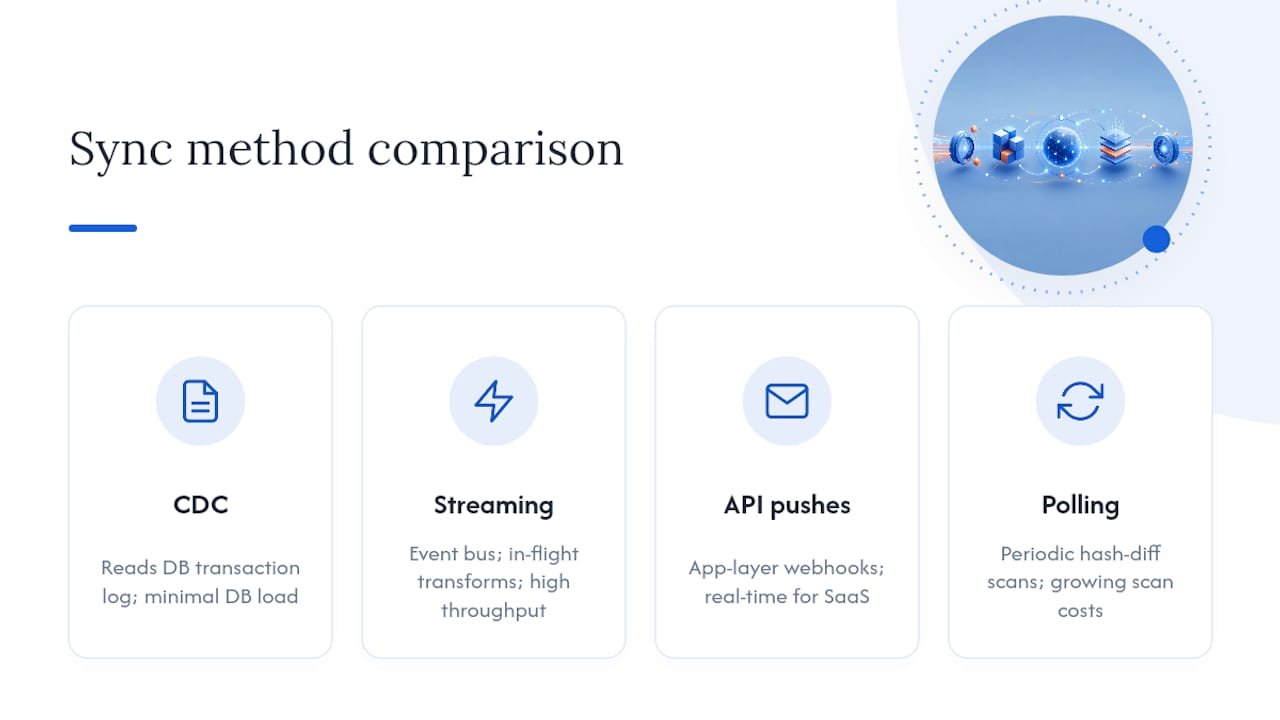
Log-based CDC reads a database’s write-ahead log or transaction log directly, capturing every insert, update, and delete without querying the tables themselves. This keeps load on the production database minimal, which is why it’s often preferred for real-time synchronization from relational systems like Postgres, MySQL, or SQL Server. Tools built on this pattern can convert migrations that took weeks into single-day operations by supporting an automatic handoff from full initial sync to continuous CDC.
Streaming pipelines move events continuously through a message bus, applying transforms in-flight rather than waiting for a downstream job. This suits high-throughput scenarios like clickstream data or IoT telemetry where volume rules out repeated polling.
API and webhook pushes work at the application layer. A SaaS platform fires a webhook the instant a record changes, which is often the only real-time option available since you rarely get log access to a vendor’s database.
Polling with hash-diff is the fallback when none of the above are available. A job queries a source on an interval, hashes each row, and compares hashes to detect changes. It works, but steady-state scan costs accumulate as tables grow, and tuning the polling schedule against scan cost becomes an ongoing job in itself.
Pro Tip: Never default to polling because it’s the easiest to build. Check whether your source database exposes logical replication or a change stream first. CDC almost always wins on both latency and database load once you’re past a proof of concept.
Architecture patterns: pub/sub, stream-to-warehouse, and materialized views
Method choice and architecture pattern are two separate decisions, and conflating them is how projects end up rebuilt six months in.
A pub/sub or event bus pattern decouples producers from consumers. The CDC connector or webhook publishes events to a topic, and any number of downstream services subscribe independently, which means you can add a new consumer, say a fraud model, without touching the source integration.
The stream-to-warehouse pattern feeds a continuous event stream into an analytics warehouse, refreshing materialized views instead of running expensive queries against raw event tables. This is the standard shape for near-real-time dashboards, and it depends on careful partitioning and schema management to keep query performance from degrading as volume grows.
For applications that need sub-second reads rather than analytics, materialized views paired with a cache layer (Redis or similar) serve pre-computed results instead of hitting the source system live.
Two elements make all three patterns hold together over time:
- A schema registry that enforces contracts between producers and consumers before a breaking change ships
- A transform layer positioned in-flight, not bolted on downstream, since relying on downstream ETL negates the low-latency benefit you built the streaming pipeline to capture
How to plan and roll out a real-time sync pilot
Treat your first real-time sync project as a pilot with a defined exit criterion, not an open-ended platform build.
- Set latency and freshness SLAs first. Decide what “real-time” means for this specific use case, sub-second, under 5 minutes, under 1 hour, before evaluating any tool.
- Audit sources for available connector methods. Confirm which systems expose CDC or logical replication, which only offer webhooks, and which will need polling.
- Design a canonical schema and onboard a schema registry. Agree on field names and types once, centrally, rather than letting each downstream consumer define its own expectations.
- Build transform rules and dry-run them. Apply transforms in-flight where possible, and validate against a small dataset before touching production traffic.
- Backfill, cut over, then verify. A safe sequence runs: pilot on a subset of tables to validate latency and schema drift handling, enable dry-run with full initial sync and verifier checks, mirror reads for business validation, then flip traffic once SLAs hold.
Pro Tip: Keep a rollback path alive for at least one full business cycle after cutover. The failure mode that actually bites teams isn’t the sync breaking, it’s a subtle transform bug that only surfaces once real edge-case data flows through.
Trade-offs: latency, consistency, schema drift, and backpressure
Every real-time sync design makes trade-offs, and the ones that bite hardest are rarely the ones teams plan for upfront.
Eventual versus strong consistency shapes how your application should behave. If a consumer might briefly read stale data, design the UI and business logic to tolerate it rather than assuming perfect synchronization.
Backpressure happens when consumers can’t keep up with producer volume. Partitioning topics by a sensible key (customer ID, region) lets you scale consumers horizontally instead of one giant queue backing up.
Schema drift is inevitable once more than one team owns a source system. Automated schema evolution handles additive changes gracefully; breaking changes still need versioning and a registry that rejects incompatible writes before they cause downstream failures.
Operational readiness checklist:
- Dashboards tracking consumer lag per partition, not just aggregate throughput
- Alerting thresholds tied to your actual SLA, not arbitrary round numbers
- A runbook for “consumer stopped processing” separate from “producer stopped emitting”
- Dead-letter queues for events that fail transformation, so one bad record doesn’t halt the pipeline
Choosing tools and integration platforms without vendor lock-in
Tool selection should follow your architecture decisions, not precede them. Five broad categories cover most needs: streaming platforms for high-throughput event processing, dedicated CDC engines for database-level capture, integration-platform-as-a-service tools for connecting SaaS applications, lightweight sync engines for simpler point-to-point needs, and file-level sync tools for unstructured data.
That last category matters more than people expect. Tools like Syncthing handle peer-to-peer file synchronization with privacy controls built in, appropriate when the sync problem is documents or media files rather than structured records. Classic utilities like rsync still get maintained and updated, but they solve a fundamentally different problem than streaming CDC and shouldn’t be mistaken for a real-time solution.
Evaluate any candidate platform against connector breadth, native schema handling, in-flight transformation support, observability depth, and documented SLA guarantees. Low-code visual pipeline builders such as SynaptixPlatform suit teams that want streaming orchestration without hand-coding every connector. Open-source engines cost less in licensing but shift operational burden onto your team; managed services cost more but reduce the coding and maintenance load, which shortens time to production meaningfully for lean teams.
How Brainiacconsulting scopes a real-time sync build for RevOps stacks
Brainiacconsulting’s custom AI agents and integration work with Salesforce and HubSpot follow the same sequence outlined above: discovery of source systems, connector selection matched to what each platform actually exposes, a canonical schema built before any pipeline code, and monitoring wired in from day one rather than retrofitted. That approach is documented in a case study on deploying Marketo and Salesforce to lift SQL conversion through better data timeliness.
Impact of network issues and how to mitigate them
Network interruptions are not an edge case in real-time sync, they’re a certainty over any pipeline’s lifetime, and the design has to assume connections will drop.
The immediate risk is duplicate or lost events. If a consumer acknowledges a message and then crashes before processing completes, a naive at-most-once delivery model loses that event permanently. At-least-once delivery with idempotent consumers solves this: the consumer can safely process the same event twice without corrupting state, usually by checking an event ID against what’s already been applied.
Retries with exponential backoff prevent a downed downstream service from being hammered the instant it comes back online. A fixed retry interval can create a thundering herd; backoff spaces retries out so a recovering service isn’t immediately overwhelmed again.
Fallback mechanisms matter just as much as retries. If a real-time consumer can’t reach its target, queuing the event for later delivery beats dropping it silently. Dead-letter queues catch events that fail repeatedly so they don’t block the rest of the stream while still preserving them for manual inspection.
Circuit breakers stop a pipeline from repeatedly calling a service that’s clearly down, failing fast instead of piling up timeouts. Combined with health checks on both producer and consumer sides, this keeps a partial outage from cascading into a full pipeline stall. None of this is exotic engineering, but skipping it is the single most common reason a real-time sync project that worked in testing falls over in production.
Security and privacy considerations in real-time sync
Data moving continuously between systems multiplies your attack surface compared to a batch job that runs once a night and shuts down.
Encrypt data in transit between every hop, source to broker, broker to consumer, using TLS at minimum. Encrypt sensitive fields at rest in any intermediate storage, including message queues, since a compromised broker shouldn’t expose plaintext customer data.
Access control needs to be granular at the topic or stream level, not just at the database level. A consumer that only needs order status shouldn’t have read access to a stream carrying full payment details. Field-level masking or tokenization lets you sync operational data broadly while keeping regulated fields (payment card numbers, health records, government IDs) restricted to the specific services legally allowed to see them.
Compliance regimes like GDPR and CCPA apply to real-time flows exactly as they do to batch ones, but with less room to react. If a customer exercises a deletion right, a continuously syncing pipeline needs a mechanism to propagate that deletion downstream immediately, not wait for the next scheduled job. Build audit logging into the pipeline itself, tracking what data moved where and when, since after-the-fact reconstruction from application logs is far harder once data has already fanned out to a dozen consumers.
Data conflict resolution in distributed real-time systems
Conflicts happen the moment two systems can both write to the same record and sync in opposite directions, which describes most bidirectional CRM and inventory integrations.
Last-write-wins is the simplest resolution strategy: whichever update carries the most recent timestamp survives. It’s easy to implement but silently discards legitimate concurrent changes, which is a real problem when two sales reps update the same lead record within seconds of each other.
Vector clocks track causal relationships between updates across nodes, letting a system detect when two changes are genuinely concurrent rather than sequential, and flag true conflicts instead of guessing. This adds complexity but avoids the silent data loss that last-write-wins accepts as a trade-off.
Operational transformation and CRDTs (conflict-free replicated data types) allow certain data structures, counters, sets, ordered lists, to merge concurrent updates automatically without losing information from either side. They’re common in collaborative editing tools and increasingly used in distributed databases that need multi-region write support.
For most business systems, the practical answer is simpler: define field-level ownership. If your marketing automation platform owns lead score and your CRM owns deal stage, conflicts mostly disappear because each system has a single, unambiguous writer for each field. Reserve vector clocks or CRDTs for the genuinely bidirectional cases where two systems both need write authority over the same field.
Scalability strategies for high-volume real-time sync
Volume is where architecture decisions that looked fine in a proof of concept start to crack.
Partitioning is the primary scaling lever. Splitting a stream by a consistent key, customer ID, region, or product category, lets you add consumer instances that each handle one partition, scaling throughput roughly linearly instead of bottlenecking on a single consumer thread.
Row-hashing and polling-based engines scale differently than log-based CDC. Benchmarks on lightweight polling engines show they can handle thousands of rows per second across many independent queries, but that’s query-level scale-out, not the same as partitioning a single enormous table for parallel processing. If you’re syncing one table with hundreds of millions of rows, log-based CDC with proper partitioning outperforms a polling approach at that scale almost every time.
Buffering and batching within the stream itself, grouping many small events into a single write to the destination, reduces per-event overhead without sacrificing meaningful freshness for most use cases. Auto-scaling consumer groups based on lag metrics, rather than fixed instance counts, keeps infrastructure cost proportional to actual load instead of provisioned for peak volume around the clock.
Finally, separate your hot path from your cold path. Not every consumer needs the same freshness guarantee. Route only the consumers that genuinely require sub-second updates through the highest-cost, lowest-latency infrastructure, and let everything else consume from a slightly delayed, cheaper replica.
Why most teams over-engineer their first sync project
The conventional advice on real-time sync treats it as an all-or-nothing architecture decision: build the full event-driven platform or don’t bother. That’s backwards. The teams that succeed start with the narrowest possible SLA, one table, one consumer, and prove CDC works against their actual production database before touching a message bus, a schema registry, or a multi-region deployment.
Where the standard playbook falls short is conflict resolution. Most guides jump straight to CRDTs and vector clocks as though every sync project needs distributed-systems theory. Save the exotic tooling for the genuinely bidirectional edge cases.
If you take one thing from this, prioritize observability before you scale. A pipeline processing ten events a second with full lag dashboards and dead-letter queues beats one processing ten thousand events a second flying blind. Volume problems are visible and fixable. Silent data loss from an unmonitored consumer is not, and you usually don’t find out until a customer complains that their dashboard was wrong for three weeks.
— Don
Get real-time sync built by a team that already runs it for RevOps stacks
Brainiacconsulting is the practical alternative to building this in-house from scratch: instead of hiring a data engineering team to evaluate CDC engines, schema registries, and streaming platforms from zero, you get a consultancy that has already scoped and delivered these pipelines against Salesforce, HubSpot, and Marketo stacks.
That matters because most of the real-time sync failures covered above, silent schema drift, unmonitored consumer lag, conflict resolution left to chance, show up specifically at the marketing, sales, and finance data layer, where CRM and MarTech systems rarely expose clean CDC access and webhooks come with inconsistent guarantees. Brainiacconsulting’s Atlas AI Operations engagements handle that discovery and connector work directly, building the canonical schema and monitoring layer alongside the sync pipeline rather than treating it as an afterthought. If your team is weighing whether to build this internally or bring in help, request a scoping conversation through Brainiacconsulting and get a straight answer on what your specific stack actually needs.
Sources
- What is real-time data integration? | IBM
- Real-Time Data Integration: Streaming & CDC | Informatica
- adiom-data/dsync
- Syncthing