
Sales playbook automation means turning the guidance in your playbook into workflows that run on their own: a trigger fires in your CRM, the right research, message or task appears, and the result is logged. The playbook stops being a document reps are supposed to remember and becomes a system that acts at the moment a deal needs it. Done well, it removes admin work and keeps your best practices consistent. Done badly, it automates a weak process faster.
This guide covers what the term means, what a playbook should contain before you automate it, which tasks to hand to software, how to roll it out, and how to measure it.
TL;DR
- Sales playbook automation uses AI and workflow tools to execute predefined plays automatically, instead of leaving a PDF or slide deck for reps to interpret.
- Automate the repetitive, data-heavy work (enrichment, list building, sequence enrollment, task creation). Keep discovery, objection handling and relationships human.
- Start with one bottleneck you can name and measure, test outputs against human decisions, and roll out in phases with CRM writeback that is logged and reversible.
- Measure decision quality, speed and funnel outcomes, not how many AI outputs were produced.
- Assign human owners for strategy and for approving what goes live.
Table of Contents
- What sales playbook automation actually is
- What belongs in the playbook before you automate it
- What to automate and what to keep human
- How to plan, build and roll out
- Measuring whether it works
- Governance, privacy and human oversight
- Our perspective
- Where Brainiac can help
- FAQ
- Sources
What sales playbook automation actually is
A traditional playbook is generally a static PDF or slide deck that describes a process. An automated one is an active system connected to your CRM and other tools that executes actions, personalizes communication and gives real-time guidance. One industry glossary describes it as automatically executing predefined sequences of actions for specific scenarios, which turns documentation into a living process.
The practical differences are easy to see:
- Updates. Static playbooks need manual revisions. AI playbooks update in real time from data, personalize content by stage and persona, and learn from outcomes.
- Delivery. A PDF waits to be opened. An automated play surfaces inside the tools sellers already use.
- Feedback. A document never tells you whether anyone followed it. A connected system records what ran and what happened next.
There is a useful caution in the older thinking on this. The Sandler and Highspot view is that a playbook exists for guided selling and coaching, not just for managers to check CRM stage compliance. Automation should serve the seller first. If reps experience it as surveillance, they will route around it.
What belongs in the playbook before you automate it
Automation is a multiplier. If the underlying plays are vague, you multiply vagueness. Before you build anything, make sure the playbook can answer what a rep should say, ask, do and use at each stage. The Sandler and Highspot guide describes a sales-process playbook as a codification of what top performers do at each stage. It lists these components:
- The buyer journey
- Stage-specific best practices and exit criteria
- Sales tools and skills tips
- Forecast definitions and criteria
- Discovery talk tracks and qualification checklists
Many playbooks add buyer personas, discovery guides, messaging and objection handling.
Write plays, not chapters
The format that automates best is the discrete play. One 2026 guide describes a successful AI playbook as a set of defined plays, each with a trigger, an understanding of key risks and angles, talk tracks and approved assets surfaced directly in sellers’ tools. A trigger might be a competitor appearing in a deal, a pricing page visit from a named account, or an opportunity sitting too long in one stage.
TOPO’s 2020 Sales Engagement Leadership Report frames the goal well: an effective playbook helps sellers prioritize, recognize common buying scenarios, choose the right touch pattern and execute with minimal friction. Think of each play as a short route on a map: where you are, what is likely ahead, and which turn to take.
A simple template for one play:
- Trigger: the CRM or intent signal that starts it.
- Context: what the rep needs to know in under a minute.
- Action: what the system does (enrich, draft, assign, notify) and what the human does.
- Assets: the approved content, surfaced in place.
- Exit criteria: how you know the play worked or should stop.
- Owner: the person accountable for the play’s accuracy.
What to automate and what to keep human
The cleanest rule is by type of work. One workflow guide recommends automating list building, data enrichment, sequence enrollment and task creation, while keeping discovery, objection handling and relationship-building human. TOPO’s analysis points the same way: AI payoff is highest in repetitive, data-heavy tasks, and performance often suffers in work that is primarily relational or strategic.
| Playbook task | Automate? | Why |
|---|---|---|
| Account and contact enrichment | Yes | Repetitive, data-heavy, easy to verify |
| Lead scoring and routing | Yes, with review rules | Rules can use demographic and activity data, then assign or notify sales |
| Sequence enrollment and task creation | Yes | Removes mundane admin work |
| Pre-call research summaries | Yes, reps review | Saves time, but the rep owns the conversation |
| Discovery conversations | No | Relational and adaptive |
| Objection handling | No (support with talk tracks) | Needs judgment in the moment |
| Pricing exceptions and large-deal strategy | Human-led | High stakes |
Lead qualification is the best first candidate
Lead handling is where the logic is clearest. A Salesforce partner lifecycle guide notes that lead scoring can use demographic and activity information, that sales can be assigned or notified to follow up, and that disqualified leads may be nurtured instead of dropped. The weak link is usually data quality, not scoring logic. If you want the reasoning on why enrichment has to come before routing, see our piece on lead routing automation for revenue ops, and for the data side, our pipeline stages for AI lead enrichment. If you are scoring on intent signals, predictive lead scoring that teams can act on covers signals and backtests.
Write the human-review rules down
The same workflow guide suggests requiring human review when deal value is high, the buyer is a C-suite contact, outreach is cold, or the AI confidence score falls below your threshold. Those are sensible defaults. Put your own thresholds in the play itself so nobody has to guess.
How to plan, build and roll out
A phased approach beats a big launch. Here is the sequence we recommend, which is consistent with the guidance in the research.
- Name one bottleneck. Alore advises starting with a specific revenue bottleneck you can name and measure, because automating work that does not improve qualified opportunities or revenue is wasted effort. Slow lead response, stalled stage-two deals and missing account data are typical candidates.
- Map the current process. Write down what actually happens, not what the playbook says should happen. The gap is where your first play lives.
- Audit the CRM data. Automation reads your fields. If stage definitions are inconsistent or key fields are empty, fix that first. Our guide on whether your CRM is ready for AI agents walks through the checks.
- Test outputs in staging. Compare what the AI recommends against what experienced reps decided, and tune thresholds from the results.
- Enable controlled CRM writeback. Effective revenue automation connects to the CRM so every automated action is logged, attributable and reversible. If you cannot undo it, do not let it write.
- Roll out in phases. Start with one team and one play. Expand once the numbers hold. Our guardrails for CRM automation workflows cover what to lock down as you widen scope.
The delivery layer matters as much as the logic. Highspot describes how Hyster-Yale converted static playbooks into interlinked pages that recommended content by industry or deal stage directly inside Salesforce. The lesson is general: put guidance where the rep already works.
Pilot first
We push clients toward a single pilot with a clear success metric before any broad commitment. Our AI agent strategy for marketing and sales explains how to design one, and the free AI automation ROI calculator helps you size the opportunity before you spend.
Measuring whether it works
Counting outputs is the easy mistake. A thousand AI-drafted emails say nothing about revenue. Better measures are stage KPIs, conversion rates and attribution, plus audits for message drift, data decay and performance. A useful scorecard has four groups:
- Decision quality: how often automated recommendations match what your best reps would do.
- Speed: time to first touch, time in stage, time saved per rep.
- Funnel outcomes: qualified opportunities, stage conversion, win rate.
- System health: data completeness, error rates, reversals.
McKinsey’s sales-operations perspective suggests prioritizing automation by measuring seller time and cutting non-value-added administrative work, and using enablement to help people adopt new workflows. Baseline seller time before you start, or you cannot show the saving later. For a practical view of judging AI results by business outcomes rather than volume, this look at measuring AI workflow wins is a good companion.
Attribution deserves a word. When plays fire from signals, you want to know which touches and plays move deals. Treat attribution as a map rather than a courtroom verdict: it shows the terrain and likely routes, not a single guilty touchpoint. Our three-phase reporting automation plan shows how to build that visibility without vendor lock-in.
Governance, privacy and human oversight
Automated plays touch customer data and speak on your company’s behalf, so they need an owner. RevSpire’s point is that automation changes creation, upkeep and delivery, but human owners stay responsible for strategy and for approving what goes live. Copy.ai makes the same point from the vendor side: automation handles repetitive work while people provide strategic input and quality control.
For a formal frame, the U.S. National Institute of Standards and Technology’s AI Risk Management Framework treats governance as cross-cutting across its risk-management functions and names safety, privacy and harmful-bias management among trustworthiness characteristics. It also notes that subject matter experts can help evaluate testing and validation findings. In a sales context, that means your best reps and your legal or privacy lead belong in the review loop.
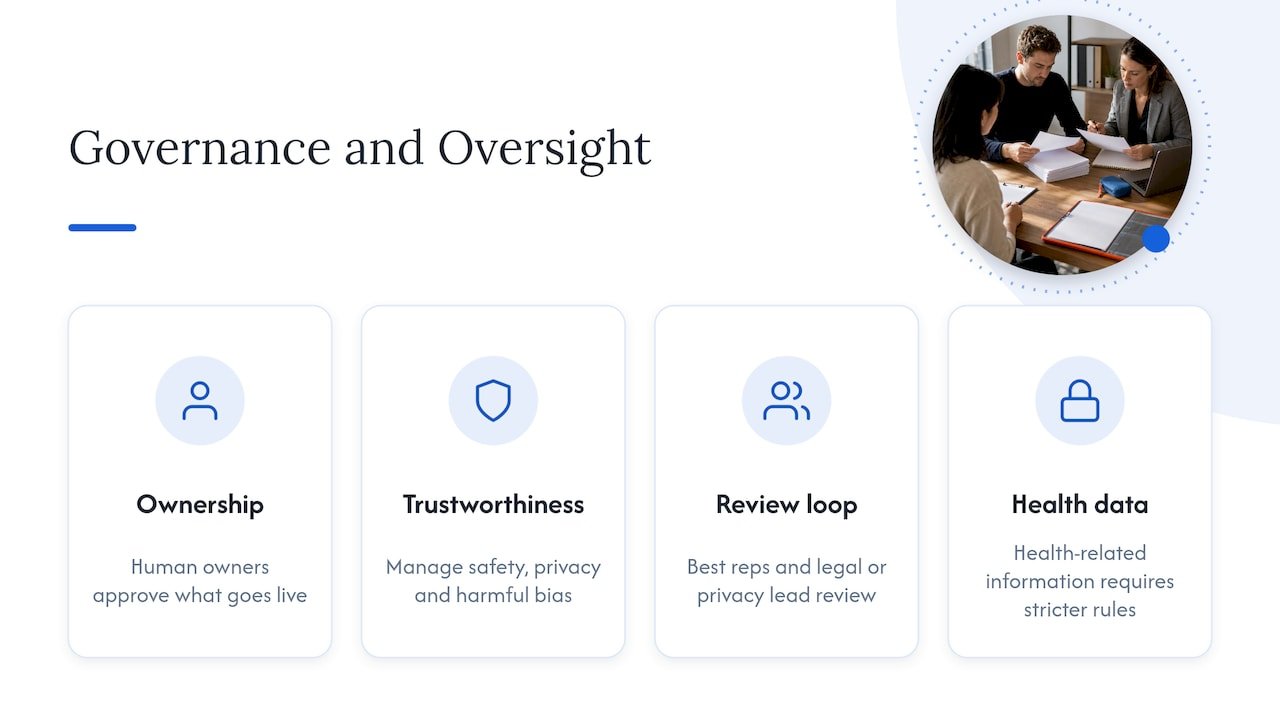
If your plays handle health-related information, the rules are stricter. A HIPAA roadmap for ChatGPT deployments shows what staged controls look like in the U.S., and your compliance counsel should confirm what applies to you.
A short guardrail checklist
- Every play has a named owner and a review date.
- Approved assets only: the system draws from content you have signed off.
- Review rules for high-value deals, senior buyers, cold outreach and low-confidence output.
- Logged, reversible CRM writes.
- A regular audit for drift, stale data and bias.
Our perspective
Most playbook projects fail for a dull reason: the playbook describes an ideal process nobody runs. We would rather see you automate one honest, narrow play that reps trust than twenty polished ones that nobody opens.
We also believe in visibility. Our approach is open-source and built inside your environment, so you can see what each agent does, what data it reads and where it writes. No black boxes means your managers can coach from the system, and your analysts can check it. That matters most in marketing, sales and finance, where a wrong automated action has a cost.
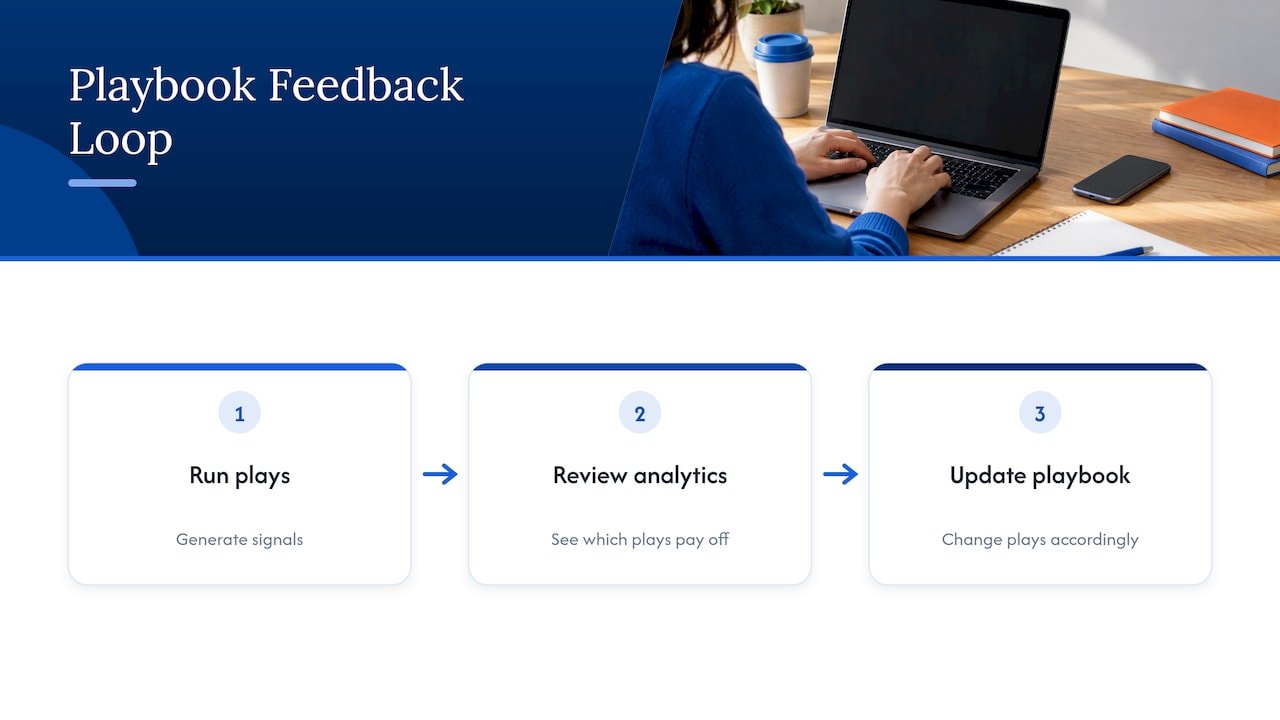
Finally, treat the playbook and your analytics as one loop. Plays generate signals, analytics show which plays pay off, and the playbook changes accordingly. Automation that does not feed that loop is only a faster way of doing the same thing.
— Don
Where Brainiac can help
If you want to move from a document to working plays, we design and run AI agents and analytics systems for marketing, sales and finance teams, with integrations into platforms such as Salesforce and HubSpot. Start with a scoped custom agent deployment, or begin with the AI readiness assessment and roadmap if you are unsure which play to automate first.
You can also talk to our team about your CRM, your current playbook and the bottleneck you most want to fix.
FAQ
What is included in a sales playbook?
A sales-process playbook typically covers the buyer journey, stage-specific best practices and exit criteria, sales tools, skills tips, forecast definitions, discovery talk tracks and qualification checklists. Many also add personas, messaging and objection handling. For automation, write each element as a play with a trigger and an owner.
Can AI replace a sales playbook?
No. AI changes how a playbook is created, kept current and delivered, but people still set the strategy and approve what goes live. Think of AI as the delivery and upkeep layer, not the author of your selling approach.
Which sales tasks should stay human?
Discovery, objection handling and relationship-building. Research recommends automating list building, enrichment, sequence enrollment and task creation, and requiring human review for large deals, C-suite buyers, cold outreach and low-confidence AI output.
How long does a rollout take?
That depends on your data and scope. A phased plan, such as a 90-day one, is a common pattern: map the process, test against human decisions in staging, then tune thresholds on real outcomes. Begin with one play and one team rather than the whole funnel.
Sources
- Sales Playbook Automation glossary
- Sales playbook automation, HubSpot blog
- AI Sales Playbooks, Copy.ai
- How to Build a World-class Sales Playbook, Sandler and Highspot
- TOPO Sales Engagement Leadership Report
- AI Sales Playbooks: Grounding, Governance and Tools, RevSpire
- Structuring a multi-step sales process with automation, Apollo
- AI Sales Playbook guide for B2B teams, TOPO
- Designing a Lead Lifecycle, Salesforce AppExchange
- AI Sales Automation Strategies, Alore
- Hyster-Yale case study, Highspot
- Looking beyond technology to drive sales operations, McKinsey
- AI Risk Management Framework 1.0, NIST