
Prompt engineering for marketers is the habit of giving an AI model the goal, context, source material, tone and format it needs, then testing and refining the result until it is dependable enough to use. Done well, it turns a generic first draft into work that fits your brand, your data and your review process. This guide covers the frameworks, the techniques, how to connect prompts to real marketing data, how to check citations, and how to measure whether your prompts are actually improving.
TL;DR
- A good marketing prompt states the goal, the context, the source material and the expected output. Frameworks such as Goal-Context-Source-Expectations and CO-STAR give you a repeatable shape.
- When output is weak, add context, tighten constraints, ask for another format, or have the model help rewrite the prompt. Do not simply rerun it.
- For reporting, attribution and lead work, ground the model in approved data, separate retrieval from analysis, and tell it to return nothing rather than guess.
- Treat reusable prompts like reporting logic: document them, version them, and review them whenever a business definition changes.
Table of Contents
- What prompt engineering means in marketing work
- A prompt structure you can reuse
- Techniques that improve output
- Applying prompts to reporting, attribution and lead work
- Grounding prompts in approved data, with privacy in mind
- What “AI answer citations” mean and how to check them
- Testing prompts and improving them over time
- Perspective: prompts are a start, systems are the goal
- When to bring in help
- FAQ
- Sources
What prompt engineering means in marketing work
Google Cloud describes prompt engineering as the art and science of designing and optimizing prompts to guide large language models toward the responses you want. For a marketer, that definition is less abstract than it sounds. Every time you ask a model for a nurture email, a campaign summary or a segment analysis, you are writing a brief. Prompt engineering is simply writing that brief with the same care you would give a freelancer or a new analyst.
The difference between a casual prompt and an engineered one is rarely cleverness. It is specificity. “Write a LinkedIn post about our new product” leaves the model to guess your audience, your claims, your tone and your length. A prompt that names the buyer, supplies approved product facts, sets the voice and limits the format removes the guessing, and the guessing is where generic copy and invented details come from.
The skill also extends well beyond copywriting. Marketing teams now use prompts for:
- Content drafting, repurposing and brand-voice checks
- Campaign reporting and cross-channel performance summaries
- Attribution questions and pipeline analysis
- Lead enrichment and qualification notes in the CRM
- Ecommerce revenue analysis, such as where margin or conversions leak
The first group tolerates a looser approach. The last four do not, because the output feeds decisions. That is why the later sections of this guide spend more time on data, validation and testing than on wording tricks.
A prompt structure you can reuse
Start with a framework, because a checklist beats memory when you are busy. Two are worth knowing.
Goal, Context, Source, Expectations
IAB Australia’s prompting guide recommends a four-part structure of Goal, Context, Source and Expectations for marketing tasks. In practice:
- Goal: what you need and why. “Draft a renewal email that reduces churn in accounts under 12 months old.”
- Context: who it is for, what is going on, what the model should assume.
- Source: the material it must rely on, such as a product sheet, a brand guide or a pasted data extract.
- Expectations: format, length, tone, and what a finished answer looks like.
The strategic marketing planning overview from Baby Love Growth is a useful companion if you want to see how structured inputs support planning and content work more broadly.
CO-STAR
Adobe’s Campaign documentation uses CO-STAR, which stands for Context, Objective, Style, Tone, Audience and Requirements. It suits content generation especially well because it separates style from tone, which is where many brand-voice problems hide. Style is how the writing is built (short sentences, bulleted, formal). Tone is the feeling (reassuring, direct, upbeat).
A worked example
Here is a weak prompt and a stronger one for the same job.
Weak: “Write an email to leads who downloaded our pricing guide.”
Stronger: “Goal: write a follow-up email that gets a reply from operations managers at mid-sized logistics firms who downloaded our pricing guide in the last seven days. Context: they are comparing vendors and have not spoken to sales. Source: use only the three benefits and the customer proof point pasted below. Expectations: under 120 words, plain language, one question as the call to action, no discount language, and a subject line under 50 characters. Provide two versions.”
The second prompt is longer, but the editing time afterward is shorter. That trade is the whole business case for the practice.
Techniques that improve output
Give the model a role and an audience
Adobe’s guide for marketers points to persona-based prompting and iterative refinement as two of the most useful techniques. Asking the model to act as a B2B lifecycle marketer, then naming the segment you are writing for, narrows the register and the assumptions it makes. Roles are a steer, not a guarantee, so always pair them with real constraints.
Show examples (few-shot prompting)
If you want a particular voice, paste two or three of your best past examples and say what they have in common. This is usually more effective than describing the voice in adjectives. Use examples that you would be happy to see repeated, because the model will imitate their weaknesses too.
Ask for reasoning on analytical tasks
For questions that involve comparing numbers or weighing trade-offs, ask the model to work through the steps before it gives a conclusion, and to list its assumptions. You are not doing this to see a clever chain of logic. You are doing it so a human can spot where the logic went wrong.
Place instructions where the model will honour them
Long prompts with pasted documents can bury the task. Community discussion among developers suggests models can lean on recent text, so instructions placed at the end of a prompt may be followed more reliably. Treat that as a habit to test rather than a rule: put the task up top, paste the source material, then restate the task and format at the bottom.
Refine in a loop, not a restart
When output is weak, resist the urge to type the same request again. Adobe’s guidance on refinement is to add context, tighten constraints, request alternative formats, or use AI to help rewrite the prompt. A practical diagnostic:
| Symptom | Likely cause | Fix |
|---|---|---|
| Generic, could be any brand | Missing context and source | Paste approved facts and a voice sample |
| Right content, wrong feel | Style and tone not separated | Specify both, add an example |
| Too long or rambling | No format constraint | Set word count, structure and count of options |
| Invented details | Model filling gaps | Tell it to say “not provided” when information is missing |
| Inconsistent across runs | Vague criteria | Add explicit review criteria and a checklist |
For complex tasks, build the human review criteria into the prompt itself. Tool-mint’s playbook recommends including specific roles, audience segments, clear constraints and review criteria for larger jobs, which makes the checking step faster for whoever signs off.
Applying prompts to reporting, attribution and lead work
Content prompts fail visibly. Data prompts fail quietly, which is worse. A confident paragraph about last quarter’s channel performance can be wrong in ways nobody notices until a budget is set on it.
Connect the model to live data instead of pasting screenshots
Many teams now connect marketing platforms to assistants through connectors, so the model queries actual performance data rather than a stale export. One analyst playbook describes connecting marketing data to Claude or ChatGPT through Supermetrics to investigate cross-channel trends. Whatever the connector, the principle holds: the closer the model is to the system of record, the less it has to invent.
Separate the stages of a report
For any report that will influence spend, split the work into four steps: retrieval, validation, analysis and interpretation. A practitioner write-up on marketing operations prompts makes this point, noting that separating these stages makes errors easier to detect. If one prompt pulls numbers, checks them, explains them and recommends action, you cannot tell which part broke.
A sequence that works:
- Retrieve: “Return the sessions, leads and opportunities by channel for these dates, as a table, with no commentary.”
- Validate: “Check the table for missing channels, duplicate rows and totals that do not match the CRM. List discrepancies.”
- Analyze: “Using only the validated table, identify the three biggest changes versus the prior period.”
- Interpret: “Suggest possible explanations, labelled as hypotheses, and what data would confirm each.”
This is also how we think about attribution. A model can describe the map of touchpoints, but it should not hand down a verdict. Keep the causal claims for a human who knows the sales cycle.
Lead enrichment and qualification
For enrichment, define a schema before you prompt: the exact fields, their allowed values and their formats. A GTM engineering guide advises telling the model to return null rather than guess when the source lacks the information. A blank field is honest and easy to route to a person. A plausible but invented job title poisons your CRM and your scoring.
Ecommerce revenue analysis
For a store, the same discipline applies. Give the model a defined question (“Which three products lost the most margin after discounts and returns last quarter?”), the exact tables it may use, and your definitions of revenue, margin and returning customer. Ask it to show the calculation. When the answer surprises you, that is the moment to check the definition, not to trust or dismiss the model.
Grounding prompts in approved data, with privacy in mind
A model’s built-in knowledge is broad and not about your business. Google Cloud’s guidance argues that the most value comes from grounding foundation models in enterprise data such as CRM and ERP systems, rather than relying on pre-trained knowledge alone. For marketers, that translates into concrete habits:
- Supply approved source material (product facts, claims, pricing language, brand guide) in the prompt or through a connected knowledge base.
- Keep confidential and personal data out of tools unless your organization has approved that workflow.
- Require a named human to review for accuracy, privacy, claims and brand fit before anything is published or sent. Tool-mint’s playbook lists exactly these checks.
The NIST Generative AI Profile (AI 600-1) frames this as ongoing governance, naming risks such as data memorization, harmful bias and inferential privacy harms. The implication is that a one-time policy is not enough. If you are a smaller business without a security team, a practical AI risk assessment framework can help you decide which marketing workflows are safe to automate first. If your prompts touch customer records, speak to your legal counsel or privacy officer about what your obligations are before you connect any data.
Guardrails matter even more once prompts become agents that write back to your systems. Our guide on CRM automation guardrails for agentic AI sets out what revenue teams should have in place first.
What “AI answer citations” mean and how to check them
Two different things get called citations, and marketers meet both.
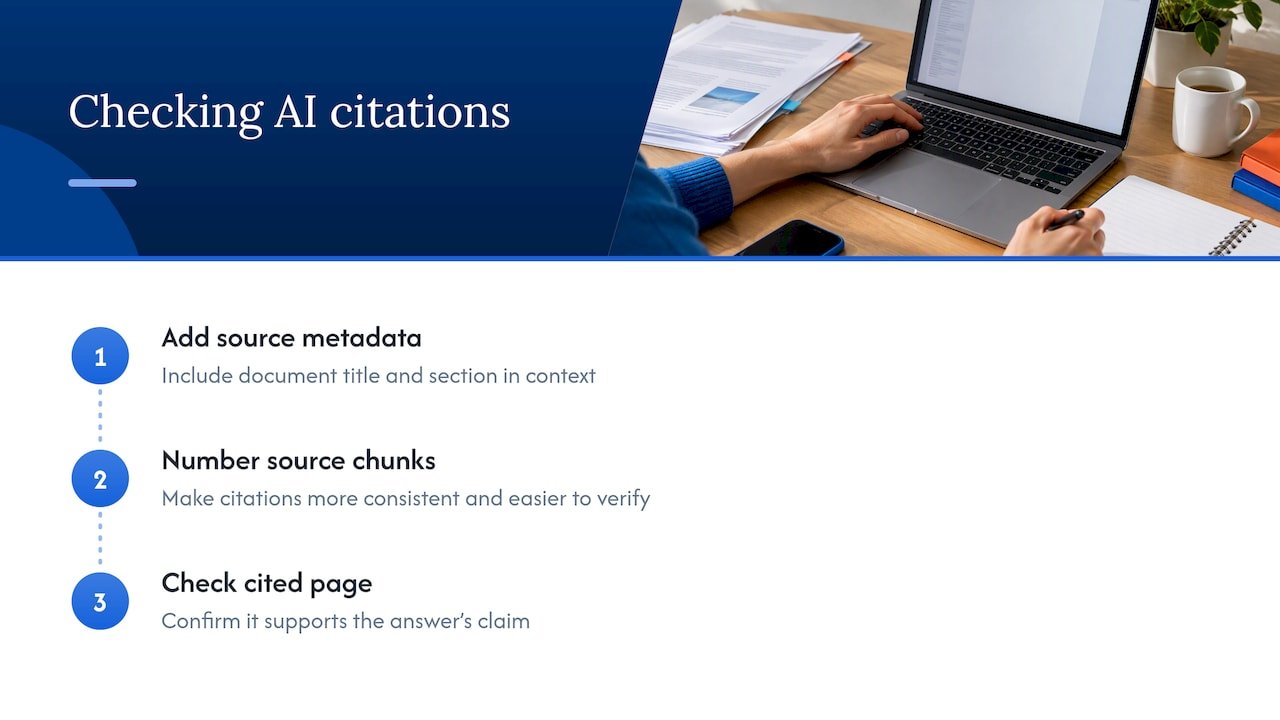
The first is what you want from your own prompts: answers that point to the source document and section behind each factual claim, so a reviewer can trace it. Developer discussions of retrieval-based chatbots describe doing this by injecting source metadata, such as document title and section, into the prompt context and instructing the model to cite them for every factual statement. A numbered indexing scheme for your source chunks makes citations more consistent and easier to verify.
A citation instruction you can adapt:
Use only the numbered sources below. After every factual statement, add the source number and section in brackets. If no source supports a statement, write “not supported by the sources” instead of answering.
The second meaning is the one discussed in search: whether public AI answer engines cite your brand or pages. That is a visibility question, and it is the territory of generative engine optimization. If you want to understand where to start, our comparison of GEO, SEO and AEO and which work to do first is a good place to begin, and this look at AI Overview optimization shows how content structure influences what gets surfaced.
Either way, a citation is a lead, not proof. Always open the cited page and confirm it says what the answer claims. Models can attach a real-looking reference to a claim the page does not support.
Testing prompts and improving them over time
A prompt that worked once is an anecdote. A prompt you trust has been tested against a set of realistic inputs.
Build a small test set
Collect 10 to 20 real cases for each recurring task: past leads with a known outcome, reports where you know the right answer, briefs with different audiences. Run each version of your prompt against the same set and compare.
Score what matters
For content, score brand fit, factual accuracy against your source material, and edit time. For retrieval-based work, researchers evaluating retrieval-augmented generation have used measures of retrieval relevance, nugget coverage, groundedness, factuality and citation quality. You do not need the research tooling to borrow the idea: ask whether the answer covered the key points, whether each claim is supported, and whether the citations check out.
Automated evaluators can help at volume. Google Cloud describes a service that assesses groundedness and factual accuracy and explains its quality scores. Treat their scores as a screen that decides where humans look first, not as a final judge. Our own piece on evaluating whether an AI analytics platform is accurate enough goes deeper on that approach.
Version your prompts
Reusable reporting prompts deserve the treatment of reporting logic: documented, versioned, and updated when business definitions change. A simple prompt library with an owner, a date, a purpose, the test set used and a change log is enough. Redefine “qualified lead” and every prompt that mentions it needs a review.
Perspective: prompts are a start, systems are the goal
We see the same pattern with most marketing teams. Someone discovers a prompt that works, shares it in chat, and within a month there are nine variants, none documented, each producing slightly different numbers. The prompt was never the real problem. The missing system around it was.
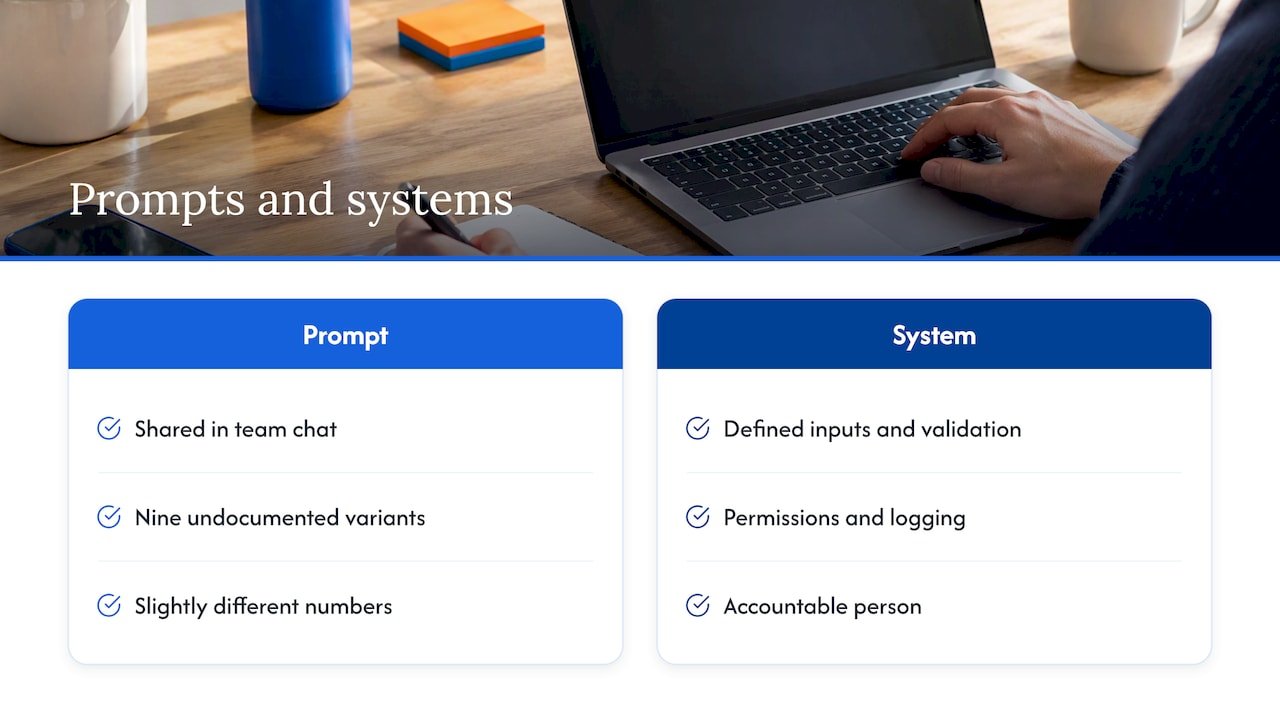
Our view is that prompt engineering is the right first skill and the wrong final destination. It teaches a team to be precise about goals, definitions and sources. But once a prompt is run weekly, touches CRM data or feeds a board report, it should graduate into something built: an agent or workflow with defined inputs, validation steps, permissions, logging and a person accountable for it. Our open-source approach exists for that reason. You should be able to see what the system does and why, with no black box between your data and your decisions.
We would also keep one principle firmly in view: attribution is a map rather than a courtroom verdict. Use models to draw the map faster and to ask better questions of it, and keep judgment about causality with people who know the business.
— Don
When to bring in help
Most teams can get far with the structure above. Outside help earns its place when prompts have outgrown a shared document: you are running the same analysis every week, pushing outputs into Salesforce or HubSpot, or need governance your security team will sign off on.
That is where we work. We design and operate AI agents and analytics systems for marketing, sales and finance teams. If you are not sure where to begin, our AI strategy and readiness advisory covers readiness assessment, opportunity prioritization, roadmap and governance. If you already know the workflow you want automated, see custom agent deployment, or start with the overview of what we offer.
FAQ
Do I need technical skills to do prompt engineering for marketing?
No. The core skill is writing a clear brief: goal, audience, source material and format. Technical knowledge helps once you connect models to data sources or build agents, but most of the early gains come from being specific and reviewing output carefully.
Which framework should I use, CO-STAR or Goal-Context-Source-Expectations?
Either works, and the choice matters less than using one consistently. CO-STAR suits content tasks where style and tone need separate control. Goal-Context-Source-Expectations is simple enough for reporting and analysis prompts where the source data is the main concern.
How do I stop the model from making things up?
Supply the source material, tell the model to use only that material, and instruct it to say when information is missing instead of guessing. For structured tasks, define the fields and ask for a null value when the source does not contain the answer. Then have a person check the claims that matter.
Can I put customer data into a prompt?
Only if your organization has approved that tool and workflow for that type of data. Confidential and sensitive information should stay out by default. Check with your privacy or legal team before connecting customer records to any model.
How do I know if my prompts are getting better?
Run each version against the same set of real examples and score accuracy, brand fit and the time a person spends editing. Record the version, the test set and the result. If edit time and error rates fall across versions, the prompt is improving.
Sources
- Prompt Engineering for AI Guide, Google Cloud
- A Guide to Prompting with LLMs: 2026 Edition, IAB Australia
- Generate Content prompting guide, Adobe Campaign
- The modern marketer’s guide to prompting AI, Adobe
- AI Prompts for Marketers: A Practical Prompting Playbook, Tool-mint
- Prompt engineering for RAG, OpenAI Community
- Marketing data analyst’s prompt playbook
- The GTM Engineer’s Guide to Prompt Engineering, Octave
- Prompt Engineering for Marketing Operations
- Ground gen AI outputs in enterprise data, Google Cloud
- NIST AI 600-1, Generative AI Profile
- Migration of a RAG chatbot to Agents SDK, OpenAI Community
- Laboratory for Analytic Sciences at TREC 2025, NIST
- Vertex Gen AI Evaluation service, Google Cloud