
Choose Outreach if you have a RevOps team that wants granular control over sequences, rules and governance. Choose Salesloft if you want reps to adopt guided daily workflows quickly. Both are quote-based, both cover multichannel outreach, conversation intelligence and forecasting, and both are sound products. The better pick depends less on the feature list than on who will run the tool every day.
Below we compare them on the criteria that decide most evaluations: workflow control, AI, CRM integration, onboarding effort and reported pricing. We also cover what has to be true in your CRM and data before either tool pays off.
TL;DR
- Outreach leans toward configurable, governed sequences and suits process-driven teams with sales-operations capacity.
- Salesloft leans toward guided, rep-friendly cadences and faster ramp, and suits teams that value quick adoption.
- Neither publishes list prices. One third-party benchmark reports Outreach at $100 to $160 per user per month and Salesloft at $125 (Advanced) to $150 (Premier), billed annually.
- Onboarding differs: one RevOps comparison puts typical Outreach rollouts at 6 to 12 weeks and Salesloft at 2 to 4 weeks.
- Whichever you pick, clean CRM data, lead routing and handoff rules decide whether the platform produces pipeline.
Table of Contents
- Outreach vs Salesloft at a glance
- Sequences and workflow control
- AI features: agents versus guidance
- CRM integrations, conversation intelligence and forecasting
- Onboarding and ease of use
- What each platform costs in the US
- Which team fits which platform
- Before you choose: the data and handoff layer
- Our perspective
- Where Brainiac Consulting fits
- FAQ
- Sources
Outreach vs Salesloft at a glance
Think of the two platforms as two ways to run the same play. Outreach gives your operations team a control panel. Salesloft gives your reps a guided route. Both put sequences, calls, email, tasks and pipeline views in one place.
| Criterion | Outreach | Salesloft |
|---|---|---|
| Core philosophy | Configurable workflows and governance | Guided cadences and next-best actions |
| Sequence logic | Advanced branching, wait conditions, time windows, A/B testing | Simpler branching tied to Cadence and Rhythm |
| AI approach | Agents for research, personalization and meeting prep, with credit-based usage | Rhythm prioritization, conversation intelligence, forecasting |
| Typical owner | RevOps or sales operations | Sales leadership and front-line managers |
| Typical onboarding | Longer, admin-heavy | Shorter, rep-friendly |
| Pricing | Quote-based | Quote-based |
These are the broad patterns that comparison write-ups and vendor material describe. Your own evaluation should test them against your actual motion.
Sequences and workflow control
Sequences are where the two products feel most different.
Outreach is generally described as the deeper tool for sequence design. It supports if/then branching, wait-day conditions, sending windows and A/B testing, plus governance controls such as rulesets, throttles and permissions. If you run several segments, regions or business units with different rules, that structure keeps outreach consistent without every manager building their own version.
Salesloft centers on its Cadence module for email, phone and social steps, and connects it to Rhythm, which ranks what a rep should do next from buyer signals. The branching is simpler, but the daily experience is more directive. A rep opens the tool and sees a prioritized list instead of a blank canvas.
A practical way to choose:
- Count how many people will build and maintain sequences. If it is one or two operations specialists, configurability is an asset. If it is twenty reps, simplicity is.
- List the rules you must enforce, such as contact limits, approved templates and territory ownership. The more rules, the more governance matters.
- Decide whether you want to test messaging systematically. A/B testing at scale favors the more configurable tool.
If you also run marketing automation in HubSpot, it helps to understand where workflows end and sequences begin, so the two systems do not send conflicting messages to the same contact.
AI features: agents versus guidance
Both vendors now lead with AI, and the approaches differ in emphasis.
Outreach positions itself as an agentic platform. Its packaging includes agents for research, personalization, meeting prep and revenue work, with Agent Studio for custom agents and Kaia for real-time call coaching. AI usage is metered through credits, so the cost depends on how much your team uses it, not only on seat count.
Salesloft applies AI across Rhythm (prioritizing accounts and tasks), Conversations (recording, transcription and coaching insights), Deals and Forecast. The emphasis is on recommending the next action and surfacing deal risk.
What this means in practice:
- If you want AI to execute research and drafting steps for reps, the credit-based agent model fits, and you should budget for usage.
- If you want AI to tell reps where to spend their hours and to coach after the call, the guided model fits.
- In both cases, AI output is only as good as the account, contact and activity data feeding it.
That last point is where most teams stall. Our guide on proving sales AI agents in three to four months walks through how to set success measures before you switch anything on.
CRM integrations, conversation intelligence and forecasting
Both platforms sync with the major CRMs. Salesloft offers native sync with Salesforce, Microsoft Dynamics 365 and HubSpot, and Outreach lists more than 90 supported integrations and writes call data from Kaia back to CRM deal records. Marketplace counts vary by source, so ask each vendor for the integrations you actually use, not the headline number.
For conversation intelligence, Outreach’s Kaia is framed as in-the-moment guidance, while Salesloft emphasizes post-call summaries, risk and objection detection, and coaching workflows. Salesloft’s forecasting has been strengthened by its combination with Clari. Outreach’s forecasting sits on its higher Amplify tiers.
The integration question that matters most is not whether the tool connects. It is what happens to the data once it does. Duplicate leads, unclear ownership and stale fields turn a sync into a flood of noise. If you are connecting HubSpot and Salesforce underneath either tool, our checklist for a reliable HubSpot and Salesforce integration covers the field mapping and conflict rules that prevent that.
Onboarding and ease of use
This is where the two diverge most visibly in buyer feedback. Review summaries tend to describe Salesloft as easier for reps to learn and Outreach as asking for more administrative investment. One RevOps comparison puts typical implementation at roughly 6 to 12 weeks for Outreach and 2 to 4 weeks for Salesloft.
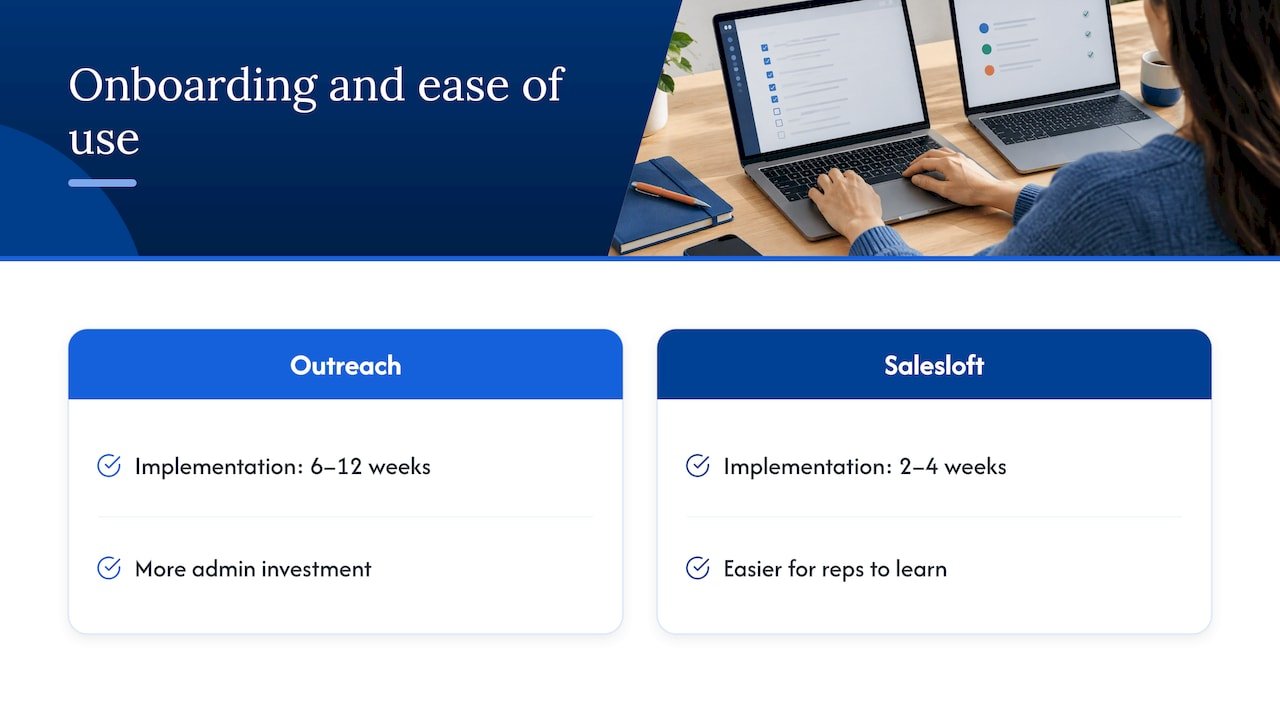
Treat those as typical ranges, not promises. Your timeline depends on CRM cleanliness, the number of sequences to migrate, user count and who owns the project. A tool that takes two extra weeks to configure may still be the better choice if it saves your team hours every week afterward.
Adoption is the other half of ease of use. A sales rep who finds the tool slows them down will work around it. Short, personal touches often outperform heavy automation, which is why some teams pair their sequences with approaches such as a sales rep personal newsletter that keeps prospects warm between outreach steps.
What each platform costs in the US
Neither vendor publishes standard list prices. Both sell by quote, typically on annual contracts, and the final figure depends on seats, modules, volume and negotiation.
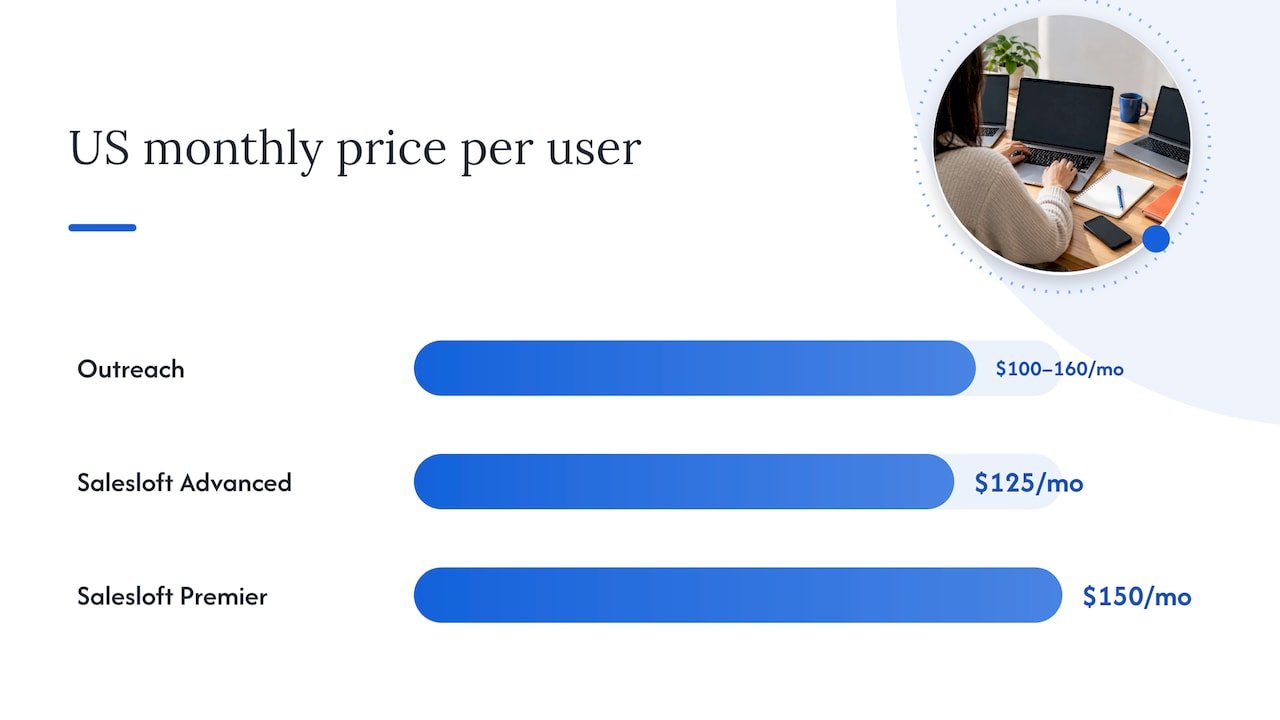
Third-party benchmarks give a starting range. CostBench reported in June 2026 that Outreach runs about $100 to $160 per user per month and Salesloft about $125 per user per month on Advanced and $150 on Premier, billed annually, with Elite priced custom. Other reviewers report different figures, so treat all of these as ranges to test against a real quote.
Budget for what sits outside the seat price:
- AI usage. Outreach’s AI runs on credits across its Amplify tiers, so heavy use of agents changes the total.
- Calling. Dialer minutes and calling add-ons are often priced separately.
- Higher tiers. Conversation intelligence, forecasting and deal management typically sit in the upper packages.
- Admin time. A heavier configuration burden is a real cost, even though it never appears on the invoice.
When you request quotes, give both vendors the same inputs: team size, CRM, required integrations, call-recording needs and contract term. That is the only way the numbers compare.
Which team fits which platform
Outreach tends to fit when:
- You have a RevOps or sales-operations function that will own configuration.
- Your sales process has multiple segments, strict rules or compliance needs.
- You want to run structured experiments on messaging and cadence design.
- You are interested in agent-style automation and are prepared to manage usage.
Salesloft tends to fit when:
- Reps need to be productive within weeks, with limited admin support.
- Sales managers want coaching workflows built around conversations.
- You want prioritization and forecasting in one connected system.
- Your sequences are simple enough that deep branching would go unused.
Smaller teams without a dedicated operations owner usually do better with the simpler tool. Larger teams with governance needs usually benefit from the configurable one. If you are somewhere in the middle, the deciding factor is who maintains the system a year from now.
Before you choose: the data and handoff layer
Most failed rollouts of sales engagement tools share a cause: the platform was blamed for problems that began upstream. Leads arrive without enrichment, get routed to the wrong rep, sit unaccepted, and then enter a sequence with the wrong persona and the wrong message.
Fix four things first:
- Enrichment before routing. Complete company and contact data should exist before a lead is assigned. See how we approach lead routing automation with enrichment first.
- Clear acceptance rules. Define how long a rep has to act and what happens when they do not, as in our sales handoff automation approach.
- Shared definitions. Marketing and sales should agree on what qualifies a lead. Our piece on aligning teams in RevOps covers this.
- Pipeline measures. Know which three or four metrics you will watch. Our pipeline analytics playbook outlines those that predict revenue.
With these in place, either platform has a fair chance. Without them, neither will rescue your pipeline.
Our perspective
We are often asked which sales engagement platform is better, and we usually answer with a different question: what do you want the tool to do that your team does not already do well?
A sequencing tool is an engine. It makes whatever you feed it go faster, including bad data, unclear ownership and fuzzy targeting. We have seen teams switch platforms twice in three years and keep the same conversion problem, because the problem lived in routing, enrichment and handoff, not in the cadence builder.
Our approach is to treat the platform as one component of a revenue operation that you can see end to end. We build and operate AI agents and analytics systems that sit alongside your CRM and engagement tools, using open-source methods and integrations with Salesforce and HubSpot, so you can inspect every step instead of trusting a black box. Lead enrichment, intent prediction and pipeline hygiene are designed to make whichever tool you choose work harder.
Our advice: pick the platform that matches your operating capacity, then invest in the layer beneath it. Attribution should be a map of how buyers actually move, not a courtroom verdict on which touch deserves the credit.
Don
Where Brainiac Consulting fits
If you are weighing Outreach against Salesloft, the decision usually sits inside a bigger question: how should AI and automation run across marketing, sales and finance? We help teams answer it. Our work includes AI strategy and readiness advisory, custom agent deployment, martech implementation, marketing operations support and revenue attribution, all built to run inside your own environment.
Start with an AI readiness assessment and roadmap to identify where agents will help first, or look at our custom agent deployment if you already know the workflow you want automated. You can see the full range on the Brainiac Consulting home page.
FAQ
Is Outreach or Salesloft better for a small team?
Small teams without a dedicated operations owner usually get value faster from the tool that is easier to adopt, which reviewers generally describe as Salesloft. Outreach can still work if someone owns configuration. Match the tool to the person who will maintain it.
Do Outreach and Salesloft publish their prices?
No. Both sell by custom quote, usually on annual contracts. Third-party benchmarks such as CostBench report per-user ranges, but your quote will depend on seats, modules, AI usage and term.
Is Outreach a CRM?
No. It is a sales engagement platform that works alongside a CRM such as Salesforce or HubSpot. It handles sequences, calls, meetings and deal activity, while the CRM remains your system of record.
How long does implementation take?
It varies with data quality, user count and the number of sequences to migrate. One RevOps comparison cites roughly 6 to 12 weeks for Outreach and 2 to 4 weeks for Salesloft as typical. Ask each vendor for a plan based on your setup.