

Open source marketing attribution means running your attribution logic on code you can read, host and change, instead of renting a black-box report. For multi-touch attribution (MTA), that usually means a library such as a Python package, your own warehouse and a data pipeline fed by your website, ad platforms and CRM. It gives you full visibility into how credit is assigned. It also hands you the work of collecting clean data, maintaining the stack and interpreting results honestly. This guide covers the models, the projects, the build steps and the limits, so you can decide whether to build, buy or blend.
TL;DR
- Open source attribution gives you transparent credit rules (first-touch, last-touch, linear, time-decay, Markov, Shapley) that you can audit and adapt to your own funnel.
- The code is the easy part. Identity stitching, data collection and governance decide whether the numbers can be trusted.
- MTA is observational. It describes correlation, so pair it with media mix modelling or incrementality tests before you move large budgets.
- It suits teams with analytics engineering capacity and a warehouse already in place. Others should start smaller or get help.
Table of Contents
- What open source MTA actually is
- The attribution models you can run
- Open source projects worth knowing
- How to implement it with your own data
- Where open source attribution falls short
- Is open source the right fit for your team?
- Our perspective
- Getting help building it
- FAQ
- Sources
What open source MTA actually is
Multi-touch attribution spreads credit for a conversion across the interactions that came before it: an ad click, an email open, a webinar, a sales call. The IAB’s guidebook describes MTA as giving a more tactical understanding of how to improve ROI across fewer touchpoints than top-down methods, and notes that marketers use it to inform digital spending decisions.
The “open source” part changes who controls the logic. In a commercial tool, the credit rules, the identity matching and the data exclusions sit behind a vendor interface. In an open source build, every rule is a function you can read. When finance asks why paid social got 18% of last quarter’s credit, you can point to code and inputs rather than a support ticket.
We like to describe attribution as a map rather than a courtroom verdict. A map shows you the terrain and helps you choose a route. It does not prove that a particular road caused your arrival. Open source makes that map’s legend visible, which is its greatest advantage.
The attribution models you can run
Most open source MTA tools split into two families: rule-based (heuristic) models and data-driven (algorithmic) models.
Heuristic models
According to the Gnosis Analytics MTA methodology, the rule-based set works like this:
- First-touch: 100% of the credit goes to the initial interaction.
- Last-touch: 100% goes to the final interaction.
- Linear: credit is spread evenly across all touchpoints.
- Time-decay: recent touchpoints carry more weight, for example with a 7-day half-life.
These are easy to explain and cheap to compute. They also bake in an opinion. First-touch flatters awareness channels, last-touch flatters branded search and retargeting, and linear pretends every touch mattered equally.
Algorithmic models
The mta Python package describes Markov Chain and Shapley Value approaches as more advanced: one analyzes sequential dependencies between touches, the other uses a game-theoretic method to allocate credit by marginal contribution. In the Gnosis methodology, Markov removal-effect and sampled Shapley-proxy methods are available once you reach a tier of at least 500 conversions. That threshold matters. Data-driven models need volume, and a team with 40 conversions a month will get unstable results whatever the maths.
Which should you start with?
| Situation | Sensible starting model | Why |
|---|---|---|
| Under a few hundred conversions | Time-decay or position-based | Stable, explainable, little data needed |
| Long B2B cycles with many touches | Linear plus a Markov comparison | Shows how much credit moves between models |
| 500+ conversions, clean identity | Markov removal-effect | Reveals channels that matter in sequence |
| Budget decisions of real size | Any MTA plus MMM or tests | Guards against correlation being read as cause |
Run two models side by side before you commit. If last-touch and Markov agree on a channel, you can trust that signal more. If they disagree wildly, you have found the question worth investigating.
Open source projects worth knowing
The landscape is small but real. Here is what the evidence supports:
- mta (Python): MIT-licensed, and according to the OpenPartner launch post it implements first-touch, last-touch, linear, position-based, time-decay, Markov Chain and Shapley Value models. It is a good first library for experiments.
- Media mix modelling frameworks: a Databricks overview lists Robyn (MIT), Meridian (Apache 2.0) and PyMC-Marketing (Apache 2.0). These work at aggregate level rather than on individual journeys, which makes them a natural companion to MTA.
- Link attribution platforms: Dub’s repository describes an open source platform for short links, conversion tracking and affiliate programmes. Its core is AGPLv3, while enterprise features are commercially licensed. Read licences carefully, because AGPL obligations differ from MIT ones.
What the projects show about maintenance: some are very young (the mta package on PyPI is at version 0.0.9), so check release cadence, open issues and who maintains each project before you build anything critical on it. Pin versions, and keep the logic you depend on small enough that you could fork it.
A 2026 academic overview by Runge and Pauwels in the Journal of Marketing Analytics (via Springer) presents open source MMM as an opportunity, but stresses integrating and calibrating it with attribution models. That is the right instinct: the tools complement each other.
How to implement it with your own data
The flow is the same whether you sell software, services or products. Here is a sequence we would follow.
- Define the conversion. Pick one event: a closed-won opportunity, a purchase, a qualified demo. Do not start with five.
- Inventory sources. Website events (such as GA4), ad platform spend and clicks, email and CRM activity, and orders or opportunities. The IAB recommends phased expansion of data sources because speed, completeness and complexity trade off. Start with two or three.
- Land the data in a warehouse. One worked example from Rabbit Metrics loads Meta Ads data, GA4 events and orders with Polars, stitches the identifiers together and loads the result into BigQuery. Your stack may differ, but the shape is the same.
- Stitch identities. Map anonymous IDs to known users and accounts. This step is where most projects go wrong (more below).
- Build touchpoint paths. One row per conversion, with an ordered list of touches and timestamps inside a lookback window you define and document.
- Run models and compare. Execute two or three models, store outputs with the model version and parameters, and diff them.
- Validate. Check totals against finance, test against a holdout where possible, and write down what you excluded.
- Publish to the tools people use. Push channel and campaign credit back into your BI layer and CRM so sales and marketing see the same numbers.
If your CRM is Salesforce or HubSpot, attribute at the opportunity level, not just the lead. Our view on why this matters is in what marketers get wrong about attribution, and for B2B buying groups, account-based attribution credits revenue to accounts rather than single contacts. Ecommerce teams have different mechanics, covered in our piece on ecommerce attribution models.
Putting AI agents on top
Once attribution tables sit in a warehouse, they become a surface for automation. The Rabbit Metrics example notes that SQL agents can surface underperforming campaigns, attribution windows that change ROAS, and creative fatigue by segment. We would extend that to weekly reporting drafts, pipeline hygiene alerts and lead scoring inputs. Keep humans in the loop and put guardrails around anything that writes to your CRM; our CRM automation workflows guide covers that.
Where open source attribution falls short
Transparency does not fix the underlying measurement problems. Be clear about them before you present numbers to a CFO.
Signal loss and privacy
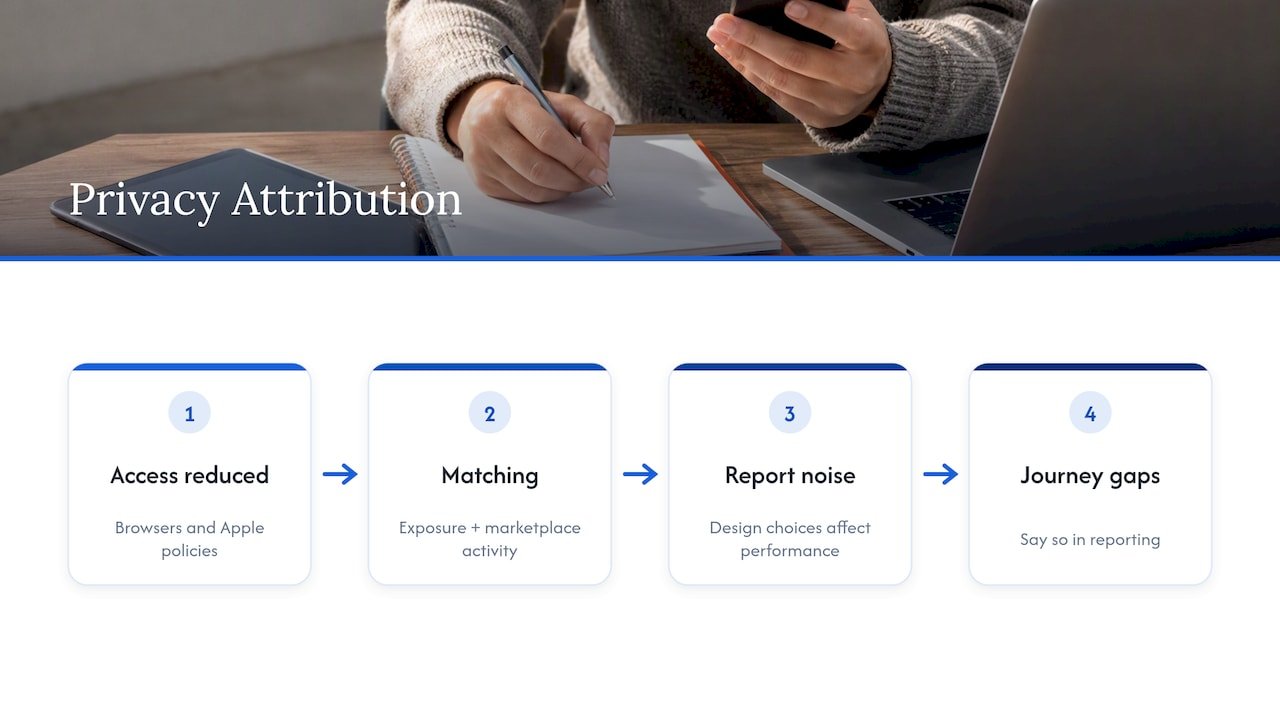
An FTC-hosted paper notes that digital attribution has historically relied on third-party cookies, conversion pixels and mobile identifiers, while browsers and Apple platform policies are reducing access to them. The same analysis cautions that even privacy-preserving attribution still involves matching media exposure with marketplace activity. Google’s own implementation guide for Attribution Reporting explains that privacy-preserving reports add noise and require design decisions that affect measurement performance. In practice, your journey data will have holes, and you should say so in the reporting.
Identity resolution
The IAB lists identity resolution, shared devices, cookie rejection and flawed matching as challenges when connecting online and offline exposures with conversions. An academic study of cross-device tracking at the Proceedings on Privacy Enhancing Technologies found that 96 of 100 tested sites accepted usernames or email addresses usable for cross-device correlation, and 16 shared personally identifying information with third parties. Two lessons follow. First-party identifiers such as logins and form fills are the strongest stitching material. And you carry the compliance duty for what you collect, so involve legal counsel on consent and data sharing, especially if you operate in states with consumer privacy laws.
Over-merging is the quiet failure. One practitioner write-up on attribution pipeline design points out that when an identity graph joins too many profiles, credit flows to the wrong channels. Test your merge rules on a sample you can verify by hand.
Correlation is not lift
MTA is observational. The Gnosis methodology advises pairing it with MMM or quasi-experimental designs to validate causal claims, since MTA describes correlation rather than definitive causal lift. A retargeting audience converts at a high rate, and MTA will happily credit the ads. Whether those people would have bought anyway is a different question, and only a holdout can answer it. We cover that approach in always-on incrementality testing.
Data quality and governance
The IAB warns that MTA quality depends on robust collection and governance, and recommends validation and audit reporting as data sources multiply. Treat your attribution pipeline like financial reporting: documented definitions, versioned code, reconciliation checks and an owner.
Is open source the right fit for your team?
The IAB is blunt: MTA needs careful analytic design, proper implementation and interpretation, and without proper resources the risk of failure is high. Use this checklist.
Open source is a good fit when:
- You already have a warehouse and someone who writes SQL and Python daily.
- You need auditable logic for compliance, finance or board scrutiny.
- Your funnel is unusual (long B2B cycles, offline touches, partner channels) and packaged tools model it poorly.
- You want attribution outputs to feed your own agents and dashboards.
Think twice when:
- No one owns data engineering, so the pipeline would depend on a single contractor.
- Conversion volume is too low for algorithmic models.
- Your tracking is not yet consistent. Fix UTM discipline and CRM stage definitions first. Our marketing ops audit walks through tracing leads to revenue in five phases.
A hybrid often wins. Many teams keep a native CRM attribution product for day-to-day reporting and use open source code for deeper analysis and validation. If you run Marketo, our Marketo Measure service covers that route.
Our perspective
We build attribution and analytics systems for marketing, sales and finance teams, and we favour open builds for one reason: nobody should have to trust a number they cannot inspect. When a CMO asks where pipeline came from, the answer should be traceable from the dashboard to the query to the raw events.

But we are equally wary of the “we built a model, so it must be true” trap. The most useful engagements we run are the ones where the team agrees on three things up front: what counts as a conversion, what the model is allowed to claim, and which experiment will test its biggest claim. Attribution is a decision aid. It tells you where to look, and tests tell you what to believe.
Our practical advice is to start with one conversion, two models and a documented identity rule. Ship a report people actually use. Add MMM and holdouts once the plumbing is trusted. Resist the urge to buy or build the most sophisticated model first. Clean inputs beat clever algorithms nearly every time.
— Don
Getting help building it
If you want the transparency of open source without staffing the whole build, that is the work we do. Our revenue attribution services cover design, implementation and ongoing operation, with integrations into Salesforce, HubSpot, Marketo, Power BI and Tableau, and our builds stay open so your team can see and own every rule. If you are not sure your data is ready, an AI readiness assessment is a sensible first step.

You can see how we have approached similar problems in our case studies, or start from our main site to talk through your stack.
FAQ
Is open source marketing attribution free?
The software licence may cost nothing, but running it does not. You pay for warehouse storage and compute, engineering time to build and maintain pipelines, and analyst time to interpret results. Check each project’s licence too, since terms such as AGPL come with conditions.
What is the difference between MTA and marketing mix modelling?
MTA works at the level of individual journeys and touchpoints, and is best for tactical digital decisions. MMM works on aggregate spend and outcomes over time, so it needs less personal data and captures offline media. Used together, MMM can calibrate and sanity-check what MTA reports.
How many conversions do I need for data-driven attribution?
There is no universal number, but the Gnosis methodology makes Markov and sampled Shapley-proxy methods available at a tier of 500 or more conversions. Below that, simpler rule-based models such as time-decay are steadier and easier to explain.
Can open source MTA prove that a channel caused sales?
No. It is observational, so it shows association between exposure and conversion. To estimate causal lift, run holdout or geo experiments, or calibrate with media mix modelling, then compare the results with your MTA output.
Does privacy regulation make attribution impossible?
No, but it limits what you can see. Expect gaps from cookie and identifier restrictions, lean on first-party data you have consent to use, and have counsel review your collection and sharing practices.
Sources
- The Essential Guide to Marketing Mix Modeling and Multi-Touch Attribution (IAB)
- MTA Methodology, Gnosis Analytics Docs
- mta on PyPI
- Launching OpenPartner
- Media mix modeling: open source vs proprietary (Databricks)
- Dub repository on GitHub
- Open-Source Media and Marketing Mix Modeling (Springer)
- Measuring True ROAS: Build a Meta Ads and GA4 Attribution Pipeline
- Private attributes: The meanings and mechanisms of privacy-preserving attribution (FTC)
- Attribution Reporting measurement implementation guide (Google)
- Cross-Device Tracking: Measurement and Disclosures
- Design a Marketing Attribution Pipeline (DataDank)