
Customer intent prediction uses machine-learning models to estimate what a person is likely to do next, such as buy, upgrade, leave or contact support, based on their behaviour and history. The value is not the score itself. It is what your team does within minutes of the score changing: a rep calls, an offer appears, an agent opens a ticket, or a campaign pauses. This guide covers the signals, the models, the workflow, the measurement and the privacy risks, so you can decide what to build first.
TL;DR
- Intent prediction forecasts an individual’s next action from behavioural signals. Churn prediction is one outcome of it, not the same thing.
- Start with one decision (route a lead, trigger an offer, flag a stalled deal) and work backwards to the data it needs.
- Gradient-boosted tree models are a strong default for tabular behaviour data. Accuracy alone is a misleading way to judge them.
- A score only pays off when it is wired into your CRM, marketing platform or an AI agent, with guardrails and monitoring.
- In the US, data provenance and quality are a compliance matter, not just a modelling one.
Table of Contents
- What customer intent means, and what prediction adds
- The signals that carry intent
- How AI and machine learning predict intent
- How different teams use intent predictions
- Putting predictions to work: a practical sequence
- Measuring accuracy and business impact
- Privacy, data quality and governance in the US
- Our perspective: intent is a map, not a verdict
- Where Brainiac fits
- FAQ
- Sources
What customer intent means, and what prediction adds
Customer intent is the goal behind an interaction. Zendesk describes it as the driving force that motivates a customer to engage with a brand, the specific outcome they want. Verint frames it the same way for service contacts: the purpose behind a customer’s contact, which tells you whether self-service or a live agent is the right route. Shopify’s guide adds that intent is broader than purchase intent, because it also reveals needs, preferences and pain points.
Prediction turns that idea into a number. According to CDP.com’s glossary, intent prediction infers what a customer is likely to do next from real-time behavioural signals and historical interaction patterns, then activates a response automatically. Think of it as a weather forecast for each account or visitor: not a verdict, but a probability you can plan around.
Intent, propensity and churn are different questions
Teams often blur three related ideas.
- Intent asks where someone is in their journey and what they are trying to do. Adobe’s documentation separates it from propensity: propensity models estimate whether a visitor will purchase, while intent analysis uses explicit behavioural signals to locate the visitor in the buying journey.
- Purchase propensity is a likelihood that a given action happens at all.
- Churn risk is the likelihood that an existing customer leaves. Twilio treats likelihood to purchase and likelihood to churn as separate predictive outcomes, one for people likely to buy, the other for people at risk of leaving.
In practice, churn is the intent to leave. If you run an online store, the retention side deserves its own treatment, and we cover it in churn prediction for ecommerce. This article stays on the broader question of forecasting the next action.
The signals that carry intent
A model is only as informative as the behaviour you feed it. The signals most often used, as listed by CDP.com, include:
- Search queries, on your site and in the channels that bring people to it
- Product page visits and time on page
- Comparison behaviour, such as viewing two plans or products back to back
- Pricing page visits
- Content consumption patterns
- Session depth and cross-device visit frequency
- Sequential behaviour, meaning the order of actions, not just their count
On the B2B side, the same logic extends to accounts. One widely documented example is a predictive score that estimates an account’s likelihood of opening an opportunity within 90 days, built from historical CRM, marketing-automation, web and third-party activity. The useful lesson is the framing: a defined outcome, a defined window, and several data sources combined.
Explicit signals beat vague engagement
Adobe’s guidance is that signals of a visitor’s stated or implied objective suit intent segmentation better than indirect engagement measures, which may show consideration without showing purchase intent. A visitor who reads three blog posts is interested. A visitor who opens the pricing page, then the integrations page for their CRM, then the security documentation is behaving like a buyer. Weight the second pattern accordingly.
What the signals cannot tell you
Three limits matter in daily use.
- Anonymous visitors. They can be scored, but with reduced accuracy, and reliable predictions depend on data that is complete and clean.
- Symptoms versus causes. TenAgile’s marketing text warns that predictive models often flag symptoms such as fewer logins, rather than the reason behind them. A score tells you who to talk to, not what to say.
- Cold start. New customers have little history. Research from London Business School describes a probabilistic model that combines behaviour within a customer’s journey with patterns across other customers to infer preferences early. In practice, that means borrowing strength from similar customers until an individual history exists.
How AI and machine learning predict intent
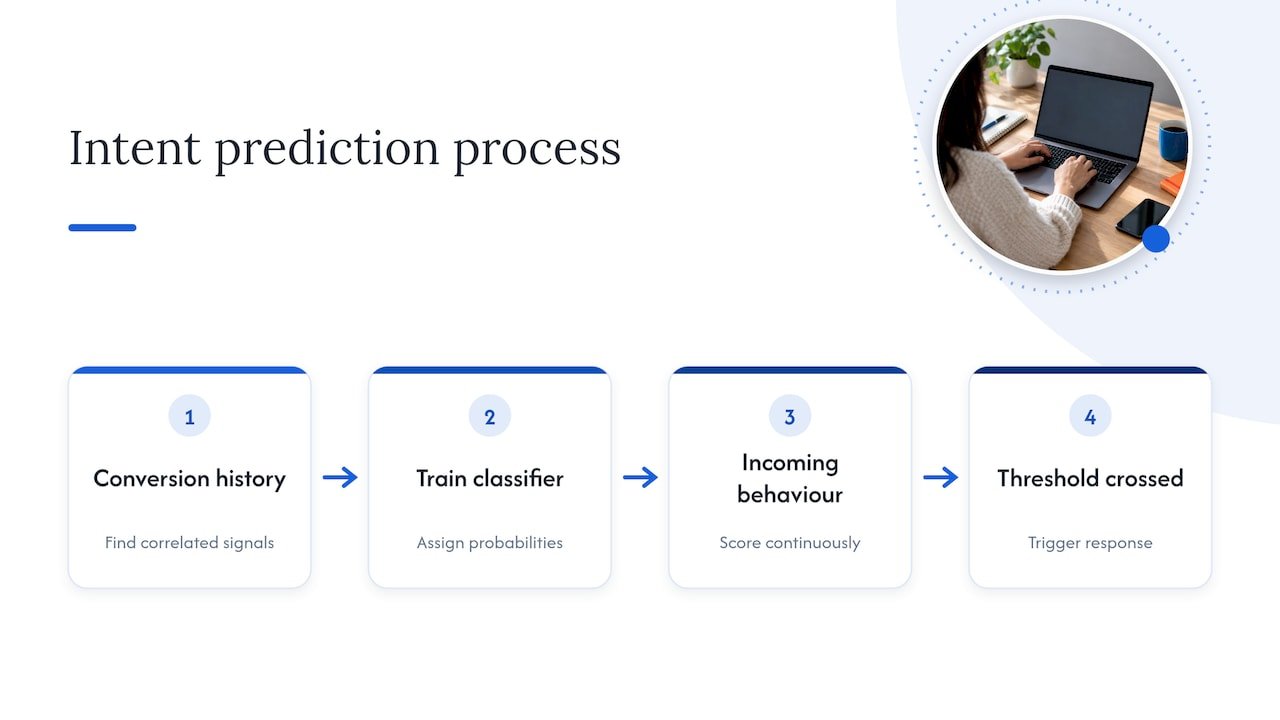
The core recipe is consistent across tools. As CDP.com describes it, you analyze historical conversion data to find the behavioural signals that correlate with an outcome, train a classification model (gradient-boosted trees or neural networks are common) to assign probabilities, then apply it continuously to incoming behaviour and trigger a response once a threshold is crossed.
Choosing a model family
For tabular behavioural data, tree ensembles are a sensible first choice. A 2025 study in PLOS One found that CatBoost and XGBoost performed best with complex features, achieving high F1 scores, while its author suggests that transformer-style self-attention may better capture patterns in long time series. An earlier study found that a random forest could predict online shoppers’ purchase intent at the moment of site access, reaching 86.78% accuracy but only a 0.60 F1 score after oversampling.
That gap between 86.78% and 0.60 is the most practical lesson in the literature. Buyers are a small share of visitors, so a model can look accurate while missing many of them. Judge it on precision, recall and F1 for the class you care about.
When language models help
If your intent signals come from conversations, such as chat, support or an AI assistant, language models enter the picture. A 2024 paper by Liao and colleagues reports that small language models using graph-based methods can outperform large language models at capturing context-specific purchase intent from consumer interactions with AI assistants. The takeaway is to match the model to the data. A bigger model is not automatically a better predictor.
For a broader view, a 2026 review in WIREs Data Mining and Knowledge Discovery offers a taxonomy linking AI methods to concrete marketing objectives, which is a useful reference when deciding which method fits which goal.
How different teams use intent predictions
The same score serves different jobs depending on who acts on it.
| Team | Decision the score informs | Typical action |
|---|---|---|
| Marketing | Which segments to nurture, pause or retarget | Change the next email, ad audience or content offer |
| Sales and revenue operations | Which leads and accounts deserve a call today | Reorder queues, route to the right rep, flag stalled deals |
| Customer service | What the customer is trying to do | Offer self-service or send to a live agent |
| Ecommerce | Who is close to buying, and who is drifting | Show the right offer, trigger a reminder, flag at-risk repeat buyers |
Service is the best-documented case. AWS describes a contact-intent workflow in which historical contact activity trains a model, a confidence threshold decides whether the predicted intent is shown to the customer, and the customer’s confirmed answer is fed back to improve future predictions. That confirmation loop is worth copying anywhere: every time a human confirms or corrects a prediction, you gain a labelled example for free.
For sales, intent is closely tied to scoring. If that is your main use case, read our guide to making predictive lead scoring actionable, which covers signals, backtests and CRM write-back. Once leads are scored, routing automation that enriches before it routes makes sure the right person sees the right lead first. For B2B teams struggling with duplicate or fragmented accounts, fixing account identity comes before any model, because a score attached to the wrong account is worse than no score.
Putting predictions to work: a practical sequence
IDC’s guidance on operationalizing customer intelligence maps well to what we see in real projects. It recommends selecting a use case, strengthening the data foundation, pairing predictive and generative AI, piloting a bounded AI agent, and setting up governance. Here is how we would turn that into steps.
- Name one decision. “Which trial users should a rep contact this week?” is a decision. “Understand our customers” is not.
- Define the outcome and window. For example, “starts a paid plan within 30 days.” Vague outcomes produce vague models.
- Audit the data. Check completeness, identity matching across devices and systems, and how late each source arrives. Real-time action needs real-time data.
- Build a baseline. Start with a simple model and a rules-based comparison. If the model cannot beat “visited pricing twice,” you have learned something valuable.
- Set a threshold and an action. Decide what happens at what confidence level, and who is accountable for the result.
- Pilot with a bounded agent or workflow. Keep scope narrow, with a human in the loop at first.
- Close the loop. Record outcomes and feed them back so the model stays current.
Our approach to the pilot stage is laid out in prove it with one pilot, and the CRM side, where scores trigger tasks and updates, is covered in CRM automation workflows with guardrails. For the behavioural data itself, our whitepaper on behavioral analytics in marketing explains how to structure it.
Interpreting a score without over-reading it
A score of 0.82 does not mean a customer is 82% sure. It means that, among past customers who looked like this one, about that share went on to act, if the model is well calibrated. Treat scores as a ranking tool and test calibration before you attach hard rules to thresholds. Choosing the right intervention afterward is its own skill, and this piece on analytics and marketing ROI is a helpful companion when you move from reading predictions to deciding what to do about them.
Measuring accuracy and business impact
There are two layers to measure, and teams that skip the second one end up with technically good models nobody trusts.
Model quality is about whether the score separates people who act from people who do not:
- Precision: of those flagged, how many acted?
- Recall: of those who acted, how many were flagged?
- F1 and the precision-recall trade-off at your chosen threshold
- Calibration: do predicted probabilities match observed rates?
- Backtesting on a time-based holdout, never a random split that leaks the future into training
Business impact is about whether acting on the score changed anything. A model can accurately predict who would have bought anyway. To find out whether your intervention caused the lift, hold out a comparison group that receives no action and compare outcomes. Our guide to always-on, privacy-first incrementality testing shows how to run that comparison continuously. If you are evaluating a vendor’s claims, use our checklist on whether an AI analytics platform is accurate enough.
Finally, plan for decay. Customer behaviour shifts with seasons, pricing and product changes. IDC cautions that real-time intent systems need data quality controls, governance, monitoring and drift detection, and that autonomous actions without them can compound small errors. Schedule retraining and review the metrics on a calendar, not when someone notices a problem.
Privacy, data quality and governance in the US
Intent models feed on personal behavioural data, so the compliance questions start before the first line of modelling code.
- Provenance. In 2024, then FTC Chair Lina Khan said at PrivacyCon that business incentives for AI model training do not override existing privacy obligations, and that firms may be required to delete models informed by illegally obtained data. If your training data came from a source you cannot defend, the model is exposed too.
- Data quality. NIST’s technical best practices say that completeness, accuracy, consistency, reliability and currency must be addressed through the whole product lifecycle to prevent flawed outcomes and bias.
- Auditability. A 2021 comment submitted to NIST proposed logging every input-to-decision trail, so outputs can be audited and understood. It also argued that AI risk should be assessed before data processing starts. Both ideas are easy to build in early and costly to retrofit.
Privacy rules differ by state and sector, so have your counsel confirm what applies to the data you collect and the actions you automate, especially anything that affects pricing, credit, employment or eligibility.
Our perspective: intent is a map, not a verdict
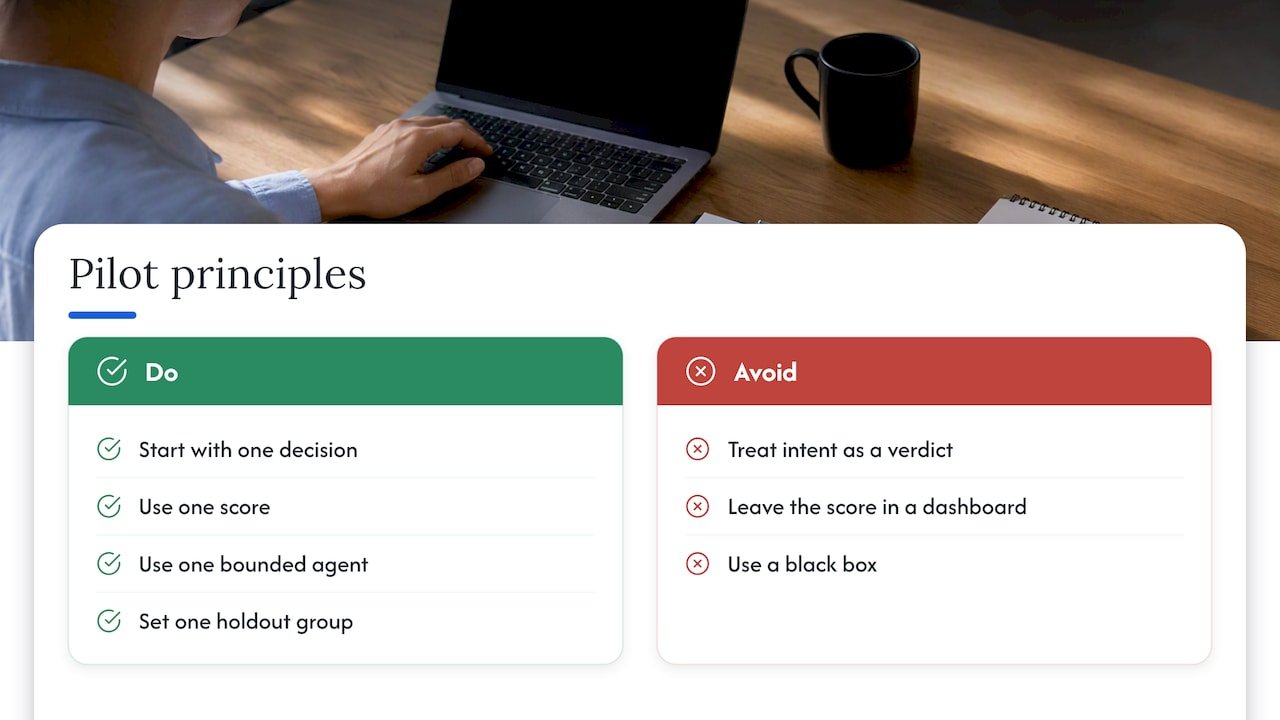
We see the same pattern in most engagements. Teams invest in a model, get a respectable score, and then discover that nobody owns the action. The score sits in a dashboard. We think of attribution and intent as a map rather than a courtroom verdict: they show you where the terrain is promising, and they do not prove what any one person will do.
That is why we build in the open. Our methodology is open-source, our agents run inside your environment, and we integrate with the platforms you already use, including Salesforce, HubSpot and Marketo. You can see what the model reads, what it writes back and why. A black box that scores accounts is hard to defend to a CRO or a compliance team, and impossible to improve.
Our advice is to start small. One decision, one score, one bounded agent, one holdout group. If it moves pipeline, expand. If it does not, you have spent weeks, not quarters, finding out.
— Don
Where Brainiac fits
If you want intent prediction running inside your CRM and marketing stack rather than in a slide deck, we design and operate it. Our custom agent deployment puts production-grade agents inside your environment to enrich leads, score intent and act on it. If you are not yet sure where to begin, our AI strategy and readiness work starts with an assessment and a prioritized roadmap.
We also support the surrounding operations, from marketing operations optimization to governed analytics. When you are ready to scope a pilot, contact our team.
FAQ
What is customer intent prediction?
It is the use of machine-learning models to estimate what an individual customer or account is likely to do next, such as purchase, upgrade, churn or contact support. The model learns from historical outcomes and applies that pattern to live behaviour. The output is usually a probability that triggers an action once it passes a threshold.
How is it different from churn prediction?
Churn prediction answers one question: which existing customers are likely to leave. Intent prediction is wider and covers buying, browsing, upgrading and contacting support as well. Churn models also tend to rely on usage, support and billing data, so they often detect risk after behaviour has already changed.
Which model is best for predicting intent?
There is no single winner. Gradient-boosted trees such as CatBoost and XGBoost performed well on complex behavioural features in a 2025 PLOS One study, and are a sound baseline for tabular data. For conversational data, smaller language models can be competitive. Test two or three on your own data with a time-based holdout.
How much data do I need?
Enough past outcomes in your target class to learn from, plus clean identity matching across your systems. Rare outcomes need more history or careful handling of class imbalance. If you have little history, start with rules and collect labelled outcomes while you run a simple pilot.
Can small businesses use it?
Yes, if the decision is narrow and the data already exists in a CRM or store platform. A small service business can score inbound enquiries, and a small store can flag likely buyers. The key is a single clear action tied to each score, not a large platform.
Sources
- Zendesk: What is customer intent?
- Verint: What is customer intent?
- Shopify: Customer intent
- Twilio: Predictions
- Adobe: Building customer journey segments, part two
- CDP.com: Intent prediction
- 6sense: Intent model
- TenAgile: Understanding customer intent through predictive analytics
- London Business School: Padilla, Ascarza and Netzer
- PLOS One: Machine learning in predicting consumer behaviour
- PMC: Real-time prediction of online shoppers’ purchasing intention
- SSRN: Context-specific small language models vs. LLMs
- WIREs: Consumer behavior analysis in digital marketing using AI
- AWS: Predict customer contact intent
- IDC: Operationalizing customer intelligence
- FTC: Remarks at PrivacyCon 2024
- NIST: Best practices in machine learning
- NIST: AI RMF RFI comments
- Analytics in marketing and ROI