
AI lets ABM teams run rolling account selection, prioritize contacts in real time, personalize at scale, and coordinate plays across channels. The catch is governance: Forrester warns that poorly governed generative AI in go-to-market work puts enterprise value at risk. Plan for human oversight and account-level measurement before you scale.
TL;DR:
- Weekly account list refreshes have been reported to identify 30–40% more accounts showing purchase intent than static ICP lists; balance scores against sales capacity.
- Begin with low risk enrichment and briefing tasks, verify CRM hygiene and identity resolution, and compare agent outputs with human decisions before activation.
- Measure pilots through account level pipeline, stage progression, and return on objectives; trace AI actions to outcomes instead of relying on MQL counts.
- Forrester reports 19% of buyers using generative AI feel less confident after inaccurate output; name agent owners and obtain legal review before handling customer data.
Table of Contents
- What are the top practical AI use cases in ABM?
- How do you implement AI in ABM, from pilot to scale?
- Which signals should drive account selection, and how often should lists refresh?
- How do you personalize and coordinate plays without losing control?
- Which account-level KPIs show real impact from AI-powered ABM?
- What governance and human oversight does agentic AI need in ABM?
- Where should you start, and where should you be cautious?
- How can Brainiac Consulting help you operationalize AI for ABM?
- FAQ
- Sources
What are the top practical AI use cases in ABM?
Most teams we talk with already use AI in some of these areas, or are piloting them. Map each one to your own priorities before you pick a starting point.
- Dynamic ICP discovery: rolling account lists that update as buying signals change, instead of a static list set once a year.
- Account prioritization: propensity scoring that blends intent and engagement signals so sellers see who to call first.
- Personalized messaging: role- and account-specific content variants built from approved templates.
- Orchestration and agentic workflows: agents that handle routine tasks and trigger plays when an account crosses a threshold.
- Operational efficiency: lead enrichment, account briefing packs and creative variants produced in minutes, not hours.
Forrester describes how AI strengthens the core ABM pillars of unified data, cross-functional workflows and sharper account insight. Industry coverage also points to execution complexity as ABM’s weak spot, which is exactly where AI-enabled workflows help most.
How do you implement AI in ABM, from pilot to scale?
Treat the first project as an experiment with a clear finish line. Our approach to proving it with one governed pilot follows the same logic.
- Pick one objective and define success up front, such as account-influenced pipeline or progression rate between stages.
- Check data readiness: identity resolution, CRM hygiene, intent feeds and CDP connections. Weak B2B account identity undermines every score downstream.
- Define agent roles and shadow-validation rules, so outputs are compared with human decisions before any action goes live. Humans keep the strategic calls.
- Run a pilot, measure account-level outcomes, and iterate before you widen scope.
Pro Tip: Start with enrichment and briefing tasks. They carry low risk, show value fast, and give you clean data for the harder prioritization work.
Our lead enrichment pipeline checklist covers the stages worth instrumenting during a pilot.
Which signals should drive account selection, and how often should lists refresh?
Good selection starts with a mix of signal types, not a single intent feed:
- Intent: topic research and third-party surge data.
- Behavioural: site visits, content consumption and product usage.
- Firmographic: size, industry, growth and funding events.
- Technographic: the tools an account already runs.
- Sales engagement: replies, meetings and stakeholder breadth.
Signal velocity, meaning how quickly an account’s activity is changing, is what makes rolling selection work. Practitioner reporting says that moving from static ICP lists to weekly rolling selection identifies 30–40% more in-market accounts. For many B2B programs, a weekly refresh is a sensible starting cadence.
Forrester makes the same argument for moving from static tiers to dynamic segmentation. Then combine propensity scores with commercial priorities such as strategic logos, territory capacity and sales bandwidth. The result is an executable shortlist your team can actually work, not a ranked spreadsheet nobody trusts.
How do you personalize and coordinate plays without losing control?
AI should widen what your team can produce, not decide your strategy. Within that boundary, three habits matter:
- Generate role- and account-specific variants from approved messaging templates, so tone and claims stay on brand.
- Trigger multi-step plays across email, sales outreach, ads and content when an account’s signals cross a threshold.
- Put human approval gates on sensitive accounts and on any new creative variant before it ships.
Practitioners warn that AI output works best as a first draft. One practitioner source reports that account research can drop from hours to roughly 10 minutes, but a human editor still applies the strategic framing. For a broader look at AI across content planning and tactics, this overview of AI in marketing strategies offers a useful complement.
Pro Tip: Keep a short list of “never automate” accounts, usually your top strategic targets, and route every touch on them through a named owner.
Which account-level KPIs show real impact from AI-powered ABM?
Retire MQL counts as your headline number. Measure what ABM is meant to change: account-influenced pipeline, stage progression rates and return on objectives (ROO). Engagement metrics such as clicks and opens still help, but only as supporting evidence.
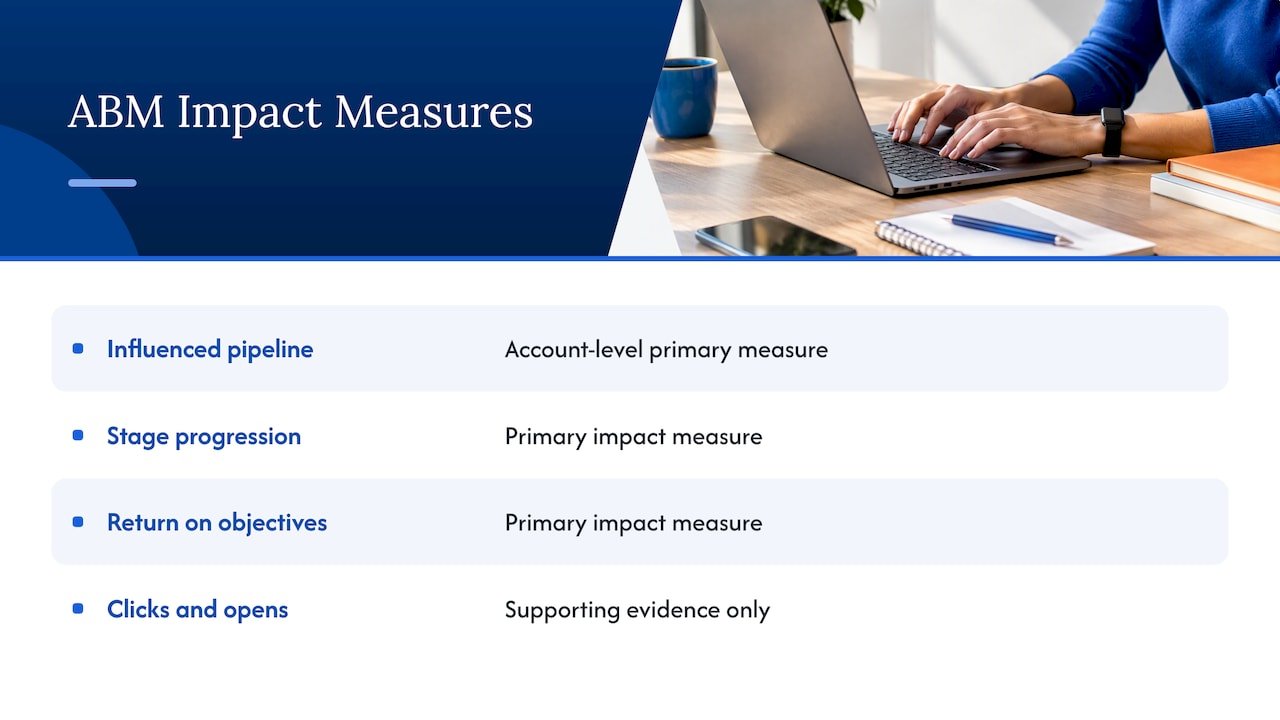
Instrument attribution at the account level, so an AI-driven action, say a triggered play or a re-prioritized list, can be traced to pipeline movement. Without that link, you cannot tell whether AI improved results or just produced more activity.
Don’t leave this for later. Practitioner guidance says measurement infrastructure is the single biggest determinant of whether an ABM program survives budget reviews.
What governance and human oversight does agentic AI need in ABM?
Governance is what separates a useful pilot from an expensive mistake. Forrester recommends onboarding AI agents as roles, not treating them as black-box task tools. The same research stream urges leaders to connect AI agents to GTM initiatives with accountability.
- Give each agent a defined scope, explicit guardrails and an escalation path to a named person.
- Use shadow validation and human-in-the-loop checks, and roll out in phases so errors surface before actions reach buyers.
- Invest in AI literacy. Forrester finds that 19% of buyers using generative AI feel less confident because of inaccurate output, and your team needs the skills to catch those errors first.
- Review data privacy, security and compliance with legal before any agent touches customer data.
Where should you start, and where should you be cautious?
Start with a pilot tied directly to pipeline, using weekly rolling selection, and secure an executive sponsor before the first agent runs. ABM only works when sales, marketing and operations agree on the account list and the plays. Spend as much effort on governance and measurement as on the model or tool you choose. A strong model on top of weak data and no measurement just produces faster noise.
— Don
How can Brainiac Consulting help you operationalize AI for ABM?
We build the path from a first assessment to production, so your ABM program doesn’t stall after the demo. It starts with an AI readiness assessment that baselines your data, maps and prioritizes opportunities, and produces a roadmap and business case. From there we run a governed pilot, then scale with agentic operations built to work inside your existing CRM and marketing automation stack.
If you want a clear first step, book an AI readiness assessment with us at Brainiac Consulting, or ask about a short pilot engagement.
FAQ
What are examples of account-based marketing?
Common examples include personalized outreach to a named list of target accounts, account-specific ads, tailored content hubs and coordinated sales and marketing plays. With AI, these are often triggered by account signals and refreshed on a rolling basis.
Is it legal to use AI for marketing?
Using AI for marketing is generally lawful, but data privacy, consent and security rules still apply to the data you feed it. Forrester’s research notes data privacy, security and inaccuracy concerns among marketing leaders, so check your own obligations with legal counsel.
Is AI digital marketing worth it?
It can be, especially for account research, personalization and workflow automation. Reporting suggests revenue uplift is still inconsistent, so prove value with an account-level pilot first.
How does AI change account based marketing strategies?
It shifts ABM from static, tiered lists to dynamic selection and faster execution. Teams still need cross-functional alignment, which state-of-ABM reporting emphasizes alongside hyper-personalization.